49 African Art and Global Trade
1450–1860
CHAPTER OUTLINE
1450–1860
CHAPTER OUTLINE
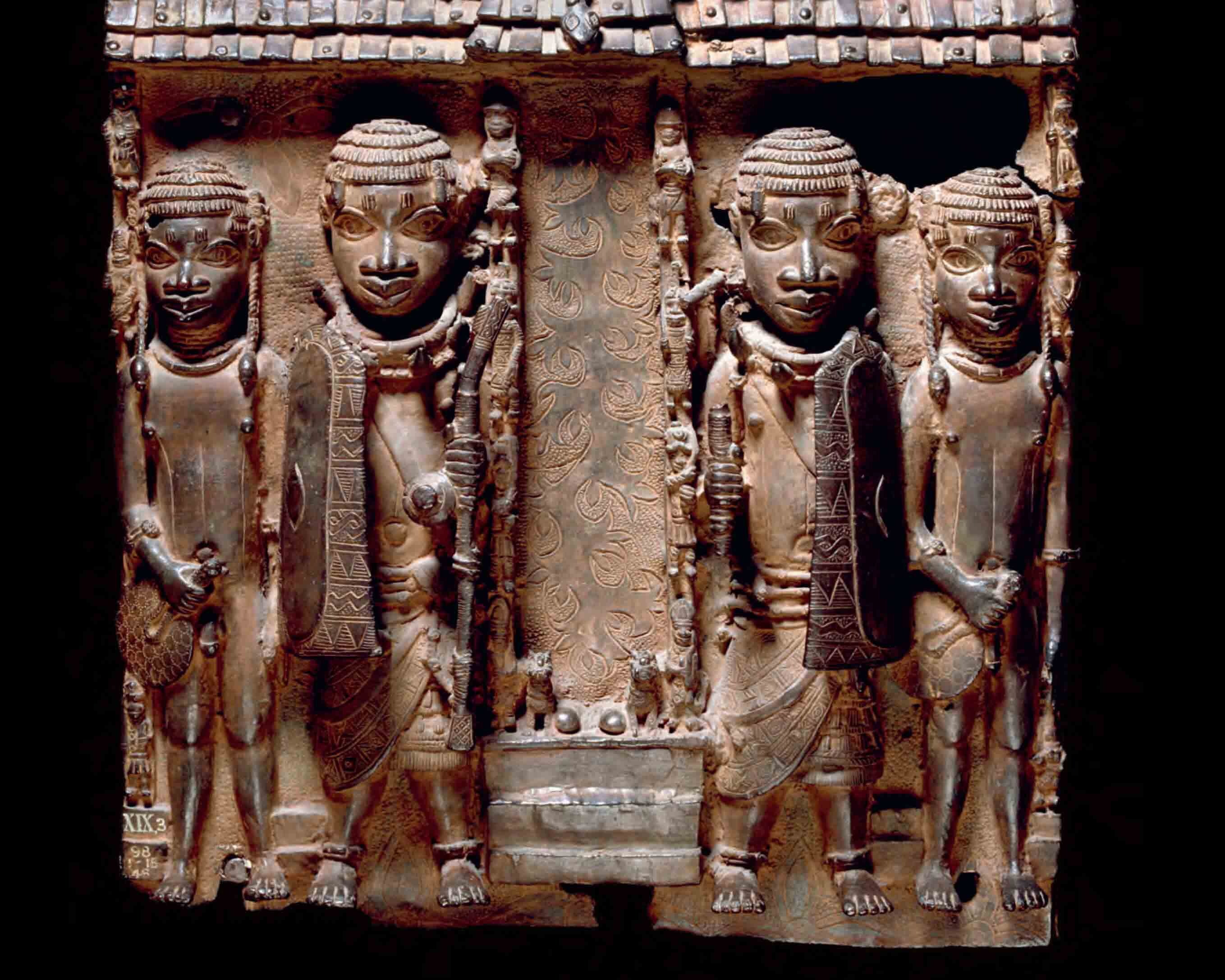
Four figures stand guard, two on either side of a set of steps. The two inner figures, which are slightly taller and more imposing than the two outer ones, carry shields and staffs. On the upper step sit two spheres and two tiny leopards. The space above the steps is decorated with a vegetal pattern. The two columns on either side of this space are covered with tiny figures.
Five centuries ago, new patterns of global trade began to alter dramatically the societies of Africa, Europe, and the Americas. Trade networks and pilgrimage routes had connected African cultures to Europe and Asia for more than one thousand years (see Chapter 25), but materials had moved through a series of intermediaries. Not until the end of the fifteenth century, when Portuguese ships began to sail around the African continent seeking a new route to India, did Africans living on the western, central, and southern coasts of the continent have direct contact with Europeans.
Benin
By the sixteenth century, Spanish and Portuguese mariners had also reached the Americas, establishing triangular trade routes that linked Africa to Europe via Brazil and the Caribbean. This transatlantic trade reoriented commerce that had previously crossed the Sahara Desert toward the western coast of Africa, while Portuguese attacks in 1506 on the Swahili cities of the East African coast disrupted the trade routes that crossed the Indian Ocean. As new trading centers grew, African kingdoms responded to the influx of luxury goods and foreign technologies. Meanwhile, European traders, missionaries, and mercenaries began to record their impressions of the artworks that adorned Africa’s royal courts, especially in the kingdoms of Benin and Kongo, and they took home examples of Africa’s fine ivories, cloth, and metalwork. Although few works of art are mentioned in the oral traditions of African cultures, the written accounts of foreign observers provide art historical information for the coastal regions of the continent in the years between 1450 and 1860 (Map 49.1).
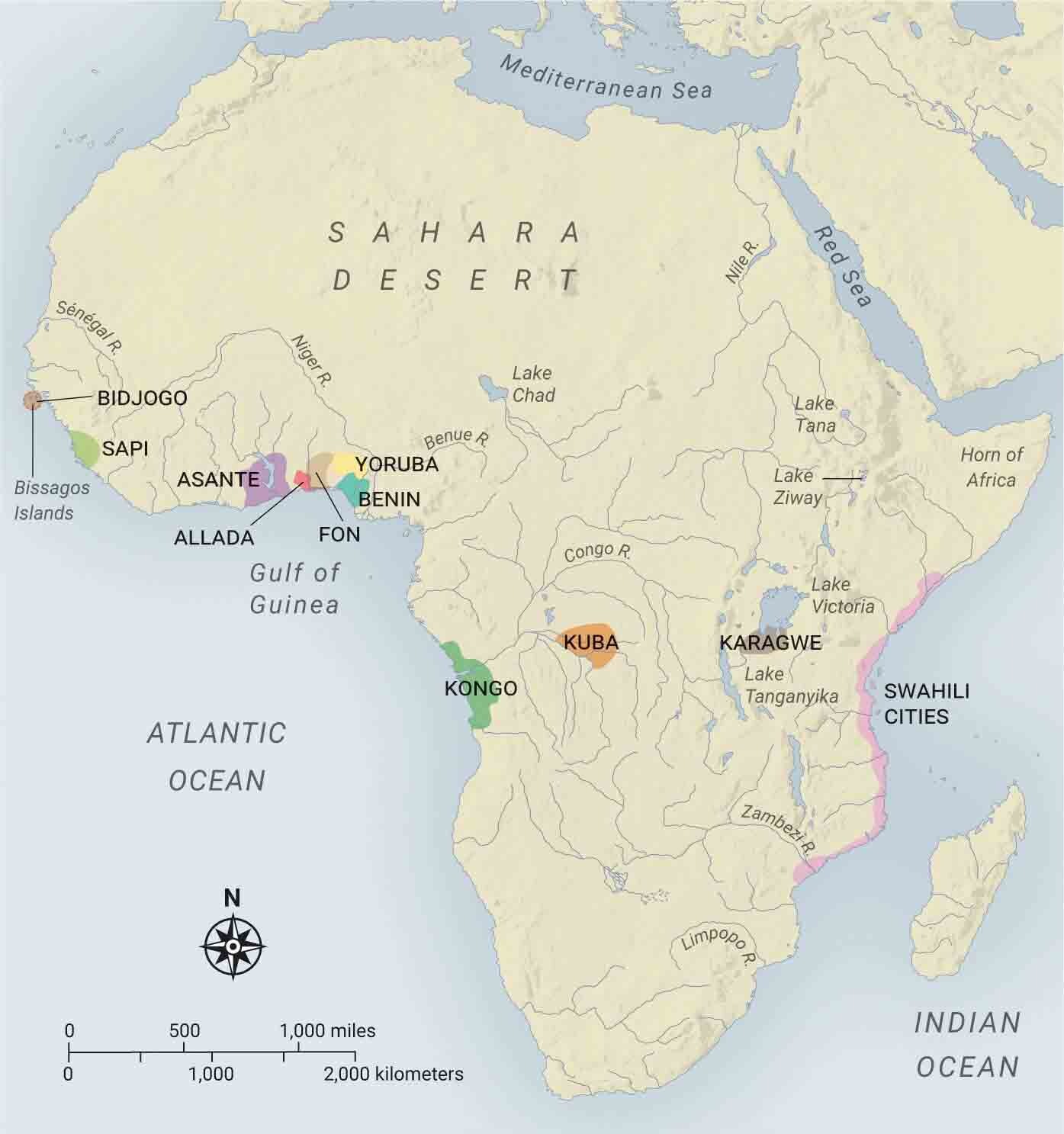
Groups and kingdoms shown are, from west to east, Bidjogo, Sapi, Asante, Allada, Fon, Yoruba, and Benin in West Africa, Kongo on the western coast of southern Africa, Kuba farther inland, Karagwe on the southern shore of Lake Victoria, and Swahili Cities up and down the eastern coast.
The labor and skill of Africans who were captured in their homeland and transported by ship to the Americas created great wealth in the seventeenth and eighteenth centuries in Europe, the Americas, and Africa. In earlier eras, when African armies enslaved the populations they conquered, they sometimes sold those prisoners to merchants who transported them to markets in North Africa or Asia. Usually these captives and their offspring were gradually integrated into the cultures where they were enslaved. In the Americas, however, both the individuals who had been seized in Africa and their descendants were most often trapped in permanent bondage. European intellectuals justified this practice by linking enslavement to racial categories based on skin color, laying the foundation for enduring forms of inequality that outlasted the abolition of enslavement in the Americas in the nineteenth century. In this way, global trade routes, while nurturing new forms of art and governance, also contributed to long-term oppression and injustice.