Ancient Greece is the earliest civilization that offers us enough evidence to construct a well-rounded view of musical culture, although there are still many gaps. As shown in Figure 1.6, Greek civilization encompassed not only the Greek peninsula but islands in the Aegean, much of Asia Minor, southern Italy and Sicily, and colonies ringing the Mediterranean and Black Seas. From this ancient culture, we have numerous images, a few surviving instruments, writings about music’s roles and effects, theoretical writings on the elements of music, and over forty examples of music in a notation we can read.
INSTRUMENTS AND THEIR USES
We know about ancient Greek instruments and how to play them from writings, archaeological remains, and hundreds of images on clay pots. The most important instruments were the aulos (pl. auloi), lyre, and kithara. The Greeks also used harps, panpipes, horns, an early form of organ, and a variety of percussion instruments such as drums, cymbals, and clappers.
The aulos was a pipe typically played in pairs, as pictured in Figure 1.7. Each pipe had finger holes and a mouthpiece fitted with a reed. No reeds survive, but written descriptions suggest that they were long tubes with a beating tongue. Images of auloi being played show both hands in the same finger position, leading most scholars to conclude that the two pipes were played in unison, with slight differences in pitch creating a plangent sound. But modern reconstructions based on surviving auloi can also be played to produce parallel octaves, fifths, or fourths, or a drone or separate line in one pipe against a melody in the other, so that these methods cannot be ruled out.
The aulos was used in the worship of Dionysus, god of fertility and wine. Links to fertility and wine explain its presence in the drinking scene in Figure 1.7; the instrument is played by a woman who was likely a prostitute as well as a musician. The great tragedies by Aeschylus, Sophocles, and Euripides, created for the Dionysian festivals in Athens, have choruses and other musical portions that were accompanied by or alternated with the aulos.
FIGURE 1.7Greek red-figure drinking cup showing a scene at a symposium, or drinking party, where a woman plays the double aulos. A drinking cup, like the one on which this painting appears, is seen on the lower right. On the left is the player’s aulos bag, with a smaller bag attached to it that held the reeds for the aulos.
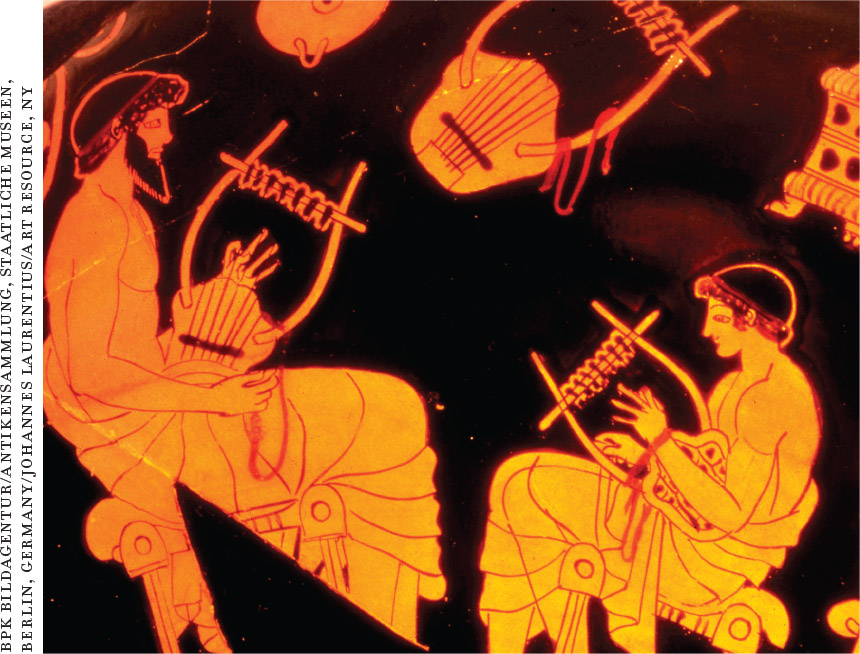
Lyres usually had seven strings and were strummed with a plectrum, or pick. There were several forms of lyre, the most characteristic of which used as a soundbox a tortoise shell over which oxhide was stretched. As shown in Figure 1.8, the player held the lyre in front, resting the instrument on the hip and supporting it by a strap around the left wrist. The right hand strummed with the plectrum while the fingers of the left hand touched the strings, perhaps to produce harmonics or to dampen certain strings to prevent them from sounding.
The lyre was associated with Apollo, god of light, prophecy, learning, and the arts, especially music and poetry. Learning to play the lyre was a core element of education in Athens. Both men and women played the lyre, which was used to accompany dancing, singing, or recitation of epic poetry like Homer’s Iliad and Odyssey; to provide music for weddings; or to play for recreation.
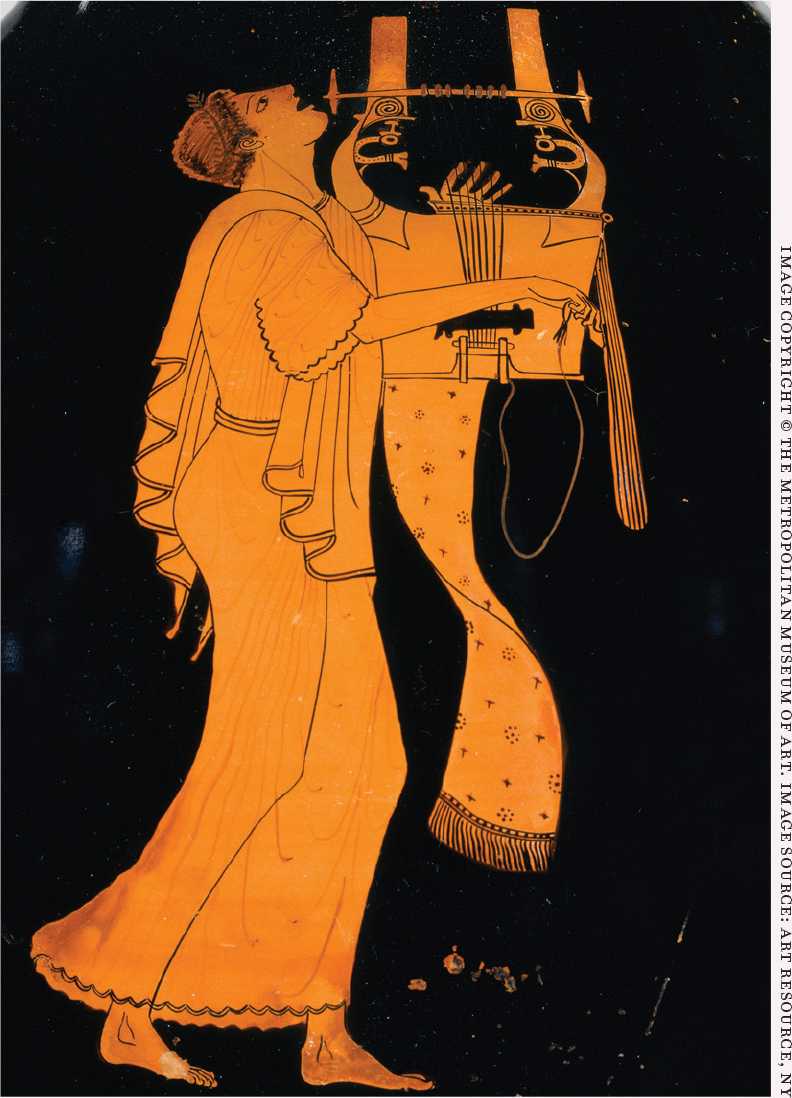
The kithara was a large lyre, used especially for processions and sacred ceremonies and in the theater, and normally played while the musician was standing. Figure 1.9 shows a kitharode, a singer accompanying himself on the kithara (see In Performance: Competitions and Professional Musicians).
FIGURE 1.8Greek red-figure drinking cup showing a lyre lesson. The teacher (left) has just strummed the strings using the plectrum in his right hand. Viewing the student’s lyre from the back, we can see the tortoise-shell sound box, the strap around the left wrist, and the fingers of the left hand touching the strings.
Images from ancient Greece rarely show performers reading from a scroll or tablet while playing. It is clear from this and from the written record that the Greeks, despite having a well-developed form of notation by the fourth century BCE (see pp. 17–18), primarily learned music by ear; they played and sang from memory or improvised using conventions and formulas.
GREEK MUSICAL THOUGHT
More writings about music survive from ancient Greece than from any earlier civilization. As a result, we know a great deal about Greek thought concerning music. There were two principal kinds of writings on music: (1) philosophical doctrines on the nature of music, its effects, and its proper uses; and (2) systematic descriptions of the materials of music, what we now call music theory. In both realms, the Greeks achieved insights and formulated principles that have remained important to this day. The most influential writings on the uses and effects of music are passages by Plato (ca. 429–347 BCE) in his Republic and Timaeus and by Aristotle (384–322 BCE) in his Politics. Greek music theory evolved continually from followers of Pythagoras (d. ca. 500 BCE) to Aristides Quintilianus (fourth century CE), its last important writer. As we might expect in a tradition lasting nearly a millennium, writers expressed differing views, and the meanings of many terms changed. The following emphasizes the features that were most characteristic of Greek music and most important for the later history of Western music.
Music, religion, and society In Greek mythology, music’s inventors and earliest practitioners were gods and demigods, such as Apollo, Hermes, Amphion, and Orpheus. The word music (Greek mousikē) derives from the word for the Muses and originally denoted any of the arts associated with them, from history to dance. For the Greeks, music was both an art for enjoyment and a science closely related to arithmetic and astronomy. It pervaded all of Greek life, from work, the military, schooling, and recreation to religious ceremonies, poetry, and the theater.
IN PERFORMANCE
Competitions and Professional Musicians
FIGURE 1.9Kitharode singing to his own accompaniment on the kithara, with his head tilted back, the fingers of his left hand touching some of the strings, apparently to dampen them, and the right hand holding the plectrum, which he has just strummed across the strings. Greek red-figure amphora from the fourth century BCE, attributed to the Berlin Painter.
From the sixth century BCE or earlier, the aulos and kithara were played as solo instruments, and competitions were held for the best performers. Contemporary accounts related that Sakadas of Argos won the prize for solo aulos playing at the Pythian Games in 586, 582, and 578 BCE , performing the Pythic Nomos, a virtuoso composition that portrayed Apollo’s victory over the serpent Python. One writer attributes the piece to Sakadas, making him the earliest composer of instrumental music whose name we know.
Contests of kithara and aulos players, as well as festivals of instrumental and vocal music, became increasingly popular after the fifth century BCE. Indeed, the image in Figure 1.9 is from an amphora, a jar for wine or oil, awarded as a prize to the winner of a competition.
As instrumental music grew more independent, the number of virtuosos rose and the music became more complex and showy. When famous artists appeared, thousands gathered to listen. Some performers accumulated great wealth through concert tours or fees from rich patrons, particularly after they garnered fame by winning competitions. Among the musicians acclaimed for their performances were a number of women, who were excluded from competitions. But outside the competitions, most professional performers were of low status, often slaves.
Music, poetry, and dance Music as a performing art was called melos, from which the word melody derives. The surviving Greek music is monophonic, consisting of a single melodic line, but that does not mean it was always performed that way. We know from pictures that singers accompanied themselves on lyre or kithara, but we do not know whether they sounded notes in the melody, played a variant of the melody (creating heterophony), or played an independent part (creating polyphony). Melos could denote an instrumental melody alone or a song with text, and “perfect melos” was melody, text, and stylized dance movement conceived as a whole. For the Greeks, music and poetry were nearly synonymous. In his Republic, Plato defined melos as a blend of text, rhythm, and harmonia (here meaning relationships among pitches). In his Poetics, Aristotle enumerated the elements of poetry as melody, rhythm, and language, and noted that there was no name for artful speech, whether prose or verse, that did not include music. “Lyric” poetry meant poetry sung to the lyre; “tragedy” incorporates the noun ōdē, “the art of singing.” Many other Greek words for different kinds of poetry, such as hymn, were musical terms.
Music and number For many Greek writers, numbers were the key to the universe, and music was inseparable from numbers. Rhythms were ordered by numbers, because each note was some multiple of a primary duration. Although there is no evidence that Pythagoras himself knew or wrote anything about music, later writers attributed to him the discovery that the octave, fifth, and fourth, long recognized as consonances, are also related to numbers. These intervals are generated by the simplest possible ratios: for example, when a string is divided, segments whose lengths are in the ratio 2 : 1 sound an octave, 3 : 2 a fifth, and 4 : 3 a fourth.
Harmonia Because musical sounds and rhythms were ordered by numbers, they were thought to exemplify the general concept of harmonia, the unification of parts in an orderly whole. Through this flexible concept—which could encompass mathematical proportions, philosophical ideas, or the structure of society as well as a particular musical interval, scale type, or style of melody—Greek writers conceived of music as a reflection of the order of the universe.
Music and astronomy Music was closely connected to astronomy through this notion of harmonia. Indeed, Claudius Ptolemy (fl. 127–48 CE), the leading astronomer of antiquity, was also an important writer on music. Mathematical laws and proportions were considered the underpinnings of both musical intervals and the heavenly bodies, and certain planets, their distances from each other, and their movements were believed to correspond to particular notes, intervals, and scales in music. Plato gave this idea poetic form in his myth of the “music of the spheres,” the unheard music produced by the revolutions of the planets. This notion was invoked by writers throughout the Middle Ages and later, including Shakespeare in The Tempest and John Milton in Paradise Lost, and underlay the work of Johannes Kepler (1571–1630), the founder of modern astronomy.
MUSIC AND ETHOS
Greek writers believed that music could affect ethos, one’s ethical character or way of being and behaving. This idea was built on the view of music as a system of pitch and rhythm governed by the same mathematical laws that operated in the visible and invisible world. Harmonia in music reflected, and could therefore influence, harmonia (usually translated “harmony”) in other realms. The human soul was seen as a composite whose parts were kept in harmony by numerical relationships. Because it reflected this orderly system, music could penetrate the soul and restore its inner harmony.
The doctrine of imitation Through the doctrine of imitation outlined in his Politics, Aristotle described how music affected behavior: music that imitated a certain ethos aroused that ethos in the listener (see Source Reading). The imitation of an ethos was accomplished partly through the choice of harmonia, in the sense of a scale type or style of melody. While later centuries would interpret him as attributing such effects to a mode or scale alone, Aristotle probably also had in mind the melodic turns and style characteristic of a harmonia and the rhythms and poetic genres most associated with it.
SOURCE READING
Aristotle on the Doctrine of Imitation, Ethos, and Music in Education
Music’s importance in ancient Greek culture is shown by its appearance as a topic in books about society, such as Aristotle’s Politics. Aristotle believed that music could imitate and thus directly affect character and behavior, and therefore should play a role in education.
[Melodies] contain in themselves imitations of ethoses; and this is manifest, for even in the nature of the harmoniai there are differences, so that people when hearing them are affected differently and have not the same feelings in regard to each of them, but listen to some in a more mournful and restrained state, for instance the so-called Mixolydian, and to others in a softer state of mind, for instance the relaxed harmoniai, but in a midway state and with the greatest composure to another, as the Dorian alone of the harmoniai seems to act, while the Phrygian makes men divinely suffused; for these things are well stated by those who have studied this form of education, as they derive the evidence for their theories from the actual facts of experience. And the same holds good about the rhythms also, for some have a more stable and others a more emotional ethos, and of the latter some are more vulgar in their emotional effects and others more liberal. From these considerations therefore it is plain that music has the power of producing a certain effect on the ethos of the soul, and if it has the power to do this, it is clear that the young must be directed to music and must be educated in it. Also education in music is well adapted to the youthful nature; for the young owing to their youth cannot endure anything not sweetened by pleasure, and music is by nature a thing that has a pleasant sweetness.
Aristotle, Politics 8.5, trans. Harris Rackham, in SR 3, p. 29.
Music in education Plato and Aristotle both argued that education should stress gymnastics (to discipline the body) and music (to discipline the mind). In his Republic, Plato insisted that the two must be balanced, because too much music made one weak and irritable while too much gymnastics made one uncivilized, violent, and ignorant. Only certain music was suitable, since habitual listening to music that roused ignoble states of mind distorted a person’s character. Those being trained to govern should avoid melodies expressing softness and indolence. Plato endorsed two harmoniai—the Dorian and Phrygian, because they fostered temperance and courage—and excluded others. He deplored music that used complex scales or mixed incompatible genres, rhythms, and instruments. In both his Republic and Laws, Plato asserted that musical conventions must not be changed, since lawlessness in art and education led to license in manners and anarchy in society. Similar ideas have been articulated by governments and guardians of morality ever since, and ragtime, jazz, rock, punk, and hip hop have all been condemned for these very reasons.
Aristotle, in his Politics, was less restrictive than Plato. He held that music could be used for enjoyment as well as education and that negative emotions such as pity and fear could be purged by inducing them through music and drama. However, he felt that children of free citizens should not seek professional training on instruments or aspire to the virtuosity shown by performers in competitions because it was menial and vulgar to play solely for the pleasure of others rather than for one’s own improvement.
GREEK MUSIC THEORY
No writings by Pythagoras survive, and those of his followers exist only in fragments quoted by later authors. The earliest theoretical works we have are Harmonic Elements and Rhythmic Elements (ca. 330 BCE) by Aristoxenus, a pupil of Aristotle. Important later writers include Cleonides (ca. second or third century CE), Ptolemy, and Aristides Quintilianus. These theorists defined concepts still used today, as well as ones specific to ancient Greek music. Their writings show how much the Greeks valued abstract thought, logic, and systematic definition and classification, an approach that has influenced all later writing on music.
Rhythm Only part of Aristoxenus’s Rhythmic Elements survives, but enough remains to show us that rhythm in music was closely aligned with poetic rhythm. Aristoxenus defines durations as multiples of a basic unit of time. This scheme parallels Greek poetry, which features patterns of longer and shorter syllables, not stressed and unstressed syllables as in English.
Note, interval, and scale In Harmonic Elements, Aristoxenus distinguishes between continuous movement of the voice, gliding up and down as in speech, and diastematic (or intervallic) movement, in which the voice moves between sustained pitches separated by discrete intervals. A melody consists of a series of notes, each on a single pitch; an interval is formed between two notes of different pitch; and a scale is a series of three or more different pitches in ascending or descending order. Such simple definitions established a firm basis for Greek music and all later music theory. By contrast, Babylonian musicians apparently had no name for intervals in general, but had names only for intervals formed between particular pairs of strings on the lyre or harp. The greater abstraction of the Greek system marked a significant advance.
Tetrachord and genus Unique to the Greek system were the concepts of tetrachord and genus (pl. genera). A tetrachord (literally, “four strings”) comprised four notes spanning a perfect fourth. There were three genera (classes) of tetrachord, shown in Example 1.1: diatonic, chromatic, and enharmonic. The outer notes of the tetrachord were considered stationary in pitch, while the inner two notes could move to form different intervals within the tetrachord and create the different genera. Normally the smallest intervals were at the bottom, the largest at the top. The diatonic tetrachord included two whole tones and a semitone. In the chromatic, the top interval was a tone and a half (equal to a minor third) and the others semitones. In the enharmonic, the top interval was the size of two tones (equal to a major third) and the lower ones approximately quarter tones. All these intervals could vary slightly in size, giving rise to “shades” within each genus.
EXAMPLE 1.1Tetrachords
Aristoxenus remarked that the diatonic genus was the oldest and most natural, the chromatic more recent, and the enharmonic the most refined and difficult to hear. Indeed, we have seen that the Babylonian system, which predated the Greek by more than a millennium, was diatonic.
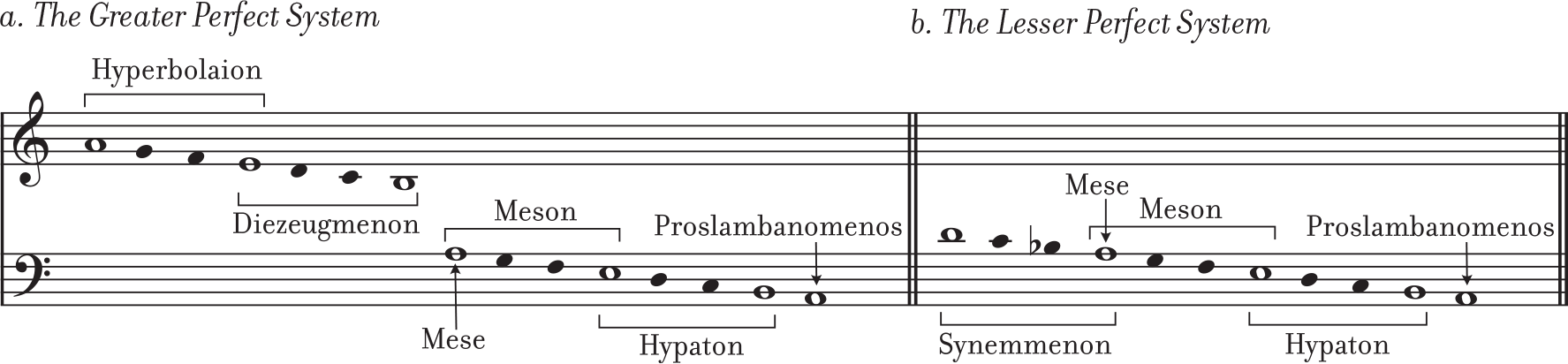
The Greater Perfect System Since most melodies exceeded a fourth, theorists combined tetrachords to cover a larger range. Two successive tetrachords were conjunct if they shared a note, as do the first two tetrachords in Example 1.2a, or disjunct if they were separated by a whole tone, as are the second and third tetrachords. The system shown in Example 1.2a, with four tetrachords plus an added lowest note to complete a two-octave span, was called the Greater Perfect System. The outer, fixed tones of each tetrachord are shown in open notes, the movable inner tones in black notes.
Each note and tetrachord had a name to indicate its place in the system. As we see in Example 1.2a, the middle note was called “mese” (middle), the tetrachord spanning a fourth below it “meson,” the lowest tetrachord “hypaton” (first), and those above the mese “diezeugmenon” (disjunct) and “hyperbolaion” (of the extremes). The lowest note was called “proslambanomenos.” There was also a Lesser Perfect System, shown in Example 1.2b, spanning an octave plus a fourth, with only one conjunct tetrachord (“synemmenon,” conjunct) above the mese. The system was not based on absolute fixed pitch but on the intervallic relationships of notes and tetrachords to each other. The transcription here in the range A–a′ is purely conventional.
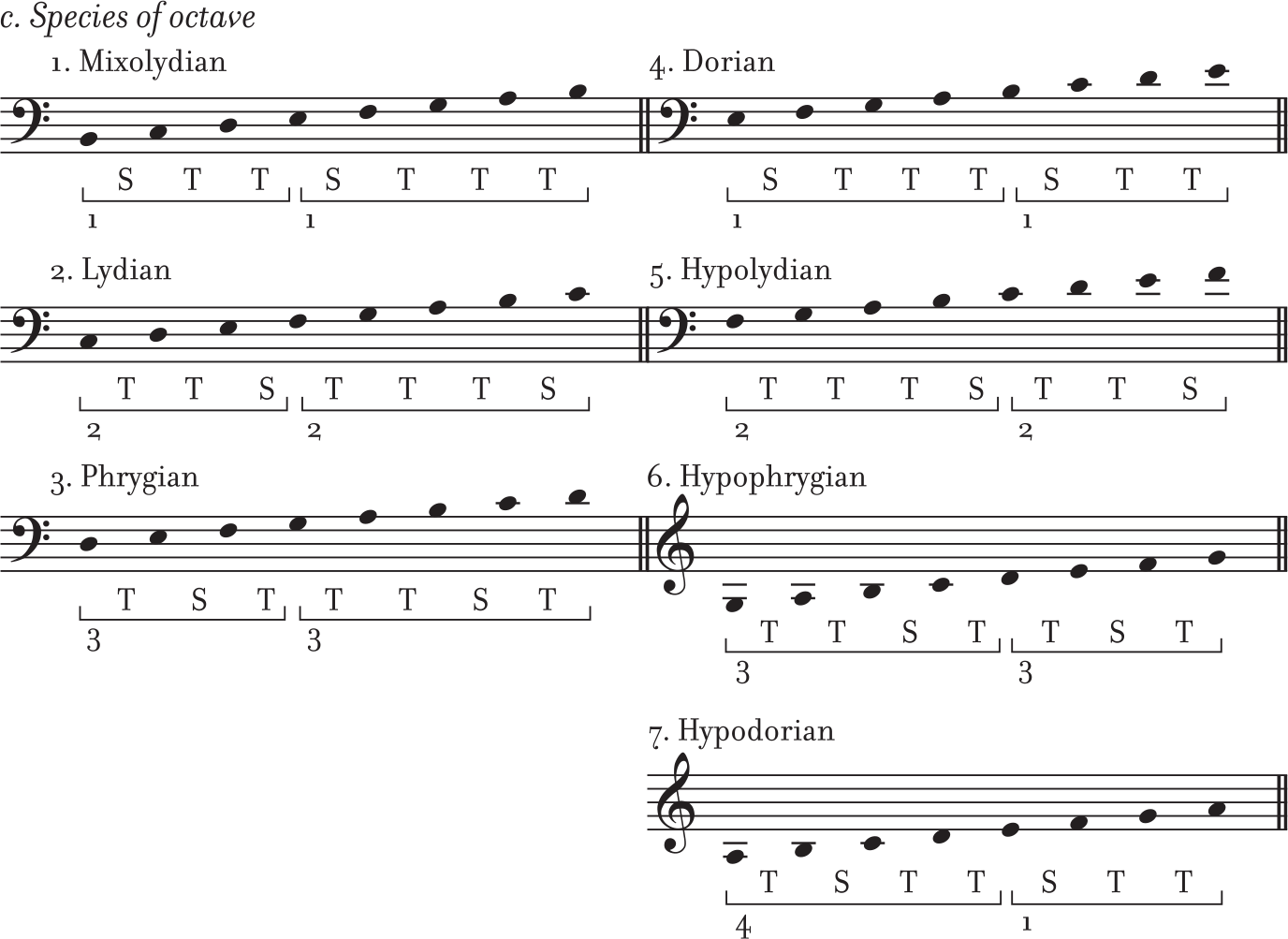
Species of consonances In his Harmonic Introduction, Cleonides noted that in the diatonic genus the three main consonances of perfect fourth, fifth, and octave were subdivided into tones (T) and semitones (S) in only a limited number of ways, which he called species. This concept has proven useful in understanding Greek melody, medieval chant, Renaissance polyphonic music, and even twentieth-century music, so it is worthy of special attention. A fourth contains two tones and one semitone, and there are only three possible arrangements or species, illustrated in Example 1.3a: with the semitone at the bottom (as in B–c–d–e), on top (as in c–d–e–f), or in the middle (as in d–e–f–g). Example 1.3b shows the four species of fifth.
The seven species of octave, shown in Example 1.3c, are combinations of the species of fourth and fifth, a division of the octave that became important in medieval and Renaissance theory. Cleonides identified the species by what “the ancients” supposedly called them. The first octave species, represented by the span from B to b, was Mixolydian, followed by Lydian (c–c′), Phrygian (d–d′), Dorian (e–e′), Hypolydian (f–f′), Hypophrygian (g–g′), and Hypodorian (a–a′). These seven octave species parallel the seven diatonic tunings recognized by the Babylonians, suggesting a continuity of practice and perhaps of theory. As we will see in Chapter 2, some medieval theorists later adopted these names for their modes, but the latter do not match Cleonides’s octave species, and the octave species lack one defining aspect of mode: a principal note on which a melody is expected to end.
EXAMPLE 1.2Scale systems
EXAMPLE 1.3Cleonides’s species of consonances
Tonoi The names Cleonides used for the octave species also had other associations. Dorian, Phrygian, and Lydian were ethnic names originally associated with styles of music practiced in different regions of the Greek world (see map in Figure 1.6). Plato and Aristotle used these names for harmoniai, in the sense of scale types or melodic styles. The addition of prefixes (such as Hypo-) multiplied the number of names in use. Later writers, including Aristoxenus, Cleonides, and Aristides Quintilianus, used the same names for up to fifteen different tonoi, defining a tonos as a scale or set of pitches within a specific range or region of the voice. These essentially involve transposing the system of tones up or down by some number of semitones. Like harmoniai, tonoi were associated with character and mood, the higher tonoi being energetic and the lower tonoi sedate.
EXAMPLE 1.4Seikilos song in original notation (above the staff) and transcription
As long as you live, be lighthearted. Let nothing trouble you. Life is only too short, and time takes its toll.
We should not presume that all music from the Dorian region (southern Greece) used the Dorian octave species, Dorian harmonia, and Dorian tonos, or that these three concepts were equivalent or even closely related. Rather, it appears that writers over a span of almost a thousand years were applying familiar terms to new uses. This tendency for musicians to use old terms in new ways is common to all eras, and we will see it many times in other chapters. It can be frustrating when learning the history of music, since definitions seem always to be changing. What is most important here is to recognize that not all uses of words such as “harmonia” and “tonos” or of names such as “Dorian” mean the same thing, and to seek to understand how each is used in context.
ANCIENT GREEK MUSIC
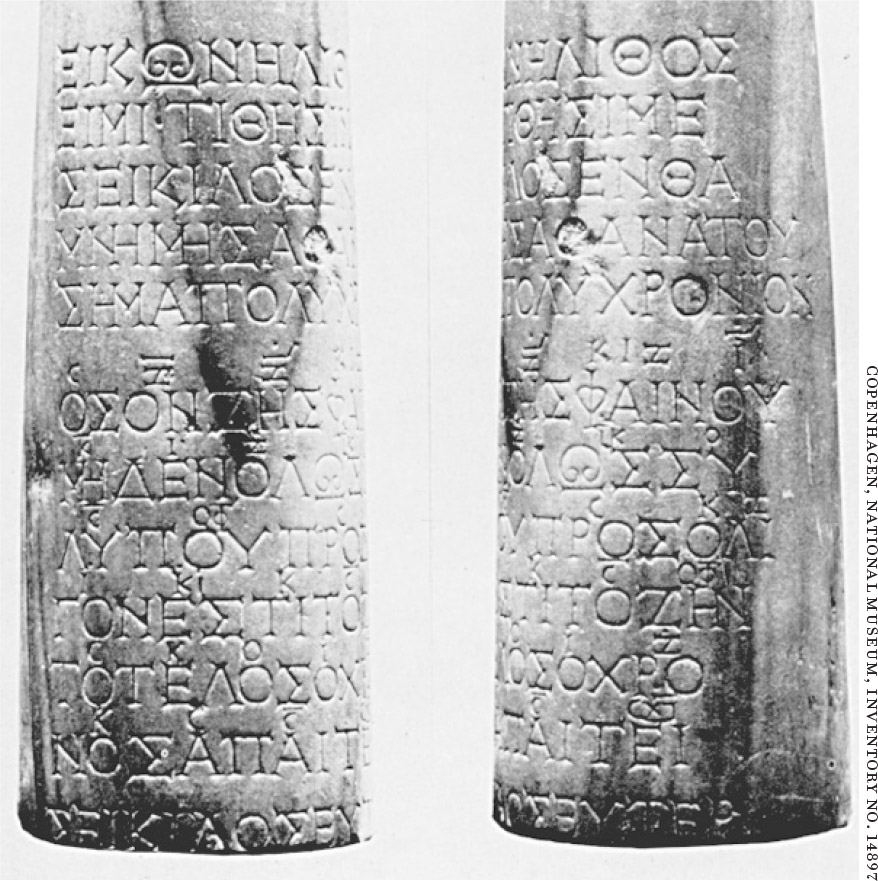
FIGURE 1.10Tomb stele from Tralles, near Aydin in southern Turkey, probably first century CE. It is inscribed with an epitaph by Seikilos with pitch and rhythm notation, transcribed in Example 1.4 and NAWM 1.
About forty-five pieces or fragments of ancient Greek music survive, ranging from the fifth century BCE to the fourth century CE. Most are from relatively late periods, composed to Greek texts when Greece was dominated by Rome, and most were recovered only in the twentieth century. All employ a musical notation in which letters and other signs are placed above the text to indicate notes and their durations. The earliest examples are two fragmentary choruses from plays by Euripides (ca. 485–406 BCE) with music that is probably by Euripides himself. Later pieces are more complete, including two Delphic hymns to Apollo, the second from 128–127 BCE; a short verse or epigram by Seikilos inscribed as an epitaph on a tombstone from around the first century CE; and four hymns by Mesomedes of Crete from the second century CE. Consistencies among these surviving pieces of music and the theoretical writings reveal a close correspondence between theory and practice.
The Epitaph of Seikilos (NAWM 1), inscribed on the tombstone in Figure 1.10, is shown in Example 1.4 in original notation and modern transcription. Over the modern notation appear alphabetical signs for the notes, and above those are marks indicating when the basic rhythmic unit should be doubled or tripled. The melody is diatonic, covers an octave in range, and uses the Phrygian octave species. The notation indicates the tonos called Iastian by the theorists, in which the system shown in Example 1.2a is transposed up a whole step (resulting in F and C). The text balances extremes, counseling us to be lighthearted even while acknowledging death. This is consistent with the Iastian tonos, which is near the middle of the fifteen tonoi in terms of range and thus suggests moderation. The melody seems similarly moderate in ethos, neither excited nor depressed, but balancing the rising fifth and thirds that begin most lines of the poem with falling gestures at the end of each line.
NAWM 1Figure 1.10: Anonymous, Epitaph of Seikilos
FIGURE 1.11Papyrus fragment, ca. 200 BCE, with part of a chorus from Euripides’sOrestes, transcribed in NAWM 2.
The fragment from Orestes (NAWM 2) by Euripides survives on a scrap of papyrus from about 200 BCE, shown in Figure 1.11. There are seven lines of text with musical notation above them, but only the middle portion of each line survives. The notation calls for either the chromatic or enharmonic genus along with the diatonic and for instrumental notes interspersed with the vocal. Both traits are noted in descriptions of Euripides’s music, suggesting that this music is indeed by him.
In this choral ode, the women of Argos implore the gods to have mercy for Orestes, who has murdered his mother Clytemnestra for her infidelity to his father, Agamemnon. The poetry, and therefore the music, is dominated by a rhythmic pattern (the dochmaic foot) used in Greek tragedy for passages of intense agitation and grief. The music reinforces this ethos through small chromatic or enharmonic intervals, stark changes of register, and truncated lines filled in by instrumental notes.
These examples conform to the descriptions we have of Greek music and show (1) the role of instruments in supporting vocal music; (2) the idea that music imitates ethos; (3) the importance of poetic rhythm and structure in shaping melody; and (4) the use of diatonic, chromatic, and enharmonic genera as well as notation, tonoi, and octave species. While many questions remain, we can understand the musical culture of ancient Greece through the four types of evidence we have examined in this chapter.
Plucked string instrument with a resonating soundbox, two arms, crossbar, and strings that run parallel to the soundboard over a bridge and attach to the crossbar.
Music or musical texture in which a melody is performed by two or more parts simultaneously in more than one way, for example, one voice performing it simply, and the other with embellishments.
(pl. harmoniai) Ancient Greek term with multiple meanings: (1) the union of parts in an orderly whole; (2) interval; (3) scale type; (4) style of melody.
(Greek, “custom”) (1) Moral and ethical character or way of being or behaving. (2) Character, mood, or emotional effect of a certain tonos, mode, meter, or melody.
(from Greek, “four strings”) (1) In Greek and medieval theory, a scale of four notes spanning a perfect fourth. (2) In modern theory, a set of four pitches or pitch-classes. (3) In twelve-tone theory, the first four, middle four, or last four notes in the row.
(1) In ancient Greek music, adjective describing a tetrachord with two whole tones and one semitone. (2) Name for a scale that includes five whole tones and two semitones, where the semitones are separated by two or three whole tones. (3) Adjective describing a melody, chord, or passage based exclusively on a single diatonic scale.
(from Greek chroma, “color”) (1) In ancient Greek music, adjective describing a tetrachord comprising a minor third and two semitones, or a melody that uses such tetrachords. (2) Adjective describing a melody that uses two or more successive semitones in the same direction, a scale consisting exclusively of semitones, an interval or chord that draws notes from more than one diatonic scale, or music that uses many such melodies or chords.
(1) In ancient Greek music, adjective describing a tetrachord comprising a major third and two quarter tones, or a melody that uses such tetrachords. (2) Adjective describing the relationship between two pitches that are notated differently but sound alike when played, such as G and A.
(1) In ancient Greek music, adjective used to describe the relationship between two tetrachords when the bottom note of one is the same as the top note of the other. (2) Of a melody, consisting mostly of steps.
(1) In ancient Greek music, adjective used to describe the relationship between two tetrachords when the bottom note of one is a whole tone above the top note of the other. (2) Of a melody, consisting mostly of skips (thirds) and leaps (larger intervals) rather than steps.
(pl. tonoi) Ancient Greek term used with different meanings by various writers; one meaning is a particular set of pitches within a certain range or region of the voice.






 and C
and C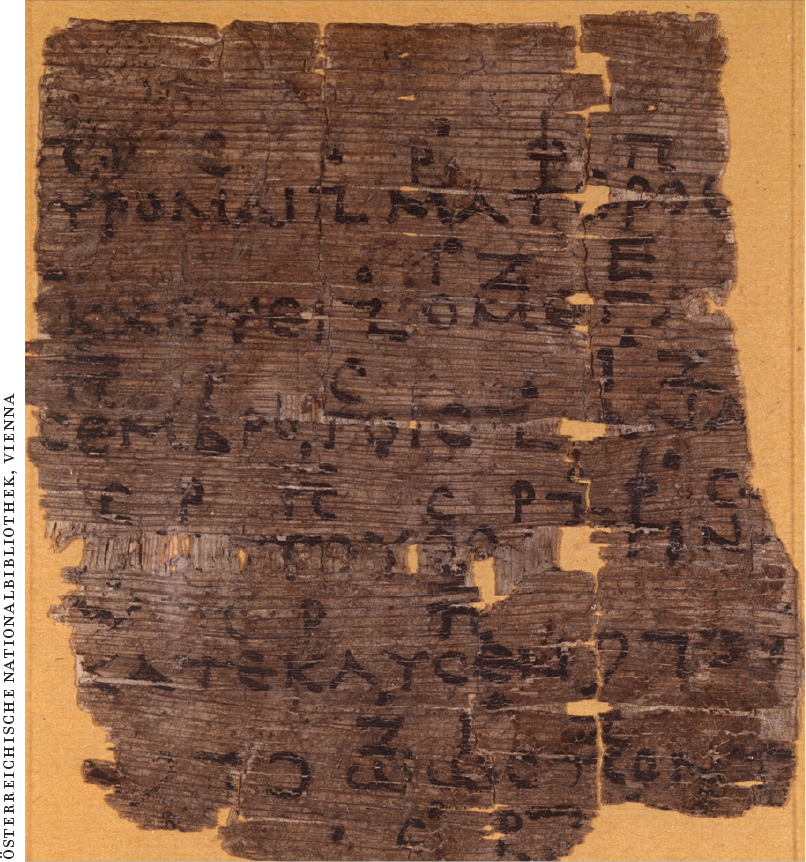
 .
.