MUSIC IN THE EARLY CHURCH
The earliest recorded musical activity of Jesus and his followers was singing hymns (Matthew 26:30, Mark 14:26). The apostle Paul exorted Christian communities to sing “psalms and hymns and spiritual songs” (Ephesians 5:19, Colossians 3:16). In about 112, Pliny the Younger, governor of a Roman province in Asia Minor, reported the Christian custom of singing “a song to Christ as if to a god.” Christians often met for communal evening meals at which they sang psalms and hymns.
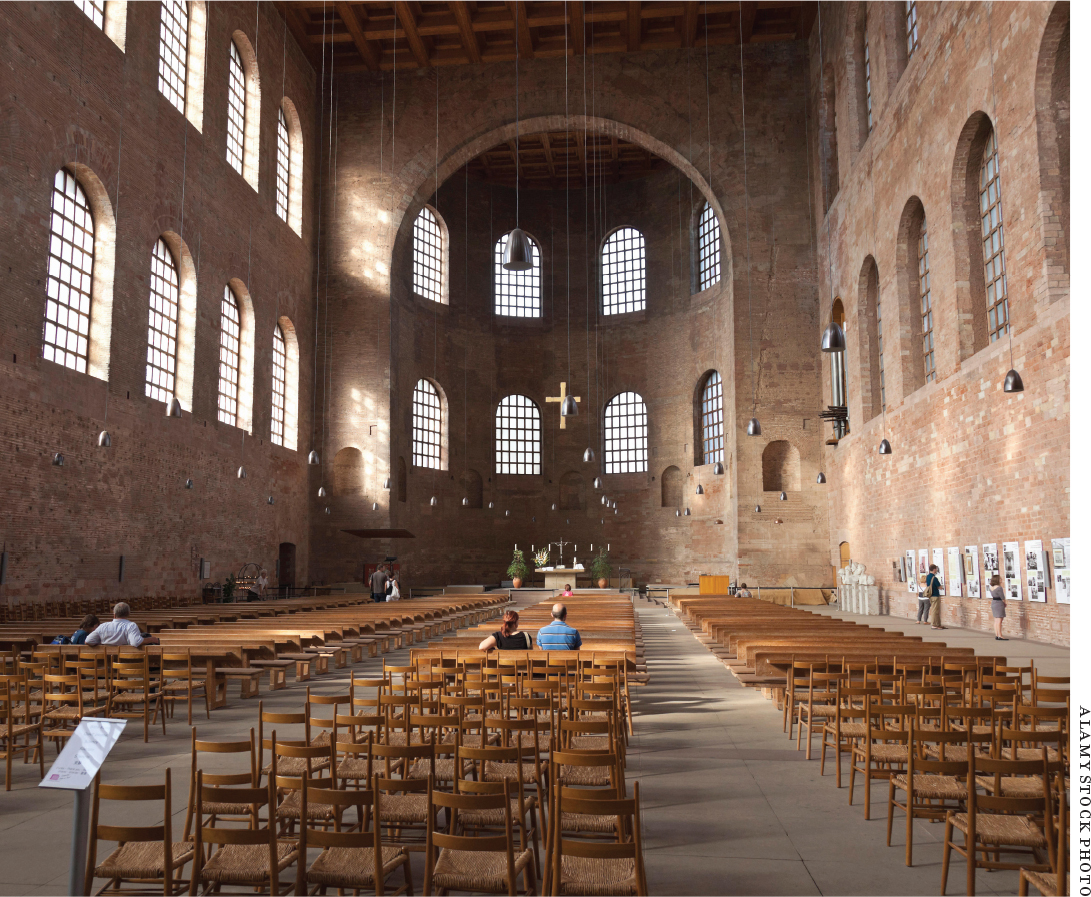
As the number of converts increased in the fourth century and official recognition grew, small informal gatherings began to give way to public meetings in large rectangular buildings called basilicas, such as the one in Figure 2.2. Here the chanting of prayers and Scripture helped carry the text clearly throughout the large space. The most devout believers sought a life of constant prayer. Living in isolation as hermits or together in monasteries, they chanted or recited psalms many times each day and during nightly vigils as a form of prayer. Singing psalms was seen as a practice that used the pleasures of music to discipline the soul, turn the mind to spiritual things, and build the Christian community (see Source Reading, p. 24), and it became a central focus of monastic life. By the late fourth century, Christian observances began to reflect a standardized format, and singing was a regular feature, drawing texts both from the Book of Psalms and from non-biblical hymns (see Source Reading, p. 25). This practice of singing psalms and hymns was codified in the rites of the medieval church (described in Chapter 3) and has continued to this day, in modified forms, among Christians worldwide.
While songs of praise were encouraged, some early church leaders rejected other aspects of ancient practice. Influential Christian writers such as St. Basil (ca. 330–379), St. John Chrysostom (ca. 345–407), St. Jerome (ca. 340–420), and St. Augustine (354–430), known today as “the church fathers,” interpreted the Bible and set down principles to guide the church. Like the ancient Greeks, they believed the value of music lay in its power to influence the ethos of listeners, for good or for ill. St. Augustine was so deeply moved by the singing of psalms that he feared the pleasure it gave him, while approving its ability to stimulate devout thoughts (see Source Readings, p. 24). Most church fathers rejected the idea of cultivating music simply for enjoyment and held to Plato’s principle that beautiful things exist to remind us of divine beauty. This view underlay many pronouncements about music by church leaders and by later theologians of the Protestant Reformation.
For early church leaders, music was the servant of religion, and only music that opened the mind to Christian teachings and holy thoughts was worthy of hearing in church. Believing that music without words cannot do this, most church fathers condemned instrumental music. The many references to harp, trumpet, and other instruments in the Book of Psalms and other Hebrew Scriptures were explained away as allegories. Although Christians may have used lyres to accompany hymns and psalms in their homes, instruments were not used in church. For this reason, the entire tradition of Christian music for over a thousand years was one of unaccompanied singing. Moreover, early converts associated elaborate singing, large choruses, instruments, and dancing with pagan spectacles. Avoiding such music helped to set off the Christian community from the surrounding pagan society and to proclaim the urgency of subordinating the pleasures of this world to the eternal welfare of the soul.