NAWM 72 Giulio Caccini, Vedrò ’l mio sol
FORERUNNERS OF OPERA
Although the earliest operas date from around 1600, the association of music with drama goes back to ancient times. The choruses and principal speeches in the plays of Euripides and Sophocles were sung (see NAWM 2). Medieval liturgical dramas were sung throughout (see NAWM 5), and the religious mystery and miracle plays of the late Middle Ages included some music. Renaissance plays often incorporated songs or offstage music, as do many plays of Shakespeare.
RENAISSANCE ANTECEDENTS
One source for opera was the pastoral drama, a play in verse with music and songs interspersed. In a tradition derived from ancient Greece and Rome, pastoral poems told of idyllic love in rural settings peopled by rustic youths and maidens as well as mythological figures. Simple subjects, bucolic landscapes, nostalgia for classical antiquity, and yearning for an unattainable earthly paradise made pastoral themes attractive to poets, composers, and patrons. In this imaginary world, song seemed the natural mode of discourse. The first pastoral poem to be staged was Angelo Poliziano’s Favola d’Orfeo, on the legend of Orpheus, produced in Florence in 1471. As we saw in Chapter 10, in the late fifteenth century Juan del Encina wrote pastoral plays called eclogues for Spanish courts. Pastoral dramas and eclogues became increasingly popular at Italian courts and academies during the sixteenth century. Their subject, style, mythological character types, and use of music and dance were all adopted by the earliest opera composers.
Another influence on opera was the madrigal. Although intrinsically a lyric genre, some madrigals were miniature dramas, using contrasting groups of voices to suggest dialogue between characters (see NAWM 48 and 50). Madrigal composers’ experience in expressing emotion and dramatizing text through music laid the foundation for opera. Occasionally, composers grouped madrigals in a series to represent a succession of scenes or a simple plot, a genre known as madrigal comedy or madrigal cycle. The best known was L’Amfiparnaso (The Slopes of Parnassus, 1594) by Orazio Vecchi (1550–1605).
Intermedio Perhaps the most direct source for opera was the intermedio (pl. intermedi), a musical interlude on a pastoral, allegorical, or mythological subject performed between acts of a play. The genre arose from a practical need: Renaissance theaters lacked curtains that could close between acts, so something was needed to mark divisions and suggest the passage of time. Intermedi served this function. Usually there were six, performed before, between, and after a play’s five acts and often linked by a common theme. Some intermedi were brief, but those for important occasions were elaborate productions that combined dialogue with choral, solo, and instrumental music, dances, costumes, scenery, and stage effects: in sum, almost all the ingredients of opera except a plot and the new style of dramatic singing (see pp. 302–4).
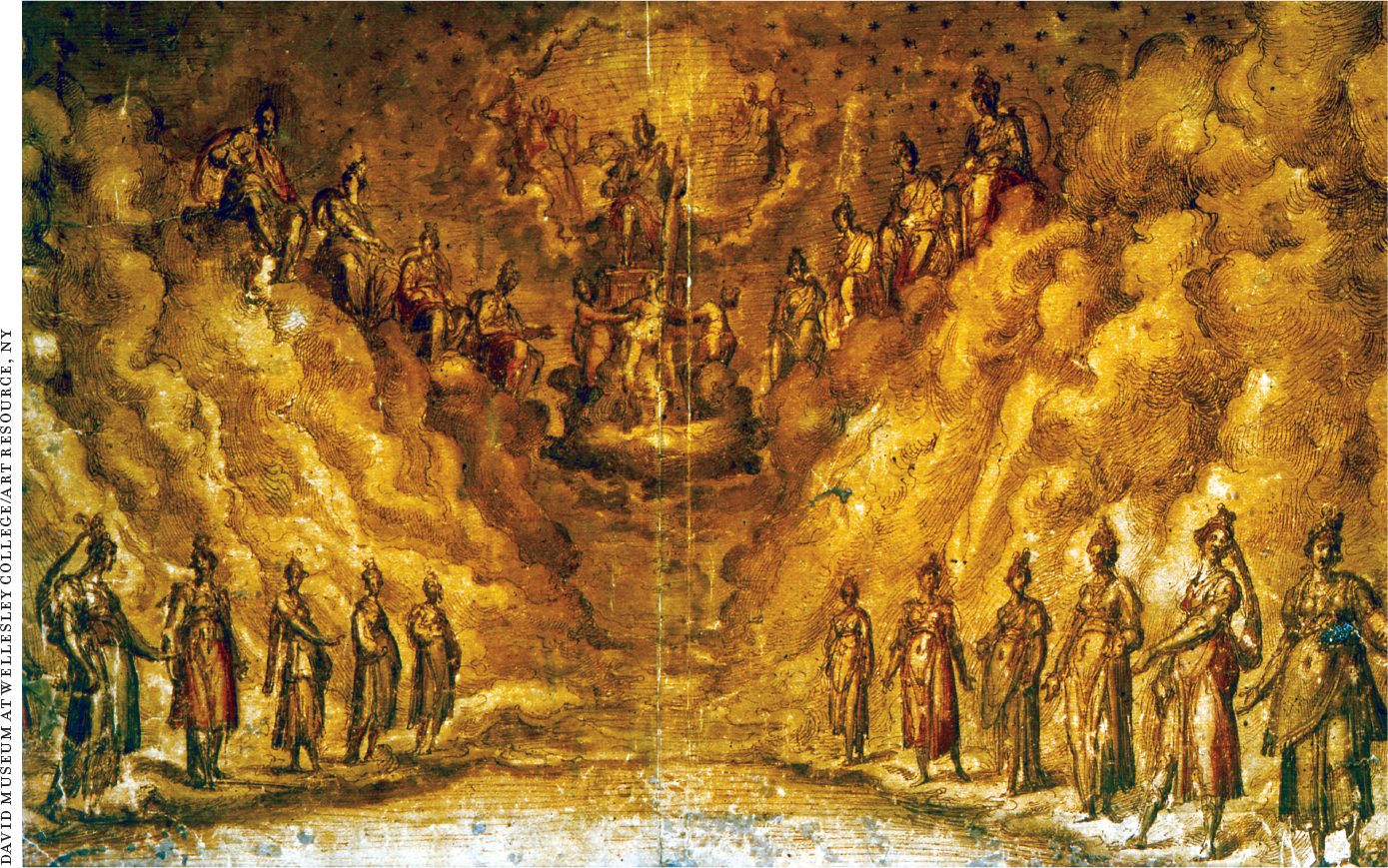
The 1589 intermedi The most spectacular intermedi were those for the comic play La pellegrina (The Pilgrim Woman) at the 1589 wedding in Florence of Grand Duke Ferdinand de’ Medici of Tuscany and Christine of Lorraine. Several artists who were later involved in the earliest operas worked on these intermedi, including their producer, composer and choreographer Emilio de’ Cavalieri (ca. 1550–1602); poet Ottavio Rinuccini (1562–1621); and singer-composers Jacopo Peri (1561–1633) and Giulio Caccini (ca. 1550–1618). The unifying theme, conceived by Florentine count Giovanni de’ Bardi (1534–1612), was the power of ancient Greek music, a consuming interest of his circle. Figure 14.1 shows the set and costumes of the first intermedio, on the harmony of the spheres, giving a sense of how lavish the production was.
GREEK TRAGEDY AS A MODEL
These musical and theatrical genres provided materials that composers incorporated in early operas, but opera might never have emerged without the interest of humanist scholars, poets, musicians, and patrons in reviving Greek tragedy. They hoped to generate the ethical effects of ancient Greek music by creating modern works with equal emotional power. Their discussions, at first abstract and entirely theoretical, led to experiments that ultimately culminated in the first operas. In this sense, opera fulfilled a profoundly humanist agenda, a parallel in dramatic music to the emulation of ancient Greek sculpture and architecture.
Music in Greek tragedy Renaissance scholars disagreed about the role of music in ancient tragedy. One view, that only the choruses were sung, was put into practice in a 1585 performance in Vicenza of Sophocles’s Oedipus Rex in Italian translation. For that production, Andrea Gabrieli cast the choruses in a homophonic declamatory style that emphasized the rhythm of the spoken word.
Girolamo Mei A contrary view, that the entire text of a Greek tragedy was sung, was expressed by Girolamo Mei (1519–1594), a Florentine scholar who edited several Greek dramas. While working in Rome as a cardinal’s secretary, Mei embarked on a thorough investigation of Greek music, particularly its role in the theater. After reading in Greek almost every ancient work on music that survived, he concluded that Greek music consisted of a single melody, sung by a soloist or chorus, with or without accompaniment. This melody could evoke powerful emotional effects in the listener through the natural expressiveness of vocal registers, rising and falling pitch, and changing rhythms and tempo.
THE FLORENTINE CAMERATA
Mei communicated his ideas to colleagues in Florence, notably Count Bardi and Vincenzo Galilei (ca. 1520s–1591), a theorist and composer and the father of astronomer Galileo. From the early 1570s, Bardi hosted an academy where scholars discussed literature, science, and the arts and musicians performed new music. Galilei and Giulio Caccini (and perhaps also Jacopo Peri) were part of this group, which Caccini later called the Camerata (association). Mei’s letters about Greek music often appeared on the agenda as part of a wider interest in classical antiquity, fostered by the ruling family of Florence, the Medici, as a way to reinforce their image of themselves as the “Caesars of their age” and their goals of political empire.
Vincenzo Galilei In his Dialogo della musica antica et della moderna (Dialogue of Ancient and Modern Music, 1581), Galilei used Mei’s doctrines to attack vocal counterpoint. He argued that only a single line of melody, with pitches and rhythms appropriate to the text, could express a given line of poetry. When several voices simultaneously sang different melodies and words, in different rhythms and registers, some low and some high, some rising and others descending, some in slow notes and others in fast, the resulting chaos of contradictory impressions could never deliver the emotional message of the text. Word-painting, imitations of sighing, and the like, so common in madrigals, he dismissed as childish. Only a solo melody, he believed, could enhance the natural speech inflections of a good orator or actor.
MONODY, ARIA, AND SOLO MADRIGAL
Galilei was advocating a type of monody, a term used by modern historians to embrace all the styles of accompanied solo singing practiced in the late sixteenth and early seventeenth centuries (as distinct from monophony, which is unaccompanied melody). Solo singing was not new; soloists sang epics and other strophic poems to standard formulas with light accompaniment, composers wrote songs for voice and lute, and it was common to sing one part of a polyphonic madrigal while instruments played the other parts. But the Camerata’s discussions of Greek music led several members down new paths.
Caccini’s Le nuove musiche Caccini wrote numerous songs for solo voice with continuo in the 1580s and 1590s and published them in 1602 under the title Le nuove musiche (The New Music). Those with strophic texts he called arias (Italian for “airs”), which at this time could mean any setting of strophic poetry. The others he called madrigals, showing that he considered these to be the same type of piece as polyphonic madrigals: through-composed settings of nonstrophic poems, sung for one’s own entertainment or for an audience. Today we use the term solo madrigal to distinguish the new type from the madrigal for several voices.
In his foreword, Caccini boasted that the madrigal Vedrò ’l mio sol (NAWM 72 and Figure 13.10) was greeted in Bardi’s Camerata “with affectionate applause.” Caccini set each line of poetry as a separate phrase ending in a cadence, shaping his melody to the natural accentuation of the text. He wrote into the music the kind of embellishments that singers would usually have added in performance. Faithful to the goals of the Camerata, he placed ornaments to enhance the message of the text, not just to display vocal virtuosity. His foreword to Le nuove musiche includes descriptions of the vocal ornaments then in use, providing a valuable resource for scholars and singers today.
- pastoral drama
Play in verse with incidental music and songs, normally set in idealized rural surroundings, often in ancient times; a source for the earliest opera librettos.
- madrigal comedy
In the late sixteenth and early seventeenth centuries, a series of madrigals that represents a succession of scenes or a simple plot.
- madrigal cycle
In the late sixteenth and early seventeenth centuries, a series of madrigals that represents a succession of scenes or a simple plot.
- intermedio
Musical interlude on a pastoral, allegorical, or mythological subject performed before, between, or after the acts of a spoken comedy or tragedy.
- Camerata
(Italian, “circle” or “association”) Circle of intellectuals and amateurs of the arts that met in Florence, Italy, in the 1570s and 1580s.
- monody
(1) An accompanied solo song. (2) The musical texture of solo singing accompanied by one or more instruments.
- aria
(Italian, “air”) (1) In the late sixteenth and early seventeenth centuries, any section of an Italian strophic poem for a solo singer. (2) Lyrical monologue in an opera or other vocal work such as cantata and oratorio.
- solo madrigal
In the late sixteenth and early seventeenth centuries, a through-composed setting of a nonstrophic poem for solo voice with accompaniment, distinguished from an aria and from a madrigal for several voices.