After Bardi moved to Rome in 1592, discussions about new music—and performances of such works—continued under the sponsorship of another nobleman, Jacopo Corsi (1561–1602). Among the participants were two veterans of the 1589 intermedi, poet Ottavio Rinuccini and singer-composer Jacopo Peri, shown in Figure 14.2. Convinced that Greek tragedies were sung in their entirety, they set out to re-create the ancient genre in modern form. Peri’s setting of Rinuccini’s pastoral poem Dafne was performed in October 1598 at Corsi’s palace. Although only fragments of the music survive, this was the first opera, modeled on the Greek plays: a staged drama, sung throughout, with music designed to convey the characters’ emotions. (It was not called an “opera,” however; that did not become the common term for such works until later, when the genre was well established.)
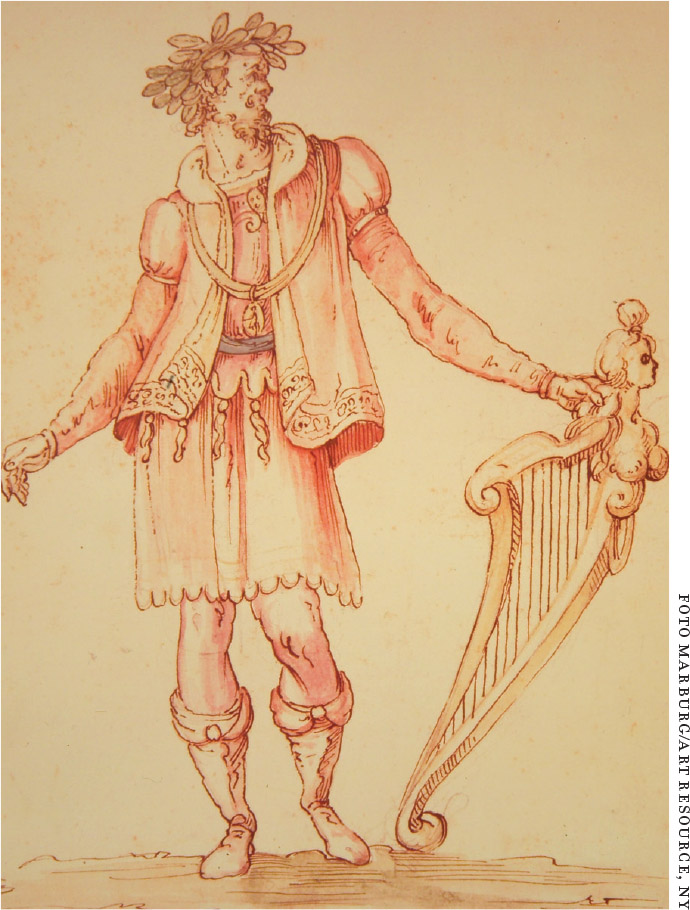
FIGURE 14.2Jacopo Peri, in a costume designed by Bernardo Buontalenti, as the legendary singer Arion in Peri and Christofano Malvezzi’s fifth intermedio of 1589. Arion, returning from concerts in Corinth, sings an echo aria just before he plunges into the sea to escape his mutinous crew.
Meanwhile, Emilio de’ Cavalieri, who was in charge of theater, art, and music at the Florentine ducal court, mounted smaller scenes with his own music in a similar style. In February 1600, he produced in Rome his musical morality play Rappresentatione di anima et di corpo (Representation of the Soul and the Body), at that time the longest entirely musical stage work. These works typify the search for new expressive means that could match the power ancient writers ascribed to Greek music.
L’EURIDICE
In 1600, Peri set to music Rinuccini’s pastoral drama L’Euridice. The subject demonstrates music’s power to move the emotions: through his singing, Orfeo (Orpheus) makes even the denizens of the underworld weep and persuades them to restore his wife Euridice to life.
L’Euridice was performed in Florence that October for the wedding of Maria de’ Medici, niece of the grand duke, to King Henri IV of France. Cavalieri directed, and Peri sang the role of Orfeo. Although the event looms large in music history as the first performance of the earliest surviving opera, the work was only a small part of the wedding entertainment, eclipsed at the time by more established forms such as a horse ballet. The production incorporated sections of another setting of the libretto, this one by Caccini, who would not allow his singers to perform music composed by others. Both versions were soon published, and they remain the earliest surviving complete operas. Of the two settings, Caccini’s is more melodious and lyrical, resembling the arias and madrigals of Le nuove musiche. But Peri claimed that his was better suited to the drama, because he found a new way to imitate speech and varied his approach according to the dramatic situation.
SOURCE READING
Peri’s Recitative Style
In the preface to his opera L’Euridice, Jacopo Peri described his search for a new kind of musical setting, midway between speech and song, that could convey a character’s emotions as forcefully as did the music of ancient Greek dramas. This new style, known as recitative, became an essential part of the new genre of opera.
Putting aside every other manner of singing heard up to now, I dedicated myself wholly to searching out the imitation that is owed to these poems. And I reflected that the sort of voice assigned by the ancients to song, which they called diastematic (as if to say sustained and suspended), could at times be hurried and take a moderate course between the slow sustained movements of song and the fluent and rapid ones of speech, and thus suit my purpose (just as the ancients, too, adapted the voice to reading poetry and heroic verses), approaching that other [voice] of conversation, which they called continuous and which our moderns (though perhaps for another purpose) also used in their music.
I recognized likewise that in our speech certain sounds are intoned in such a way that a harmony can be built upon them, and in the course of speaking we pass through many that are not so intoned, until we reach another that permits a movement to a new consonance.
Keeping in mind those manners and accents that serve us in our grief and joy and similar states, I made the bass move in time with these, faster or slower according to the affections. I held the bass fixed through both dissonances and consonances until the voice of the speaker, having run through various notes, arrived at a syllable that, being intoned in ordinary speech, opened the way to a new harmony. I did this not only so that the flow of the speech would not offend the ear (almost stumbling upon the repeated notes with more frequent consonant chords), but also so that the voice would not seem to dance to the movement of the bass, particularly in sad or severe subjects, granted that other more joyful subjects would require more frequent movements.
From Peri, Le musiche sopra l’Euridice (Florence, 1601), trans. in Claude V. Palisca, Humanism in Italian Renaissance Musical Thought (New Haven: Yale University Press, 1985), 428–32.
Recitative style For dialogue, Peri invented a new idiom, soon known as recitative style. In his preface to L’Euridice (see Source Reading), Peri recalled the distinction made in ancient Greek theory between continuous changes of pitch in speech and intervallic, or “diastematic,” motion in song (see Chapter 1). He sought a kind of speech-song that was halfway between them, similar to the style that scholars thought the Greeks used for reciting epic poems. By holding steady the notes of the basso continuo while the voice moved freely through both consonances and dissonances, he liberated the voice from the harmony enough so that it simulated free, pitchless declamation of poetry. When a syllable arrived that would be stressed in speaking—in his words, “intoned”—he formed a consonance with the bass.
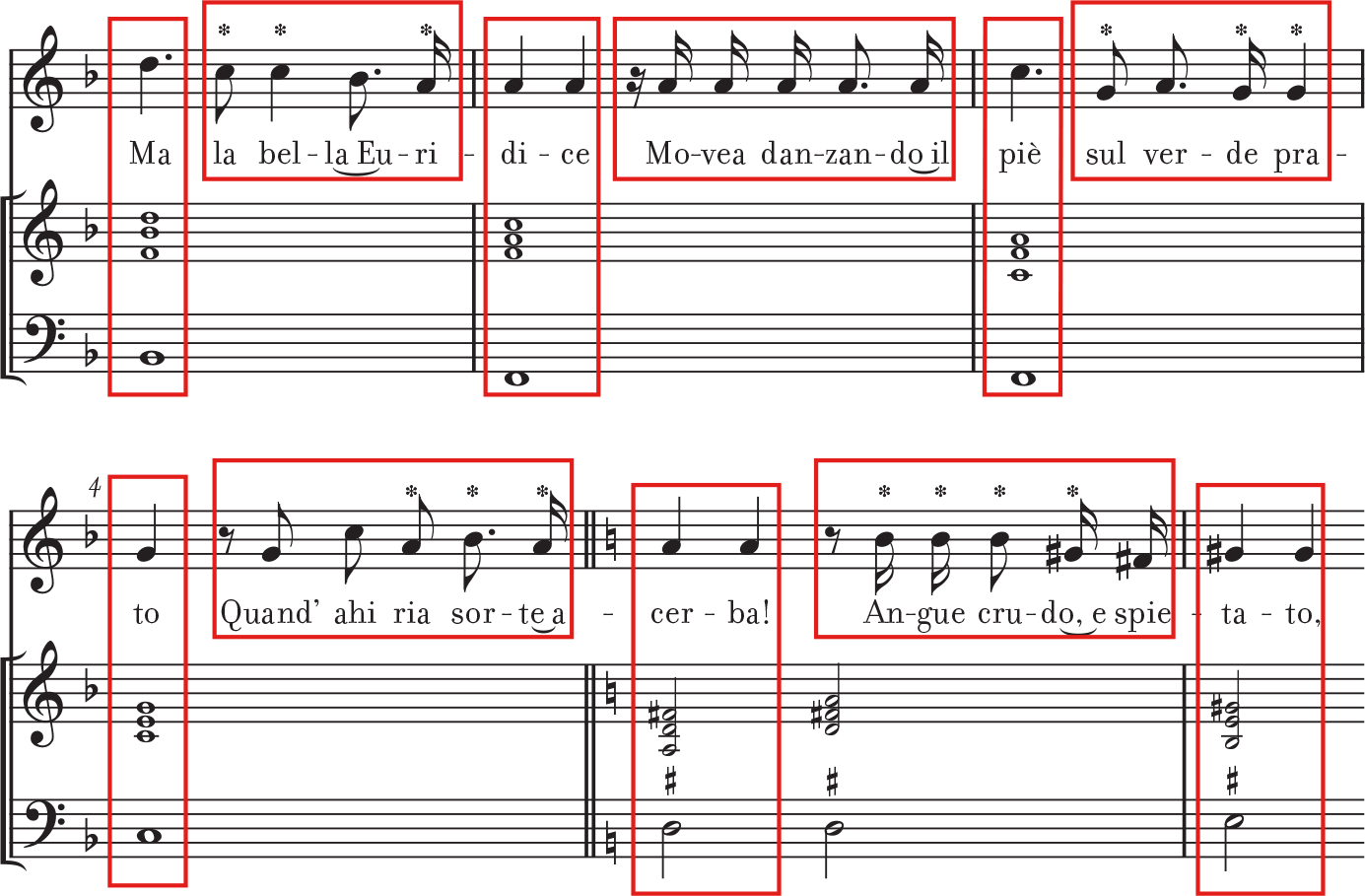
Example 14.1 shows how Peri followed his own prescription for the new style. The vertical boxes identify the syllables that are sustained or accented in speech and the consonant harmonies that support them. The horizontal boxes contain the syllables that are passed over quickly in speech and may be set with either dissonances (marked by asterisks) or consonances against the bass and its implied chords. The ways dissonances are introduced and left often violate the rules of counterpoint, but the effort to imitate speech exempts these notes from normal musical conventions. This combination of speechlike freedom and sustained, harmonized accented syllables realized Peri’s idea of a medium halfway between speech and song.
Aria Two excerpts from L’Euridice illustrate contrasting types of monody used by Peri. Tirsi’s aria, or strophic song (NAWM 73a), sets a short lyric poem with music that is rhythmic and tuneful, resembling a canzonetta or dance song. It is introduced by a brief sinfonia, a term used throughout the seventeenth century for an abstract ensemble piece, especially one that serves as a prelude. An instrumental refrain called a ritornello (Italian for “small return”) follows each stanza; here the ritornello echoes the introductory sinfonia.
NAWM 73aJacopo Peri, Le musiche sopra l’Euridice: Aria: Nel pur ardor
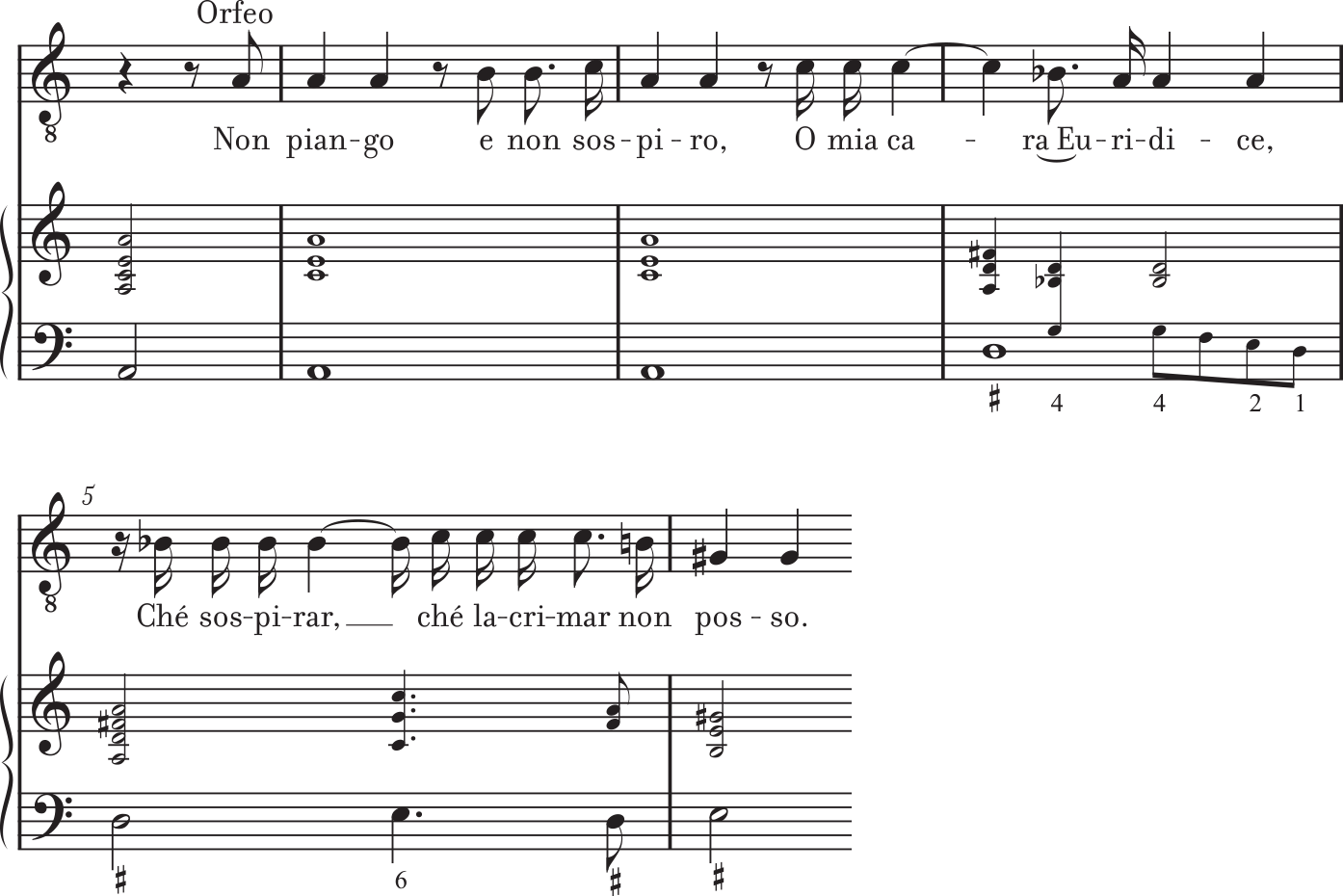
Varied styles of recitative The speech in which Dafne narrates Euridice’s death (NAWM 73b and Example 14.1) uses recitative. The bass and chords have no rhythmic profile or formal plan and are there only to support the voice’s recitation, which is free to imitate the inflections and rhythms of poetic speech. This moment of narration is more like epic than drama, telling a story rather than acting it out. For more lyric moments, Peri heightens the expressivity of his recitative, using methods from the madrigal tradition to convey a character’s feelings. When Orfeo first reacts to the news of Euridice’s death, as shown in Example 14.2, his breathless shock is conveyed by frequent rests (measures 1–3), and his grief by suspensions (measure 4), unprepared dissonance (measure 5), chromaticism (measures 4–6), and unexpected harmonic progressions (measures 5–6). The range from narrative recitative to expressive recitative shows that Peri’s new idiom could encompass both the epic and the lyric sides of early opera, as well as being used for dialogue.
NAWM 73bJacopo Peri, Le musiche sopra l’Euridice: Dialogue in recitative: Per quel vago boschetto
EXAMPLE 14.1Jacopo Peri, narrative recitative fromEuridice
But the lovely Eurydice dancingly moved her feet on the green grass, when—O bitter, angry fate!—a snake, cruel and merciless, [that lay hidden in the grass, bit her foot.]
EXAMPLE 14.2Peri, expressive recitative fromEuridice
I do not weep and I do not sigh, O my dear Eurydice, for to sigh, to weep I cannot.
A blend of new and older styles In L’Euridice, Peri devised an idiom that met the demands of dramatic poetry. Although he and his associates knew they had not revived Greek music, they claimed to have realized a speech-song that was close to what had been used in ancient theater but was also compatible with modern practice. At the same time that it introduced a new style based on ancient models, Peri’s opera also borrowed from the traditions of the madrigal, aria, pastoral drama, and intermedio, using what was most appropriate for each moment of the drama.
THE IMPACT OF MONODY
The various styles of monody, including recitative, aria, and madrigal, quickly made their way into all kinds of music, both secular and sacred. Monody made musical theater possible because it could convey in music everything from narration to dialogue to soliloquy, with the immediacy and flexibility needed for truly dramatic expression. The stylistic diversity Peri introduced was continued and expanded in all later opera, as composers followed his lead in suiting their music to the dramatic situation.
(1) Generic term used throughout the seventeenth century for an abstract ensemble piece, especially one that serves as an introduction to a vocal work. (2) Italian opera overture in the early eighteenth century. (3) Early symphony.
(1) In a fourteenth-century madrigal, the closing section, in a different meter from the preceding stanzas. (2) In sixteenth- and seventeenth-century vocal music, instrumental introduction or interlude between sung stanzas. (3) In an aria or similar piece, an instrumental passage that recurs several times, like a refrain. Typically, it is played at the beginning, as interludes (often in modified form), and again at the end, and it states the main theme. (4) In a fast movement of a concerto, the recurring thematic material played at the beginning by the full orchestra and repeated, usually in varied form, throughout the movement and at the end.