CHAPTER
1
MUSIC IN ANTIQUITY

The culture of Europe and the Americas—known as Western culture to distinguish it from the traditional cultures of Asia—has deep roots in the civilizations of antiquity. Our agriculture, writing, cities, and systems of trade derive from the ancient Near East. Our mathematics, calendar, astronomy, and medicine grew from Mesopotamian, Egyptian, Greek, and Roman sources. Our philosophy is founded on Plato and Aristotle. Our primary religions, Christianity and Judaism, arose in the ancient Near East and were influenced by Greek thought. Our literature grew out of Greek and Latin traditions and drew on ancient myth and scripture. Our artists imitated ancient sculpture and architecture. From medieval empires to modern democracies, governments have looked to Greece and Rome for examples.
The music of Western culture, known as Western music, also has roots in antiquity, from the scales we use to the functions music serves. The strongest direct influence comes through Greek writings, which became the foundation for European views of music. The influence of ancient music itself is more difficult to trace. Little notated music survived, and few if any European musicians before the sixteenth century could read the ancient notation. Yet some musical practices continued, passed down through oral tradition.
These echoes of ancient music in the Western tradition are reason enough to begin our survey by examining the roles of music in ancient cultures, the links between ancient practices and those of later centuries, and the debt Western music owes to ancient Greece. Starting with ancient music also lets us consider how we can learn about music of the past and what types of evidence we can use to reconstruct the history of music from any age.
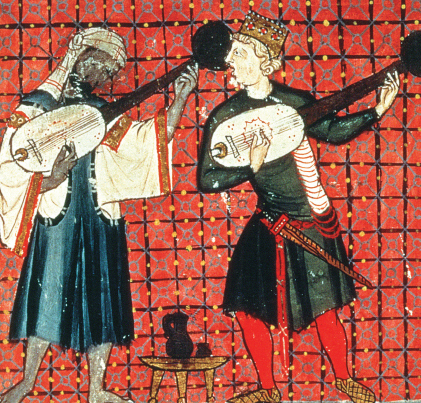
Music is sound, and sound by its nature is impermanent. What remains of the music from past eras are its historical traces, of four main types: (1) physical remains such as musical instruments and performing spaces; (2) visual images of musicians, instruments, and performances; (3) writings about music and musicians; and (4) music itself, preserved in notation, through oral tradition, or (since the 1870s) in recordings. Using these traces, we can try to reconstruct what music of a past culture was like, recognizing that our understanding will always be partial and will be influenced by our own values and concerns.
We are most confident of success when we have all four types of evidence in abundance. But for ancient music, relatively little remains. Even for Greece, by far the best-documented ancient musical tradition, we have only a small portion of the instruments, images, writings, and music that once existed. For other cultures we have no music at all. By examining what traces survive and what we can conclude from them, we can explore how each type of evidence contributes to our understanding of music of the past.