It is sometimes not the originator of an idea, but the first person to show its full potential, who secures for it a permanent place in human history. So it appears with opera, whose first widely renowned composer was not Peri or Caccini but Claudio Monteverdi (see biography and Figure 14.3).
CLAUDIO MONTEVERDI
(ca. 1567–1643)
The most innovative and imaginative composer of his day, Monteverdi wrote only vocal works, including sacred pieces, madrigals, and operas. His music is always perfectly suited to the text. He was particularly inventive in creating expressive devices and combining styles and genres to capture feelings and personalities in music.
Monteverdi was born in Cremona, in northern Italy. Trained by the cathedral’s music director, he was a prodigy as a composer, publishing two volumes of sacred music by age sixteen and three books of madrigals in his early twenties.
Monteverdi was an accomplished viol and viola player by 1590, when he entered the service of Vincenzo Gonzaga, duke of Mantua. He married a court singer, Claudia Cattaneo, and in 1601 was appointed master of music in the ducal chapel.
The Gonzagas commissioned Monteverdi’s first operas, L’Orfeo (1607) and L’Arianna (1608; only the heroine’s much-praised lament survives). Between the two premieres, Claudia died, leaving him with three small children. Overworked and poorly paid, he suffered a nervous breakdown, then complained bitterly to the duke that he was being mistreated. He was rewarded with an annual pension in 1609 and a generous salary increase. His Vespro della Beata Vergine (Vespers of the Blessed Virgin), published in 1610, may have been intended as self-advertisement, as he was unhappy in Mantua and was seeking a new position. The collection features a range of styles from modern vocal display to severe counterpoint.
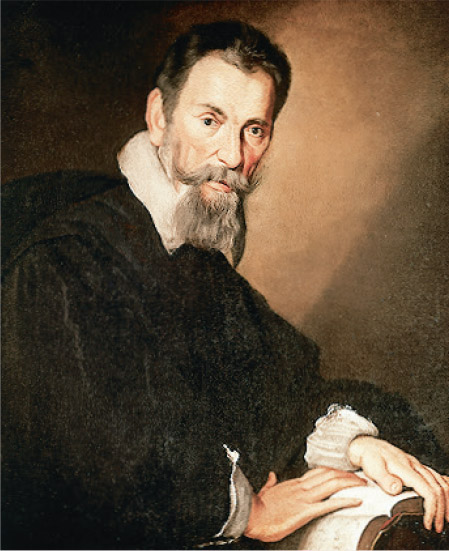
FIGURE 14.3Claudio Monteverdi, in a portrait by Bernardo Strozzi. LANDESMUSEUM FERDINANDEUM, INNSBRUCK, AUSTRIA. PHOTO: ERICH LESSING/ART RESOURCE, NY
The new duke dismissed Monteverdi in 1612, but the following year he became maestro di cappella at St. Mark’s in Venice, the most prestigious musical post in Italy, where he remained until his death thirty years later. He wrote a great deal of sacred music for St. Mark’s and for the confraternities that were an important part of Venetian life. In 1632, he became a priest.
Throughout his career, however, Monteverdi remained drawn to the madrigal, publishing no fewer than 250 in nine collections over five decades. He helped to transform the genre from the witty, polyphonic, a cappella partsongs of the late Renaissance to powerful explorations of the concertato medium and updated its language with emotionally charged, unprepared dissonances and declamatory melodies.
His operas Il ritorno d’Ulisse (The Return of Ulysses, 1640) and L’incoronazione di Poppea (The Coronation of Poppea, 1643), written in his seventies, use a varied mixture of styles to portray the characters and their emotions.
After his death at the age of seventy-six, Monteverdi was lauded in poetry and music. His influence spread through the circulation of his published works and the operas of his younger contemporaries.
MAJOR WORKS 3 surviving operas, L’Orfeo, Il ritorno d’Ulisse, and L’incoronazione di Poppea; 9 books of madrigals; 3 other volumes of secular songs; Vespro della Beata Vergine; 3 masses; 4 collections of sacred music
L’ORFEO
Monteverdi’s first opera, L’Orfeo, was commissioned by Francesco Gonzaga, heir to the throne of Mantua, and produced there in 1607. It was modeled on L’Euridice in subject and mixture of styles, but Monteverdi drew on an even wider range of styles and genres and used the contrasts to shape both the music and the drama. The librettist, Alessandro Striggio, organized the drama into five acts, each centered around a song by Orfeo and ending with a vocal ensemble that comments on the situation, like the chorus in a Greek tragedy. Monteverdi brought to opera his experience composing madrigals known for expressive text setting and dramatic intensity. He also used a larger and more varied group of instruments than Peri; the score, published in 1609, calls for recorders, cornetts, trumpets, trombones, strings, double harp, and several different continuo instruments, including a regal (a buzzy-sounding reed organ) for the scenes in the underworld.
Monody Monteverdi followed Peri in using several kinds of monody from songlike aria to recitative. His Prologue is a declamatory aria with ritornello in which Monteverdi wrote out each strophe, varying the melody and the duration of the harmonies to reflect the accentuation and meaning of the text, a procedure called strophic variation. He used the same approach for the work’s centerpiece, Orfeo’s Act III aria Possente spirto, and included in the published score a florid ornamentation of the first four strophes (see Example 13.3). Monteverdi’s recitative is more varied than Peri’s, moving from narrative to songfulness to agonized expression as the drama warrants.
Ensembles In addition to monody, Monteverdi included duets, dances, and ensemble madrigals and ballettos, providing a range of contrasting styles to reflect the varying moods in the drama. The ritornellos and choruses help to organize scenes into schemes of almost ceremonial formality. For example, Act I is an arch, framed by strophic variations in the Prologue and at the end of the act. Two choruses, a madrigal and a balletto, alternating with recitatives, precede the central impassioned recitative of Orfeo, followed by a response from Euridice and then the same balletto and madrigal in reverse order.
Act II If Act I is a static arch, appropriate to a wedding ceremony, Act II (excerpted in NAWM 74) is a dramatic rush forward. Orfeo and his companions salute the happy day in a series of arias and ensembles, each with its own ritornello, strung together without a break. The series culminates with a strophic aria for Orfeo, Vi ricorda (NAWM 74a), in which he recalls his unhappiness turning to joy as he won Euridice. The form and the lighthearted style parallel Peri’s canzonetta for Tirsi, and the hemiola rhythms give it a dancelike lilt.
NAWM 74aClaudio Monteverdi, L’Orfeo: Excerpts from Act II, Aria/canzonetta: Vi ricorda o boschi ombrosi
Ironically, at the peak of joy, a Messenger arrives to bring the tragic news that Euridice has died from a snakebite. A sudden change of continuo instrument to an organ with wooden pipes and of tonal area from Ionian mode (C major) to Aeolian (A minor) marks the Messenger’s cry, Ahi, caso acerbo (Ah, bitter event; NAWM 74c), in an impassioned recitative. At first, Orfeo’s companions do not understand and keep singing in their own tonal and timbral world as they wonder what is wrong. But after the Messenger relates her story, a shepherd repeats her opening cry, which becomes a recurring refrain for the rest of the act, as the other characters join her in grief. This use of tonal area, timbre, and formal organization to deepen the dramatic impact shows Monteverdi’s skill in using all the resources at hand for expression.
NAWM 74cClaudio Monteverdi, L’Orfeo: Excerpts from Act II, Dialogue in recitative: Ahi, caso acerbo
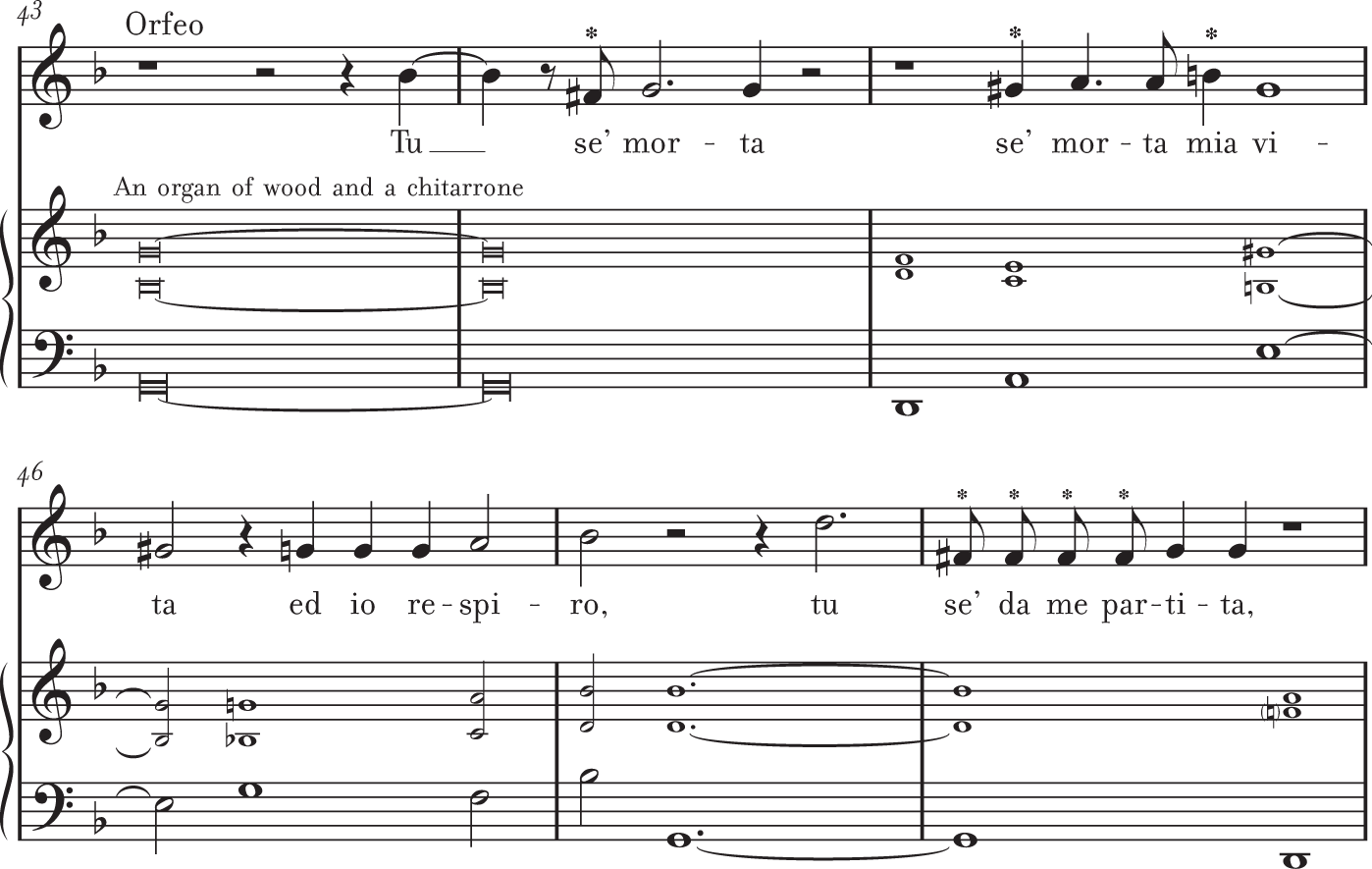
Orfeo’s lament Tu se’ morta (NAWM 74d) attains a new height of lyricism for recitative that leaves the first monodic experiments far behind. In the opening passage, shown in Example 14.3, each phrase of music, like each phrase of text, builds on the preceding one, intensifying it through pitch and rhythm. The dissonances against sustained chords, marked with asterisks, not only enhance the illusion of speech but also express Orfeo’s bitter feelings. The raw passage from an E-major to a G-minor chord (measures 45–46) underscores the irony that he still lives when Euridice—his “life”—is dead.
NAWM 74dClaudio Monteverdi, L’Orfeo: Excerpts from Act II, Recitative: Tu se’ morta
EXAMPLE 14.3Claudio Monteverdi, Orfeo’s lament, fromL’Orfeo, Act II
You are dead, my life, and I still breathe? You have departed from me,
LATER DRAMATIC WORKS
L’Arianna Orfeo was so successful that Duke Vincenzo Gonzaga commissioned a second opera, L’Arianna, from Monteverdi for the next year. It won great renown, but only a fragment survives: Arianna’s lament. Both Orfeo and Arianna were staged in other cities as much as three decades later, an unusual longevity for operas at the time, when most were produced only once.
Combattimento di Tancredi e Clorinda Monteverdi moved to Venice in 1613 as maestro di cappella at St. Mark’s. Alongside church and vocal chamber music (described in Chapter 15), he continued to write operas and other dramatic works. Especially significant is Combattimento di Tancredi e Clorinda (The Combat of Tancred and Clorinda, 1624), a short work blending music and mime. The text, an excerpt from Torquato Tasso’s epic Gerusalemme liberata (Jerusalem Delivered, 1575), describes the combat between the crusader knight Tancred and the armored pagan heroine Clorinda. Most of the poem is narration, which Monteverdi assigned to a tenor in recitative. The few short speeches of Tancred and Clorinda are sung by a tenor and soprano, who also mime the actions during the narrative. The instruments (strings with continuo) accompany the voices and play interludes that suggest the action, such as galloping horses and clashing swords. To convey anger and warlike actions, Monteverdi devised the concitato genere or stile concitato (excited style), characterized by rapid reiteration on a single note, whether on quickly spoken syllables or in a measured string tremolo. Other composers imitated this device, and it became a widely used convention.
Venetian operas Near the end of his life, Monteverdi composed three operas for the new public theaters in Venice. We will consider them below (see pp. 311–14) after first tracing what happened to opera in the intervening decades.
Early seventeenth-century vocal genre, a setting of a strophic poem, in which the melody of the first stanza is varied but the harmonic plan remains essentially the same, although the duration of harmonies may change to reflect the accentuation and meaning of the text.
(Italian, “excited style”) Style devised by Claudio Monteverdi to portray anger and warlike actions, characterized by rapid reiteration of a single note, whether on quickly spoken syllables or in a measured string tremolo.
(Italian, “excited style”) Style devised by Claudio Monteverdi to portray anger and warlike actions, characterized by rapid reiteration of a single note, whether on quickly spoken syllables or in a measured string tremolo.