NAWM 75a Claudio Monteverdi, L’incoronazione di Poppea, Act I, Scene 3: Dialogue in recitative: Signor, deh non partire
PUBLIC OPERA IN VENICE
A decisive step in the history of opera was taken in 1637 with the opening in Venice of the first public opera house, Teatro San Cassiano. Until then musical theater depended on individual aristocratic or ecclesiastical patrons, but now it was presented for and supported in part by the paying public, with financial backing from wealthy and prominent families. That combination of private underwriting with income from ticket sales has continued to the present, and the operatic conventions and modes of production established in Venice underlie the history of opera ever since. Without these changes, opera might not have endured.
Audience Venice was ideal for public opera. Each year during Carnival season, which ran from the day after Christmas to the day before Lent, almost as many people came to Venice as lived there year-round, attracted by the mixing of social classes, freedom from religious and social constraints, and extravagant entertainments typical of the season. This large, diverse, and eager audience provided a favorable environment for opera. The first opera staged in Venice, Francesco Manelli’s Andromeda on a libretto by Benedetto Ferrari, premiered during Carnival in 1637 and was an immediate success. Both Manelli and Ferrari had worked in Rome, as had most of their troupe, so opera was a Roman transplant. Their success led them to collaborate again the next year. Then in 1639 both composed operas as a second theater opened, and soon the new genre was a regular feature of Carnival.
Theaters If the enthusiastic audience was crucial for the success of public opera, no less important were the theaters themselves and the funding that sustained them. Venice was an oligarchy controlled by rich merchant families, several of whom financed the building or remodeling of theaters for opera, seeing them as vehicles both for enhancing their prestige and for turning a profit. Nine theaters were competing by 1678, when Teatro San Giovanni Grisostomo, shown in Figure 14.5, opened as the last new theater of the century. Wealthy families and individuals could lease boxes, and anyone could rent a seat on the ground level for a single performance. Everyone, including box holders, had to buy admission tickets. With steady financing and a guaranteed audience, those engaged in putting on an opera could count on multiple performances during the Carnival season, and many in the audience would attend the same opera numerous times.
Impresarios and singers Theater owners contracted with an impresario to produce the season’s operas, including hiring the librettists, composers, singers, and production staff. Singers were as important in attracting the public as the drama and spectacle, and usually more important than the composer or librettist, so impresarios competed for the most popular singers by paying them high fees. The singers Signora Girolama and Giulia Masotti earned two to six times as much for an opera’s run as the composer received for writing it. Naturally, singers—especially women and castrati—were drawn to Venice to further their careers. The vogue of the operatic diva was inaugurated by Anna Renzi, who came from Rome and conquered the Venetian stage in 1641 (see Innovations: The Impresario and the Diva and Figure 14.6, pp. 312–13), and composers wrote parts expressly for her talents.
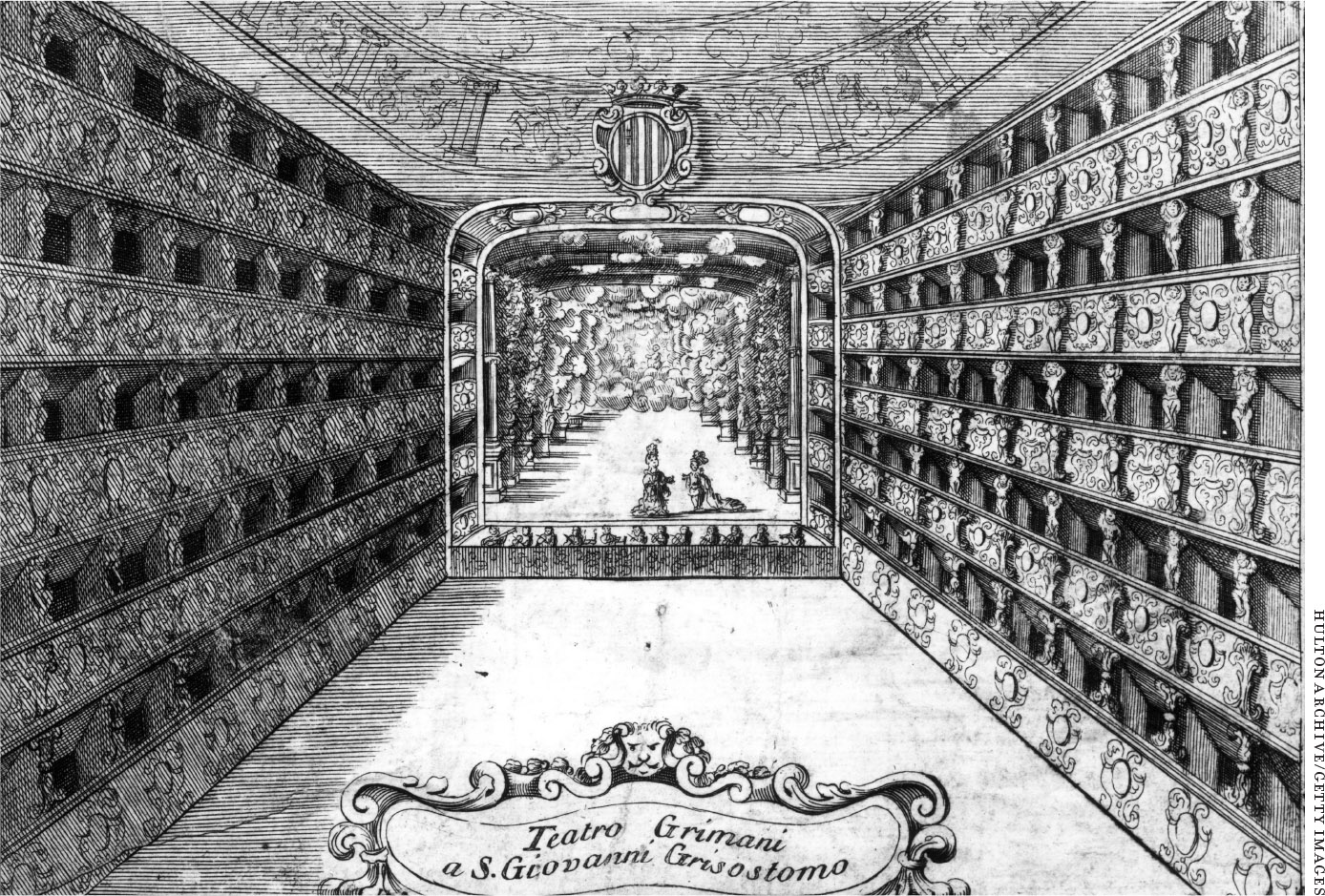
Librettos and staging Alongside operas on mythological themes, Venetian librettists drew subjects from the epics of Homer, Virgil, Tasso, and Ariosto, and from Roman history. Plots were chosen with an eye for a wide range of emotions, dramatic conflicts, and striking stage effects, from magical transformations to clouds that carried singers. Three acts (plus a prologue) rather than the five of earlier times were now typical. Instead of the epic style of narration we saw in early opera, exemplified in descriptions of Euridice’s death, librettists sought to tell the story through drama itself, using the interactions of characters to move the plot along. The number of arias increased to fifty or sixty in an opera. To keep the focus on the drama and the principal singers, choruses and dances were mostly eliminated or used only at the end of an act. As shown in Figure 14.5, the stage sets created a sense of a three-dimensional room or landscape with a series of painted flats on each side. In a marvel of stagecraft, these could be removed and replaced in seconds, using a system of ropes, levers, and pulleys. Drama, spectacle, and comic episodes all helped operas appeal to the broad and diverse audience in the theaters, which encompassed visitors from across Europe and Venetians from every social class.
Monteverdi’s Venetian operas After the initial successes of Manelli and Ferrari, one of the first to compose operas for Venice was Monteverdi, already renowned for Orfeo (1607) and Arianna (1608). He had come to Venice in 1613 as maestro di cappella at St. Mark’s and continued to compose dramatic works for private performance, such as Combattimento di Tancredi e Clorinda (see p. 307). He turned to the public stage in 1640 with a revision of Arianna, followed by three new operas. Two survive: Il ritorno d’Ulisse in patria (The Return of Ulysses to His Homeland, 1640), based on the last part of Homer’s Odyssey, and L’incoronazione di Poppea (The Coronation of Poppea, 1643), a historical opera on the Roman emperor Nero’s illicit affair with the ambitious Poppaea Sabina, whom he eventually married.
L’incoronazione di Poppea Poppea is often considered Monteverdi’s masterpiece. Because it was written for a commercial theater rather than a wealthy court, it lacks the varied instrumentation of Orfeo; operas in Venice were typically performed with harpsichords, theorbos, and a bowed bass instrument playing continuo, plus two solo violins and a viola for ritornellos and sinfonias. Yet Poppea surpasses Orfeo in depiction of human character, emotions, and interpersonal drama.
The scene between Nerone (Nero) and Poppea in Act I, Scene 3 (NAWM 75), exemplifies Monteverdi’s willingness to change styles frequently to reflect the actions and passions of the characters: expressive recitative inflected with dissonance and chromaticism as Poppea begs Nerone not to leave; simpler recitation for dialogue; arias with ritornellos, often in triple meter, for declarations of love; and ariosos for highlighting brief expressions of specific feelings. Thus the stylistic variety in Poppea, though even greater than in Orfeo, serves the same dramatic goals. Monteverdi freely reorders text in the libretto to make speeches into dialogue, intensifying the drama, and sometimes uses aria style even for sections not in strophic verse. Throughout, he exploits conventions of form, genre, texture, and expressive gesture to depict the characters and at the same time comment on them, inserting his authorial voice.
NAWM 75b Claudio Monteverdi, L’incoronazione di Poppea, Act I, Scene 3: Aria: In un sospir
NAWM 75c Claudio Monteverdi, L’incoronazione di Poppea, Act I, Scene 3: Aria: Signor, sempre mi vedi
NAWM 75d Claudio Monteverdi, L’incoronazione di Poppea, Act I, Scene 3: Dialogue in mixed styles: Adorati miei rai
INNOVATIONS
The Impresario and the Diva

From its very beginnings, opera was a complicated, costly, even extravagant affair requiring the collaboration of the librettist, the composer (who held a decidedly lower status than the author of the words), and the artists whose performances engaged the audience directly. In addition, it demanded the services of a vast array of craftspeople and providers who worked behind the scenes. Among these silent and unseen participants—including stage managers, carpenters, painters, costume designers, tailors, hairdressers, and copyists—none was more crucial than the impresario, who was roughly equivalent to the modern producer. Transferred into English from the Italian, the word impresario acquired its distinctive meaning with the rise of public opera in Venice. The theater’s owner, head of one of the noble families of Venice, entrusted the impresario with managing the theater successfully for one season at a time, which meant bringing in a profit after all the production expenses and artists’ fees were paid. Naturally, the economic outcome depended in good measure on the impresario’s decisions about how many and which operas were to be performed in a given season. Competition was fierce, so the impresario also had to consider the financial risks involved in mounting spectacular scenic effects or hiring the most highly paid singers, and measure these costs against the potential gains of attracting larger audiences.
This volatile commercial atmosphere fostered, among other things, the phenomenon of the operatic diva (or star). Impresarios went to great lengths and expense to secure effective performers because they realized that a singer could make or break an entire opera season no matter what work was being produced. Although the power of singers had been a theme in opera from its beginnings—think of Orfeo, whose legendary song persuaded supernatural beings to return his spouse to life—that power now resided with the singers themselves rather than with the characters they portrayed. Sopranos, especially those who were able to win favor through virtuosic ornamentation and persuasive interpretation, quickly achieved stardom. Once having made it to the top, a diva could demand that composers and librettists alter roles to suit her particular vocal talents and range. In so doing, she not only exercised her star power but actually influenced the development of opera in ways that eventually affected its dramatic structure as well as its musical values.
The career of Anna Renzi, leading lady of the Venetian operatic stage in the 1640s, is a case in point and illustrates the rise in stature of the female singer. Renzi was only about twenty when her teacher brought her from Rome to Venice to perform the title role in La finta pazza (The Feigned Madwoman), the work that was scheduled to open the newest public opera house in that city, the Teatro Novissimo, in 1641. The composer, Francesco Sacrati, undoubtedly tailored the role specifically to her in order to capitalize on her particular talents. That she played a woman pretending to be afflicted with madness on that occasion and then, two years later, created the role of Nerone’s spurned empress Ottavia in Monteverdi’s L’incoronazione di Poppea speaks to her capabilities as an actress, one who could impart a certain dramatic intensity to her characters. Although her powers as a performer were by all accounts splendid, her meteoric ascent was at least in part a product of “media hype.” The librettist of La finta pazza, Giulio Strozzi, anxious to prove that public opera employed singers as divine as those of the wealthiest courts, published a special volume of adulatory poetry in her honor in 1644. The engraving of her likeness seen in Figure 14.6 comes from that volume.
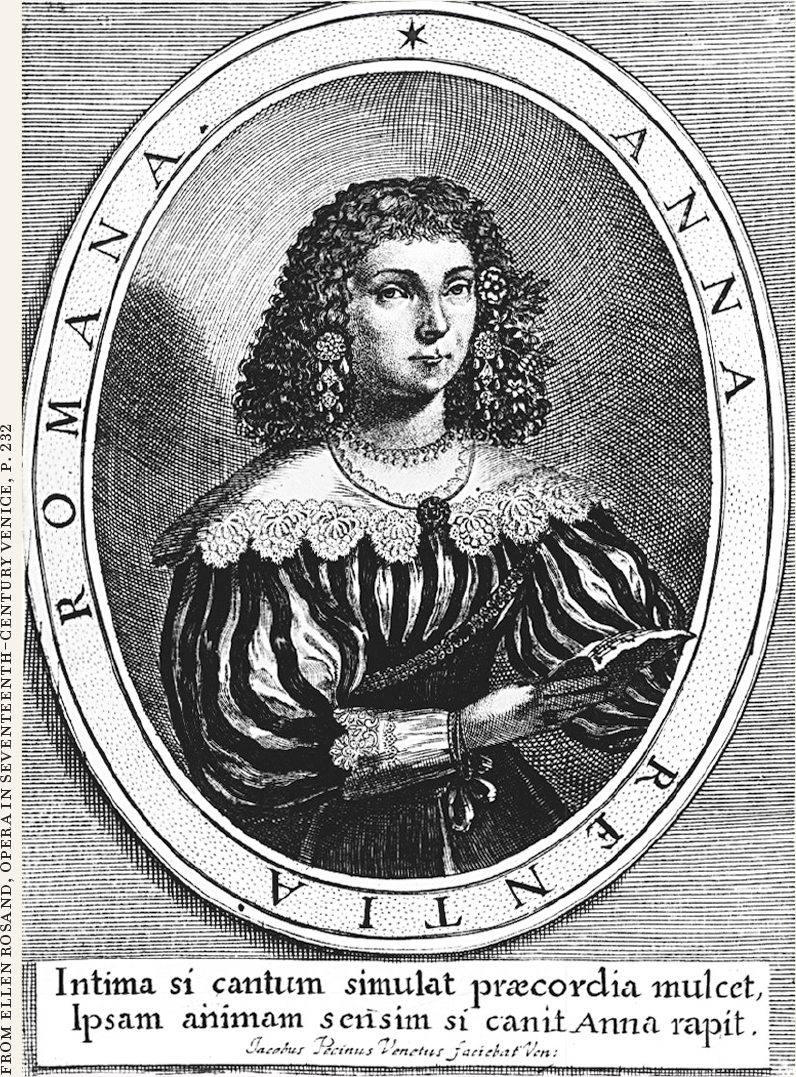
In an introductory essay, Strozzi describes Renzi’s stage presence and vocal qualities, stressing the apparently spontaneous nature of her movements and gestures: “Our Signora Anna is endowed with such lifelike expression that her responses and speeches seem not memorized but born at the very moment. In sum, she transforms herself completely into the person she represents.” He goes on to praise her diction and vocal delivery, extolling her “fluent tongue, smooth pronunciation, not affected, not rapid, a full, sonorous voice, not harsh, not hoarse.” He also remarks on her stamina and resilience, her ability to “bear the full weight of an opera no fewer than twenty-six times, repeating it virtually every evening . . . in the most perfect voice.” Finally, Strozzi approaches Renzi’s offstage attributes and portrays her as a person of “great intellect, much imagination, and a good memory . . . ; of melancholy temperament by nature [she] is a woman of few words, but those are appropriate, sensible, and worthy.” Although she did not have what might be called a “classic beauty,” Renzi’s qualities essentially set the standard for the prima donna (Italian for “first lady,” the lead soprano in an opera).
Divas became larger-than-life heroines with lucrative international careers. Following her memorable Venetian years, Renzi performed roles in other Italian cities and in Innsbruck, where Queen Christina of Sweden, who was then visiting the Austrian court, acknowledged her stunning skills by making her a present of her own medal and chain. Other prima donnas (and leading male singers) enjoyed similarly close relationships with patrons, composers, librettists, and impresarios in whose homes they sometimes lived when they were on the road. Not surprisingly, they frequently exploited these ties by exerting their influence on such matters as the selection of a plot, the number and length of arias written for their parts, and the casting of supporting roles. Occasionally a singer even refused to participate in a production unless a particular composer was commissioned to write the music.
Singer power and singer worship, then, ultimately played a big part in the direction that opera took in the seventeenth century. But the story does not end there. After taking hold of the Venetian imagination, the glamorous world of opera and its stars went on to captivate all of Europe and eventually the Americas. Even today, the powerful personalities of divas and their equivalents outside of opera—rock stars and film icons—are the driving force behind much of the entertainment industry.
*Quotations from Giulio Strozzi are taken from Ellen Rosand, Opera in Seventeenth-Century Venice: The Creation of a Genre (University of California Press, 1991), 228–35.
Francesco Cavalli The leading composer of opera in Venice was Francesco Cavalli (1602–1676), who was probably Monteverdi’s student and certainly his colleague at St. Mark’s, beginning as a singer in 1616, then serving as organist from 1639 and as maestro di cappella from 1668 until his death. From 1639 to 1673, Cavalli composed almost thirty operas for Venice plus others for Naples, Milan, Florence, and Paris. He was the most successful and best-paid opera composer of the time, but he also looms large in opera history because he preserved his own scores for posterity.
Operatic conventions In ten operas from 1642–52, Cavalli and librettist Giovanni Faustini established the essential structural, poetic, and musical conventions of Venetian opera. Whether based on history, epic, or myth or on newly created characters, the plots center on two pairs of noble lovers, who are united at the end after conflicts, intrigues, and misunderstandings keep them apart. One pair, called prima donna (first lady) and primo uomo (first man), typically outrank the other, have larger roles, and were often cast with the most popular singers (whose regal behavior led to the modern meaning of prima donna). The female nobles are sopranos, and the males are castrati. They are joined by advisors, often including a bass who lends a sense of gravity, and by servants in comic roles, usually played by male singers for both male and female parts.
Recitatives are in versi sciolti, free verse in seven- or eleven-syllable lines, and aria texts in regular meter and rhyme. The characters convey the drama through soliloquies and conversations, narrating any events that we do not witness directly. Both recitative and aria are part of the story, as each action by a character produces an affection or emotion in another, prompting action in response, in accord with the Aristotelian notion of the affections that prevailed at the time (see Chapter 13). Cavalli’s music captures the actions and passions of each character with empathy and insight, using speechlike inflection and syllabic declamation to convey the words and the feelings behind them. The recitatives reflect the drama through changes of pacing, style, and harmonic treatment, and the arias, mostly in triple meter, unfold in graceful, melodious, smoothly flowing phrases supported by simple harmonies. Following these conventions let librettists and composers create operas quickly while allowing infinite variation in details and a wide range of plots. The combination of predictability and freshness gave their operas broad appeal.
Artemisia After Faustini’s death in 1651, Cavalli worked most often with librettist Nicolò Minato. Their second collaboration, Artemisia (1657), exemplifies midcentury Venetian opera. Artemisia, ruler of Caria, is a historical figure, whose elaborate tomb for her husband Mausolus gave us the word mausoleum. Everything else in the opera is invented. Artemisia is secretly in love with a commoner, who is actually a visiting prince, Meraspe, in disguise. She has vowed to put to death the man who killed her husband; since Meraspe did so accidentally in a tournament, he cannot reveal his identity or his love for her. Their inability to be honest with each other produces a series of misunderstandings that drive the plot.
EXAMPLE 14.4 Francesco Cavalli, Artemisia, Act I, Scene 3, opening aria
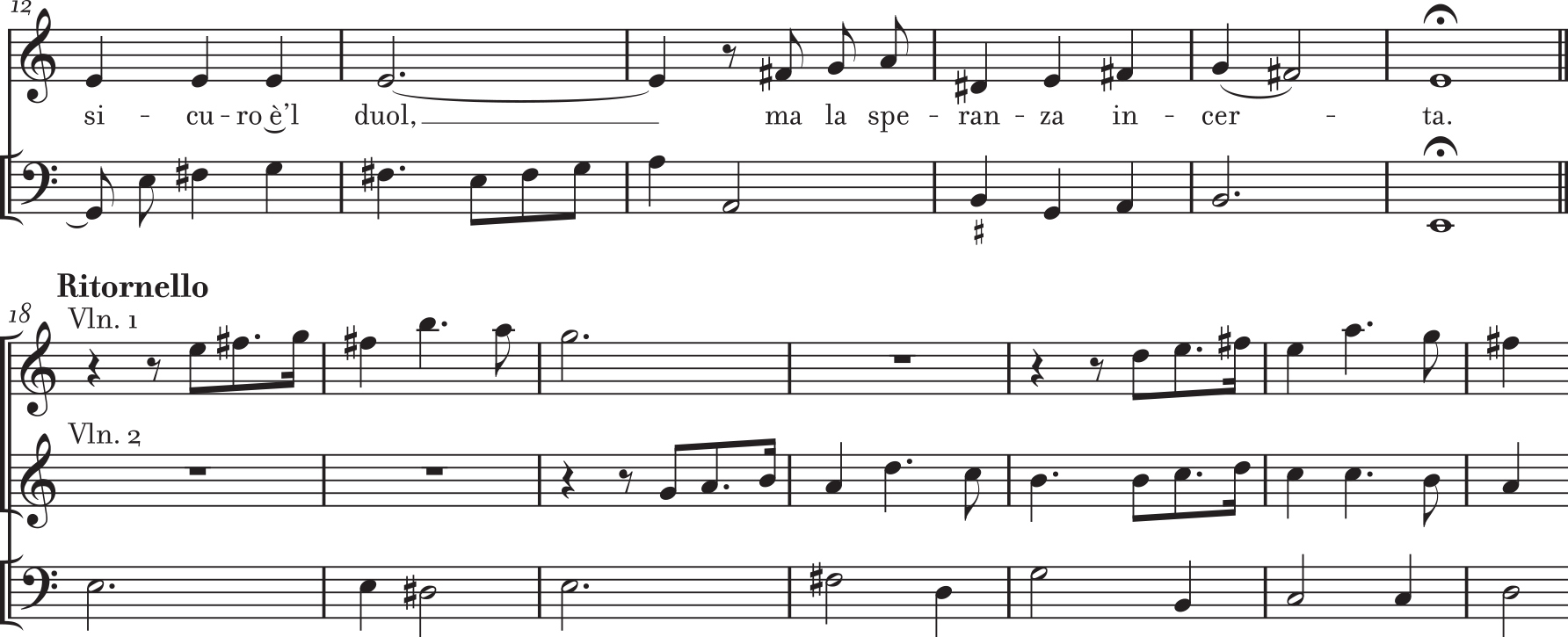
In Act I, Scene 3 (NAWM 76), Meraspe muses on his feelings in a lyrical strophic aria with a refrain (“certain is the pain, but hope is doubtful”) and a ritornello for two solo violins and continuo (NAWM 76a). Example 14.4 shows the last phrase of the aria and the beginning of the ritornello. Cavalli subtly depicts the emotions and images of the text, capturing pained certainty with a repeated note, the uplift of hope with a stepwise rising motive stated twice in succession (anticipated in the continuo in the previous two measures), and doubt with the descending tritone that links the two motives. The ritornello is a conventional part of the form, but it also provides a pause for reflection and a further glimmer of hope with its rising figure, echoed and repeated by the two violins.
NAWM 76a Francesco Cavalli, Artemisia, Act I, Scene 3: Aria: Dubbia m’appar la luce
Then the opera’s second pair enter: Ramiro and Artemia, nobles from Meraspe’s homeland. In recitative dialogue sometimes heightened with arioso (NAWM 76b), their conversation reveals that Ramiro loves Artemia, who is not interested, and she in turn loves Meraspe, who advises her to return Ramiro’s love. After Meraspe leaves, Ramiro pleads for pity and Artemia refuses, conversing through a duet in aria style framed by a ritornello (NAWM 76c).
NAWM 76b Francesco Cavalli: Artemisia: Act I, Scene 3: Dialogue in recitative: Vuo’ legger l’epitafio
NAWM 76c Francesco Cavalli: Artemisia: Act I, Scene 3: Duet: Pietà di mie pene
Throughout the scene, Cavalli follows the conventions he helped to establish, while neatly capturing in melody each personality and emotion, all in his typically direct and lyrical style. The continuo and ritornellos sometimes comment on the actions and feelings of the characters, inserting a narrator’s authorial voice, as in the continuo’s anticipation of the figure associated with hope in Example 14.4, and in a later passage its use of a lament bass (see Chapter 15) to suggest the characters’ deep pain.
ITALIAN OPERA ABROAD
The conventions that made Venetian operas a success at home also made those operas, and the genre itself, successful exports throughout Italy and Europe. From Venice, touring companies took opera to Bologna, Naples, Lucca, Genoa, and other Italian cities. In the 1650s, permanent opera houses were established in Naples and Florence, and others soon followed.
Meanwhile, Italian opera began to reach other lands. Italian operas were staged in Paris in the 1640s, culminating in a commission to Roman composer Luigi Rossi (1597–1653) for a new version of Orfeo (1647). Cavalli wrote Ercole amante for Paris (staged in 1662), and a copy of a Cavalli opera reached England, though no performance is known. Austria became a center of Italian opera. In Innsbruck, the archduke of Tyrol had a Venetian-style opera house built in 1654, and Antonio Cesti (1623–1669) wrote four operas for that theater, including Orontea (1656), which became one of the most frequently performed operas of the century. The French turned to their own style of opera in the 1670s (although it was devised by an Italian immigrant; see Chapter 16), but Italian opera reigned in German-speaking lands through the early nineteenth century.
- impresario
During the Baroque period, a businessman who managed and oversaw the production of operas; today, someone who books and stages operas and other musical events.
- diva
A leading and successful female opera singer. See also prima donna.
- prima donna
(Italian, “first lady”) A soprano (1) singing the leading female role in an opera. See also diva.