A.3 Haloalkanes and Nitroalkanes: Roots, Prefixes, and Locator Numbers
To specify a particular substituent in an IUPAC name, you must be able to recognize the substituent in the molecule’s structure and you must know the corresponding name for the substituent.
● The halo substituents, –F, –Cl, –Br, and –I, are called fluoro, chloro, bromo, and iodo, respectively.
● The nitro substituent is –NO2.
With this information, we can name a substituted straight-chain alkane that has a single halo or nitro substituent, so-called haloalkanes and nitroalkanes, according to the following rules.
Naming a Straight-Chain Alkane with One Substituent
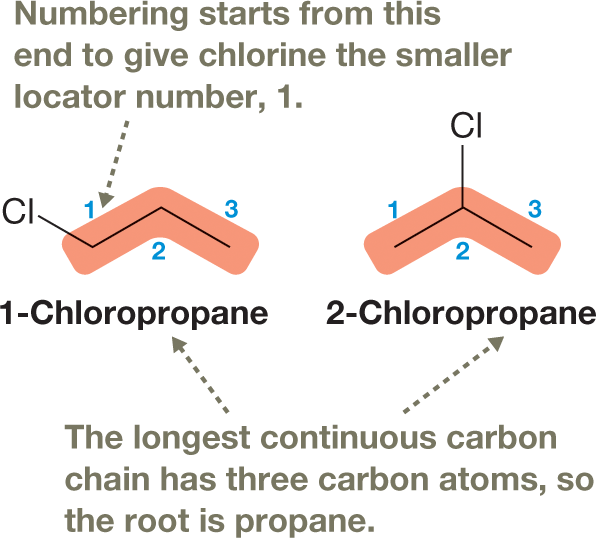
1. Identify the main chain or parent chain as the longest continuous chain of carbon atoms. The name of the corresponding alkane from Table A-1 will be the root of the molecule’s name.
2. Identify the substituent and add the name of the substituent as a prefix to the left of the root.
3. Number each carbon atom of the chain sequentially, beginning with C1 at one end of the chain, so that the carbon atom to which the substituent is bonded receives the lowest possible number. The number assigned to the carbon that is bonded to the substituent is called the locator number or locant.
4. Write the locator number to the left of the substituent name and add a hyphen to separate the locator number from the rest of the name.
Examples of how to apply these rules are shown in Figure A-3 for 1-chloropropane and 2-chloropropane.
Solved Problem A.3
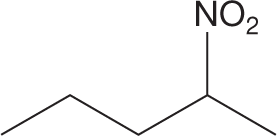
What is the IUPAC name of this molecule?
|
Think |
SHOW SECTION
|
How many carbon atoms does the longest continuous carbon chain have? What is the corresponding root? What are the two choices for assigning C1? Which of those choices would give the NO2 group the lower locator number? How do you add the locator number and the name of the substituent to the IUPAC name?
|
Solve |
SHOW SECTION
|
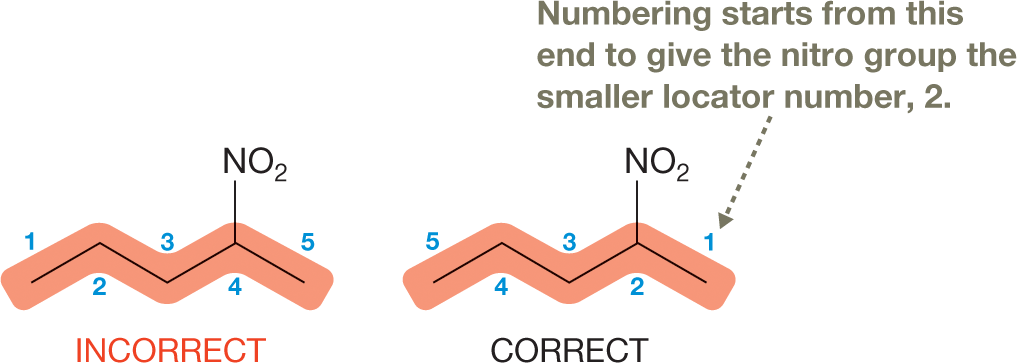
The longest continuous carbon chain has five carbon atoms, as highlighted at the right, so the root is pentane. C1 must be one of the carbon atoms at the end of the chain, so there are two possible numbering systems. In the first numbering system, the locator number for the NO2 group is 4, whereas in the second numbering system it is 2. Therefore, the second choice is correct. Finally, we add the locator number, a hyphen, and the substituent name as a prefix, so the complete IUPAC name is 2-nitropentane.
problem A.4 Write the IUPAC name for each of the following molecules.

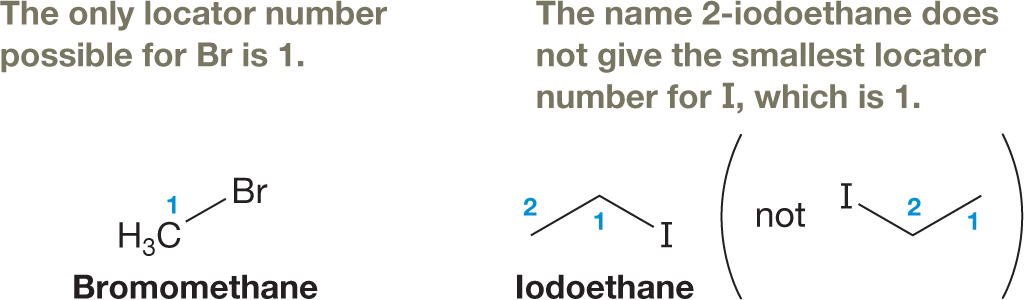
Sometimes there will be only one locator number possible for a particular substituent, regardless of which end of the chain is assigned C1.
When there is only one number locator possible for a substituent, the number locator is not added to the IUPAC name.
This is the case for bromomethane and iodoethane, shown below. Bromomethane has just a single carbon, so the Br substituent must be attached to C1. Iodoethane has two carbon atoms, so you might think that the I substituent could be bonded to C1 or C2, yielding 1-iodoethane and 2-iodoethane as possible IUPAC names.
Connections Bromomethane was used as a pesticide until being phased out in the early 2000s because it is believed to deplete Earth’s ozone layer.
The name 2-iodoethane, however, violates Rule 3 (p. 55) because the choice for assigning C1 does not give the lowest possible number to the carbon atom that is attached to the substituent.
If there are two or more substituents in the molecule, then there are additional considerations, not only to determine the numbering system for the main chain, but also to add prefixes for the substituents.
Establishing the Numbering System for a Main Chain That Has Two or More Substituents
● Choose C1 so that the substituent that is encountered first has the lowest locator number.
● If each choice for C1 results in a tie for the locator number of the first substituent, then C1 is chosen so that the second substituent encountered has the lowest locator number.
● If there is still a tie, keep looking to break the tie by giving the lowest possible locator number to the next substituent encountered.
● If a tie cannot be broken in this way, repeat these steps so that the lowest locator number is assigned to the substituent whose name is alphabetically first.
The examples below show the proper numbering system for molecules containing multiple generic substituents, G.
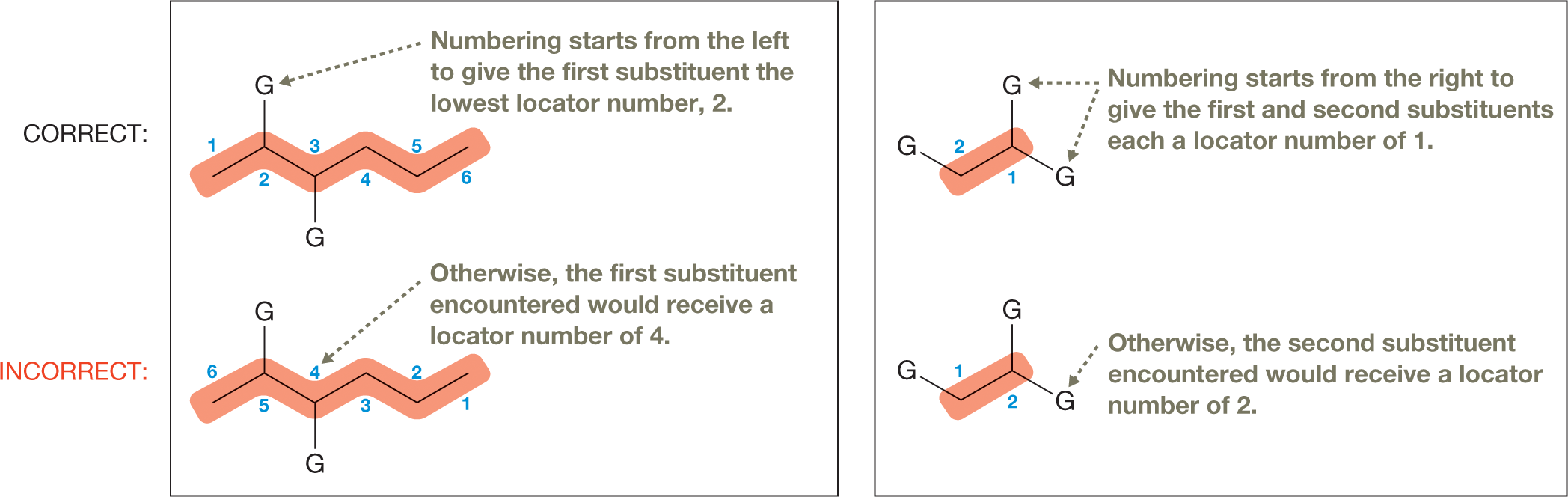
Adding Prefixes When the Main Chain Has Two or More Substituents
● The names of all substituents appear as prefixes before the root, and they are ordered alphabetically according to the substituent’s name.
● When there are two or more of the same substituent, the appropriate prefix is added just before the name of the substituent:
|
Number of Substituents |
2 |
3 |
4 |
5 |
6 |
7 |
8 |
9 |
10 |
|
Prefix |
di |
tri |
tetra |
penta |
hexa |
hepta |
octa |
nona |
deca |
These multiplying prefixes are not considered part of the substituent name when alphabetizing.
● One locator number is added for each substituent.
● If there is just one of a particular substituent, the locator number appears immediately to the left of the substituent it describes.
● If there two or more of the same substituent, the locator numbers appear immediately to the left of the prefix di, tri, etc. Furthermore, the locator numbers are written in increasing numerical order, separated from each other by commas.
● Hyphens are added to separate a letter in the name from a locator number.
● No spaces should appear in these IUPAC names.
Solved Problem A.5
What is the IUPAC name of this molecule?
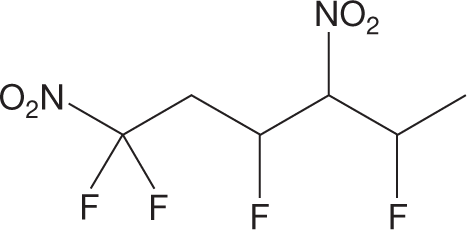
|
Think |
SHOW SECTION
|
How many carbon atoms does the longest continuous carbon chain have and what is the corresponding root? On which end of the chain should numbering begin? What are the names of the substituents and which comes first alphabetically? How do you indicate the number of each kind of substituent and what locator number is assigned to each substituent?
|
Solve |
SHOW SECTION
|
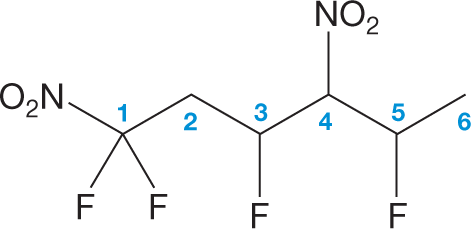
The longest continuous carbon chain has six carbon atoms, so the root is hexane. Numbering must begin on the left to give the first substituent encountered the smallest locator number, 1, as shown at the right.
There are two types of substituents, nitro and fluoro. “Fluoro” comes first alphabetically, so it appears first in the IUPAC name. The prefix tetra is added to indicate four fluoro substituents, and the locator numbers 1,1,3,5 are added to indicate their positions along the chain. The prefix di is added to indicate two nitro substituents, and the corresponding locator numbers are 1,4. The IUPAC name, therefore, is 1,1,3,5-tetrafluoro-1,4-dinitrohexane.
problem A.6 Write the IUPAC name for each of the following molecules.
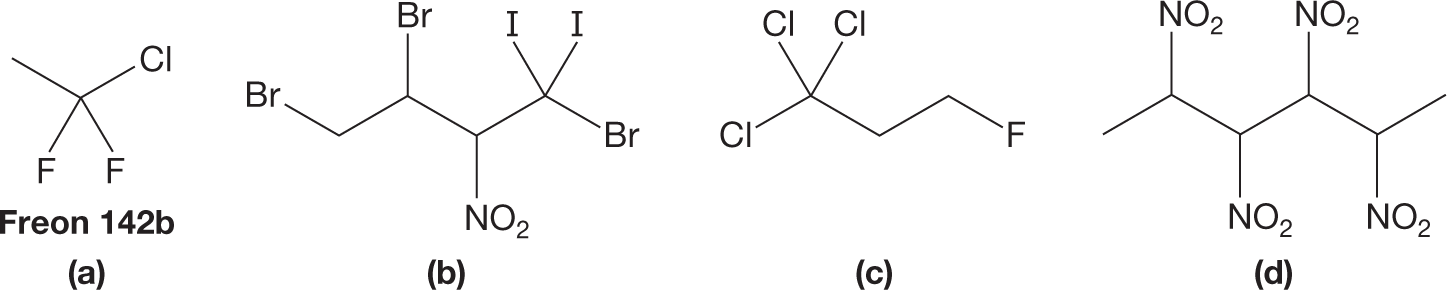
Connections Freon 142b is primarily used as a refrigerant.
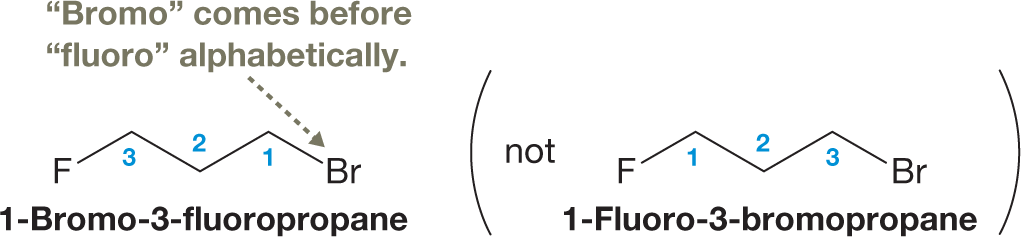
As an example where the alphabetical order of the substituent names establishes which end of the carbon chain is C1, consider 1-bromo-3-fluoropropane. Numbering from either end of the chain would result in locator numbers of 1 and 3, but “bromo” comes before “fluoro” alphabetically, so the Br substituent receives the lower locator number.
- Haloalkane
an alkane with a halo substituent (—F, —Cl, —Br, or —I).
- Nitroalkane
an alkane with a nitro substituent (—NO2).
- Main chain
in a relatively small organic molecule, the longest continuous chain of carbon atoms that establishes the root of the IUPAC name. In a polymer, the chain of atoms forming a repeating pattern that runs from one end of the molecule to the other.
- Parent chain
See main chain.
- Root
(also called parent compound) the name of the alkane containing the same number of carbon atoms as the main chain for nomenclature.
- Locator number
(also called locant) index to identify sequential carbons in a main chain or ring.
- Locant
(also called the locator number) index to identify sequential carbons in a main chain or ring.