7.9 Keto–Enol Tautomerization: An Example of Bond Energies as the Major Driving Force

In aqueous basic or acidic conditions, ketones and aldehydes exist in rapid equilibrium with a rearranged form, called an enol:
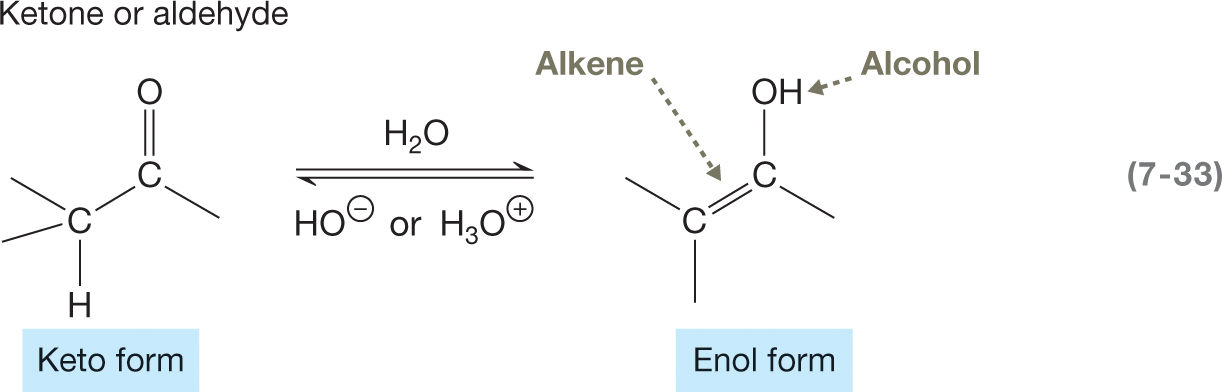
A chemical reaction represents the transformation of keto-form into enol-form under suitable conditions. It shows a condensed structural formula of a compound in ketone or aldehyde form as two carbon atoms linked by a single bond, with the carbon atom on the left carrying two vacant single bonds and a hydrogen atom linked to it by a single bond. The carbon atom on the right is linked to an oxygen atom by a double bond and has a vacant single bond, labeled keto form. It is followed by a reversible arrow denoting a water molecule; a negatively charged hydroxyl group or a negatively charged hydronium group to show enol form represented as carbon double bond carbon, labeled as alkene, with the left carbon atom carrying two vacant single bonds and the right carbon atom carrying an alcoholic group and a vacant single bond.

As a ketone or aldehyde, the species is called the keto form. In the enol form, the species has a carbon atom that is simultaneously part of a CC bond characteristic of an alkene and is bonded to OH, characteristic of an alcohol. Because the keto and enol forms are constitutional isomers in equilibrium, they are called tautomers (Greek: tauto = same; mer = part), and the equilibrium is called keto–enol tautomerization. In later chapters, we will see that this equilibrium has important consequences in a variety of chemical reactions.

In the equilibrium in Equation 7-33, one of the main differences between the keto and enol forms is the location of a hydrogen atom. In the keto form, there is a hydrogen atom on the carbon atom that is adjacent to the CO group, the so-called 𝛂 (alpha) carbon, whereas in the enol form, the hydrogen appears on the oxygen atom instead. Realizing that a proton transfer step serves to add or remove a proton from a particular species, we can account for this transformation with a mechanism consisting of back-to-back proton transfer steps. Such a mechanism depends, however, on whether a strong acid or strong base is present.

Equation 7-34 is the mechanism for the reaction in Equation 7-33 under basic conditions. The strong base removes a proton from the α carbon in Step 1, producing an enolate anion, which has a resonance-delocalized negative charge. In the resonance structure on the right, the O atom is electron-rich and, in Step 2 of the mechanism, picks up a proton from water, which acts as the acid.
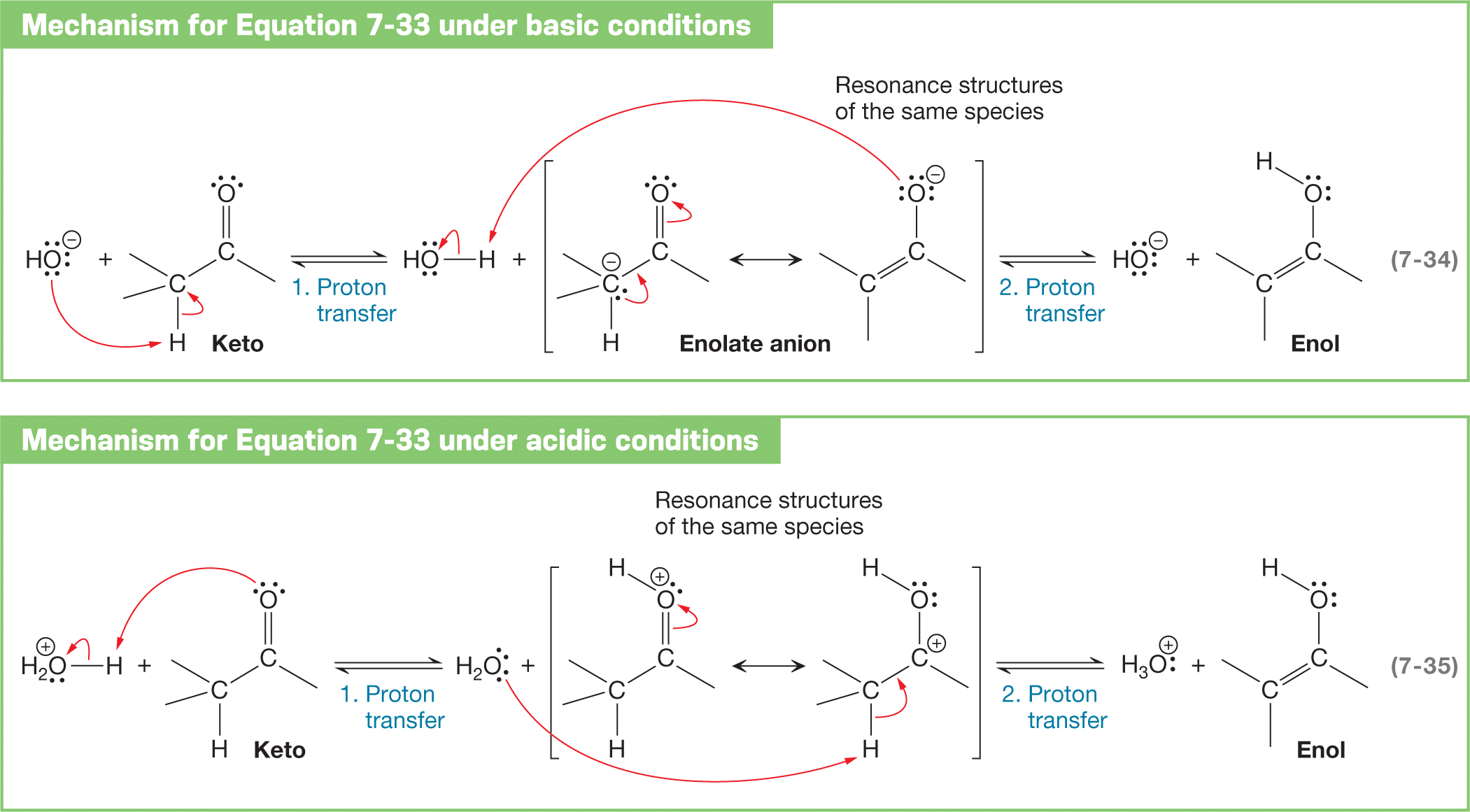
A text box labeled mechanism for equation 7-33 under basic conditions shows a chemical reaction representing keto-enol tautomerization. The reaction shows an oxygen atom of a hydroxyl group carrying three lone pairs of electrons and a negative charge reacting with keto form in which the oxygen atom of the carbonyl group is shown to carry two lone pairs of electrons. A curved arrow is drawn from an oxygen atom of the hydroxyl group with the head pointing toward hydrogen atom of the keto-form. Another curved arrow is drawn from the single bond between a carbon atom and a hydrogen atom with the head pointing toward the carbon atom linked to it. It is followed by a reversible arrow, marked step 1 and labeled proton transfer, to show an addition of a hydrogen atom to the oxygen of the hydroxyl group carrying two lone pairs of electrons. It also shows a unit compound showing two forms of an enolate anion as a carbon atom linked to hydrogen carrying a lone pair of electrons with a negative charge in the keto form. A curved arrow points from the carbon atom linked to hydrogen toward a single bond between two carbon atoms while another curved arrow points from a double bond in the carbonyl group toward the oxygen atom of the carbonyl group. The compound is reversible into another form in which the single bond between two carbon atoms is replaced by a double bond while the oxygen atom of the carbonyl group is shown to carry three lone pairs of electrons and a negative charge. A curved arrow is shown to point from a single bond between a hydroxyl group and hydrogen toward the oxygen atom of the hydroxyl group while another curved arrow points from the carbonyl group carrying three lone pairs of electrons toward hydrogen atom linked to a hydroxyl group. The two forms of enolate anions are labeled resonance structures of the same species. It is further followed by a reversible arrow marked step 2 and labeled proton transfer to show an oxygen atom of a hydroxyl group carrying three lone pairs of electrons and a negative charge and release of enol form of the compound. | A text box labeled mechanism for equation 7-33 under acidic conditions shows a chemical reaction representing keto-enol tautomerization. The reaction shows an oxygen atom of a water molecule carrying a lone pair of electrons and a negative charge linked to another hydrogen atom by a single bond. It is shown to react with keto form in which the oxygen atom of the carbonyl group is shown to carry two lone pairs of electrons. A curved arrow points from an oxygen atom of the carbonyl group in the keto form toward hydrogen atom linked to the water molecule while another curved arrow points from a single bond between the water molecule and hydrogen toward the oxygen atom of the water molecule. It is followed by a reversible arrow, marked step 1 and labeled proton transfer to show the oxygen atom of the water molecule carrying two lone pairs of electrons. It also shows a unit compound with two forms of an enolate anion as a hydrogen atom linked to the oxygen atom of the carbonyl group carrying a lone pair of electrons and negative charge in the keto form. A curved arrow points from the double bond of the carbonyl group toward the oxygen atom of the carbonyl group. The compound is reversible into another form in which the double bond of the carbonyl group is replaced by a single bond, with the carbon atom linked to it carrying a positive charge while the oxygen atom carries two lone pairs of electrons. A curved arrow is shown to point from the oxygen atom of the water molecule toward the hydrogen atom of the second species while another curved arrow points from a single bond between carbon and hydrogen toward a single bond between two carbon atoms in the second species. The two forms of enolate anions are labeled resonance structures of the same species. It is further followed by a reversible arrow marked step 2 and labeled proton transfer to show the oxygen atom of hydronium ion carrying a lone pair of electrons and a positive charge and the release of enol form of the compound.

The mechanism for the reaction under acidic conditions is shown in Equation 7-35. The strong acid that is present donates a proton to the O atom of the CO group in Step 1. In Step 2, water (a weak base) removes the proton from the α carbon to produce the uncharged enol product.

Because it is an equilibrium, the tautomerization reaction in Equation 7-33 takes place in the reverse direction, too. Equations 7-36 and 7-37 are the mechanisms showing how the enol form produces the keto form under basic and acidic conditions, respectively. Notice how the steps in Equations 7-36 and 7-37 are the same as in Equations 7-34 and 7-35, respectively, but in reverse order.
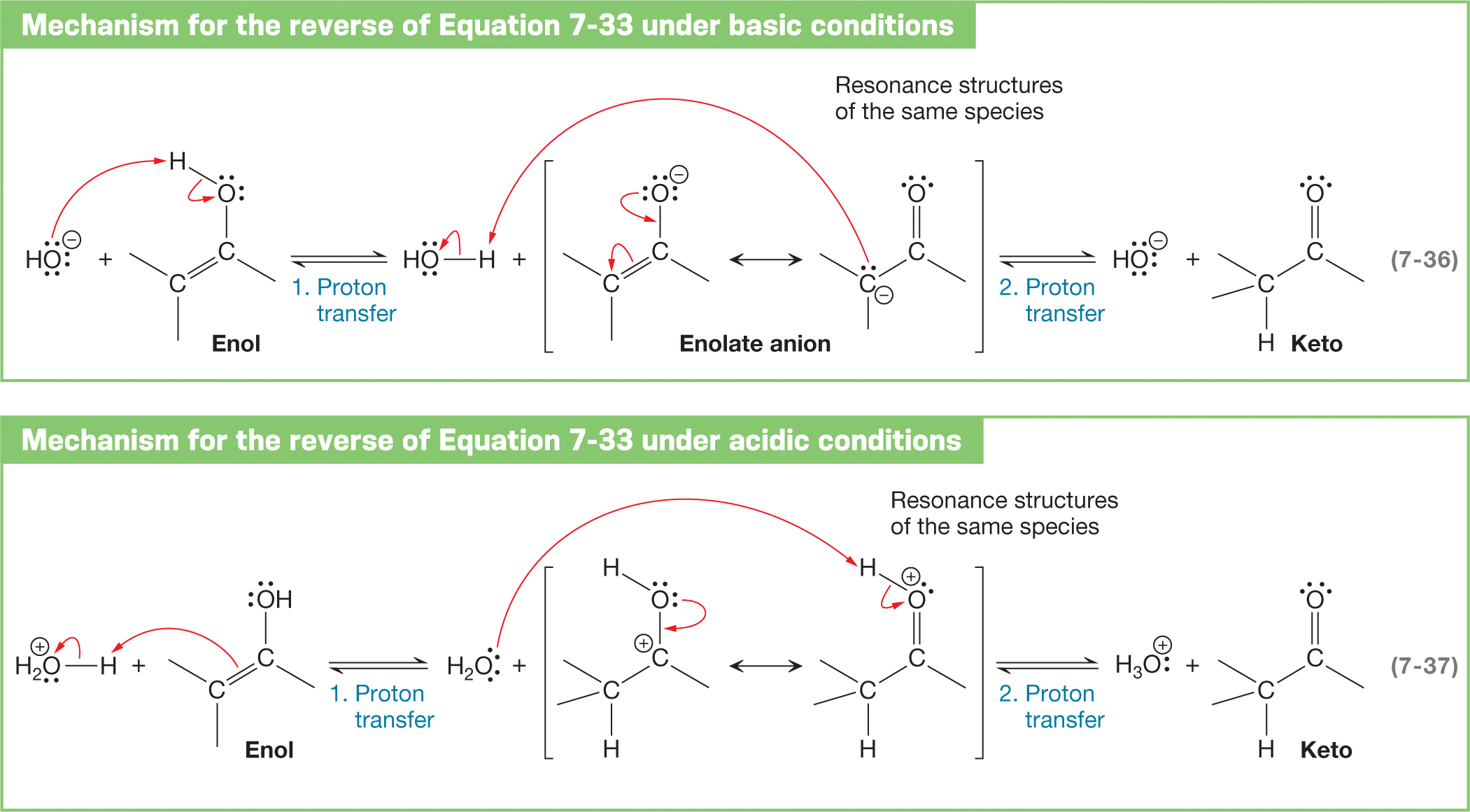
A text box labeled mechanism for the reverse of equation 7-33 under basic conditions shows a chemical reaction representing keto-enol tautomerization. The reaction shows the oxygen atom of hydroxyl group carrying three lone pairs of electrons and a negative charge reacting with enol form in which the oxygen atom of the carbonyl group is shown to carry two lone pairs of electrons. A curved arrow points from an oxygen atom of the hydroxyl group toward hydrogen atom of the enol-form while another curved arrow points from a hydrogen atom linked to an oxygen atom toward oxygen atom carrying two lone pairs of electrons. It is followed by a reversible arrow, marked step 1 and labeled proton transfer to show an addition of a hydrogen atom to the oxygen of the hydroxyl group carrying two lone pairs of electrons. It also shows a unit compound showing two forms of an enolate anion as oxygen atom carrying three lone pairs of electrons and a negative charge in the enol form. A curved arrow points from a double bond between a single bond between two carbon atoms toward carbon atom having two vacant single bonds while another curved arrow points from an oxygen atom toward a single bond between a carbon and an oxygen atom. The compound is reversible into another form in which the double bond between two carbon atoms is replaced by a single bond, with one of the carbon atoms carrying a lone pair of electrons and negative charge while the oxygen atom of the carbonyl group is shown to carry two lone pairs of electrons, with the single bond between carbon and oxygen replaced by a double bond. A curved arrow is shown to point from a single bond between the hydroxyl group and hydrogen toward the oxygen atom of the hydroxyl group while another curved arrow points from a double bond between two carbon atoms toward the carbon atom carrying vacant bonds. A third curved arrow points from an oxygen atom carrying three lone pairs of electrons in the first species toward the single bond linking it to the central carbon atom. A fourth curved arrow points from the negatively charged carbon atom of the second species toward hydrogen atom linked to the oxygen of the hydroxyl group. The two forms of enolate anion are labeled resonance structures of the same species. It is further followed by a reversible arrow marked step 2 and labeled proton transfer, to show the oxygen atom of a hydroxyl group carrying three lone pairs of electrons and a negative charge and a release of keto form of the compound. | A text box labeled mechanism for the reverse of equation 7-33 under acidic conditions shows a chemical reaction representing keto-enol tautomerization. The reaction shows an oxygen atom of a water molecule carrying a lone pair of electrons and a negative charge linked to another hydrogen atom by a single bond. It is shown to react with enol form in which the oxygen atom of the hydroxyl group is shown to carry two lone pairs of electrons. A curved arrow points from the double bond between a carbon atoms toward hydrogen atom linked to the water molecule while another curved arrow points from the single bond between water molecule and hydrogen toward the oxygen atom of the water molecule. It is followed by a reversible arrow, marked step 1 and labeled proton transfer to show the oxygen atom of the water molecule carrying two lone pairs of electrons. It also shows a unit compound with two forms of an enolate anion, shown as a hydrogen atom linked to the oxygen atom of the carbonyl group carrying two lone pairs of electrons in the enol form while the carbon atom linked to the oxygen is marked positive. A curved arrow points from the oxygen atom toward a single bond between carbon and oxygen. The compound is reversible into another form in which the single bond between carbon and oxygen is replaced by a double bond, with the oxygen atom linked to it carrying a lone pair of electrons and a positive charge. A curved arrow is shown to point from the oxygen atom of the water molecule toward a hydrogen atom of the second species while another curved arrow points from the oxygen atom of first species toward the single bond linking it to the carbon atom. A third curved arrow points from the single bond between hydrogen and positively charged oxygen toward an oxygen atom. The two forms of enolate anions are labeled resonance structures of the same species. It is further followed by a reversible arrow marked step 2 and labeled proton transfer, to show oxygen atom of hydronium ion carrying a lone pair of electrons and a positive charge and the release of keto form of the compound.

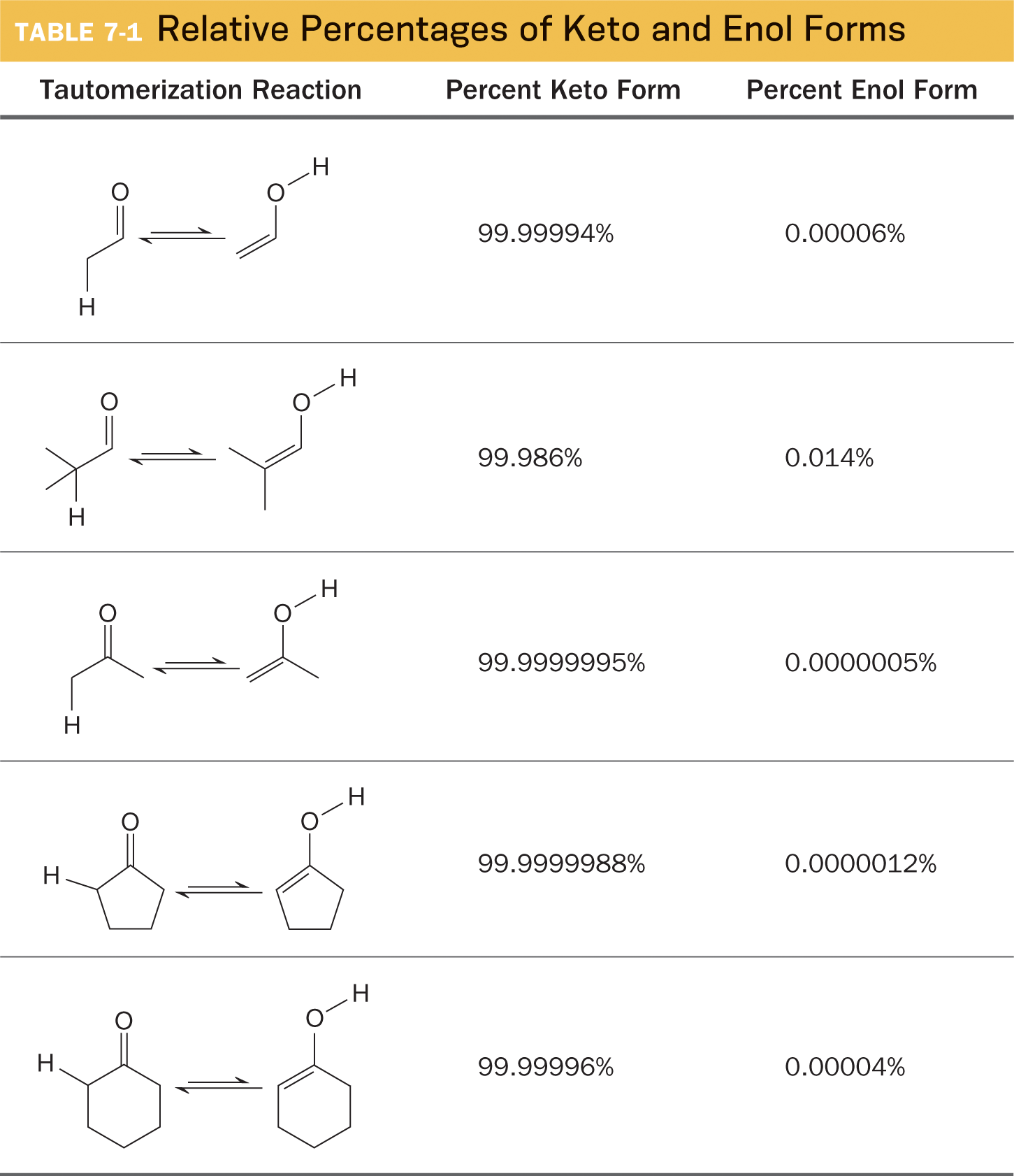
For most enolate anions, the tautomerization equilibrium (Equation 7-33, p. 350) heavily favors the keto form over the enol form.

This is shown in Table 7-1 for some specific examples. The enol form is present only in trace amounts for these compounds, suggesting that the keto form is significantly more stable. In other words, the driving force for these reactions favors the keto form.
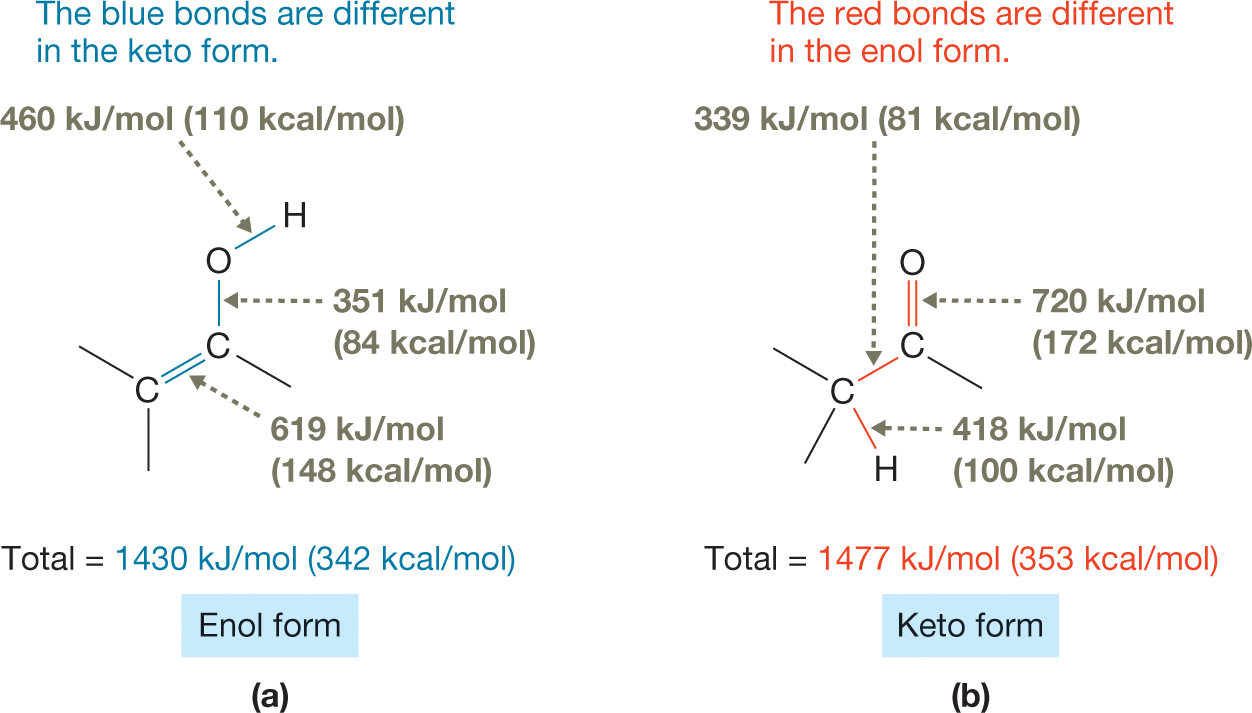
Two illustrations compare the relative stability and bond energy of keto and enol forms. The first condensed structural formula shows the enol form of a compound in which the double bond between a carbon atoms, carbon-oxygen bond and oxygen-hydrogen bond are highlighted in blue and labeled, the blue bonds are different in the keto form. The bond energies of different bonds are as follows. Carbon double bond carbon, 619 kiloJoule per mole or 148 kilocalories per mol; carbon single bond carbon, 351 kiloJoule per mole or 84 kilocalories per mole; and oxygen single bond hydrogen, 460 kiloJoule per mole or 110 kilocalories per mole. The total energy of enol form is 1430 kiloJoule per mole or 342 kilocalories per mole. The second condensed structural formula shows the keto form of a compound in which the double bond of the carbonyl group, carbon-carbon bond, and carbon-hydrogen bond are highlighted in red and labeled, the red bonds are different in the enol form. The bond energies of different bonds are as follows, Carbon double bond oxygen, 720 kiloJoule per mole or 172 kilocalories per mol; carbon single bond carbon, 339 kiloJoule per mole or 81 kilocalories per mole; carbon single bond hydrogen, 418 kiloJoule per mole or 100 kilocalories per mole. The total energy of enol form is 1447 kiloJoule per mole or 353 kilocalories per mole. The caption reads, �Relative stabilities of enol and keto forms (a) Energies of the bonds that appear in the enol form but not in the keto form. The sum of the energies is 1430 kiloJoule per mole (342 kilocalories per mole). (b) Energies of the bonds that appear in the keto form but not in the enol form. The sum of the energies is 1477 kiloJoule per mole (353 kilocalorie per mole). Because of its greater total bond energy, the keto form is more stable than the enol form.�

A table shows relative percentages of keto and enol forms for four different types of tautomerization reactions. The table is divided into three columns, labeled from left to right as, tautomerization reaction, percent of keto form, and percent of enol form. Data are included in the accompanying table.
FIGURE 7-4 Relative stabilities of enol and keto forms (a) Energies of the bonds that appear in the enol form but not in the keto form. The sum of the energies is 1430 kJ/mol (342 kcal/mol). (b) Energies of the bonds that appear in the keto form but not in the enol form. The sum of the energies is 1477 kJ/mol (353 kcal/mol). Because of its greater total bond energy, the keto form is more stable than the enol form.

YOUR TURN 7.15

SHOW ANSWERS

In Figure 7-4, there is a similar bond in red in the keto form for each bond in blue in the enol form. Therefore, we can pair these bonds as follows:
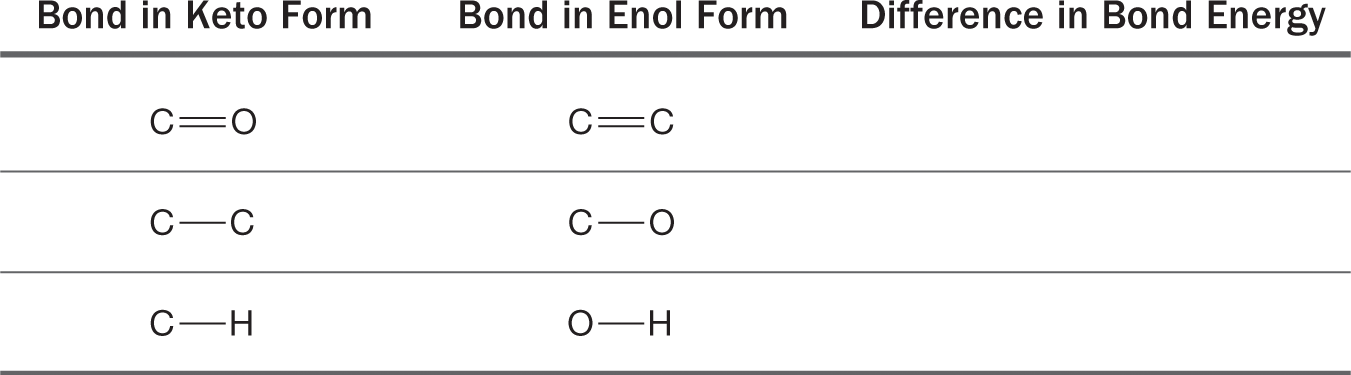
A table represents different bonds in keto and enol form to state their difference in bond energies. The table is divided into three columns and labeled from left to right as, bond in keto form, bond in enol form, and difference in bond energy. Data are included in the accompanying table.

For each pair, compute the difference in bond energy and enter it into the table. Based on these data, which bond is most responsible for the additional stability of the keto form? ________________

ΔBond energy (CO) (CC) = 720 619 kJ/mol= 101 kJ/mol;ΔBond energy (CC) (CO) = 339–351 kJ/mol =12 kJ/mol;ΔBond energy (CH) (OH)= 418 460 kJ/mol =42 kJ/mol. From this it appears that, because the difference is greatest between the CO and CC bond energies, the CO bond (being the stronger of the two) is the one that has the most influence on the outcome of the reaction.

problem 7.21 Decarboxylation (i.e., elimination of CO2) occurs when a β-ketoacid is heated under acidic conditions.

A chemical reaction represents decarboxylation of Beta-keto acid under acidic conditions. The chemical shows the condensed structural formula consisting of a benzene ring with a side chain attached to ortho-position, which shows two carbonyl groups, a CH 2 and a hydroxyl groups present on the side chain. It is shown to react with hydrogen positive ions under heat conditions to show a condensed structural formula with a benzene ring having a side chain linking it to a carbon atom by a single bond. The carbon atom is further linked to a hydroxyl group by a single bond and a CH 2 group by a double bond. It also shows a release of carbon dioxide followed by a rightward arrow to read a question mark.

The immediate product of decarboxylation is an enol, which quickly rearranges. Draw the overall product of the rearrangement.

Sugar Transformers: Tautomerization in the Body

A sugar inside a cell can be different from the one that might be needed for a particular purpose, but the body has developed an elegant way to deal with this: It can transform one sugar into another! It does so using keto–enol tautomerization reactions (Section 7.9). This is exemplified in the reaction scheme below, which is a key part of glycolysis, a metabolic pathway that breaks down simple carbohydrates for their energy.
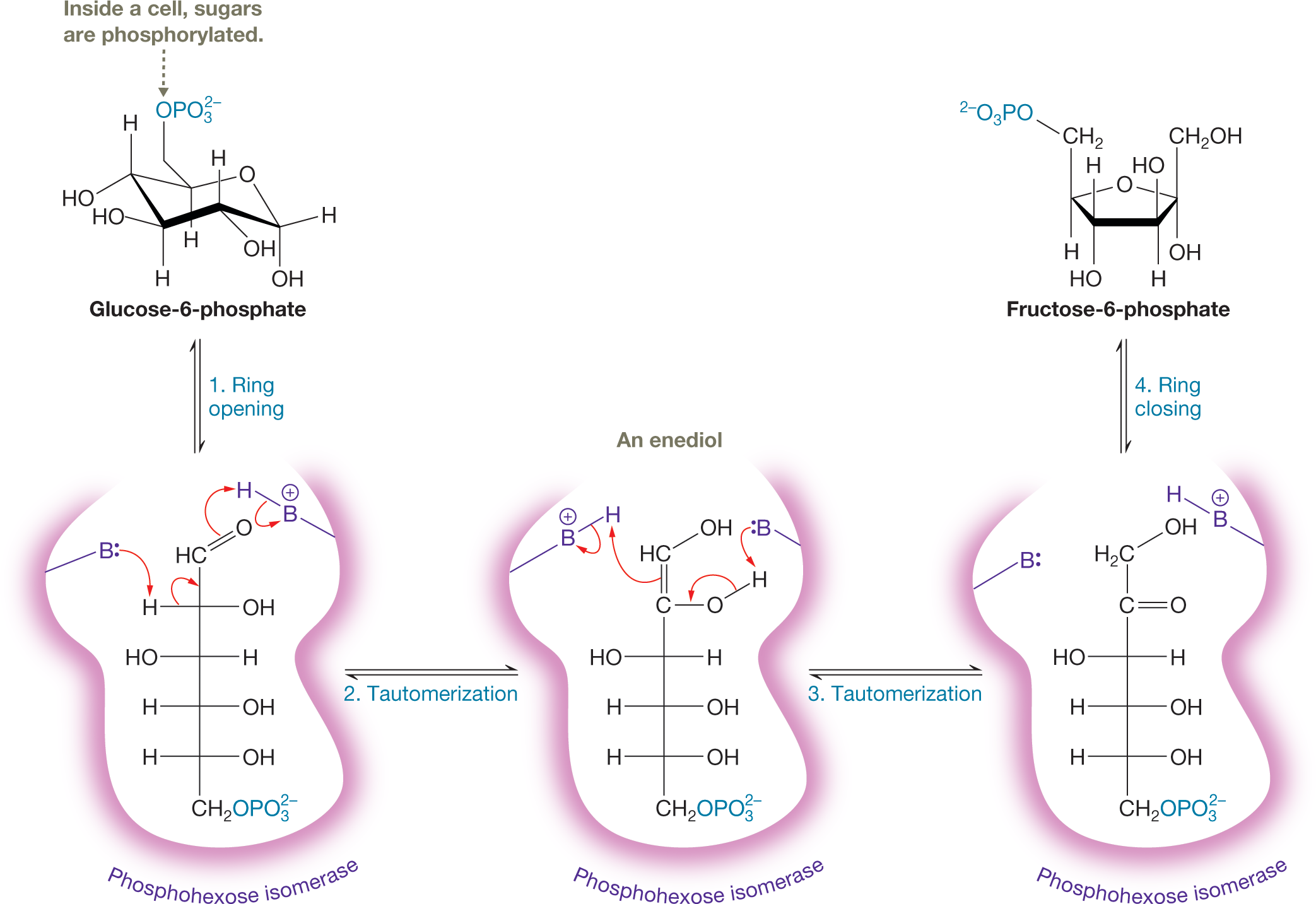
An illustration represents a four-step process to explain glycolysis. It shows a condensed structural formula of glucose-6 phosphate, with its phosphate group highlighted in blue and labeled, inside a cell, sugars are phosphorylated. It is followed by a reversible arrow labeled, 1, ring opening, to show a linear chain of six carbon atoms representing phosphohexose isomerase. The carbon atom in the first position is double bonded to an oxygen atom. The carbon atom in the third position is bonded to a hydroxyl group and a hydrogen atom by single bonds. The carbon atom in the second, fourth, and fifth positions are bonded to a hydrogen atom and a hydroxyl group each by single bonds, in reverse to the carbon atom in the third position. The carbon atom in the sixth position is bonded to two hydrogen atoms and a phosphate group. A curved arrow from B carrying a lone pair of electrons point toward hydrogen atom linked to carbon-2 while another curved arrow from carbon-2 and hydrogen bond point toward carbon-2 and carbon-1 bond. A third curved arrow from the double bond point toward an external hydrogen atom linked to a B carrying positive charge by a single bond while the fourth curved arrow from a single bond between hydrogen atom and B carrying positive charge point toward B. It is followed by a reversible arrow labeled, 2, tautomerization, to show an enediol represented as a replacement of bond between a hydroxyl group and carbon-1 toward bond between carbon-1 and 2. The carbon atom in the second position is shown to be linked to an oxygen atom, which is further linked to a hydrogen atom by a single bond each. A curved arrow from the carbon at the first position point toward another hydrogen atom linked to B carrying positive while another arrow from a single bond between the hydrogen atom and B carrying positive charge point toward B. A third arrow from the single bond between hydrogen atom and oxygen atom on carbon-2 point toward single bond between oxygen atom and carbon-2 while a fourth arrow from B carrying a lone pair of electron point toward hydrogen atom linked to an oxygen atom at carbon positioned at 2. It is further followed by a reversible arrow labeled 3, tautomerization, to show a change in the position of carbon-1 and 2. The carbon at the first position is linked to two hydrogen atoms and a hydroxyl group by a single bond. The carbon at the second position is linked to an oxygen atom by a double bond. It is further followed by a reversible arrow labeled, 4, ring closing, to show a condensed structural formula of fructose-6 �phosphate, with the phosphate group highlighted in blue.

When D-glucose enters a cell, it is phosphorylated to become glucose-6-phosphate (shown above at left), in which the hydroxyl group on C6 (the bottommost carbon in the Fischer projection) has been replaced by a phosphate () group. Before it can be broken down, however, glucose-6-phosphate must be converted into fructose-6-phosphate (shown at right). This conversion involves back-to-back tautomerization reactions catalyzed by the enzyme phosphohexose isomerase (the active site is shown in purple). The enzyme supplies the basic (B:) and acidic sites (B+H) necessary for the proton transfer steps. The first tautomerization produces an enol that contains two different OH groups, so it is more precisely called an enediol. The second tautomerization converts the enediol back into a keto form, but on doing so, the CO bond is part of a different carbon atom than in the initial sugar. The result is a different phosphorylated sugar, fructose-6-phosphate.

This process of transforming one sugar into another is not limited to just six-carbon sugars. At a later stage in glycolysis, an enzyme called phosphotriose isomerase converts one three-carbon sugar into another. These kinds of processes truly are a testament to how efficient biological organisms are.