Section 1.12 Objectives
You will be able to:
- Add lone pairs to an atom when they are not shown.
- Draw a condensed formula from a Lewis structure and vice versa.
- Draw a line structure from a Lewis structure and vice versa.
Learning organic chemistry requires drawing numerous molecules. Because drawing the complete, detailed Lewis structure every time can be tedious, organic chemists have devised various shorthand notations that save time without loss of structural information. We will be using these shorthand notations throughout the rest of the book, so please take the time now to become comfortable with them.
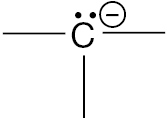
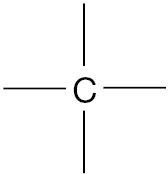
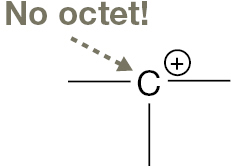
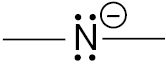
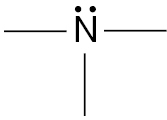
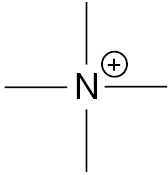
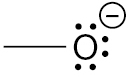
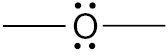
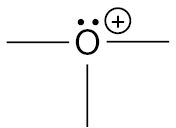
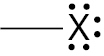
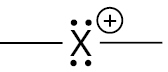
Lone pairs of electrons are frequently omitted from Lewis structures. Because lone pairs have vital roles in many organic reactions, you need to be able to put them back in as necessary. Knowing where lone pairs belong requires an understanding of how formal charge relates to the numbers of bonds and lone pairs on various atoms. Table 1-5 illustrates formal charges in various bonding arrangements. Note that the atoms have octets in all of the scenarios shown, except in the case of a positively charged carbon, C+.
|
Table 1-5 Formal Charges on Atoms with Various Bonding Scenarios |
|||
|
FORMAL CHARGE |
|||
|
Atom |
−1 |
0 |
+1 |
|
Carbon |
 |
 |
 |
|
Nitrogen |
 |
 |
 |
|
Oxygen |
 |
 |
 |
|
Halogen (X = F, Cl, Br, I) |
 |
 |
 |
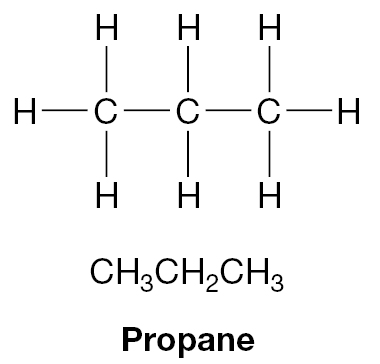
The figure shows the structural and chemical formulae of propane. The chemical formula is C H 3 C H 2 C H 3. The structural formula shows three carbon atoms linked by single bonds. The first carbon is also linked by single bonds to three hydrogen atoms. The second carbon is linked by single bonds to two hydrogen atoms.The third carbon is linked by single bonds to three hydrogen atoms.
Condensed formulas allow us to convey the structures of molecules and molecular ions without drawing bond lines. Thus, a condensed formula will appear as a sequence of common atom groupings, with each grouping written using only atom labels and subscripts. For example, CH3CH2CH3 is the condensed formula of propane (Figure 1-34), indicating that the central CH2 group is bonded to two CH3 groups.
In general, condensed formulas are written according to the following rules:
Rules for Drawing Condensed Formulas
To see how we can draw a Lewis structure from a condensed formula, consider CH3CHN–. Three hydrogens are bonded to the first carbon, and one hydrogen is bonded to the second carbon. Furthermore, the central C atom is bonded to another C atom and to a N atom, giving rise to the skeleton that appears on the left in Figure 1-35. The structure is completed by adding the electrons shown in red: a double bond between C and N and two lone pairs on N.
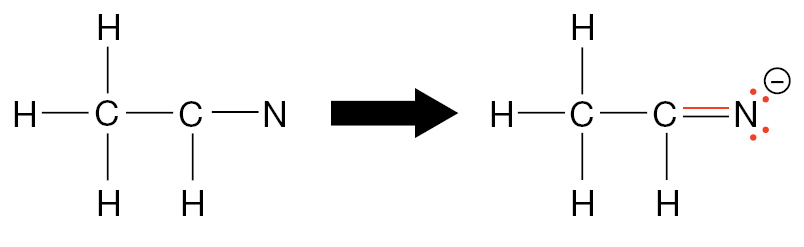
An illustration shows the conversion of a condensed structural formula of an organic compound to its Lewis structure. The condensed structural formula and the Lewis structure both show two carbon atoms bonded together by a single bond. Carbon 1 is bonded to a nitrogen atom and a hydrogen atom, and carbon 2 is bonded to three hydrogen atoms. An arrow from the first structure, which consists entirely of single bonds, leads to the second, which shows a double bond between carbon 1 and the nitrogen atom. The nitrogen atom carries a negative charge and has two lone pairs of electrons. The caption reads, Lewis structure of C H 3 C H N minus: To convert from the skeleton on the left to the Lewis structure on the right, an extra C-N bond and two lone pairs in red must be added.
SOLVED PROBLEM 1.11
How to draw a Lewis structure from a condensed formula
Break It Down Draw the Lewis structure for crotonaldehyde, CH3CHCHCHO.
|
Think |
Solve |
|
|
Which non-hydrogen atoms are bonded together? |
➤ |
The four C atoms and the O atom are connected to make a chain: C—C—C—C—O. |
|
How many H atoms are bonded to each non-hydrogen atom? |
➤ |
Each non-hydrogen atom is bonded to the hydrogen atoms that immediately follow it in the condensed formula: three hydrogens on the first carbon, and one hydrogen on each of the other carbons. 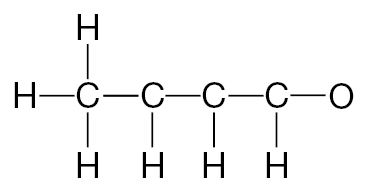
More informationAn illustration shows the condensed structural formula of crotonaldehyde. The condensed structural formula shows four carbon atoms bonded together. Carbon 1 is bonded to a hydrogen atom and an oxygen atom, carbons 2 and 3 are bonded to a hydrogen atom each, and carbon 4 is bonded to three hydrogen atoms. |
|
How can we add bonds and lone pairs to maximize the number of octets and also make sure that the total charge is zero? |
➤ |
None of the atoms bears a formal charge. Therefore, according to Table 1-5 (p. 30), each C atom should have four bonds, and the O atom should have two bonds and two lone pairs. The electrons that must be added to complete the Lewis structure are shown in red. 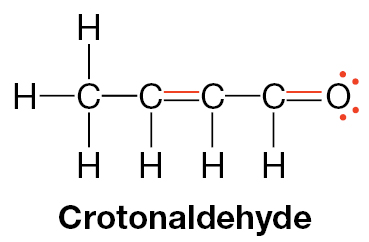
More informationAn illustration shows the Lewis structure of crotonaldehyde. The Lewis structure shows four carbon atoms bonded together. Carbon 1 is bonded to a hydrogen atom and an oxygen atom, carbons 2 and 3 are bonded to a hydrogen atom each, and carbon 4 is bonded to three hydrogen atoms. Double bonds are between carbons 2 and 3, and carbon 1 and the oxygen atom. The oxygen atom has two lone pairs of electrons. |
| Try ItDraw the Lewis structure for (a) CHCCH2CHCHCH3, (b) CH3OCH2CHCH2, and (c) NH2CH2CHNCH2CHCF2. | ||
Many organic molecules have multiple CH2 groups bonded together. In these cases, we can simplify a condensed formula by using the notation (CH2)n. Thus, CH3CH2CH2CH2CH3 simplifies to CH3(CH2)3CH3.
Parentheses are also used to clarify situations in which three or four groups are attached to the same atom. In 2-methylbutane (Figure 1-36a, next page), for example, the second C atom from the left is bonded to two CH3 groups and one CH2CH3 group. Its condensed formula is written as CH3CH(CH3)CH2CH3, indicating that the CH3 group in parentheses and the CH2 group are both bonded to the preceding CH carbon.
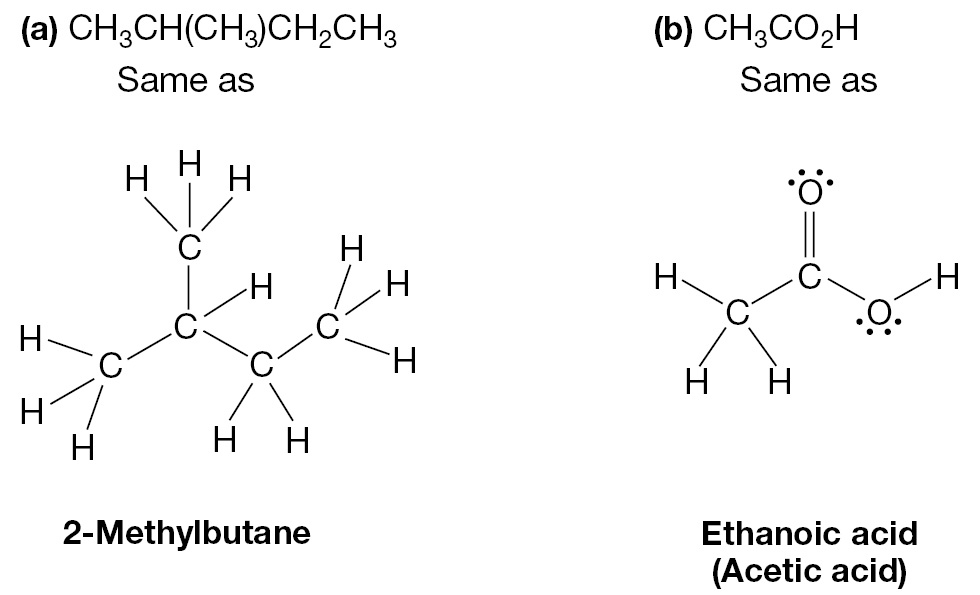
Condensed formulas and Lewis structures of 2-methylbutane and ethanoic acid. The condensed formula of 2-methylbutane is C H 3 C H open parenthesis C H 3 close parenthesis C H 2 C H 3. This is the same as the Lewis formula, which shows a chain of four carbon atoms connected by single bonds. Carbon 2 is bonded to a methyl group. The condensed formula of ethanoic acid, also known as acetic acid, is C H 3 C O 2 H. This is the same as the Lewis formula, which shows a carbon atom bonded to three hydrogen atoms and to another carbon atom in a carboxyl group. The two oxygen atoms in the carboxyl groups each have two lone pairs of electrons. The caption reads, Condensed formulas and branching: Condensed formulas are shown on the top and Lewis structures are shown on the bottom. a. Parentheses in a condensed formula denote that the group is attached to the previous C. b. The C O 2 notation represents a C atom that is doubly bonded to one O atom and singly bonded to another.
CONNECTIONS 1.11

Crotonaldehyde and its uses Crotonaldehyde (Solved Problem 1.11) is found in some foodstuffs, such as soybean oil. It is also used as a precursor in the industrial synthesis of vitamin E and sorbic acid, a food preservative.
Many common organic compounds contain a bonding arrangement in which a carbon atom is bonded to one oxygen atom by a double bond and to a second oxygen atom by a single bond. We can write this arrangement in the form CO2, as shown in Figure 1-36b for acetic acid (CH3CO2H). Another common bonding arrangement is CH═O, which is often abbreviated as CHO, as shown previously in Solved Problem 1.11.
Line structures, like condensed formulas, are compact and can be drawn quickly and easily. Unlike condensed formulas, however, they are not intended to be written as part of text. The rules for drawing line structures are as follows:
Rules for Drawing Line Structures
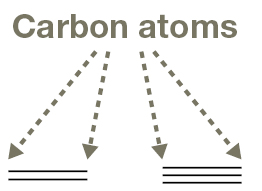
A illustration showing double and triple bond lines in structures. On the left are two short, parallel lines. Arrows indicate there is a carbon atom at each end of the lines. On the right are three short, parallel lines. Arrows indicate there is a carbon atom at each end of the lines.
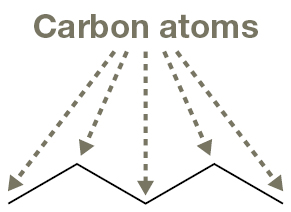
The figure shows a zigzag structure of a five carbon chain. There four segments to the line. They go up and down to form a stretched out M shape. Arrows indicate there is a carbon atom at each bend in the line and at both ends of the line.
The line structure of CH3CH2CH2CH2CH2CH2CH2NH2 is shown in Figure 1-39. Notice that the intersection of each bond line represents a C atom, as does the end of the bond on the left side of the molecule. The NH2 group is written in explicitly.

An illustration shows the conversion of a condensed structural formula of a compound to its skeletal structural formula. The condensed formula shows seven carbon atoms connected in a zigzag fashion. Carbon 1 is connected to an amine group, carbon 7 is connected to three hydrogen atoms, and each of the other carbon atoms are connected to two hydrogen atoms. An arrow from the condensed formula leads to the skeletal structural formula, which shows a zigzag line with three crests and four troughs and an amine group at the end. The skeletal structural formula omits all carbons and all hydrogens bonded to the carbon atoms. The caption reads, Line structure of C H 3 C H 26 N H 2: In the line structure on the right, neither the C atoms nor the H atoms attached to C are shown. However, the N atom is shown, and so are the H atoms attached to N.
YOUR TURN 1.12
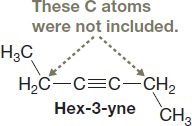
A student mistakenly interprets the line structure shown here as but-2-yne (CH3C≡ CCH3). What mistake did the student make?
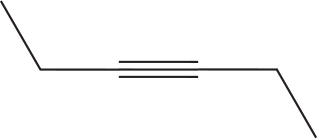
A chair-shaped skeletal structural formula shows a triple bond along its horizontal portion. There are five segments of equal length. One makes the back of the chair shape. The seat of the chair is made up of three segments. The middle section is a triple bond. The last segment points down.
SOLVED PROBLEM 1.12
How to use line structures when drawing resonance structures
Break It Down Why is it incorrect to draw resonance structures for propene as shown here?
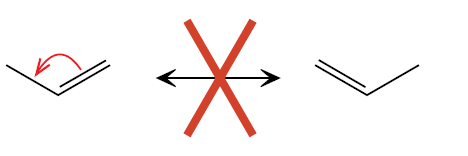
Two skeletal structural formulas of propene with a crossed-out double-headed arrow between them. Each skeletal structural formula is shaped like a V. The first structure has a double bond along its right arm, and shows a curved arrow that leads from the double bond to the left arm. The second structure has a double bond along its left arm.
|
Think |
Solve |
|
|
Does the first structure have any of the five features illustrated Figure 1-32? |
➤ |
None of the features from Figure 1-32 is present. There are no atoms with a lone pair and no atoms lacking an octet, which eliminates Features 1 through 3. There is no polar multiple bond (Feature 4), and neither is there a ring of alternating single and multiple bonds (Feature 5). |
|
What would the initial structure look like as a complete Lewis structure (i.e., with all hydrogen atoms drawn in)? How would that structure change after the electrons are moved? |
➤ |
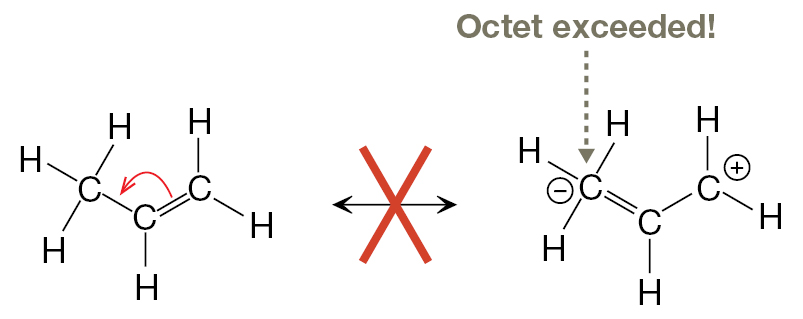
More informationTwo condensed structural formulas of propene with a crossed-out double-headed arrow between them. Each structure shows three carbon atoms connected in a bent fashion, with the central carbon bonded to a hydrogen atom. In the first structure, the carbon on the right is bonded to two hydrogen atoms by single bonds and to the central carbon by a double bond. The carbon on the left is bonded to three hydrogen atoms and to the central carbon by single bonds. An arrow from the double bond leads to the single bond between the other two carbon atoms. In the second structure, the double bond has changed position, and now lies between the central carbon and the carbon on its left, which is now marked with a negative charge. The carbon on the right is now marked with a positive charge and is connected by a single bond to the central carbon. |
|
What rule is broken in the transformation from the first structure to the second? |
➤ |
As shown above, the CH3 carbon would exceed its octet after gaining the bond indicated by the curved arrow. Atoms in the second row of the periodic table must not exceed their octet. |
|
Try ItDraw all resonance structures for each of the ions represented here as line structures. If no additional resonance structures exist, explain why. 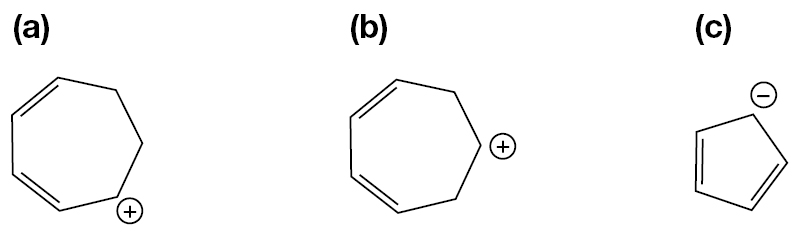
More informationThree skeletal structural formulas of different organic compounds. The first skeletal structural formula shows a seven-membered ring with double bonds between the atoms in the first and second position and in the third and fourth position. The atom in the fifth position carries a positive charge. The second skeletal structural formula shows a seven-membered ring with double bonds between the atoms in the first and second position and in the third and fourth position. The atom in the sixth position carries a positive charge. The third skeletal structural formula shows a five-membered ring with double bonds between the atoms in the first and second position and in the third and fourth position. The atom in the fifth position carries a negative charge. |
||