1.11 Strategies for Success: Drawing All Resonance Structures
Section 1.11 Objectives
You will be able to:
Use curved arrow notation to indicate the electron movement necessary to convert one resonance structure into another.
Identify features in a given Lewis structure that indicate the structure will have another resonance structure.
Draw all resonance structures of a species when you are given an initial Lewis structure.
It is important to be able to draw all resonance structures of a species. That’s because all resonance structures contribute to the features of the resonance hybrid, and the total number of resonance structures is related to the stability of the species. We therefore devote this section to giving you insights into drawing resonance structures.
To begin, remember that any two resonance structures differ only in where the electrons are located. Therefore, one resonance structure can be obtained from another just by moving valence electrons (see Looking Ahead box), but atoms must remain frozen in place! We emphasize this explicitly by using curved arrows:
A curved arrow illustrates the movement of a pair of valence electrons.
A curved arrow can originate from a lone pair of electrons or from the center of a double or triple bond to indicate the specific pair of electrons that is being moved.
The arrow points to an atom if the electrons being moved become a lone pair. Otherwise, the arrow points to the center of an existing single or double bond to represent the formation of a new double or triple bond there.
▶ LOOKING AHEAD
The electrons that can be moved to convert one resonance structure into another must be π (pi) electrons. As we will learn in Sections 3.4 and 3.5, double and triple bonds contain π electrons. In Section 14.4, we will learn that π electrons can also take the form of lone pairs in Lewis structures.
More information
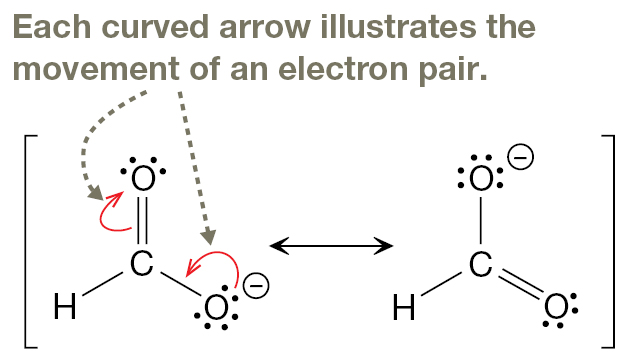
Lewis structures use curved arrows to show electron movement in the two resonance structures of H C O 2 anion. Each resonance structure has a central carbon atom bonded to a hydrogen atom and an oxygen atom with three lone pairs by single bonds, and to another oxygen atom with two lone pairs by a double bond. In the first resonance structure, the oxygen atom above the carbon is connected to it by a double bond. A curved arrow from one of the three lone pairs in the oxygen atom on the right leads to the single bond connecting it to the carbon atom, and another curved arrow from the double bond leads to the oxygen atom above the carbon. Each curved arrow illustrates the movement of an electron pair. In the second structure, the oxygen atom on the right is bonded by a double bond. In each resonance structure, the oxygen atom bonded to the carbon by a single bond carries a negative charge. The caption reads, “Curved arrow notation in resonance: Shifting the four electrons indicated by the two curved arrows converts the resonance structure on the left into the one on the right.”
FIGURE 1-31Curved arrow notation in resonance Shifting the four electrons indicated by the two curved arrows converts the resonance structure on the left into the one on the right.
Curved arrow notation is shown for HCO2– in Figure 1-31. The curved arrow on the right represents the conversion of a lone pair into a new bond between C and O. The other curved arrow represents a bond from the C═O double bond being converted into a lone pair on the O atom.
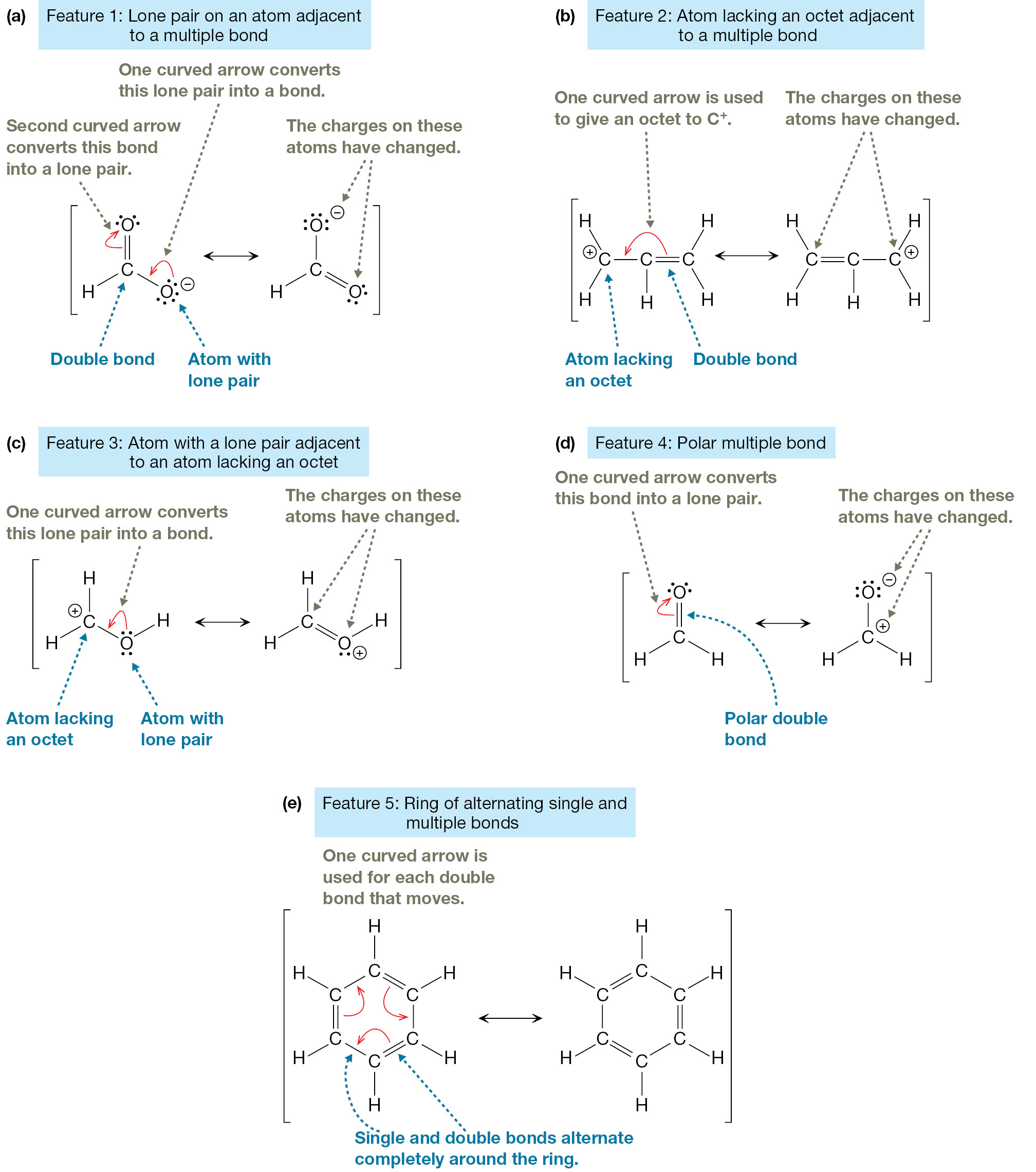
The curved arrow notation drawn in Figure 1-31 is feasible because the species contains a particular feature: a lone pair of electrons on an atom (the single-bonded O) adjacent to a multiple bond (the C═O bond). This feature, shown again as Feature 1 in Figure 1-32a, is one of five features a species can have that would allow electrons to be moved to arrive at another resonance structure. The other four features are shown in Figure 1-32b through 1-32e. Take the time to study these five features so that you can immediately recognize them in Lewis structures and so that you can quickly add the curved arrows with confidence. As you study Figure 1-32, pay particular attention to the curved arrow notation, not only in terms of the number of curved arrows added but also in terms of how the curved arrows are drawn.
YOUR TURN 1.10
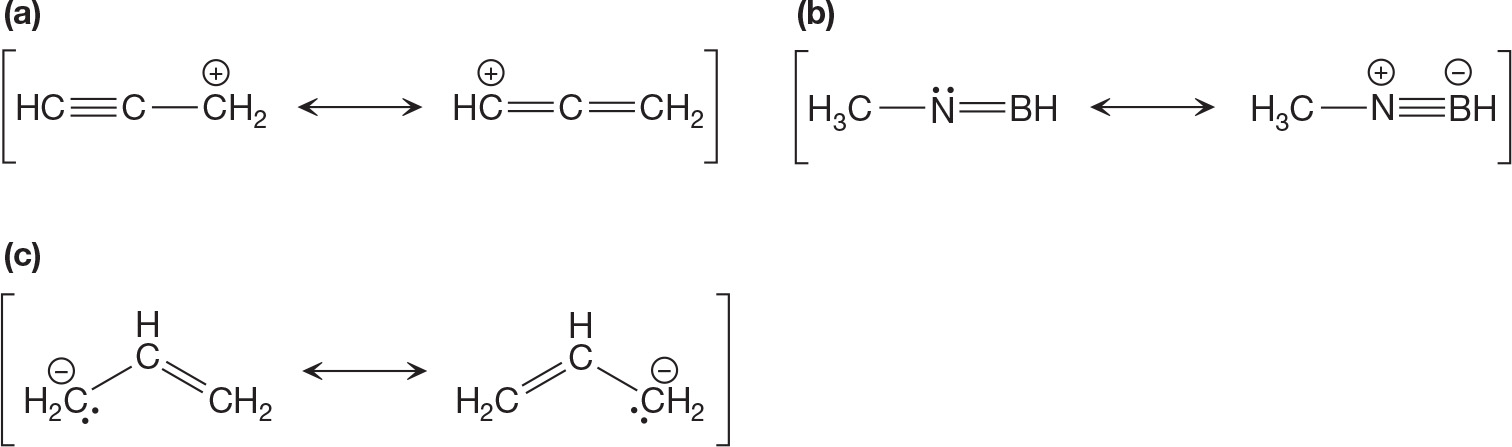
Examine the first resonance structure in each pair, and determine which feature from Figure 1-32 it possesses. Then supply the necessary curved arrow(s) to convert the first structure into the second structure.
More information
Lewis structures show three pairs of resonance structures each with a double-headed arrow between them. In the first pair, each resonance structure shows a linear chain of three carbon atoms. In the first structure, the central carbon atom is bonded to the carbon on the left by a triple bond, while the carbon atom on the right carries a positive charge. In the second structure, the central carbon atom is bonded to both the other carbon atoms by a double bond each. The carbon atom on the left carries a positive charge. In the second pair, each resonance structure shows a linear chain where a central nitrogen atom is bonded to a carbon atom on the left and a boron atom on the right. In the first structure, the nitrogen atom with one lone pair of electrons is bonded to the carbon atom by a single bond and to the boron atom by a double bond. In the second structure, the nitrogen atom, which carries a positive charge, is bonded to the carbon atom by a single bond and to the boron atom, which carries a negative charge, by a triple bond. In the third pair, each structure shows a three carbon chain. The middle carbon has one hydrogen atom linked to it. Carbons 1 and 3 both have two hydrogen atoms. In the first structure, carbon 1 and 2 are linked by a single bond. Carbon 1 is marked with a negative charge and has one lone pair of electrons. Carbons 2 and 3 are linked by a double bond. In the second structure, carbons 1 and 2 are linked by a double bond. Carbons 2 and 3 are linked by a single bond. Carbon 3 is marked with a negative charge.
SHOW ANSWERHIDE ANSWER
More information
Three different structural formula a, b, and c. Structure a is labeled feature 2, it shows a three carbon chain, the first and second carbon are triple bonded, and the third carbon has a positive charge. A curved arrow starts at the triple bond and ends at the single bond between the second and third carbon. Structure b is labeled feature 3, it shows a central nitrogen atom with a lone pair of electrons single bonded to a methyl group on the left and double bonded to a hydrogen boride group. A curved arrow starts at the lone pair of electrons and ends at the double bond. Structure c is labeled feature 1, it shows a three carbon chain. The first carbon has a lone pair of electrons and a negative charge and the second and third carbons are double bonded to each other. A curved arrow starts at the lone pair of electrons and ends at the single bond. Another curved arrow starts at the double bond and ends at the third carbon.
More information
Five illustrations of resonance structures demonstrate features that indicate the existence of another resonance structure. Feature 1 is a lone pair on an atom adjacent to a multiple bond. Both resonance structures show a carbon atom bonded to a hydrogen atom and two oxygen atoms. On the first structure, one of the oxygen atoms has two lone pairs of electrons and is linked to carbon by a double bond. The other oxygen atom is marked with a negative charge, has three lone pairs of electrons, and is linked to carbon by a single bond. A curved arrow points from one of the lone pairs to the single bond. The curved arrow converts the lone pair into a bond. A second curved arrow points from the double bond to the other oxygen. This curved arrow converts this bond into a lone pair. The second resonance structure show the oxygen that was originally double bonded to carbon now linked by a single bond. It now has three lone pairs of electrons and is marked with a negative charge. The other oxygen is now linked by a double bond to carbon. Feature 2 is an atom lacking an octet adjacent to a multiple bond. Both resonance structures show three carbon chains. In the first structure carbon one is marked with a positive charge and is lacking an octet. Carbons 1 and 2 are linked by single bonds. Carbons 2 and 3 are linked by a double bond. A curved arrow points from the double bond to the single bond. The curved arrow is used to give and octet to the carbon with a positive charge. In the second resonance structure, carbon 3 is now marked with a positive charge and carbon 1 is neutral. The double bond now exists between carbons 1 and 2. Feature 3 is an atom with a lone pair adjacent to an atom lacking an octet. Both resonance structures show a carbon atom with two hydrogen atoms linked to an oxygen atom with one hydrogen atoms. In the first structure the carbon and oxygen are linked by a single bond. The carbon is marked with a positive charge. The carbon atom is lacking an octet. The oxygen atom has two lone pairs of electrons. A curved arrow points from one of the lone pairs to the single bond. The curved arrow converts the lone pair into a bond. In the second structure, the carbon and oxygen are now linked by a double bond. The charges of the carbon and oxygen atoms have changed. The carbon atom is neutral. The oxygen atom is marked with a positive charge and has one lone pair of electrons. Feature 4 is a polar multiple bond. Both resonance structures show a carbon atom single bonded to two hydrogen atoms. The carbon atom is also linked to an oxygen atom. In the first structure, the carbon and oxygen are linked by a double bond. This is a polar double bond. The oxygen has two lone pairs of electrons. A curved arrow points from the double bond to the oxygen atom. The curved arrow converts this bond into a lone pair. In the second structure, the oxygen and carbon are now linked by a single bond. The charges on the carbon and oxygen atoms have changes. The carbon atom is marked with a positive charge. The oxygen atom is marked with a negative charge. The oxygen atom has three lone pairs of electrons. Feature 5 is a ring of alternating single and multiple bonds. Both resonance structures show a ring structure made of six carbon atoms. Each carbon is also linked by a single bond to one hydrogen atom. Between the carbon atoms, single and double bonds alternate completely around the ring. There are three double bonds. In the first structure, a curved arrow starts at each of the double bonds and points to the adjacent single bond. Each curved arrow is for each double bond that moves. In the second structure, the double bonds are now between the carbons that were previous linked by single bonds.
FIGURE 1-32Features that indicate the existence of another resonance structure When a Lewis structure has one of these features, a new resonance structure can be drawn by adding the corresponding curved arrows and moving the electrons accordingly.
For Features 1–4 in Figure 1-32, notice that the formal charges of some atoms will change on going from one resonance structure to another. Although you can recalculate the formal charge on each atom after you draw a new resonance structure, it is helpful to recognize how the following patterns generally apply:
When a lone pair on an atom is converted into a bonding pair, the formal charge on that atom becomes more positive by 1; when the reverse happens, the formal charge on the atom becomes more negative by 1.
When an atom initially lacking an octet gains its octet, the formal charge on that atom becomes more negative by 1; when the reverse happens, the formal charge on that atom becomes more positive by 1.
Features 1 and 5 call for two or more curved arrows (Fig. 1-32a and 1-32e). In these situations, notice that when one curved arrow points toward a particular atom, there is another curved arrow pointing away from that atom. This ensures that the atom does not lose or exceed its octet. It therefore helps to remember the following guideline:
Avoid drawing two curved arrows pointing toward the same atom or pointing away from the same atom.
SOLVED PROBLEM 1.10
How to draw the next resonance structure
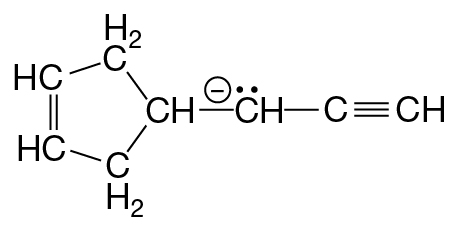
Break It Down Draw another resonance structure of the species shown here.
More information
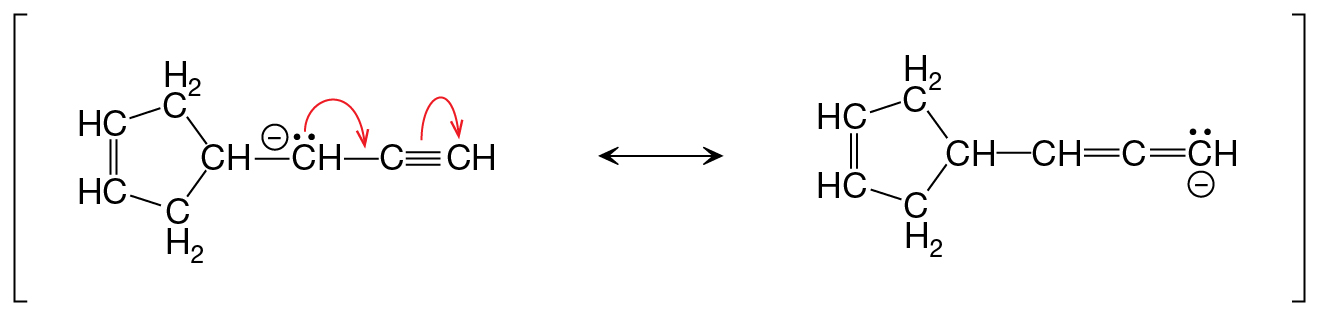
A condensed structural formula of an organic compound. The structure shows four carbon atoms bonded in a linear fashion. Carbon 1 is bonded by a triple bond to carbon 2, which is bonded by a single bond to carbon 3, which is further bonded to carbon 4 by a single bond. Carbon 4 is part of a five-carbon ring, where carbon atoms 6 and 7 are bonded by a double bond. Carbon 3 carries a negative charge and has one lone pair of electrons.
Think
Solve
Which feature from Figure 1-32 applies to this species?
➤
This species has a lone pair on an atom (the C–) that is adjacent to a multiple bond (the C≡C triple bond); this corresponds to Feature 1 in Figure 1-32a.
How many curved arrows must be added, and how should you draw them?
➤
Two curved arrows are added, and when we move the electrons according to those curved arrows, we arrive at the second resonance structure shown here.
More information
Lewis structures show two resonance structures with a double-headed arrow between them. Each resonance structure shows four carbon atoms bonded in a linear fashion. Carbon 4 is part of a five-carbon ring, where carbon atoms 6 and 7 are bonded by a double bond. In the first structure, carbon 1 is bonded by a triple bond to carbon 2, which is bonded by a single bond to carbon 3, which is further bonded to carbon 4 by a single bond. Carbon 3 carries a negative charge and has one lone pair of electrons. A curved arrow from the lone pair on carbon 3 leads to the single bond connecting it to carbon 2. Another curved arrow from the triple bond leads to carbon 1. In the second structure, double bonds connect carbons 1 and 2, and carbons 2 and 3. Carbon 1 carries a negative charge and has one lone pair of electrons.
What happens to the respective formal charges?
➤
The charge on C– becomes more positive by 1 because a lone pair is turned into a bond. The opposite is true for the triply bonded C that gains a lone pair.
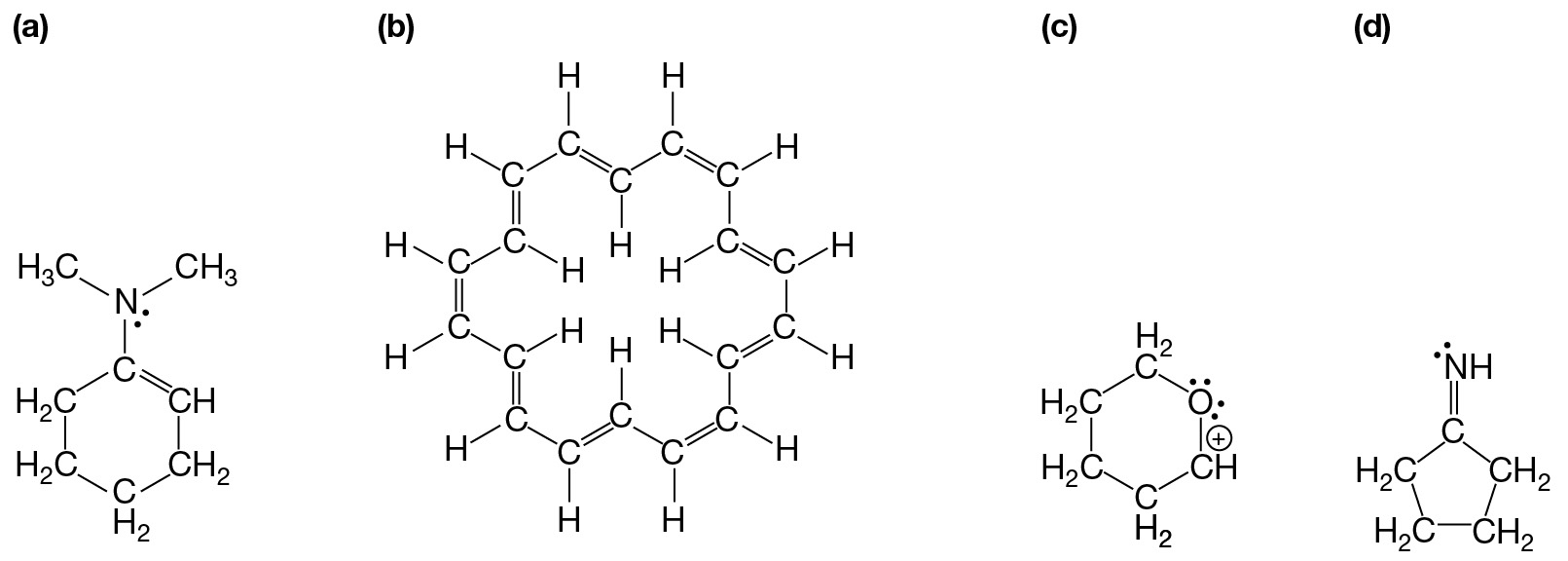
Try ItDraw a resonance structure for each of the following species.
More information
Condensed structural formulas show four different organic compounds. The first shows a six-carbon ring where carbons 1 and 2 are bonded by a double bond. Carbon 1 is further bonded by a single bond to a nitrogen atom, which has one lone pair and is bonded to two methyl groups. The second structural formula shows a ring of eighteen carbon atoms that are bonded together in a bent fashion with semi-hexagonal units, with alternating single and double bonds. The third structure shows a six-membered ring made of five carbon atoms and one oxygen atom, all connected by single bonds. The oxygen atom has two lone pairs of electrons, and the carbon atom adjacent to it carries a positive charge. The fourth structure is a five membered ring. Four of the carbon atoms that make up the ring each have two hydrogen atoms attached. The fifth carbon is double bonded to the nitrogen of an N H group. The nitrogen has a lone pair of electrons.
Frequently, a species will have more than two resonance structures. To draw all resonance structures of these species, it helps to approach the problem systematically.
Strategies for Success: Drawing All Resonance Structures
Drawing All Resonance Structures
Identify the feature. Which feature in Figure 1-32 does the species have?
Add the curved arrow(s). Each feature calls for a certain number of curved arrows to be added in a particular way.
Move the electrons. Draw the new resonance structure by moving only the electrons indicated by the curved arrow(s).
Examine the new resonance structure. Does the new resonance structure have a feature from Figure 1-32? If so, repeat Steps 2–4.
Continue this process until you have exhausted all your options for moving electrons.
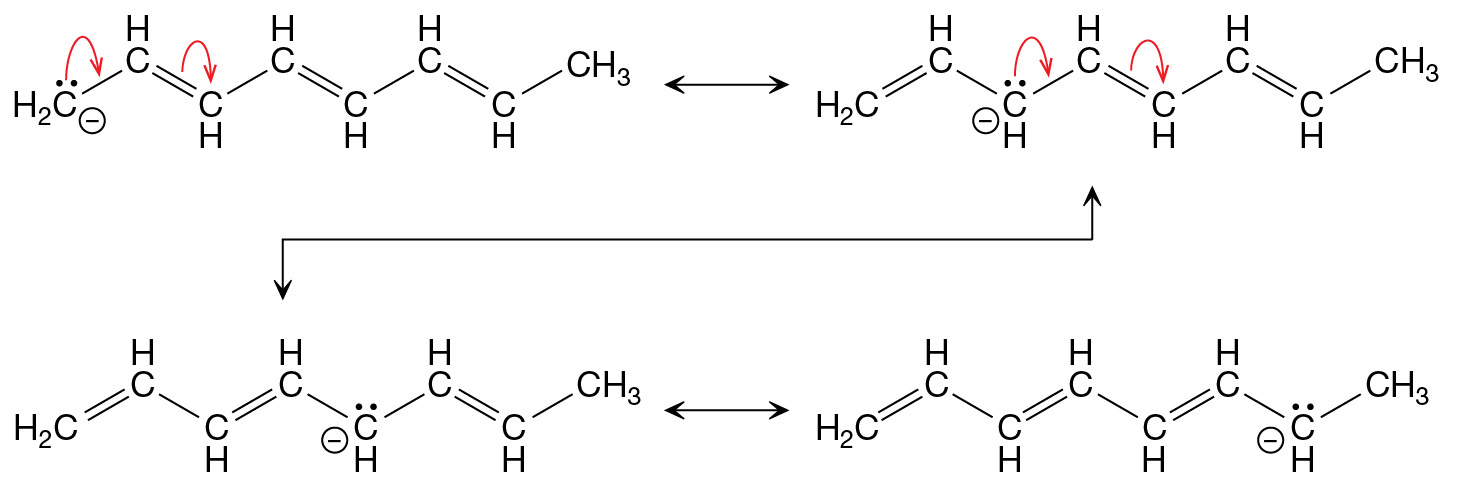
Figure 1-33 gives an example of how to apply this strategy. The first structure exhibits Feature 1 from Figure 1-32a: a lone pair on an atom (C–) that is adjacent to a multiple bond (the leftmost C═C bond). To arrive at the second structure, we add the two curved arrows and move the valence electrons accordingly to arrive at the second resonance structure. Examining the second resonance structure, we see that it, too, exhibits Feature 1, so we add two curved arrows again to arrive at the third resonance structure. The process is repeated one more time to arrive at the final structure.
More information
Condensed structural formulas show four resonance structures with double-headed arrows between them. Each structure shows a chain of eight carbon atoms. In the first structure, double bonds exist between carbons 2 and 3, carbons 4 and 5, and carbons 6 and 7. Carbon 1 has one lone pair of electrons and carries a negative charge. A curved arrow from the lone pair on carbon 1 leads to the single bond between carbon atoms 1 and 2. Another curved arrow from the double bond between carbon atoms 2 and 3 leads to carbon 3. In the second structure, double bonds exist between carbons 1 and 2, carbons 4 and 5, and carbons 6 and 7. Carbon 3 has one lone pair and carries a negative charge. A curved arrow from the lone pair on carbon 3 leads to the single bond between carbons 3 and 4. Another curved arrow from the double bond between carbons 4 and 5 leads to carbon 5. In the third structure, double bonds exist between carbons 1 and 2, carbons 3 and 4, and carbons 6 and 7. Carbon 5 has one lone pair and carries a negative charge. In the fourth structure, double bonds exist between carbons 1 and 2, carbons 3 and 4, and carbons 5 and 6. Carbon 7 has one lone pair and carries a negative charge. The caption reads, “Multiple resonance structures involving an atom with a lone pair adjacent to a multiple bond: Two curved arrows are drawn each time to convert one resonance structure into another.”
FIGURE 1-33Multiple resonance structures involving an atom with a lone pair adjacent to a multiple bond Each structure exhibits Feature 1 from Figure 1-32, so two curved arrows are drawn each time to convert one resonance structure into the next.
YOUR TURN 1.11
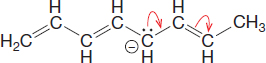
Draw in the curved arrows needed to convert the third resonance structure in Figure 1-33 to the fourth.
SHOW ANSWERHIDE ANSWER
More information
Condensed structural formula of an eight carbon chain. The first and second carbons are double bonded to each other as are the third and fourth carbons and the sixth and seventh carbons. The fifth carbon has a lone pair of electrons and a negative charge. A curved arrow starts at the lone pair of electrons and ends at the neighbouring bond on the right. A second curved arrow starts at the double bond between sixth and seventh carbons and ends at the seventh carbon.
Species that have multiple resonance structures can contain any of the five features in Figure 1-32. To gain practice drawing all resonance structures of a given species, work through Problems 1.22 and 1.23 at the end of the chapter.
the symbol () or () that illustrates the electron movement necessary to change one resonance structure into another or to form or break bonds in an elementary step of a mechanism. (Ch. 1)
 illustrates the movement of a pair of valence electrons.