Problems
Section 1.3 Atomic Structure and Ground State Electron Configurations
- 1.1In which of the following orbitals does an electron possess the most energy? 2s; 3s; 4s; 3p; 2p
- 1.2For each pair, identify the orbital in which an electron possesses more energy. (a) 4s or 5s; (b) 5p or 5d
- 1.3Write the ground state electron configuration of each of the following atoms. For each atom, identify the valence electrons and the core electrons. (a) Al; (b) S; (c) O; (d) N; (e) F
Section 1.4 The Covalent Bond: Bond Energy and Bond Length
- 1.4Consider a molecule of N2. For each pair of distances between the two N atoms, determine which distance represents a higher energy. Explain. Hint: Consult Table 1-3. (a) 50 or 75 pm; (b) 75 or 110 pm; (c) 110 or 150 pm; (d) 150 or 160 pm
- 1.5In which of the following molecules is the bond between carbon and nitrogen the shortest, and in which molecule is it the strongest? H—C≡N; H2C═NH; H3C—NH2
- 1.6According to Table 1-2, which of the following compounds has the strongest single bond, and which has the weakest? HCl; CH4; H2O; HF; Cl2
Sections 1.5–1.8 Lewis Dot Structures, Polarity, and Ionic Bonds
- 1.7Determine whether each structure shown here is a legitimate Lewis structure. If not, explain why not.

More information
Five condensed structural formulae of five molecules is shown. The first condensed structure shows a central carbon atom, attached to two carbon atoms by double bonds, which are further single bonded to two hydrogen atoms each. The second condensed structure shows a central carbon atom, single bonded to the carbon of a methyl group and double bonded to two oxygen atoms, each carrying two lone pairs of electrons. The third condensed structure shows a central sulfur atom, single bonded to the carbon of a methyl group and one chlorine atom with three lone pairs of electrons. The sulfur is also attached to two oxygen atoms by double bonds. The fourth condensed structure shows a central phosphorus atom, attached to five chlorine atoms, each carrying three lone pairs of electrons. The fifth condensed structure shows a central carbon atom, triple-bonded to a nitrogen atom carrying a lone pair of electrons and double bonded to another carbon atom, which is further attached to a hydrogen atom and the oxygen of a hydroxyl group by single bonds. The oxygen atom carries two lone pairs of electrons.
- 1.8Determine whether each structure shown here is a legitimate Lewis structure. If not, explain why not.

More information
Lewis structures of five different organic compounds. The first structure shows a three-carbon chain with a triple bond between carbons 1 and 2 and a double bond between carbons 2 and 3. Carbon 1 is bonded to a hydrogen atom, and carbon 3 is bonded to two hydrogen atoms. The second structure shows a sulfur atom with one lone pair of electrons bonded to an oxygen atom by a double bond and to two methyl groups by single bonds. The third structure shows a two-carbon chain where one carbon is bonded to three hydrogen atoms. The other is bonded by a double bond to one oxygen atom, and by a single bond to another oxygen atom, which is bonded to a hydroxyl group. All the oxygen atoms have two lone pairs each. The fourth structure shows two nitrogen atoms bonded by a double bond. One of these nitrogen atoms has one lone pair of electrons and is bonded to a hydrogen atom, and the other is bonded to two hydrogen atoms and a nitrile group. The nitrogen in the nitrile group also has one lone pair of electrons. The fifth structure shows a carbon atom with a positive charge bonded to three hydrogen atoms.
- 1.9Draw Lewis structures for each of these molecules: (a) CH5N (contains a bond between C and N); (b) CH3NO2 (contains a bond between C and N but no bonds between C and O); (c) CH2O; (d) CH2Cl2; (e) BrCN
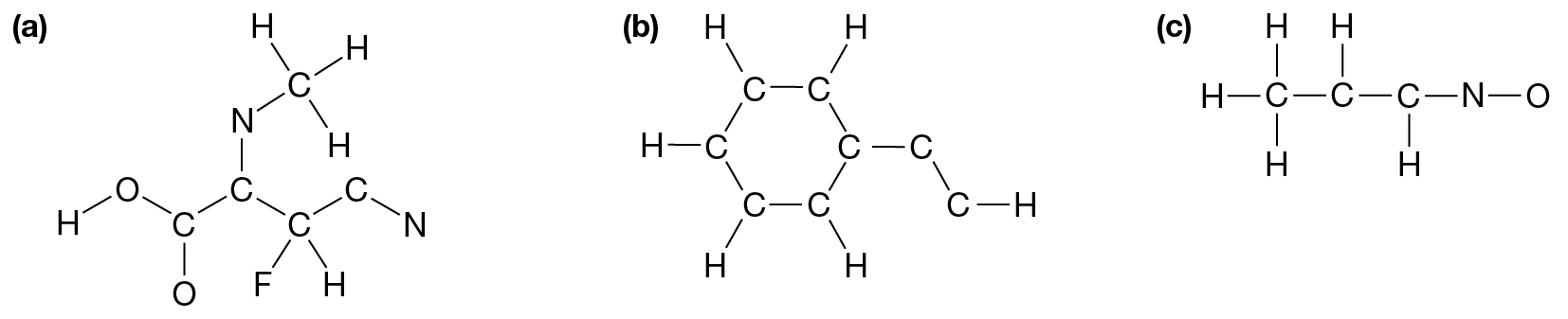
- 1.10Complete the Lewis structure for each of the following molecules, using the information provided in Table 1-4. You may assume that all formal charges are zero. All H atoms are shown; add only bonding pairs and lone pairs of electrons.
More information
Condensed structural formulas of three different organic compounds. The first structure shows a four-carbon chain where carbon 1 is bonded to an oxygen atom and a hydroxyl group, and carbon 2 is bonded to a nitrogen atom, which is bonded to a methyl group. Carbon 3 is bonded to a hydrogen atom and a fluorine atom, and carbon 4 is bonded to a nitrogen atom. The second structure shows a hexagonal six-carbon ring where one carbon atom is bonded to another carbon by a single bond. The carbon is further bonded to another carbon atom, which is bonded to a hydrogen atom. The other five carbons in the ring are each bonded to a hydrogen atom. The third structure shows a three-carbon chain where carbon 1 is bonded to a hydrogen atom and a nitrogen atom, which is bonded to an oxygen atom. Carbon 2 is bonded to a hydrogen atom, and carbon 3 is bonded to three hydrogen atoms.
- 1.11Rank the molecules in order of increasing negative charge on carbon: CH3—CH3; CH3—MgBr; CH3—Li; CH3—F; CH3—OH; CH3—NH2
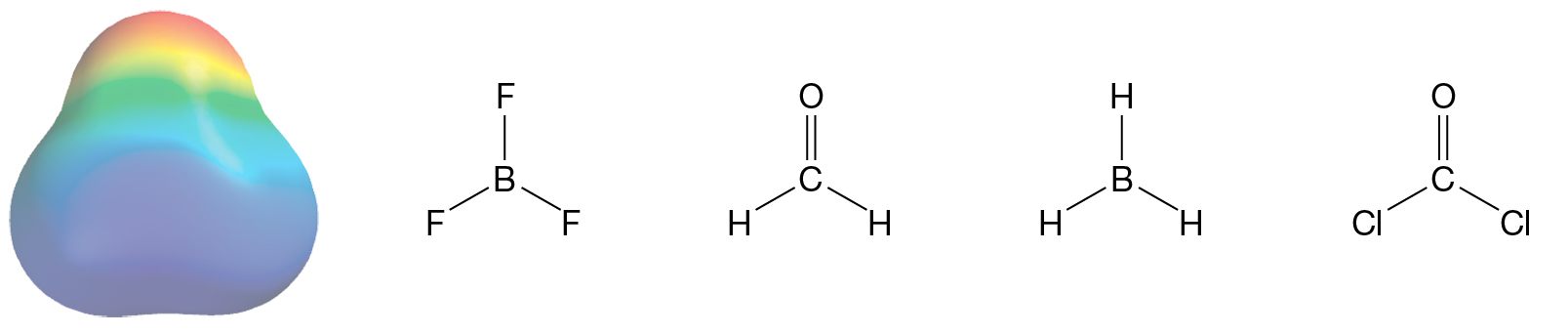
- 1.12Which of the compounds below is consistent with the electrostatic potential map shown? Explain.
More information
An electrostatic potential model of a molecule and condensed structural formulae of four molecules. The electrostatic potential map shows a trigonal planar-shaped model of a molecule. The upper region of the model is shaded in red, the middle region in yellow, green, and turquoise, and the bottom region in blue. There is greater blue color than red color. The first condensed structural formula consists of a central boron atom, single bonded to three fluorine atoms. The second condensed structural formula consists of a central carbon atom, double bonded to an oxygen atom and single bonded to two hydrogen atoms. The third condensed structural formula consists of a central boron atom, single bonded to three hydrogen atoms. The fourth condensed structural formula consists of a central carbon atom, double bonded to an oxygen atom and single bonded to two chlorine atoms.
- 1.13Which of the following compounds contains an ionic bond? (a) H2; (b) NaCl; (c) NaOH; (d) CH3ONa; (e) CH4; (f) HOCH2CH3; (g) LiNHCH3; (h) CH3CH2CO2K; (i) C6H5NH3Cl
Section 1.9 Assigning Electrons to Atoms in Molecules: Formal Charge
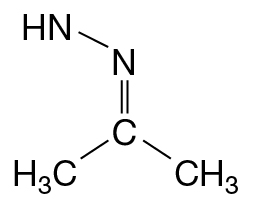
- 1.14Determine the formal charge of each atom in the species shown here, which is an intermediate in a reaction called the Wolff-Kishner reduction (Chapter 19). Assume that each atom has a filled valence shell.
More information
A condensed structural formula of a molecule. The condensed structure shows a central carbon atom, single bonded to two methyl groups and double bonded to a nitrogen atom. This is shown further attached to the nitrogen of an N H group by a single bond. The nitrogen is marked with a negative charge.
- 1.15In the methoxide anion (CH3O–), is it possible for a double bond to exist between C and O, given that the negative charge resides on O? Explain why or why not.
- 1.16Draw Lewis structures for each of the following ions. One atom in each ion has a formal charge that is not zero. Determine which atom it is and what its formal charge is. (a) C2H5 anion; (b) CH3O cation; (c) CH6N cation; (d) CH5O cation; (e) C3H3 anion (with all three H atoms on the same carbon)
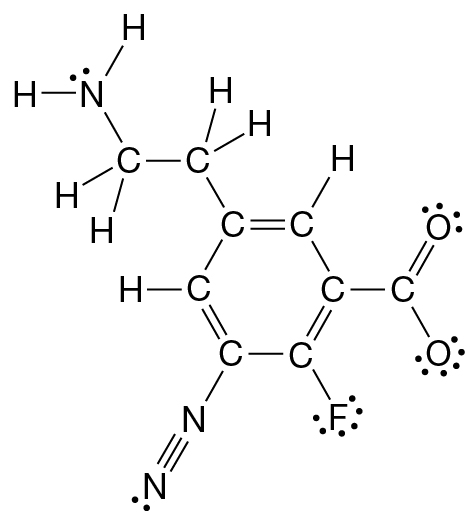
- 1.17Identify the formal charge on each atom in the following species. Assume that all valence electrons are shown.
More information
An illustration shows the Lewis structure of an organic compound. The structure shows a hexagonal six-carbon ring with double bonds between carbon atoms 1 and 2, carbons 3 and 4, and carbons 5 and 6. Carbon 1 is bonded to another carbon atom, which is bonded by a single bond to an oxygen atom with three lone pairs of electrons and by a double bond to another oxygen atom with two lone pairs of electrons. Carbon 2 is bonded to a fluorine atom with three lone pairs of electrons. Carbon 3 is bonded to a nitrogen atom, which is bonded to another nitrogen atom with a lone pair by a triple bond. Carbon 4 and 6 are each bonded to a hydrogen atom. Carbon 5 is bonded to a two-carbon chain where one carbon is bonded to two hydrogen atoms and the other is bonded to two hydrogen atoms and a nitrogen atom, which has one lone pair and is bonded to two hydrogen atoms.
- 1.18The structure shown here is a skeleton of an anion having the overall formula C6H6NO–. The hydrogen atoms are not shown.
- Draw a complete Lewis structure in which the –1 formal charge is on N. Include all H atoms and valence electrons.
- Do the same for a Lewis structure with the –1 formal charge on O.
- Do the same for a Lewis structure with the –1 formal charge on the C atom that is bonded to three other C atoms.
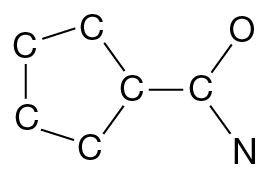
More information
Condensed structural formula of an organic compound. The structure shows a pentagonal five-carbon chain where carbon 1 is bonded by a single bond to another carbon atom, which is bonded to a nitrogen atom and an oxygen atom by single bonds.
Sections 1.10 and 1.11 Resonance Theory and Drawing All Resonance Structures
- 1.19Draw all resonance contributors for each of the following molecules or ions. Be sure to include the curved arrows that indicate which pairs of electrons are shifted in going from one resonance structure to the next.
- CH3NO2
- CH3CO2–
- CH3CHCHCH2– (the ion has two C—C single bonds)
- C5H5N (a ring is formed by the C and N atoms, and each H is bonded to C)
- C4H5N (a ring is formed by the C and N atoms, the N is bonded to one H, and each C is bonded to one H)
- 1.20Draw the resonance hybrid of CH3NO2 in Problem 1.19(a).
- 1.21(a) Draw all resonance contributors for sulfuric acid, H2SO4 (the S atom is bonded to four O atoms). (b) Which resonance structure contributes the most to the resonance hybrid? (c) Which resonance structure contributes the least to the resonance hybrid?
- 1.22Draw all resonance structures for each of the following species. Make sure to include all appropriate curved arrows.
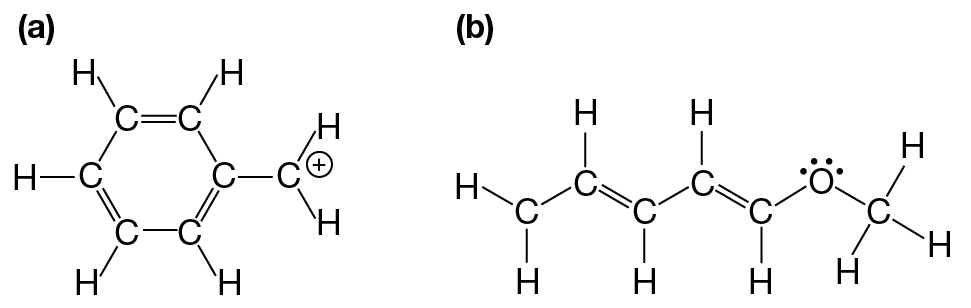
More information
Condensed structural formulas show two different organic compounds. The first structure shows a hexagonal six-carbon ring with alternating single and double bonds inside. One of the carbon atoms is bonded to a methyl group. The carbon atom in the methyl group carries a positive charge. The second structure shows a four-carbon chain with double bonds between carbon atoms 1 and 2 and carbons 3 and 4. Carbon 1 is bonded to a methoxy group. The oxygen atom in the methoxy group has two lone pairs of electrons. Carbon 4 carries a positive charge.
- 1.23Draw all resonance structures for each of the following species. Make sure to include all appropriate curved arrows.
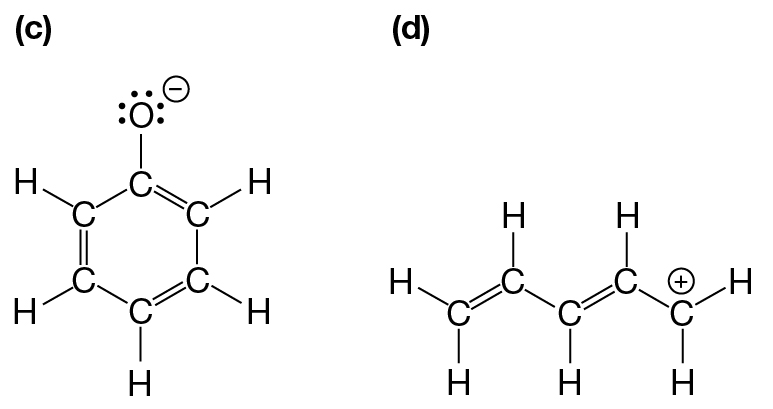
More information
The second shows two hexagonal six-carbon rings fused together. Double bonds exist between carbons 1 and 2, carbons 3 and 4, carbons 4a, and 5, carbons 6 and 7, and carbons 8 and 8a. The third structure shows a hexagonal six-carbon ring with double bonds between carbons 1 and 2, carbons 3 and 4, and carbons 5 and 6. Carbon 1 is bonded to an oxygen atom with three lone pairs of electrons, carrying a negative charge. The fourth structure shows a five-carbon chain, with double bonds between carbons 1 and 2, and carbons 3 and 4. Carbon 5 carries a positive charge.
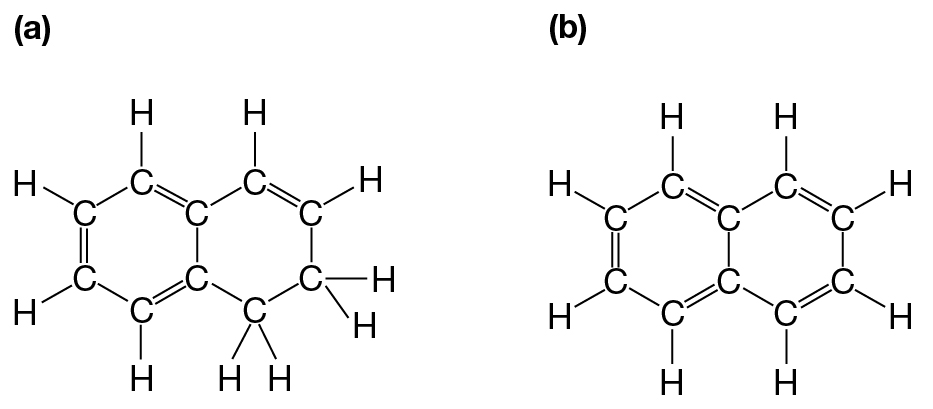
More information
Condensed structural formulas show four different organic compounds. The first structure shows two hexagonal six-carbon rings fused together. Carbons 1 and 2 are bonded to two hydrogen atoms each, while all the other carbon atoms are bonded to one hydrogen atom each. Double bonds exist between carbons 3 and 4, carbons 4a, and 5, carbons 6 and 7, and carbons 8 and 8a.
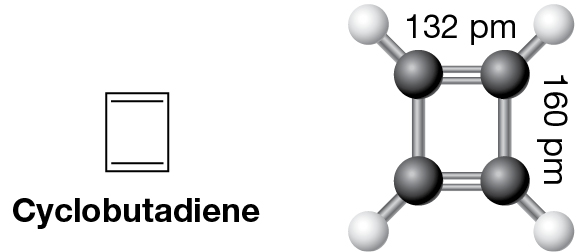
- 1.24Experiments indicate that the carbon–carbon bonds in cyclobutadiene are of two different lengths. Discuss whether cyclobutadiene has a resonance structure.
More information
Skeletal structural formula and a ball and stick model of cyclobutadiene. The skeletal formula shows a rectangular shape with an additional line along two of the opposite sides. The ball and stick model shows four carbon atoms bonded together in a rectangular fashion, with double bonds between carbons 1 and 2, and carbons 3 and 4. Each carbon atom is bonded to a hydrogen atom. The C-C single bonds measure 160 pm, and the C-C double bonds measure 132 pm.
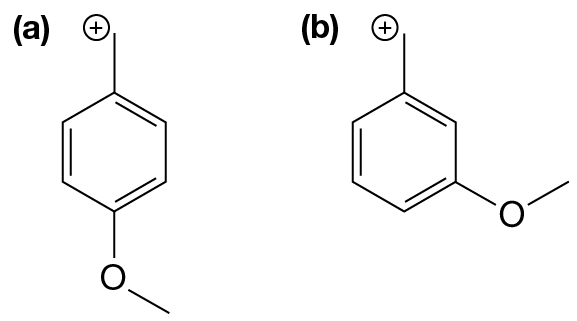
- 1.25The two species shown are structurally very similar. Draw all resonance structures for each species. Determine which species is more stable and explain why.
More information
Two skeletal structural formulas of two different organic compounds. Both the structures show a hexagonal six-carbon ring with alternating single and double bonds. One of the carbon atoms is bonded to another carbon atom carrying a positive charge. In the first structure, the carbon atom at the para position is bonded to an oxygen atom, which is bonded to another carbon atom by a single bond. In the second structure, this group is bonded to the carbon atom at the meta position.
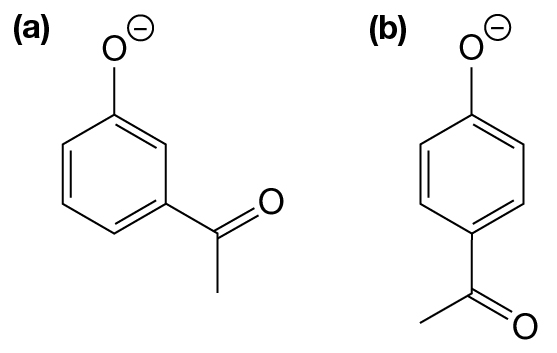
- 1.26The two species shown are structurally very similar. Draw all resonance structures for each species. Determine which species is more stable and explain why.
More information
Two skeletal structural formulas of two different organic compounds. Both the structures show a hexagonal six-carbon ring with alternating single and double bonds. One of the carbon atoms is bonded to an oxygen atom carrying a negative charge. In the first structure, the carbon atom at the meta position is bonded to another carbon atom, which is bonded to an oxygen atom by a double bond and a carbon atom by a single bond. In the second structure, this group is bonded to the carbon atom at the para position.
Section 1.12 Shorthand Notations
- 1.27Draw the complete Lewis structure of each of the following species, including lone pairs. Indicate whether the Lewis structure is already complete.

More information
Condensed structural formulas show five different organic compounds. The first structure shows a central carbon atom bonded to another carbon atom and a nitrogen atom in a bent fashion. The central carbon atom is further bonded to an oxygen atom by double bonds, and the nitrogen atom is bonded to two hydrogen atoms. The second structure shows a nitrogen atom with a negative charge bonded to two methyl groups in a bent fashion. The third structure shows a carbon atom bonded to a nitrogen atom carrying a positive charge. The nitrogen atom is further bonded to three hydrogen atoms. The fourth structure shows two carbon atoms bonded together by a single bond. One of these is bonded to three hydrogen atoms, while the other carries a positive charge and is bonded to two hydrogen atoms. The fifth structure shows a linear chain of three carbon atoms. Carbon 1 carries a negative charge and is bonded to carbon 2 by a triple bond.
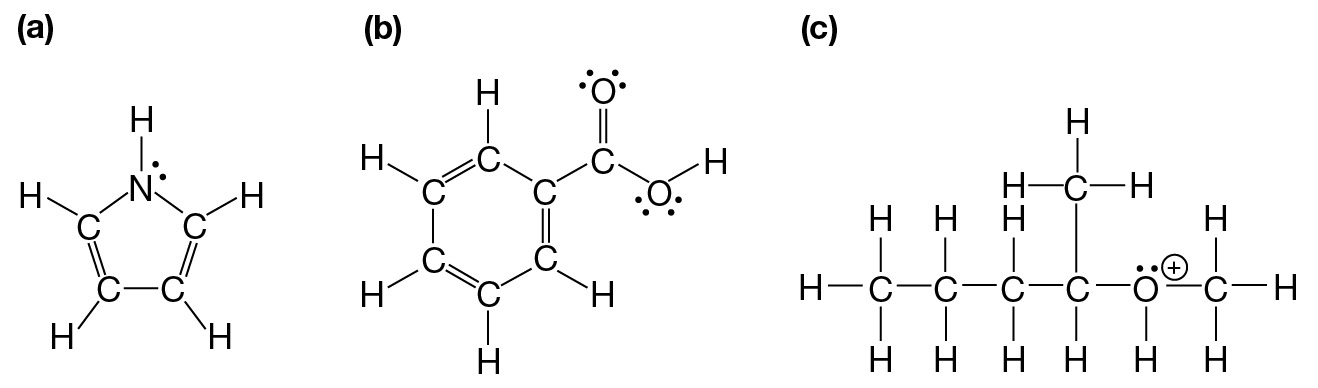
- 1.28Redraw each of the following Lewis structures as the corresponding line structure.
More information
Lewis structures showing three different compounds. The first Lewis structure shows a five-membered ring consisting of four carbon atoms and a nitrogen atom with one lone pair. Double bonds connect the carbon atoms in the second and third positions and in the fourth and fifth positions. The second Lewis structure shows a hexagonal six-carbon ring with alternating single and double bonds. Carbon atom 1 is bonded to a carboxyl group where each oxygen atom has two lone pairs of electrons. The third Lewis structure shows a five-carbon chain, where carbon 4 is bonded to an oxygen atom that has one lone pair and carries a positive charge. This oxygen atom is further bonded to a hydrogen atom and a methyl group.
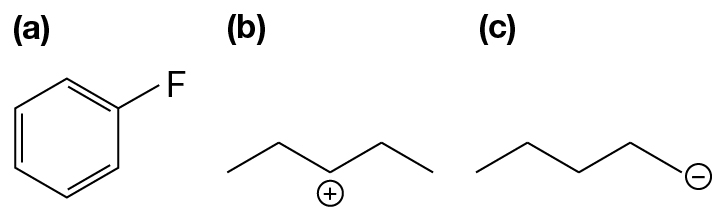
- 1.29For each of the following line structures, draw in all carbon atoms, hydrogen atoms, and lone pairs.
More information
Three skeletal structural formulas of different organic compounds. The first skeletal structural formula shows a hexagonal ring with alternating single and double bonds. A line from one of the vertices leads to a fluorine atom. The second structure shows a zigzag line with two crests and three troughs. The atom in the trough in the middle carries a positive charge. The third skeletal structural formula shows a zigzag line with two crests and three troughs. The atom in the trough at the right end carries a negative charge.
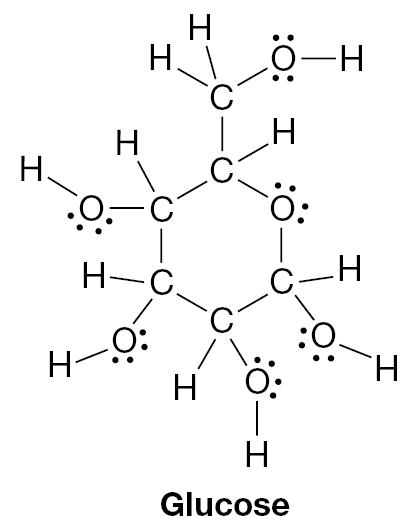
- 1.30Redraw the following structure of glucose as a line structure.
More information
Lewis structure of a glucose molecule. The structure shows a hexagonal ring composed of five carbon atoms and an oxygen atom. Carbons atoms 1, 2, 3, and 4 are each bonded to a hydrogen atom and a hydroxyl group by single bonds. Carbon 5 is bonded to a hydrogen atom and to carbon 6, which is bonded to two hydrogen atoms and a hydroxyl group by single bonds. Each oxygen atom in the molecule has two lone pairs of electrons.
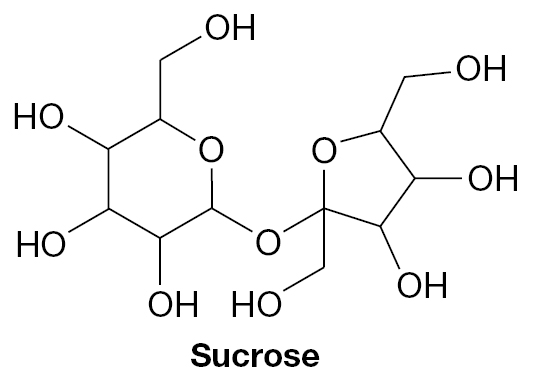
- 1.31Redraw the following line structure of sucrose as a complete Lewis structure. Include all hydrogen atoms and lone pairs.
More information
Skeletal structural formula of a sucrose molecule. The structure shows a hexagonal ring composed of five carbon atoms and an oxygen atom fused bonded via a connecting oxygen atom to a pentagonal ring composed of four carbon atoms and an oxygen atom. In the hexagonal ring, carbon 1 is bonded to a hydrogen atom and to the connecting oxygen atom, carbons 2, 3, and 4 are each bonded to a hydrogen atom and a hydroxyl group by single bonds. Carbon 5 is bonded to a hydrogen atom and to carbon 6, which is bonded to two hydrogen atoms and a hydroxyl group by single bonds. In the pentagonal ring, carbon 2 is bonded to the connecting oxygen atom and to carbon 1, which is bonded to two hydrogen atoms and a hydroxyl group by single bonds. Carbons 3, and 4 are each bonded to a hydrogen atom and a hydroxyl group by single bonds. Carbon 5 is bonded to a hydrogen atom and to carbon 6, which is bonded to two hydrogen atoms and a hydroxyl group by single bonds.
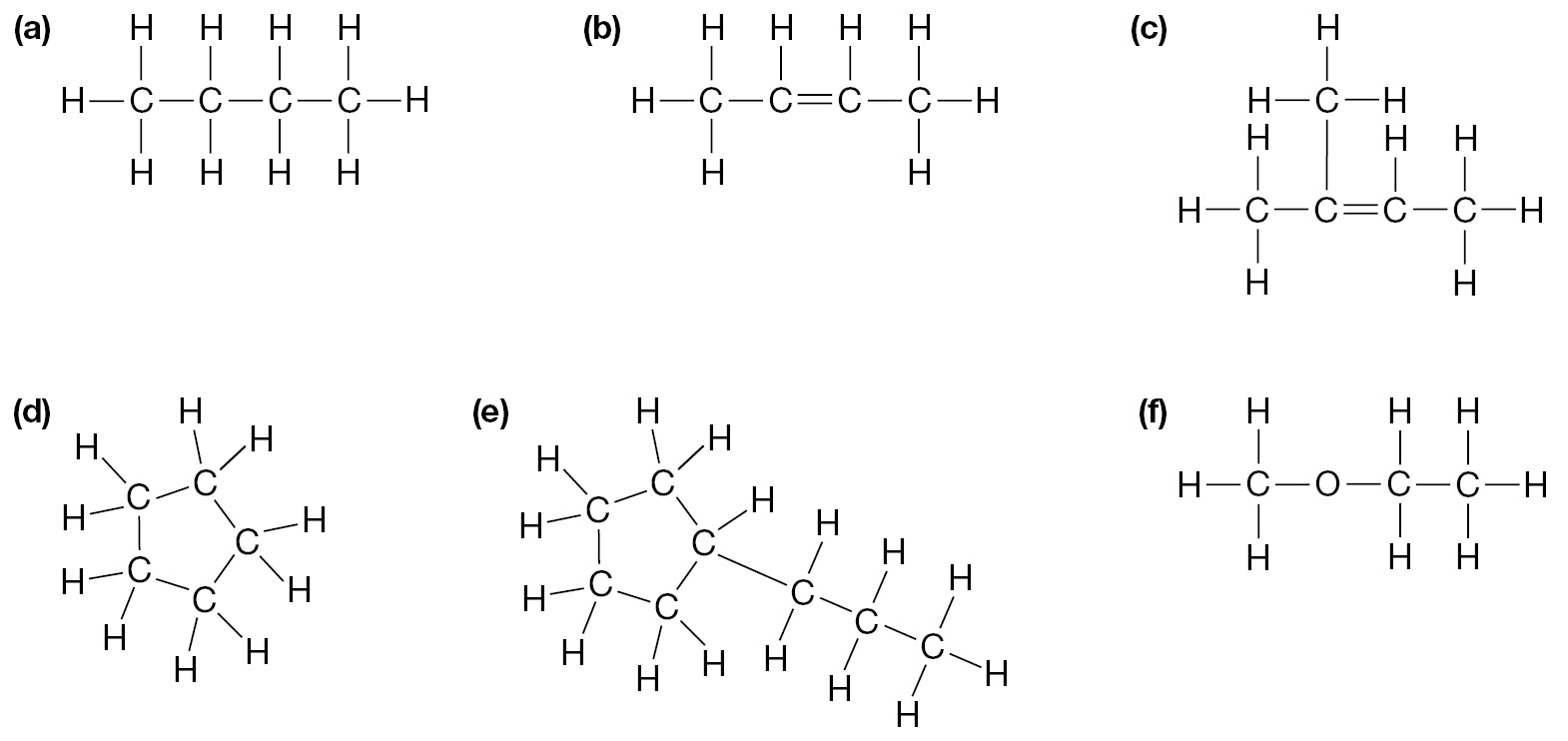
- 1.32Draw the following Lewis structures as condensed formulas.
More information
Condensed structural formulas show six different organic compounds. The first structure shows a linear four-carbon chain where carbons 1 and 4 are each bonded to three hydrogen atoms and carbons 2 and 3 are each bonded to two hydrogen atoms. The second structure shows a linear four-carbon chain where carbons 1 and 4 are each bonded to three hydrogen atoms and carbons 2 and 3 are each bonded to one hydrogen atom. A double bond connects carbons 2 and 3. The third structure shows a four-carbon chain where carbons 1 and 4 are each bonded to three hydrogen atoms. A double bond connects carbons 2 and 3. Carbon 2 is bonded to a methyl group, and carbon 3 is bonded to one hydrogen atom. The fourth structure shows a pentagonal ring made of five carbon atoms connected by single bonds. Each carbon atom is bonded to two hydrogen atoms. The fifth structure shows a pentagonal ring made of five carbon atoms connected by single bonds. One of the carbon atoms is bonded to a hydrogen atom and a propyl group, and the other four carbon atoms are each bonded to two hydrogen atoms. The sixth illustration shows a two-carbon chain where carbon 1 is bonded to two hydrogen atoms and an oxygen atom, which is bonded to a methyl group. Carbon 2 is bonded to three hydrogen atoms.
- 1.33Draw the molecules in Problem 1.32 as line structures.
- 1.34Draw Lewis structures for the following molecules. Include all lone pairs and H atoms.
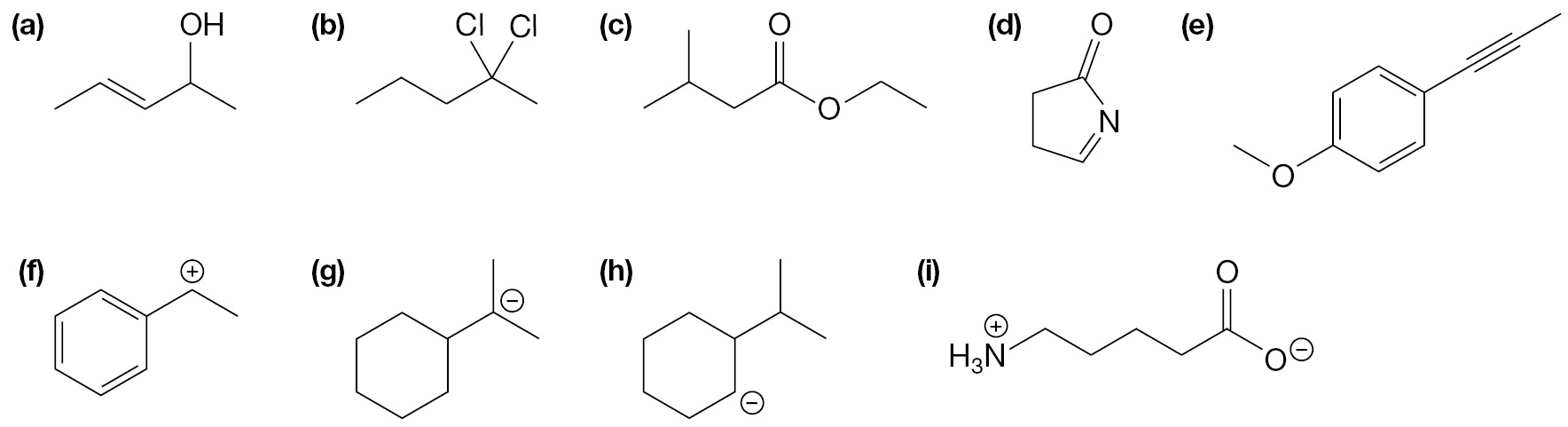
More information
Skeletal structural formulas of nine organic compounds. The first structure shows a zigzag five-carbon chain with a double bond between carbons 3 and 4. Carbon 2 is bonded to an alcohol group. The second structure shows a zigzag five-carbon chain with carbon 2 bonded to two chlorine atoms by single bonds. The third structure shows a zigzag four-carbon chain where carbon 1 is bonded by a double bond to an oxygen atom and by a single bond to another oxygen atom, which is bonded to an ethyl group. Carbon 3 in the chain is bonded to a methyl group. The fourth structure shows a pentagonal ring made of four carbon atoms and one nitrogen atom, in the second position. A double bond exists between the nitrogen atom and carbon 3. Carbon 1 is bonded to an oxygen atom by a double bond. The fifth structure shows a benzene ring with a triple bond arising from one carbon atom. The carbon at the para position is bonded by a single bond to an oxygen atom, which is connected to a methyl group. The sixth structure shows a benzene ring with one of the carbon atoms bonded to an ethyl group in which the connecting carbon carries a positive charge. The seventh structure shows a hexagonal six-carbon ring where one of the carbon atoms is bonded by a single bond to another carbon carrying a negative charge. This carbon is bonded to two methyl groups. The eighth structure shows a hexagonal six-carbon ring where one of the carbon atoms is bonded by a single bond to another carbon atom, which is bonded to two methyl groups. The carbon at the ortho position in the ring carries a negative charge. The ninth structure shows a zigzag five-carbon chain where carbon 1 is bonded to is bonded by a double bond to an oxygen atom and by a single bond to another oxygen atom carrying a negative charge. Carbon 5 is bonded to an ammonia ion carrying a positive charge.
- 1.35Draw each species in Problem 1.34 as a condensed formula. Explicitly draw all bonds between non-hydrogen atoms in which at least one non-hydrogen atom belongs to a ring.
- 1.36Redraw the line structure of cholesterol (shown here) as a condensed formula. Explicitly draw all bonds between non-hydrogen atoms in which at least one non-hydrogen atom belongs to a ring. What advantages do line structures have?
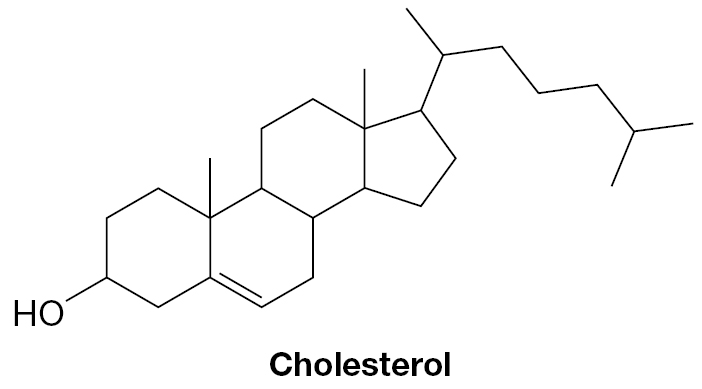
More information
A skeletal structural formula shows a cholesterol molecule. The structure shows two hexagonal six-carbon rings fused together. The second ring is fused with a third hexagonal ring in a bent fashion. The third ring is fused with a pentagonal five-carbon ring beside it. Double bonds exist between carbons 5 and 6. Carbon 3 is bonded to a hydroxyl group, and carbons 10, 13, and 25 are each bonded to a methyl group. Carbon 17 is bonded to carbon 20, which is in the second position in a zigzag seven-carbon chain.
Section 1.13 An Overview of Organic Compounds: Functional Groups
- 1.37Circle each functional group in glucose (Problem 1.30) and sucrose (Problem 1.31). What compound class is characteristic of each functional group?
- 1.38Dimethyl sulfide (H3C—S—CH3) contains a functional group that is not listed in Table 1-6. Which functional group in Table 1-6 do you think its reactivity might resemble?
- 1.39Which one of the following compounds do you think will behave most similarly to ethanol (CH3CH2OH)? Explain.
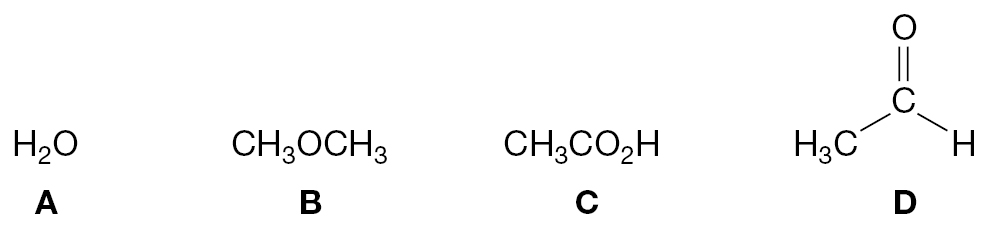
More information
Four illustrations show the condensed formulas of four different organic compounds. The first shows H 2 O, the second shows C H 3 O C H 3, the third shows C H 3 C O 2 H, and the fourth shows a carbon atom bonded to three hydrogen atoms and to another carbon atom which forms part of an aldehyde group.
- 1.40Identify all functional groups that are present in strychnine, a highly toxic alkaloid used as a pesticide to kill rodents, whose line structure is shown here. What compound class is characteristic of each of those functional groups?
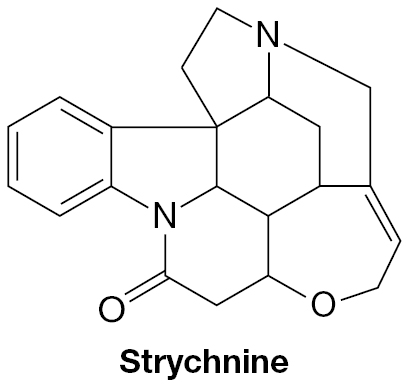
More information
structural formula of strychnine, an organic compound. The structure shows a hexagonal ring made of six carbon atoms numbered from 1 to 6, with alternate double bonds. This ring is fused with ring 2, which is a five-membered ring constituted by four carbon atoms numbered from 5 to 8, and a nitrogen atom in the ninth position. This ring is fused with ring 3, which is a six-membered ring made of five carbon atoms numbered 8, 10, 11, 12, and 13, and a nitrogen atom at the ninth position. Carbon 10 is bonded to an oxygen atom by a double bond. Ring 3 is bonded with ring 4, which is a hexagonal ring made of six carbon atoms numbered from 7, 8, 13, 14, 15, and 16. Carbon 16 is bonded to a nitrogen atom, which is part of ring 5 and ring 6. Ring 5 is a five-membered ring made of carbon atoms 7, 16, 17, and 18, the nitrogen atom at the nineteenth position. Ring 6 is a six-membered ring made of carbon atoms 14, 15, 16, 20, and 21, and the nitrogen atom at the nineteenth position. Ring 3, 4, and 6 are all fused with ring 7, which is a seven-membered ring with carbon atoms numbered 12, 13, 14, 21, 22, and 23, and an oxygen atom at the twenty-fourth position. A double bond exists between carbons 21 and 22.
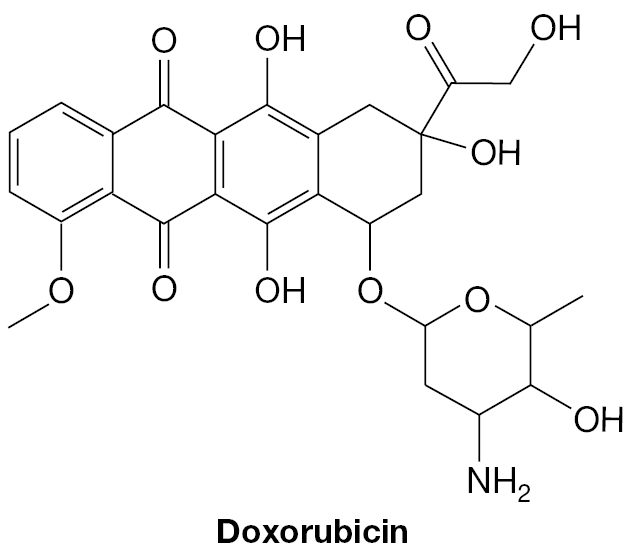
- 1.41Identify all functional groups that are present in doxorubicin, a drug used as an antibiotic and cancer therapeutic, whose line structure is shown here. What compound class is characteristic of each of those functional groups?
More information
Skeletal structural formula of doxorubicin, an organic compound. The structure shows four hexagonal rings fused in a linear manner. The first ring is a benzene ring with carbon 4 bonded to a methoxy group. The second ring is a six-carbon ring with carbons 7 and 10 each bonded to an oxygen atom by a double bond. The third ring is a benzene ring with carbons 11 and 14 each bonded to a hydroxyl group. The fourth ring is a six-carbon ring with carbon 17 bonded to a hydroxyl group and a carbon atom, which is bonded to an oxygen atom by a double bond and by a single bond to another carbon atom, which is bonded to a hydroxyl group. Carbon 15 bonded to an oxygen atom, which is bonded to a six-membered ring constituted by five carbon atoms and an oxygen atom. With respect to the oxygen atom, the carbon atom at the ortho position is bonded to a methyl group, the carbon at the meta position is bonded to a hydroxyl group, and the carbon at the para position is bonded to an amine group.
Section 1.14 The Organic Chemistry of Biomolecules
- 1.42Identify all of the amino acids whose side chains contain functional groups found in these compound classes: (a) alcohol; (b) amide; (c) carboxylic acid; (d) amine; (e) arene
- 1.43The R group in alanine is CH3, whereas the R group in aspartic acid is CH2CO2H. After consulting Figure 1-42 (p. 38), draw the complete Lewis structure for each of these amino acids.
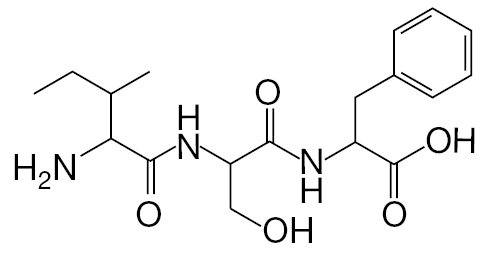
- 1.44Shown here is a tripeptide, which consists of three amino acids linked together in a chain. Circle and name each amino acid. Hint: After consulting Figure 1-42 (p. 38), can you identify each of the three α-carbons in this tripeptide?
More information
Skeletal structural formula of a tripeptide, which has three amino acids bonded together. The structure shows a carbon atom bonded to an amine group, a sec-butyl group, and to another carbon atom, which is bonded to an oxygen atom by a double bond. This carbon atom is bonded to a secondary amine group, which is bonded to another carbon atom. This carbon is bonded to two other carbon atoms, one of which is bonded to a hydroxyl group, and the other bonded to an oxygen atom by a double bond and to a secondary amine group by a single bond. This amine group is bonded to a carbon atom, which is bonded to a carboxyl group and a carbon atom, which is bonded to a benzene ring.
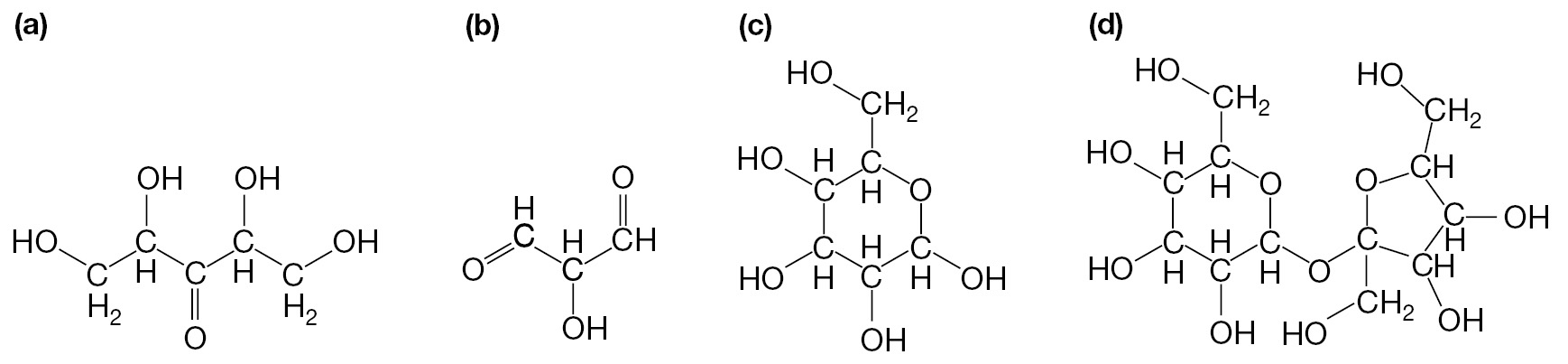
- 1.45Which of the following molecules are carbohydrates? Which are monosaccharides?
More information
Condensed structural formulas of four organic compounds. The first structure shows a five-carbon chain where carbons 1, 2, 4, and 5 are each bonded to one hydroxyl group. Carbon 3 is bonded to an oxygen atom by a double bond. The second structure shows a three-carbon chain where carbons 1 and 3 are each part of an aldehyde group and carbon 2 is bonded to a hydroxyl group. The third structure shows a hexagonal ring constituted by an oxygen atom and five carbon atoms. Carbons 1, 2, 3, and 4 are each bonded to a hydroxyl group, and carbon 5 is bonded to carbon 6, which is further bonded to a hydroxyl group. The fourth structure shows an oxygen atom connecting a hexagonal ring constituted by an oxygen atom and five carbon atoms, and a pentagonal ring constituted by an oxygen atom and four carbon atoms. In the hexagonal ring, carbon 1 is bonded to the connecting oxygen atom. Carbons 2, 3, and 4 are each bonded to a hydroxyl group, and carbon 5 is bonded to carbon 6, which is further bonded to the hydroxyl group. In the pentagonal ring, carbon 2 is bonded to the connecting oxygen atom. Carbons 1, 3, 4, and 6 are each bonded to a hydroxyl group.
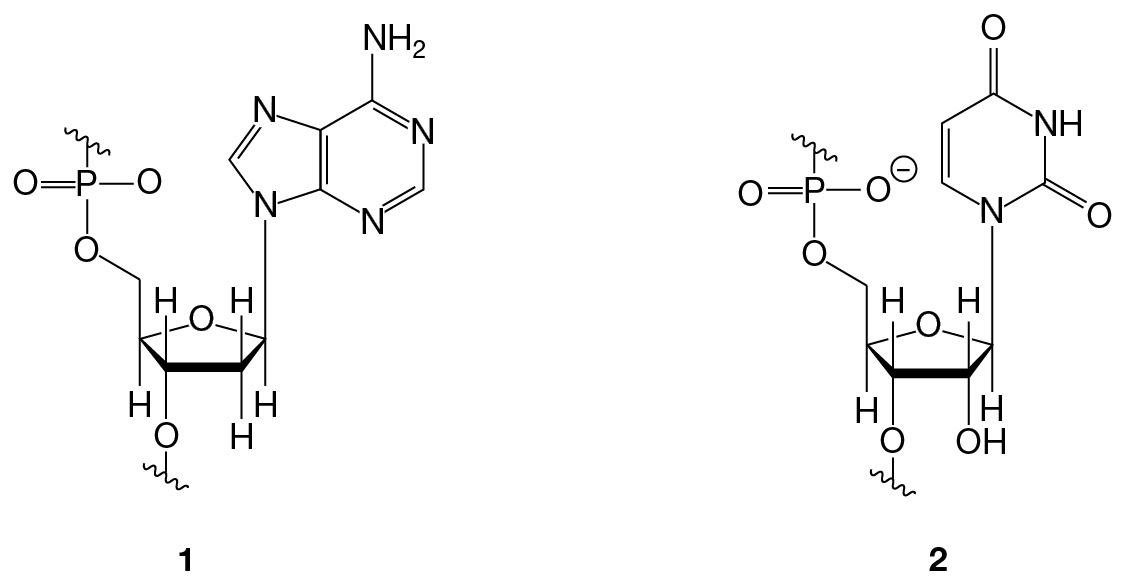
- 1.46For each of the following nucleotides, (a) circle and label the phosphate group, the sugar group, and the nitrogenous base; (b) determine whether it can be part of RNA or DNA; and (c) identify the nitrogenous base that it contains
More information
Condensed structural formulas of two nucleotides. The first shows deoxyribose sugar bonded to a phosphate group and adenine. The second shows deoxyribose sugar bonded to a phosphate group and uracil. Deoxyribose consists of a pentagonal ring constituted by an oxygen atom and four carbon atoms. Carbon 1 is bonded to a hydrogen atom and to a nitrogen atom in the nitrogenous base. Carbon 2 is bonded to two hydrogen atoms in the first structure. In the second structure carbon 2 is bonded to a hydrogen and an O H group. Carbon 3 is bonded to a hydrogen atom and to an oxygen atom, which is bonded to the phosphate group of another nucleotide, carbon 4 is bonded to a hydrogen atom and to carbon 5, which is further bonded to a phosphate group. The phosphorus atom in the phosphate group is bonded to the sugar group of another nucleotide. Adenine consists of a hexagonal ring with nitrogen atoms in the first and third positions, fused with a pentagonal ring with nitrogen atoms in the seventh and ninth positions. Double bonds exist between carbon 2 and nitrogen 3, carbon 4 and carbon 5, carbon 6 and nitrogen 1, and nitrogen 7 and carbon 8. Carbon 6 is bonded to an amine group. The nitrogen in the ninth position is bonded to deoxyribose. Uracil shows a hexagonal ring with nitrogen atoms in the first and third positions. Double bonds exist between carbons 5 and 6. Carbon 2 and carbon 4 are each bonded to an oxygen atom by a double bond. Nitrogen 1 is bonded to deoxyribose, and nitrogen 3 is bonded to a hydrogen atom.
- 1.47This is a segment of a nucleic acid. (a) Is this a segment of RNA or DNA? (b) Circle and name each nucleotide.
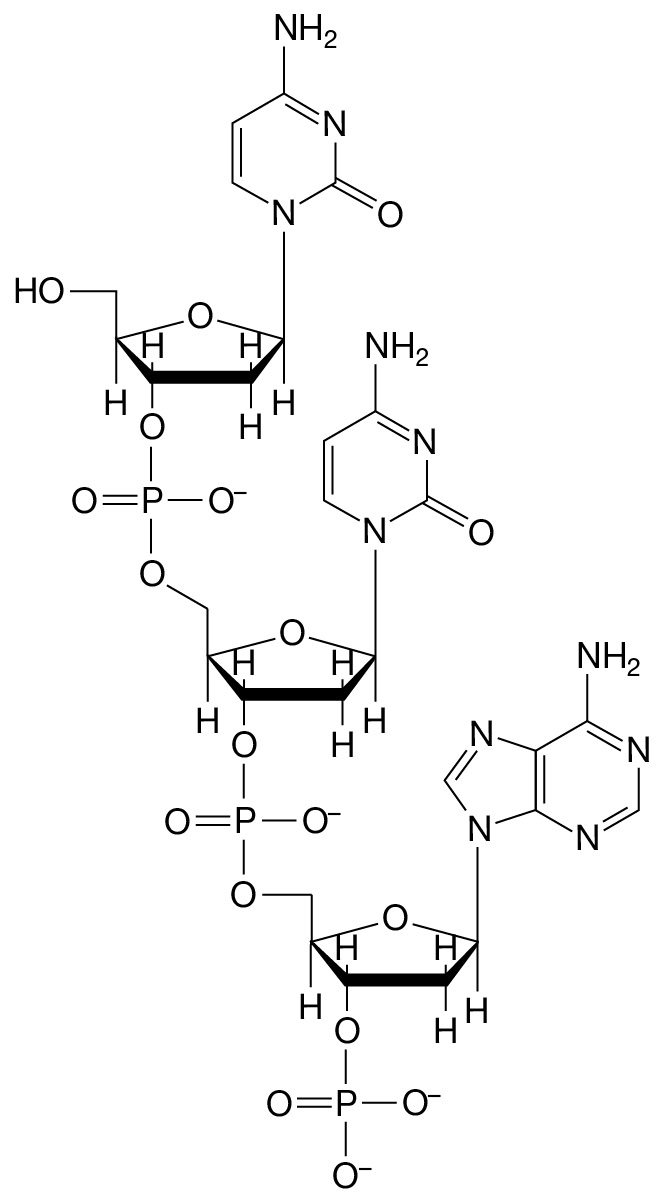
More information
Condensed structural formula of a nucleic acid segment. The structure shows a segment of a nucleic acid with three nucleotides linked together. Each nucleotide consists of a cyclic sugar linked to a nitrogenous base and a phosphate. The first nucleotide is made of deoxyribose sugar linked to a phosphate group and adenine. The second and third nucleotides are each made of deoxyribose sugar linked to a phosphate group and cytosine. Deoxyribose consists of a pentagonal ring constituted by an oxygen atom and four carbon atoms. Carbon 1 is bonded to a hydrogen atom and to a nitrogen atom in the nitrogenous base. Carbon 2 is bonded to two hydrogen atoms, carbon 3 is bonded to a hydrogen atom and to an oxygen atom, which is bonded to the phosphate group of another nucleotide, carbon 4 is bonded to a hydrogen atom and to carbon 5, which is further bonded to a phosphate group. The phosphorus atom in the phosphate group is bonded to the sugar group of another nucleotide. In the third nucleotide, carbon 5 is further bonded to a hydroxyl group. Adenine consists of a hexagonal ring with nitrogen atoms in the first and third positions, fused with a pentagonal ring with nitrogen atoms in the seventh and ninth positions. Double bonds exist between carbon 2 and nitrogen 3, carbon 4 and carbon 5, carbon 6 and nitrogen 1, and nitrogen 7 and carbon 8. Carbon 6 is bonded to an amine group. The nitrogen in the ninth position is bonded to deoxyribose. Cytosine consists of a hexagonal ring with nitrogen atoms in the first and third positions. Double bonds exist between nitrogen 3 and carbon 4, and carbons 5 and 6. Carbon 2 is bonded to an oxygen atom by a double bond and carbon 4 is bonded to an amine group. The nitrogen in the first position is bonded to deoxyribose.
- 1.48Determine whether each of the following structures is a carbohydrate. If so, is it also a monosaccharide?
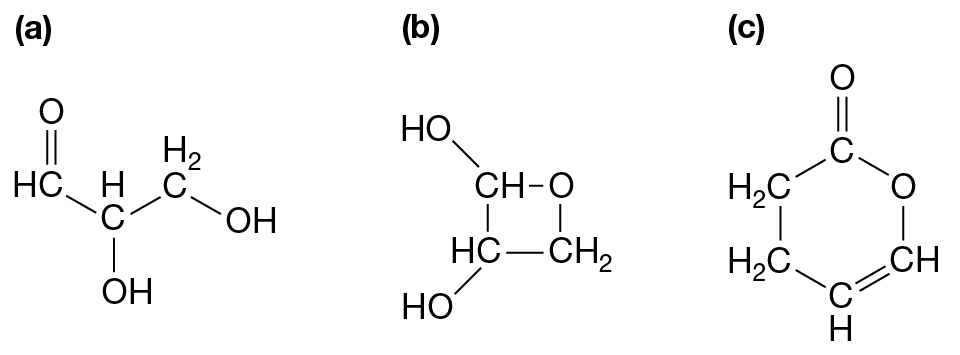
More information
Condensed structural formulas show three different organic compounds. The first structure shows a three-carbon chain where carbon 1 is part of the aldehyde group, and carbons 2 and 3 are each bonded to an alcohol group. The second structure shows four-membered ring made of three carbons and one oxygen. Carbons 1 and 2 are each bonded to an alcohol group. The third structure shows a six-membered ring made of five carbons and one oxygen. A double bond exists between carbons 1 and 2, and carbon 5 is bonded to an oxygen atom by a double bond.
Integrated Problems
- 1.49For each uncharged molecule shown here, (a) complete the Lewis structure by adding multiple bonds and/or lone pairs and (b) draw dipole arrows along each polar covalent bond. Pay attention to the lengths of the arrows.
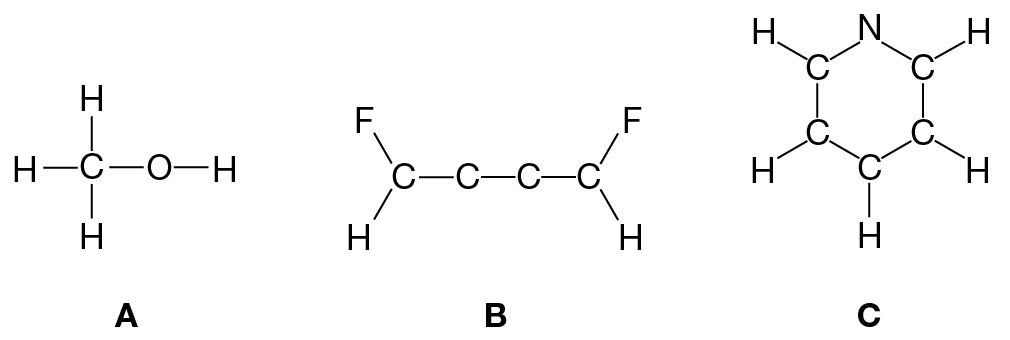
More information
A set of three condensed structural formulae of three molecules. The first condensed structural formula consists of a central carbon atom, single bonded to three hydrogen atoms and the oxygen atom of a hydroxyl group. The second condensed structural formula consists of a chain of four single bonded carbon atoms, with the first and the last carbon atom attached to a fluorine atom and a hydrogen atom by single bonds. The third condensed structural formula consists of a single bonded hexagonal ring. The ring comprises of one nitrogen atom and five carbon atoms. Each carbon atom is further single bonded to a hydrogen atom.
- 1.50Which of the following pairs are not resonance structures of one another? Lone pairs of electrons are not shown. Identify where each lone pair that is not shown belongs.
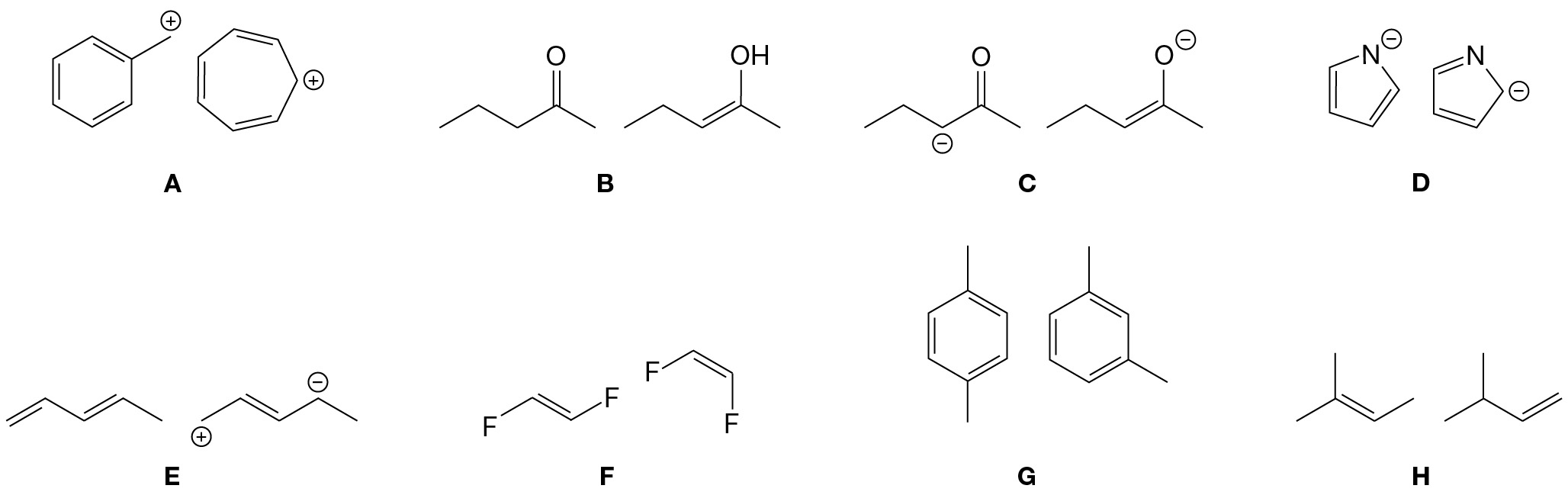
More information
Eight illustrations show different pairs of skeletal structural formulas of organic compounds. The first pair shows two structures. The first structure shows a benzene ring with alternate single and double bonds. A single bond emerges from one of the atoms in the ring, and the atom at the end of the bond carries a positive charge. The second structure shows a seven-membered ring with double bonds between atoms 1 and 2, 4 and 5, and 6 and 7. The atom in the third position carries a positive charge. The second pair shows two structures, each with a zigzag line that has two crests and three troughs. In the first structure, atom 2 is bonded to an oxygen atom by a double bond. In the second, atom 2 is bonded by a single bond to a hydroxyl group. Double bonds exist between atoms 2 and 3. The third pair shows two structures, each with a zigzag line that has two crests and three troughs. In the first structure, atom 2 is bonded to an oxygen atom by a double bond. In the second, atom 2 is bonded by a single bond to an oxygen atom carrying a negative charge. Double bonds exist between atoms 2 and 3. The fourth pair shows two structures, each with a five-membered ring with a nitrogen atom at one of the vertices. In the first structure, double bonds exist between atoms 1 and 2, and 3 and 4. The nitrogen atom carries a negative charge. In the second structure, double bonds exist between the nitrogen atom and atom 1, and atoms 2 and 3. Atom 4 carries a negative charge. The fifth pair shows two structures, each with a zigzag line that has two crests and three troughs. The first has double bonds between atoms 1 and 2, and atoms 3 and 4. The second has double bonds between atoms 2 and 3. Atom 1 carries a positive charge and atom 4 carries a negative charge. The sixth pair shows two structures. The first shows a zigzag line that has two crests and two troughs, with a fluorine atom at each end. A double bond exists between the two atoms in the middle. The second structure shows a horizontal line with two diagonal lines at either end, ending with a fluorine atom each. A double bond exists along the horizontal line. The seventh pair shows two structures, each with a benzene ring. In the first, two single bonds emerge from the atoms in the para positions, while in the second single bonds emerge from the atoms in the meta positions. The eighth pair shows two structures, each with a zigzag line that has two crests and two troughs. A single bond emerges from the atom in the second positions. In the first, a double bond exists between atoms 2 and 3, and in the second, a double bond exists between atoms 3 and 4.
- 1.51Which of the following electrostatic potential maps best represents nitromethane (CH3NO2)? Explain.
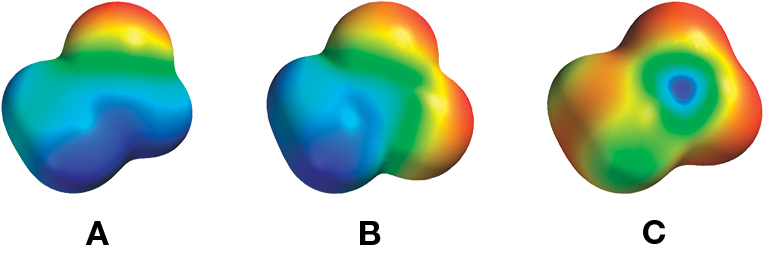
More information
Three illustrations show different electrostatic maps of nitromethane. The first is shaded in blue at the lower end and around one of the oxygen atoms, and in red near the other oxygen atom. The central portion from top to bottom is shaded in yellow, green, and turquoise. The second illustration is shaded in red at the upper ends representing the oxygen atoms and in blue at the lower end representing the hydrogen atoms. The central portion from top to bottom is shaded in yellow, green, and turquoise. The third illustration is shaded in red at the upper ends representing the oxygen atoms and in one of the lower ends representing the hydrogen atoms. The central portion representing the nitrogen atom is shaded in blue, surrounded by green and yellow.
- 1.52Which of the following species is responsible for the electrostatic potential map provided? Explain.
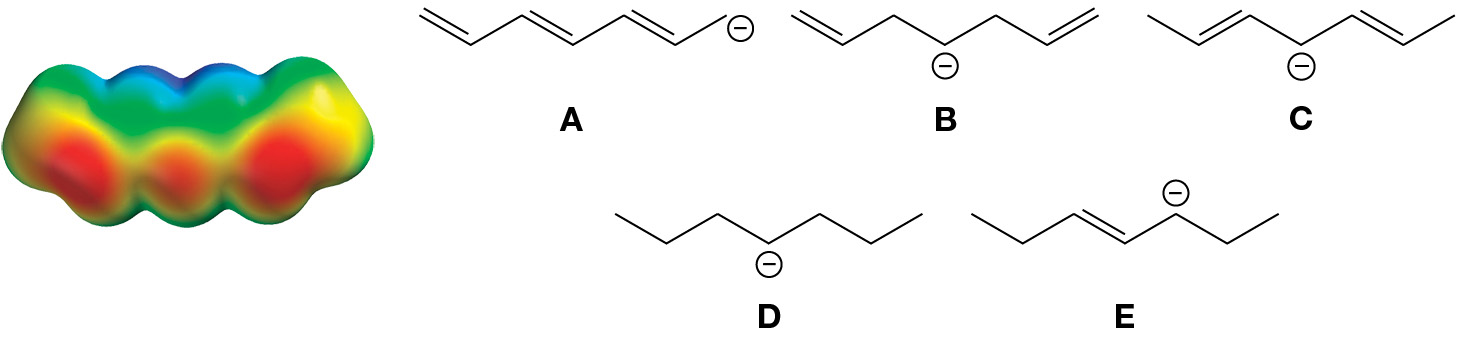
More information
An electrostatic potential map of an organic compound accompanied by five skeletal structural formulas. The electrostatic potential map shows seven atoms bonded together in a zigzag manner and is shaded in red at the troughs. The two crests in the middle are shaded in blue. The two crests on either end are shaded in green, and the central portion is shaded in green and yellow. The first skeletal structural formula shows double bonds between atoms 1 and 2, 3 and 4, and 5 and 6. Atom 7 carries a negative charge. The second shows doubles bonds between atoms 1 and 2, and 6 and 7. Atom 4 carries a negative charge. The third structure shows doubles bonds between atoms 2 and 3, and 5 and 6. Atom 4 carries a negative charge. The fourth structure consists entirely of single bonds, and atom 4 carries a negative charge. The fifth structure shows a double bond between atoms 3 and 4, atom 5 carries a negative charge.
- 1.53Draw the structure of a molecule with formula C5H9N that contains functional groups characteristic of (a) an alkyne and an amine; (b) two alkenes and an amine; (c) a nitrile
- 1.54Draw all of the resonance structures for each of the following species. Be sure to include the curved arrows that indicate which pairs of electrons are shifted in going from one resonance structure to the next. Draw the resonance hybrid of each species.

More information
Four skeletal structural formulas show four different organic compounds. The first shows a hexagonal six-carbon ring with double bonds between carbons 2 and 3, and carbons 4 and 5. Carbon 1 carries a positive charge and is bonded to a hydroxyl group. Carbon 6 is bonded to a methyl group. The second structure shows a zigzag line with three crests and four troughs. Double bonds exist between the atoms in the first and second positions and the sixth and seventh positions. A double bond emerges from the atom in the third position. The third structure shows an inverted-V with a crest and two troughs. The atoms in the first and third positions each carry a negative charge. A double bond arises from the atom in the second position. The fourth structure shows a zigzag line with three crests and four troughs. The first and seventh positions are occupied by oxygen atoms. Double bonds exist between the atoms in the second and third, fourth and fifth, and sixth and seventh positions. The oxygen atom in the first position carries a negative charge.
- 1.55(a) Draw all valid resonance contributors for this ion. Show how the electrons can be moved by using curved arrows. (b) Draw the resonance hybrid.
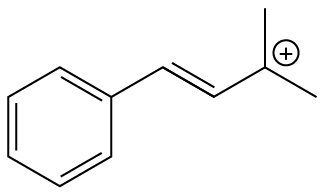
More information
A skeletal structural formula of an organic compound. The structure shows a zigzag line with two crests and three troughs. Double bonds exist between the atoms in the second and third positions. A single bond emerges from the atom in the fourth position, which carries a positive charge. The atom in the first position is bonded to a hexagonal ring with alternating single and double bonds.
- 1.56Diazomethane has the formula H2CN2. Draw all valid resonance contributors for diazomethane and, using Table 1-3, propose which one contributes more to the resonance hybrid. Hint: There are no structures that avoid charged atoms.
- 1.57(a) Draw all resonance contributors for the following ion. In drawing each additional resonance structure, use curved arrows to indicate which pairs of electrons are being shifted. (b) Draw the resonance hybrid. (c) Which C—C bond is the longest?
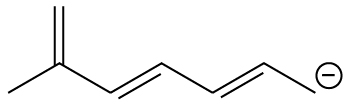
More information
A skeletal structural formula of an organic compound. The structure shows a zigzag line with three crests and four troughs. Double bonds exist between atoms in the third and fourth positions and the fifth and sixth positions. The atom in the seventh position carries a negative charge. A double bond emerges from the atom in the second position.