3.4 Valence Bond Theory and Trigonal Planar Electron Geometry: Double Bonds, sp2 Hybridization, π Bonds, and Carbocations
Section 3.4 Objectives
You will be able to:
Identify the hybridization of an atom that has a trigonal planar electron geometry.
Describe the orbitals that such an atom contributes to the VB picture of a molecule.
Draw the VB picture of a molecular species that contains atoms with trigonal planar electron geometry.
Characterize a π bond according to the type of overlap from contributing orbitals.
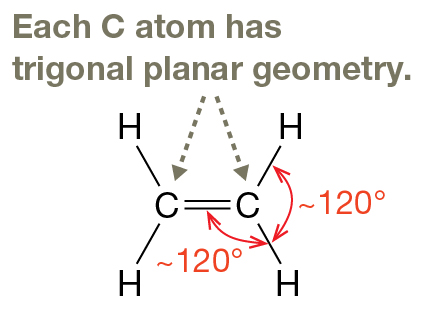
So far we have applied VB theory to species that contain single bonds only, in which each non-hydrogen atom has a tetrahedral electron geometry. In this section, we extend VB theory to describe species containing atoms with trigonal planar geometry. For example, each of the two C atoms in ethene (Figure 3-10) has a trigonal planar geometry.
More information
Condensed structural formula of ethene. Each carbon atom has trigonal planar geometry. Two carbon atoms are shown bonded by a double bond. Each carbon atom is bonded by single bonds to two hydrogen atoms. The angle between the bonds to the two hydrogen atoms on a given carbon is approximately 120 degrees. The angle between the double bond and a bond to a hydrogen atom is approximately 120 degrees.
FIGURE 3-10The geometry of ethene
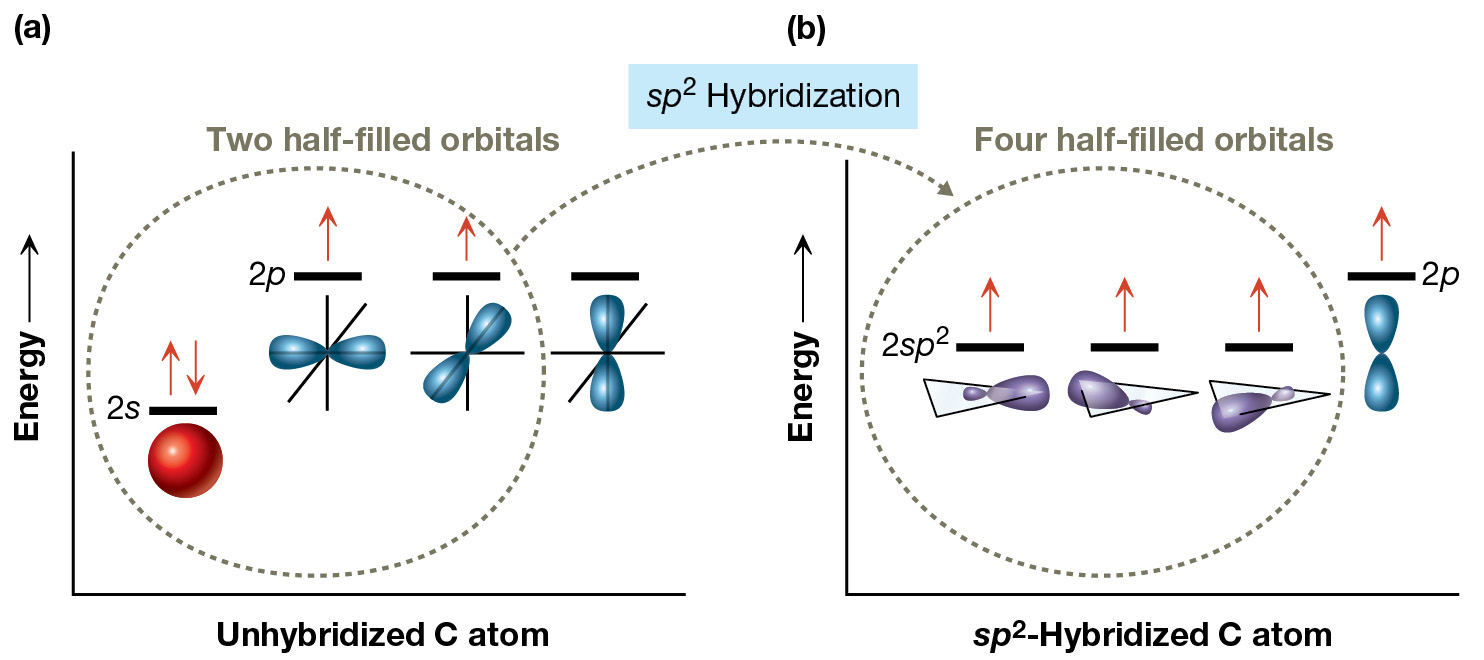
What types of valence orbitals do the C atoms in ethene contribute to the VB picture? To answer this question, we turn again to hybridization. In this case, each C atom needs three hybrid orbitals to accommodate three electron groups. To arrive at those three hybrid orbitals, we consider mixing three pure orbitals from the valence shell: the s orbital and two of the three valence p orbitals. This concept is called sp2 hybridization (the superscript 2 indicates that two of the three p orbitals are used) and is shown schematically in Figure 3-11. The new orbitals that are produced are called sp2 hybrid orbitals, and the atom is said to be sp2-hybridized:
Any atom that has a trigonal planar electron geometry is sp2-hybridized.
Three sp2 hybrid orbitals and one unhybridized p orbital are contributed from the atom’s valence shell.
The sp2 hybrid orbitals point to the corners of a triangle.
The unhybridized p orbital is perpendicular to that triangle.
Because sp2 hybrid orbitals are generated by mixing one s orbital and two p orbitals, each sp2 hybrid orbital has 33.33% s-character (one part out of three) and 66.67% p-character (two parts out of three).
More information
Two charts show the energy levels of electrons in an unhybridized carbon atom and an s p 2 hybridized carbon atom. Both have four valence electrons. The first chart is of an unhybridized C atom. Two electrons occupy the 2 s orbital. The s orbital is shown as a sphere. The s orbital has a low energy level. There are three p orbitals all shown as dumbbells along one of the 3 axes. Two are half filled with only one electron each and the other is empty. These orbital all have high energy levels. An arrow points from the first chart to the second chart and is labeled s p 2 hybridization. The second chart has 3 2 s p 2 orbitals all at intermediate energy levels and one 2 p orbital at a high energy level. Each s p 2 orbital has one large lobe and one small lobe and are pointed in different directions along a triangular plane. The 2 p orbital is shown as a vertical dumbbell. Each of the 4 orbital has one valence electron in it.
FIGURE 3-11sp2 Hybridization in H2C═CH2 (a) The s orbital and two of the p orbitals from the valence shell of the unhybridized atom mix in sp2 hybridization. (b) Those three orbitals become sp2 hybrid orbitals in an sp2-hybridized carbon atom, and they point to the corners of a triangle. The remaining p orbital is perpendicular to the triangle that contains the hybrid orbitals.
CONNECTIONS 3.4
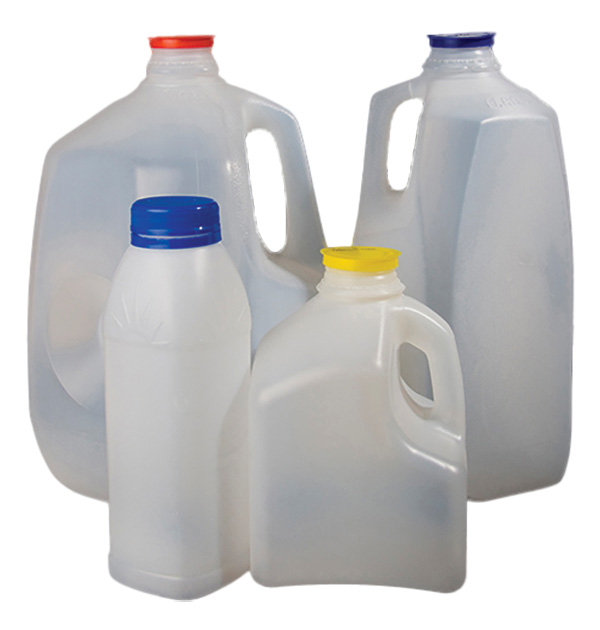
Ethene and its uses Ethene (Fig. 3-10), also called ethylene, is the starting material used to produce polyethylene, a widely used plastic. Ethene is also very useful in the chemical laboratory because the C═C double bond can undergo highly selective reactions, including ones we will encounter in Chapter 12.
Carbon, moreover, contributes four valence electrons, so the three sp2 orbitals and the p orbital in Figure 3-11 are each half-filled.
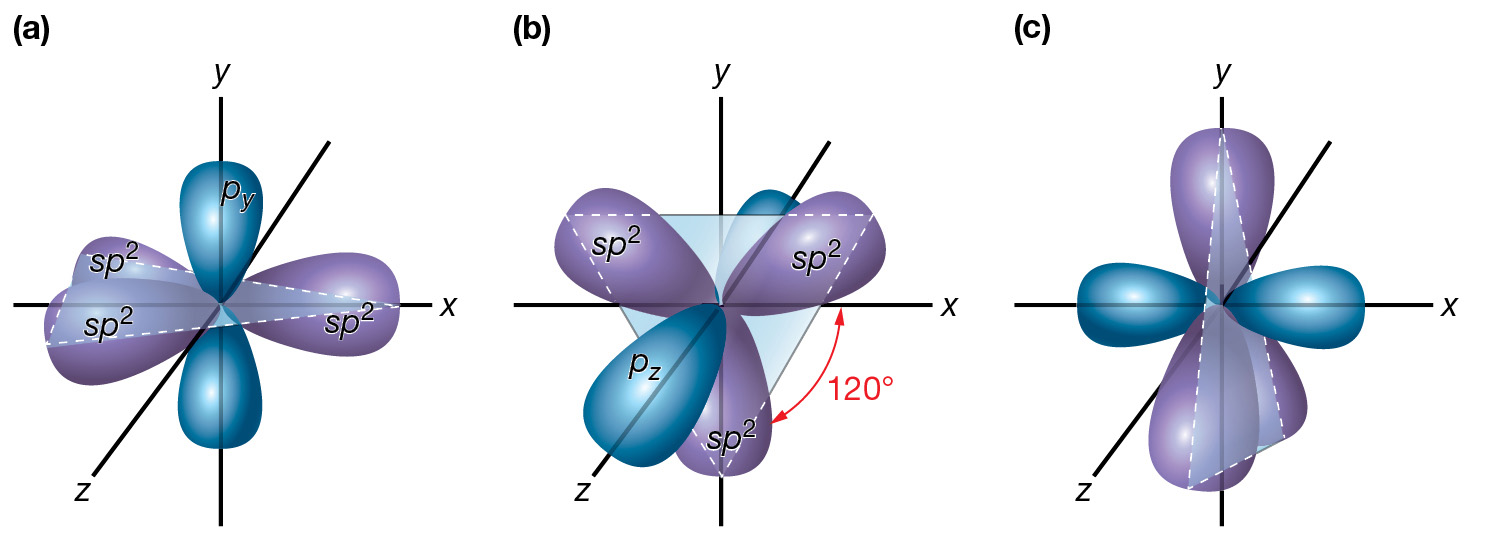
In Figure 3-11, the plane of the triangle containing the hybrid orbitals is perpendicular to the page. The unhybridized p orbital, which lies vertically in the page (i.e., along the y-axis), is the py orbital. Figure 3-12a shows how the sp2-hybridized atom would appear with all four of these orbitals drawn together, but an sp2-hybridized atom can have other orientations, too, as shown in Figure 3-12b and 3-12c.
More information
Three illustrations show the different ways of depicting an s p 2-hybridized atom. Each illustration shows the x, y, and z axes. The first illustration shows a dumbbell shaped p y orbital aligned along the y axis, with one lobe darker than the other. The s p 2 orbital, with three equal-sized lobes arranged in a triangular manner, occupies the x z plane. The edges of these three lobes are connected to show the triangle. The second illustration shows a dumbbell shaped p z orbital aligned along the z axis, with one lobe darker than the other. The s p 2 orbital, with three equal-sized lobes arranged in a triangular manner, occupies the x y plane. The edges of these three lobes are connected to show the triangle. A curved arrow from one lobe to the next is labeled “120 degrees.” The third illustration shows a dumbbell shaped p x orbital aligned along the x axis, with one lobe darker than the other. The s p 2 orbital, with three equal-sized lobes arranged in a triangular manner, occupies the yz plane. The edges of these three lobes are connected to show the triangle.
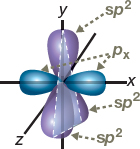
FIGURE 3-12Different orientations of an sp2-hybridized atom In all three orientations, the sp2 hybrid orbitals (purple) lie in a plane and point to the corners of a triangle (small lobes are omitted), and an unhybridized p orbital is perpendicular to that triangle. (a) The triangle is perpendicular to the page, and the unhybridized p orbital is the py. (b) The triangle lies in the plane of the page, and the unhybridized p orbital is the pz. (c) The triangle is perpendicular to the page, and the unhybridized p orbital is the px.
YOUR TURN 3.5
In Figure 3-12c, label each orbital as either sp2, px, py, or pz.
SHOW ANSWERHIDE ANSWER
More information
Orbital structure on x y z axes.There are three larger teardrop orbitals that form a triangle labeled s p 2. Perpendicular there are two smaller teardrop oribtals labeled p x.
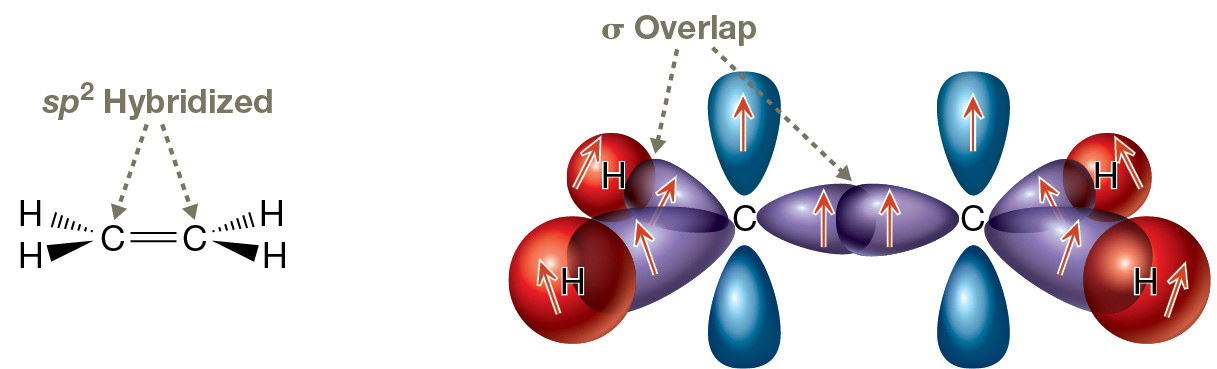
Now that we know the valence orbitals contributed by each C atom in ethene, let’s construct the molecule’s VB picture. We begin by drawing all of the contributing valence orbitals and valence electrons, as shown in Figure 3-13. Each sp2-hybridized C atom is drawn with its three hybrid orbitals and one p orbital, along with one valence electron in each orbital. Each H atom contributes an s orbital and one valence electron.
More information
Two illustrations show the overlapping of orbitals in a molecule of ethene. The first illustration shows a molecule of ethene, where two carbon atoms are bonded by a double bond. Each carbon atom is bonded to one hydrogen atom by a solid wedge and to another hydrogen atom by a dashed wedge. Arrows pointing to the two carbon atoms read, “s p 2 hybridized.” The next illustration shows a molecule of ethene where each carbon atom has three lobes around it, aligned along the directions of its bonds. Each carbon atom also has a dumbbell shaped orbital perpendicular to the plane. Around each hydrogen atom is a spherical orbital. One orbital from each carbon overlaps the other in the carbon-carbon bond, and one orbital from each carbon overlaps the orbital from hydrogen in each carbon-hydrogen bond. Arrows pointing to the overlapping portions read, “Sigma overlap.”
FIGURE 3-13Valence orbitals and electrons in ethene The dash–wedge notation of ethene is shown on the left, and the contributing orbitals are shown on the right. The H atoms each contribute a half-filled 1s orbital (red). The sp2-hybridized C atoms each contribute three sp2 hybrid orbitals (purple) and one unhybridized p orbital (blue), all of which are half-filled. Overlaps of orbitals, along the four H─C bonding axes and the one C─C bonding axis, all characterize σ symmetry.
Overlap of orbitals occurs with σ symmetry along each of the four H—C bonding axes and along the C—C bonding axis, resulting in five σ bonds. With that in mind, let’s temporarily ignore the orbitals undergoing σ overlap so we can focus on just the p orbitals, as we have done in Figure 3-14.
More information
An illustration with two parts showing the formation of bonding and antibonding molecular orbitals in ethene. The first part of the illustration shows a two-carbon chain where each carbon is bonded to a hydrogen atom by a solid wedge and to another hydrogen atom by a dashed wedge. Each carbon atom has a dumbbell shaped orbital. Two curved two-way arrows connecting the two upper lobes and the two lower lobes read, “overlap.” Next to this in parentheses the dumbell orbitals are shown as ovals which overlap. An arrow labeled “Orbital mixing” leads from this part to the second, which shows another ethene molecule where the molecular orbitals are represented by two large ovals. One oval lies below the carbon chain, and the other oval lies above it. Each oval has two electrons. An arrow points to one of the ovals and reads “Orbital built up.” A label beside this part of the illustration reads, “A pi bond.”
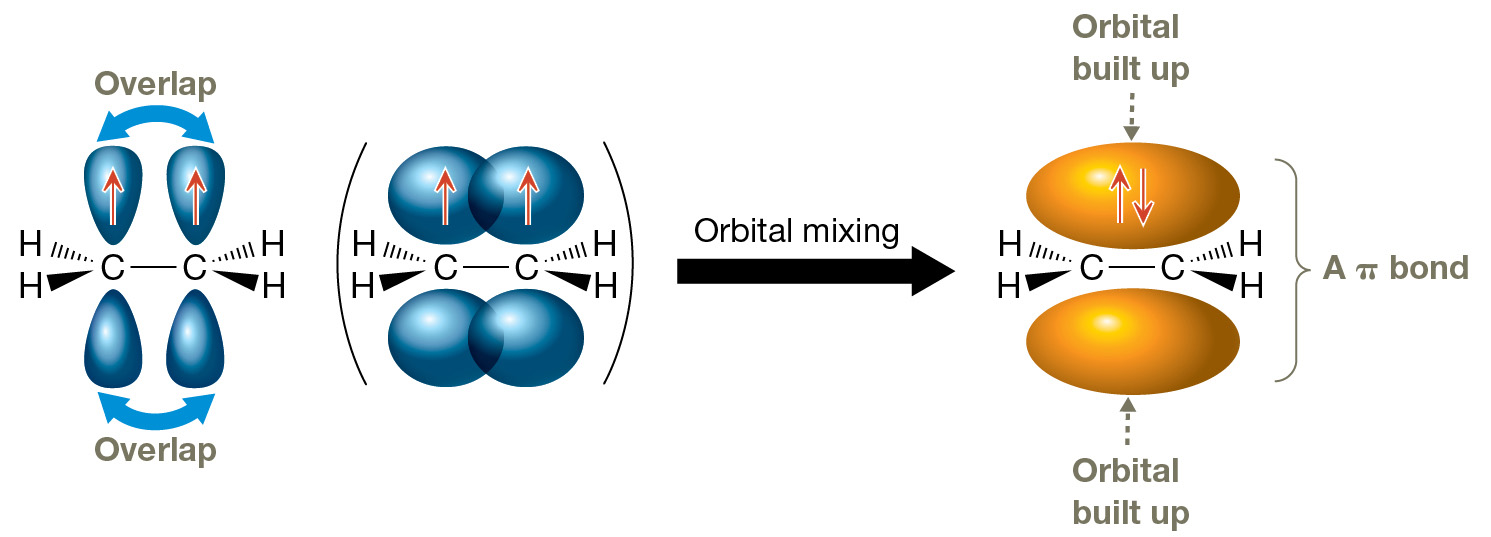
FIGURE 3-14π Overlap and π bonds (Left) Adjacent half-filled p orbitals overlap in a side-by-side fashion. Such overlap on opposite sides of the C─C bonding axis characterizes π overlap. (Right) In the resulting orbital that has been built up, the pair of electrons characterizes a π bond.
The p orbitals shown on the left in Figure 3-14, which are aligned side by side, do not overlap along a bonding axis. In fact, the p orbitals do not appear to overlap at all. Remember, however, that our depictions of orbitals represent regions of high probability of finding electrons, and there is significant probability of electrons existing beyond those regions. Therefore, even though the overlap is not immediately noticeable, those p orbitals do indeed overlap as shown in parentheses. More specifically, those p orbitals overlap on opposite sides of the C—C bonding axis, which characterizes π (pi) symmetry.
The graphic on the right in Figure 3-14 shows the orbital that results from buildup that occurs from the π overlap. The pair of electrons that occupies that orbital characterizes a π bond.
The lessons that we learn from the p orbitals in ethene can be generalized:
An orbital with π symmetry will be produced when orbitals from different atoms overlap on opposites sides of the bonding axis.
A pair of electrons occupying an orbital with π symmetry is called a π bond.
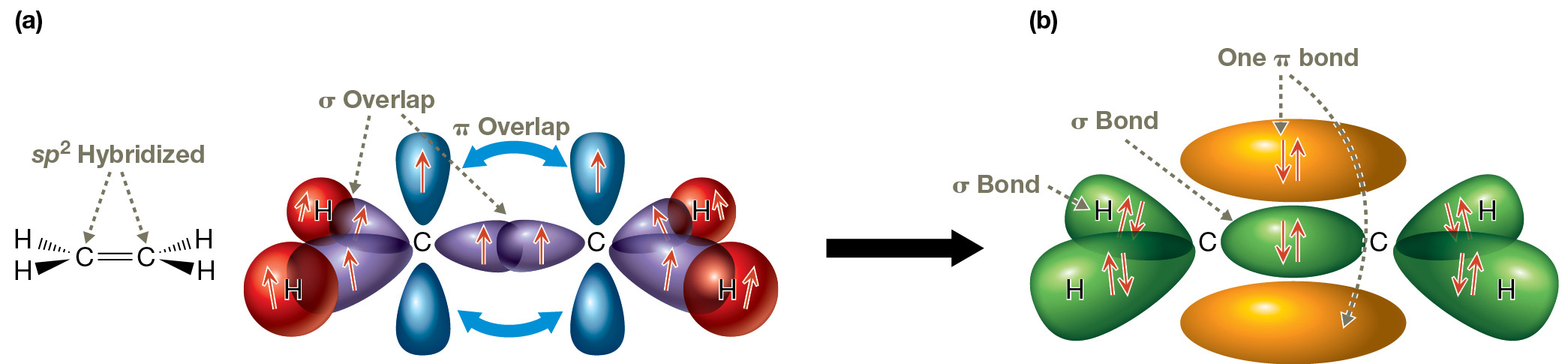
To complete the VB picture of ethene, we show in Figure 3-15 the σ and π bonds together. Notice that the C═C double bond is made up of two bond types: one σ bond and one π bond. In fact, it is always true that:
Any double bond consists of one σ bond and one π bond.
More information
Two illustrations show the overlapping of orbitals in a molecule of ethene. The first illustration shows a molecule of ethene, where two carbon atoms are bonded by a double bond. Each carbon atom is bonded to one hydrogen atom by a solid wedge and to another hydrogen atom by a dashed wedge. Arrows pointing to the two carbon atoms read, “s p 2 hybridized.” Another molecule of ethene is shown where each carbon atom has three lobes around it, aligned along the directions of its bonds. Each lobe has one electron. Each carbon atom also has a dumbbell shaped orbital perpendicular to the plane. The lobe on top has one electron. Around each hydrogen atom is a spherical orbital. One orbital from each carbon overlaps the other in the carbon-carbon bond, and one orbital from each carbon overlaps the orbital from hydrogen in each carbon-hydrogen bond. Arrows pointing to the overlapping portions read, “Sigma overlap.” Two curved two-way arrows connecting the two upper lobes and the two lower lobes read, “pi overlap.” An arrow points to a second illustration that shows the resulting orbitals. Each carbon has two teardrop shaped orbitals extending outward that have two electrons and surround a hydrogen nucleus. There is also an oval orbital between the two carbons that has two electrons. All these orbitals are sigma bonds. There are two additional oval orbitals. One is above and one is below the oval orbital between the carbons. The ovals are labeled as one pi bond.
FIGURE 3-15The valence bond picture of ethene (a) Contributing valence orbitals and valence electrons in ethene. (b) Resulting orbitals after the buildup of the orbitals is taken into account. There are five σ bonds (green) and one π bond (orange). The C═C double bond consists of one σ bond and one π bond.
SOLVED PROBLEM 3.4
How to draw the valence bond picture of a molecule that has a double bond
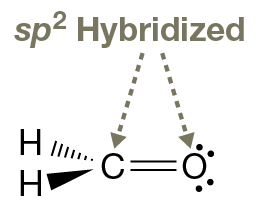
Break It Down Draw the valence bond picture of methanal (formaldehyde, H2C═O). How many σ bonds does the molecule have? How many π bonds?
Think
Solve
What electronic geometry do the C and O atoms have? What is each atom’s hybridization?
➤
Both the C and O atoms have trigonal planar electron geometry and are sp2-hybridized. The molecule is entirely planar, as shown in the dash–wedge notation. (You might build a molecular model to better visualize the molecule.)
More information
An illustration shows the dashed wedge notation of methanal. The illustration shows a molecule of methanal, where a carbon atom is bonded to an oxygen atom with two lone pairs of electrons by a double bond, to a hydrogen atom by a solid wedge, and to another hydrogen atom by a dashed wedge. Arrows pointing to the carbon atom and the oxygen atom read, “s p 2 hybridized.”
What valence orbitals does each atom contribute? How many valence electrons does each orbital contain?
➤
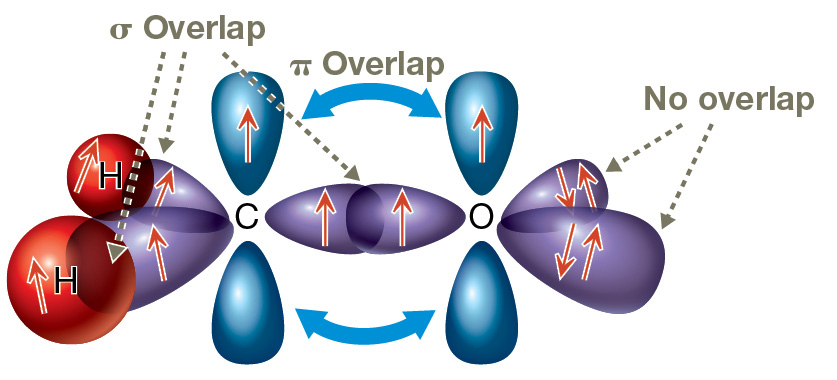
Each H atom contributes a 1s orbital containing one valence electron. The C and O atoms, which are sp2-hybridized, each contribute three hybrid orbitals and one p orbital (review Fig. 3-11). The C atom contributes four valence electrons: one valence electron in each orbital. The O atom contributes six valence electrons: Two of oxygen’s hybrid orbitals contain two electrons, whereas the third hybrid orbital and the p orbital each contain one electron.
How many regions of orbital overlap are there along bonding axes? How many are there on opposite sides of a bonding axis?
➤
Orbitals overlap along three bonding axes: the two H—C bonding axes and the C—O bonding axis. The two p orbitals are adjacent and they overlap on opposite sides of the C—O bonding axis.
More information
An illustration shows the overlapping of orbitals in a molecule of methanal. The molecule of methanal (H 2 C O) is shown. The carbon atom and the oxygen atom each have three lobes around them, aligned along the directions of the bonds. In the carbon atom, the three lobes each have one electron. In the oxygen atom, one lobe has one electron and the other lobes representing the two lone pairs have two electrons. An arrow pointing to these two lobes reads, “No overlap.” Around each hydrogen atom is a spherical orbital. One lobe from the carbon overlaps with one lobe from the oxygen. One orbital from the carbon overlaps the orbital from hydrogen in each of the two carbon-hydrogen bond. Arrows pointing to the overlapping portions read, “Sigma overlap.” The carbon and the oxygen atom also each have a dumbbell shaped orbital perpendicular to the plane. The lobe above each atom has one electron. Two curved two-way arrows connecting the two upper lobes and the two lower lobes read, “pi overlap.”
What type of bond does each kind of overlap lead to?
➤
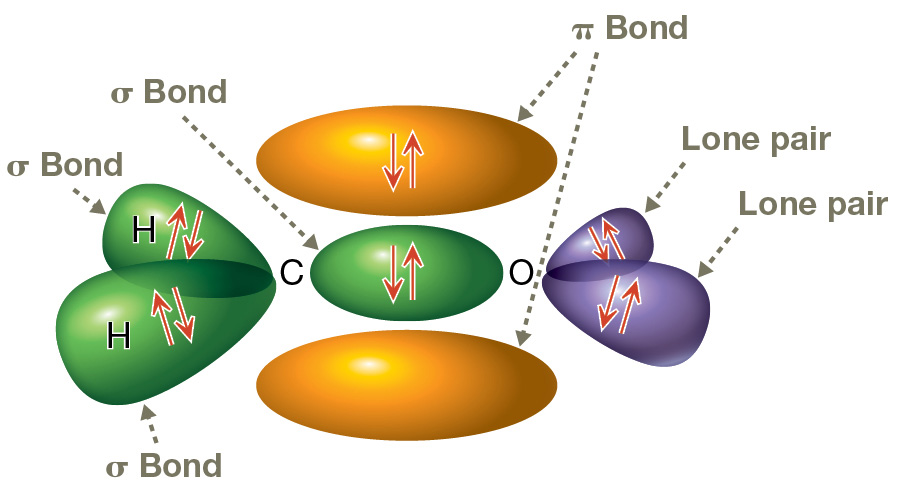
The orbitals overlapping along the bonding axes are half-filled, and each pair of those overlapping orbitals forms a σ bond (green). The overlapping p orbitals are each half-filled and form a π bond (orange). The final two hybrid orbitals on oxygen do not overlap with other orbitals and remain unchanged. The molecule has a total of three σ bonds and one π bond.
More information
An illustration shows the resulting orbitals in a molecule of methanal. There is an oval orbital with two electrons between the carbon and the oxygen. The carbon also has two other lobes extending outward that each have two electrons and surround a hydrogen nucleus. These orbitals are labeled sigma bonds. There are also two orbitals extending outward from the oxygen. Both orbitals have two electrons and are labeled as lone pairs. There are two additional oval orbitals. One is above the initial oval orbital and one is below. The one above has two electrons. Both ovals are labeled pi bond.
Try ItDraw the valence bond picture of CH3CH═NH. How many σ bonds does the molecule have? How many π bonds?
YOUR TURN 3.6
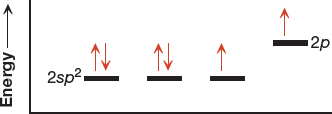
Draw an energy diagram, similar to that in Figure 3-11b (p. 121), to describe an sp2-hybridized oxygen atom. Which orbitals are half-filled? Completely filled? Empty? Do your answers agree with the statement in Solved Problem 3.4?
SHOW ANSWERHIDE ANSWER
Two hybrid orbitals are completely filled, one hybrid orbital and one unhybridized orbital are half-filled, and no orbitals are empty, in agreement with Solved Problem 3.4.
More information
Hybrid orbital diagram. Energy increases from bottom to top. In 2 s p 2 there are three orbitals, the first two are full with an up and down arrow each, and the third is half filled with an up arrow. The 2 p orbital is half filled with an up arrow.
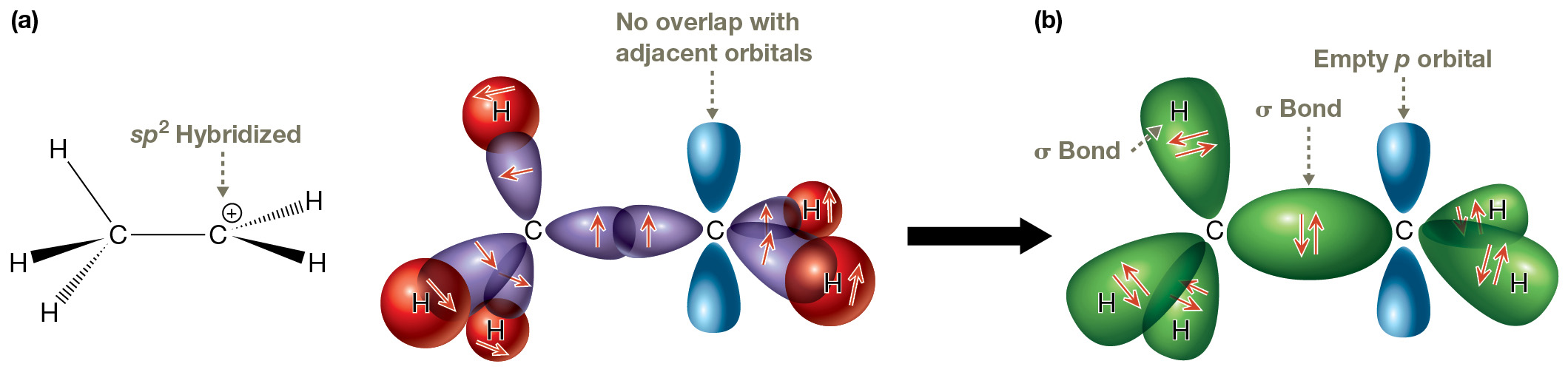
To this point in Section 3.4, we have considered atoms with trigonal planar electron geometry involved in double bonds, but an atom involved in only single bonds can have a trigonal planar geometry, too. For example, a carbon atom that has three single bonds and no lone pairs (and thus bears a +1 formal charge) has a trigonal planar geometry and, like other atoms with this geometry, is sp2-hybridized. With this in mind, we can draw the VB picture of a carbocation like CH3CH+2, as shown in Figure 3-16 (next page).
More information
Two illustrations show the structural formula and the valence bond picture of C H 3 C H 2 plus. The dashed-wedge notation of the molecule is shown. Two carbon atoms are linked by a single bond. Carbon 1 is linked by single bonds to three hydrogen atoms. One of the bonds is shown as a line. One of these bonds is shown as a dashed wedge. One of these bonds is shown as a solid wedge. Carbon 2 is marked with a positive charge and is linked by single bonds to two hydrogen atoms. One of these bonds is shown as a dashed wedge. One of these bonds is shown as a solid wedge. Carbon 2 is labeled s p 2 hybridized. An illustration shows the orbitals associated with this molecule. Each hydrogen has a spherical orbital with one electron. Carbon 1 has four lobes each with one electron. Three of the lobes overlap with a hydrogen orbital. The fourth lobe overlaps with a lobe from carbon 2. Carbon 2 has three lobes each with one electron. Two of the lobes overlap with hydrogen orbital. Carbon 1 also has a vertical dumbbell shaped orbital. Neither of those two lobes overlap with adjacent orbitals. An arrow points to a second illustration showing the resulting bonds. Carbon one has three teardrop orbitals extending outward. These orbitals each have two electrons and surround a hydrogen nucleus. There is an oval orbital with two electrons in between the two carbon nuclei. There are two teardrop shaped orbitals extending outward from carbon 2. Each of these orbitals have two electrons and surround a hydrogen nuclei. All orbitals describes so far are labeled as sigma bonds. Carbon 2 also has an empty p orbital that is dumbbell shaped and vertically oriented about the nucleus.
FIGURE 3-16The valence bond picture of CH3CH2+ (a) Contributing valence orbitals and valence electrons in CH3CH2+. (b) Resulting bonds after the buildup of the orbitals is taken into account. There are six σ bonds (green) and one empty, unhybridized p orbital (blue).
The uncharged C atom, which is sp3-hybridized, contributes four half-filled sp3 hybrid orbitals, and each H atom contributes a half-filled 1s orbital (Fig. 3-16a). The C+ atom, being sp2-hybridized, contributes three sp2 hybrid orbitals lying in a plane and an unhybridized p orbital perpendicular to that plane. Unlike what we saw with ethene (Fig. 3-13), C+ contributes only three valence electrons, so the three hybrid orbitals are half-filled but the p orbital is empty.
YOUR TURN 3.7
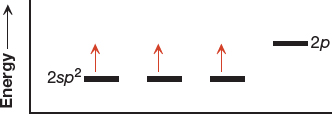
Redraw the energy diagram from Figure 3-11b, this time assuming a trigonal planar C+. How many electrons occupy each hybrid orbital? How many occupy the p orbital? Do your answers agree with the above statements?
SHOW ANSWERHIDE ANSWER
One electron occupies each sp2 hybrid orbital and the p orbital is empty, in agreement with the statements made about C+.
More information
Hybrid orbital diagram. Energy increases from bottom to top. In 2 s p 2 there are three orbitals each half filled with an up arrow and then an empty 2 p orbital.
▶ LOOKING AHEAD
Although the p orbital in Figure 3-16 does not overlap with an adjacent orbital, a significant interaction called hyperconjugation does occur. Hyperconjugation can have a substantial impact on stability, a topic we will discuss in Section 7.9a.
Figure 3-16b shows the resulting orbitals, taking into account the overlap of adjacent pairs of orbitals. Overlap along the five H—C bonding axes and the C—C bonding axis leads to six σ bonds. The p orbital, however, does not overlap with an adjacent orbital, so it remains unchanged and empty (see Looking Ahead box).
YOUR TURN 3.8
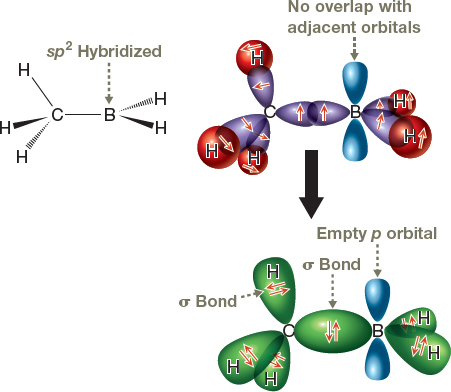
Draw the VB picture of CH3BH2, which is analogous to that of CH3CH2+.
SHOW ANSWERHIDE ANSWER
More information
Condensed and orbital structure. The first structure shows a carbon with three hydrogens bonded to a boron with two hydrogens, the boron is labeled s p 2 hybridized. The orbital structure shows red spheres around the hydrogens, purple teardrops around the C H and B H bonds, and two empty blue teardrops labeled no overlap with adjacent orbitals. Another orbital structure shows the C H and B H bonds as green tear drops labeled sigma bond, the same blue orbitals are labeled as empty p orbital.
describes an atom in which the valence s orbital mixes with two valence p orbitals to produce three sp2 hybrid orbitals. Atoms that have a trigonal planar electron geometry are sp2-hybridized. (Ch. 3)
a bond in which a pair of electrons occupies a bonding molecular orbital of π symmetry; that is, a molecular orbital in which the overlap of atomic orbitals takes place on opposite sides of a bonding axis. A double bond in a Lewis structure is generally a σ bond plus a π bond, and a triple bond is one σ bond plus two π bonds. (Ch. 3)
the symmetry of a molecular orbital that is generated by the overlap of atomic orbitals on opposite sides of the bonding axis; the bonding axis itself lies in a node. (Ch. 3)