Determine the relative stabilities of carbocations on the basis of resonance delocalization and the number of alkyl groups attached to C+.
Determine the relative driving force for elementary steps involving carbocations.
Carbocations, which carry a +1 charge, are involved in several of the elementary steps presented earlier in this chapter, as a reactant, a product, or both. Those elementary steps include heterolysis, coordination, electrophilic addition, electrophile elimination, and carbocation rearrangements. We just saw in Section 7.8 how important charge stability is to the driving force for chemical reactions. This section, therefore, takes a closer look at factors that control the relative stabilities of carbocations.
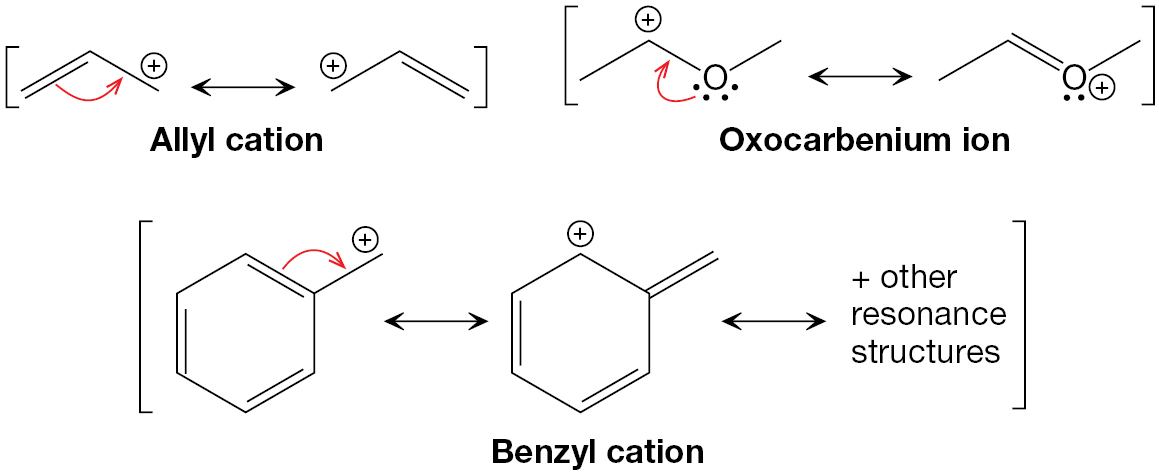
Carbocations in general are quite unstable, due to the lack of an octet on carbon and the appearance of a positive charge, but as we have seen for other charged species, resonance (Section 6.8d) can play a major role:
A carbocation undergoes substantial stabilization if its charge is delocalized via resonance.
Some common examples are shown in Figure 7-8. In the allyl cation and the benzyl cation, resonance involves a pair of electrons from the double bond attached to C+. In the oxocarbenium ion, resonance involves a lone pair of electrons from O.
More information
Three examples of the stabilization of carbocations via resonance are shown. The first example is of an allyl cation. On one side of a bidirectional arrow is a three carbon chain with a double bond between carbon 1 and carbon 2. Carbon 3 is marked with a positive charge. A curved arrow points from the double bond to the single bond between carbon 2 and carbon 3. On the other side of the bidirectional arrow is a three carbon chain with a double bond between carbon 2 and carbon 3. Carbon 1 is marked with a positive charge. The second example is of a benzyl cation. Shown is a closed six-ring structure with alternate double bonds. A single bond emerges from carbon 1. The end of this bond is marked with a positive charge. A curved arrow points from the adjacent double bond in the ring to the single bond on carbon 1. A bidirectional arrow leads to a different closed six-ring structure. This structure has a double bond emerging from carbon 1 and carbon 2 is marked with a positive charge. A second bidirectional arrow leads to a label that reads other resonance structures. The third example is of a oxocarbenium ion. On one side of a bidirectional arrow is a chain with a carbon linked to a carbon marked with a positive charge by a single bond. This carbon is linked to an oxygen by a single bond. The oxygen is linked to a final carbon by a single bond. A curved arrow points from a lone electron pair on the oxygen to the bond between the second carbon and the oxygen. On the other side of the bidirectional arrow is chain with a carbon linked to a second carbon by a single bond. This second carbon is linked by a double bonded to an oxygen marked with a positive charge which is linked to a final carbon by a single bond.
FIGURE 7-8Stabilization of carbocations via resonance
Additionally, as shown in Figure 7-9:
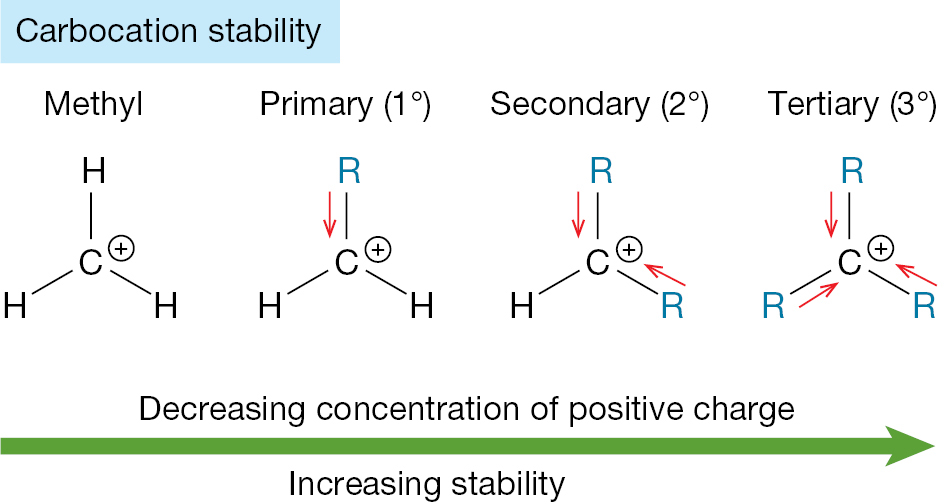
Carbocation stability generally increases with each additional alkyl group attached to the positively charged carbon atom.
More information
An increase in carbocation stability occurs with the addition of an alkyl group to a carbon atom with positive charge. It shows the skeletal structure of methyl consisting of a carbon atom with positive charge single bonded to three hydrogen atoms. This structure is further represented in three forms on moving from left to right and labeled, primary at 1 degree, secondary at 2 degrees, and tertiary at 3 degrees. The primary skeletal structure consists of a carbon atom with positive charge single bonded to two hydrogen atoms and a radical group. An arrow is drawn from the radical group pointing to the carbon atom. The secondary skeletal structure consists of a carbon atom with positive charge single bonded to a hydrogen atom and two radical groups. An arrow is drawn from the radical groups pointing to the carbon atom. The tertiary skeletal structure consists of a carbon atom with positive charge single bonded to three radical groups. An arrow is drawn from the radical groups pointing to the carbon atom. It further shows a rightward-facing arrow denoting a decrease in the concentration of positive charge and increase in stability.
FIGURE 7-9Stabilization of carbocations via attached alkyl groups
Alkyl groups stabilize the carbocation in part because they are inductively electron-donating (Section 6.8e), which helps to reduce the concentration of positive charge on C+. Alkyl groups attached to C+ also stabilize carbocations through hyperconjugation, a topic discussed in Section 7.9a.
Because of the impact on carbocation stability, carbocations are distinguished by the number of alkyl groups attached to C+. A methyl cation (H3C+) has no attached alkyl groups; a primary (1°) carbocation, RCH+2, has one alkyl group attached to C+; a secondary (2°) carbocation, R2CH+, has two alkyl groups; and a tertiary (3°) carbocation, R3C+, has three alkyl groups. Thus, carbocation stability increases in the following order: methyl < 1° < 2° < 3°.
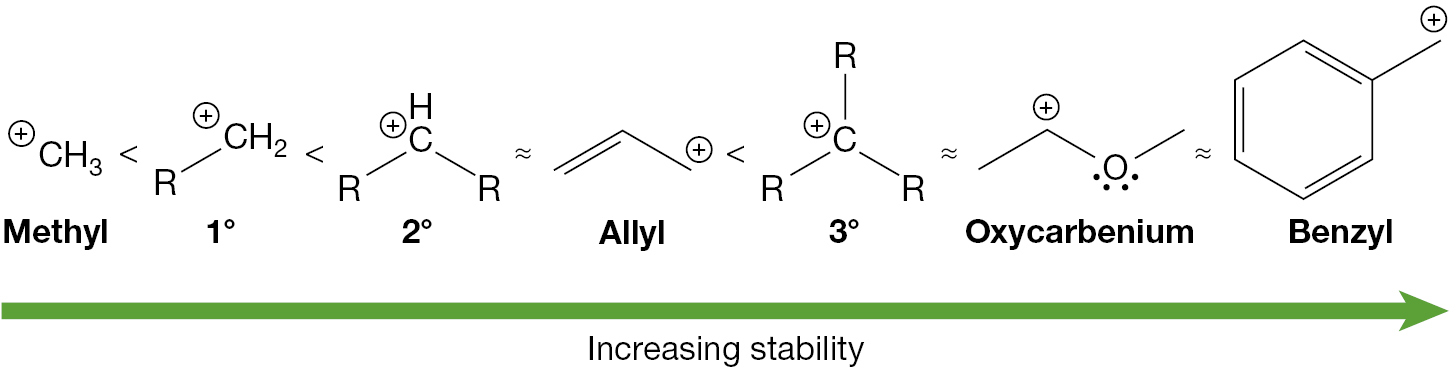
Taking into account both resonance delocalization and the electron-donating effects from alkyl groups, the general order for carbocation stability is shown in Figure 7-10. Notice that resonance delocalization has a greater stabilizing effect than does a single alkyl group (allyl vs. 1°), similar to what we saw with other ions we examined in Section 6.9. As it turns out, however, multiple alkyl groups attached to the same C+ can provide more stabilization than resonance delocalization.
More information
An illustration lists carbocations in order according to increasing stabilities. In order from least stable to most stable they are methyl, primary carbocation, secondary carbocation, allyl, tertiary carbocation, oxycarbenium, and benzyl. The secondary carbocation and the allyl have approximately equal stability. The tertiary carbocation, oxycarbenium, and benzyl all have approximately equal stability.
FIGURE 7-10Relative stabilities of carbocations
SOLVED PROBLEM 7.7
How to determine the favored side of carbocation rearrangement
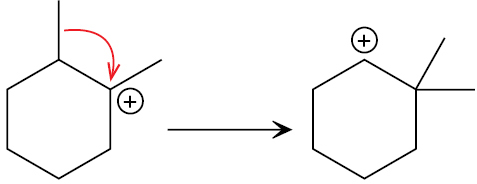
Break It Down Which side of this carbocation rearrangement is favored?
More information
A chemical reaction represents choice for favorable carbocation rearrangement. The reaction shows a closed six-ring structure with two vacant single bonds at carbon-1 and 2, with a positive charge at carbon-2. A curved arrow from a single bond at carbon-1 terminates at carbon-2 of the closed ring. It is followed by a rightward arrow to show a closed six-ring structure with a positive charge at carbon-1 and two vacant single bonds at carbon-2.
Think
Solve
On the two sides of the reaction, is there a difference in charge stability?
➤
The positive charge is on a tertiary carbon in the reactant and on a secondary carbon in the product. Because a tertiary carbocation is more stable, charge stability favors the reactant side.
Is there a substantial difference in total bond energy on the two sides of the reaction?
➤
Total bond energy is not a significant factor in this reaction because a C—C σ bond is broken in the reactant and another one is formed in the product.
Do the answers to the above two questions conflict?
➤
Charge stability is substantially different on either side of the reaction, but total bond energy is not. Charge stability favors the reactant side, so overall this carbocation rearrangement will favor the reactant side.
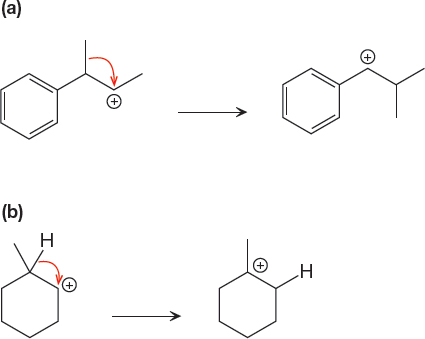
Try ItDetermine which side of each of the carbocation rearrangements shown here is favored.
More information
Two chemical reactions to represent the choice for favorable site of a carbocation rearrangement. The first chemical reaction shows a closed six-ring structure with alternate double bonds and single bonds, and a side chain of four carbon atoms emerging at carbon-2 of the closed ring. A vacant single bond emerges from carbon-2 of the side chain carrying a positive charge, marked at carbon-3. A curved arrow points from a vacant single bond on the side chain toward carbon-3 carrying a positive charge. The resultant shows an exchange of the charge and a single bond between carbon-2 and 3 of the side chain. The second chemical reaction shows a closed six-ring structure with a hydrogen atom linked to carbon-1 by a single bond. It also shows a vacant single bond at carbon-1 and a positive charge at carbon-2. A curved arrow points from a hydrogen atom toward the carbon atom carrying positive charge. The resultant shows a shift of positive charge to carbon-1 and shift of the hydrogen atom to carbon-2.
7.9a A Deeper Look: Carbocation Stability and Hyperconjugation
We just learned that the stability of a carbocation increases as the number of alkyl groups bonded to the positively charged carbon increases:
More information
An illustration shows a comparison of carbocation stability. The illustration is titled “carbocation stability.” The order of the carbocations, in order of increasing stability, is as follows: C H 3 plus or methyl, R C H 2 plus or primary, R 2 C H plus or secondary, and R 3 C plus or tertiary.
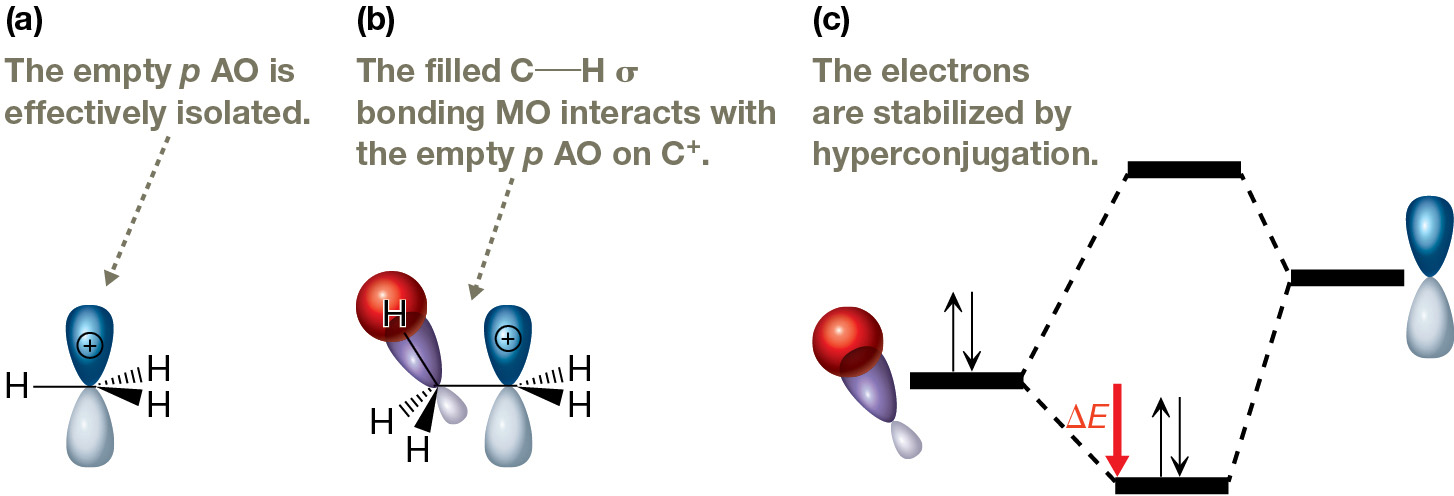
These relative stabilities were explained in terms of inductive effects: Each alkyl group is electron-donating through its attached σ bond and therefore reduces the amount of positive charge that is localized on the C+. Inductive effects, however, are only part of the story. The other major contribution comes from hyperconjugation, which is an outcome of orbital interactions, illustrated in Figure 7-11.
More information
Three illustrations show the interaction between orbitals in different ions. The first illustration shows a positively charged carbon atom bonded to a hydrogen atom on its left by a solid line, to a hydrogen atom on its right by a solid wedge, and to another hydrogen atom on its right by a dashed wedge. The p orbital of the carbon atom is represented as a dumbbell-shaped blue orbital around it, with one lobe above and one lobe below. The lobe above is shaded darker than the lobe below. Text pointing to the orbital reads, “The empty p A O is effectively isolated.” The second illustration shows a two-carbon chain where the carbon on the left is bonded to a hydrogen atom on its upper left by a solid line, to a hydrogen atom on its lower left by a solid wedge, and to another hydrogen atom on its lower left by a dashed wedge. The s orbital of the hydrogen atom on the upper left is represented as a red circle around the hydrogen atom. The p orbital of the carbon on the left is represented as a dumbbell-shaped purple orbital around it, with one lobe above and one lobe below. The lobe above overlaps with the s orbital of the hydrogen atom and is larger and shaded darker than the lobe below. The carbon atom on the right is positively charged and is bonded to a hydrogen atom on its right by a solid wedge, and to another hydrogen atom on its right by a dashed wedge. The p orbital of the carbon atom is represented as a dumbbell-shaped blue orbital around it, with one lobe above and one lobe below. The lobe above is shaded darker than the lobe below. Text pointing to the illustration reads, “The filled C H sigma bonding M O interacts with the empty p A O on C plus.” The third illustration shows a thick horizontal dash at the bottom, with a pair of opposing arrows on it. Also on this dash is a third red downward arrow labeled “delta E.” To the left of this dash, and slightly above it, is another thick horizontal dash with a pair of opposing arrows on it. This dash lies on the left end of the illustration. Beside this dash is a red sphere representing the s orbital of hydrogen, and a dumbbell-shaped purple orbital representing the filled sigma orbital of carbon. The lobe above overlaps with the s orbital of the hydrogen atom and is larger and shaded darker than the lobe below. To the right of this dash, and well above it, is another thick horizontal dash. This dash lies on the right end of the illustration. Beside this dash is a dumbbell-shaped blue orbital representing the empty p atomic orbital of carbon, with one lobe above and one lobe below. The lobe above is shaded darker than the lobe below. To the left of this dash, and slightly above it, on the upper end of the illustration, is another thick horizontal dash, which lies directly above the dash at the bottom. The four dashes are connected together by dashed lines. Text above the illustration reads, “The electrons are stabilized by hyperconjugation.”
FIGURE 7-11Hyperconjugation in carbocations (a) In CH3+, the p atomic orbital (AO) on carbon is empty and does not interact with any adjacent orbitals. (b) In CH3CH+2, the empty p AO overlaps with the σ bonding molecular orbital (MO) of the adjacent C—H bond, so the two orbitals can interact. (c) The orbital interaction in CH3CH+2 (shown in part b), called hyperconjugation, stabilizes the electrons from the σ bonding orbital.
Figure 7-11a highlights a key feature of CH+3, which is an outcome of molecular orbital (MO) theory discussed in Section 3.11. Namely, the C—H bonds, each of which represents two electrons occupying a σ bonding MO, are perpendicular to the empty p atomic orbital (AO) on carbon. Therefore, the empty p AO does not interact with any of the C—H σ bonds; the p AO is effectively isolated. By contrast, the p AO in CH3CH+2 (Fig. 7-11b) is aligned with one of the C—H bonds in the adjacent CH3 group. The empty p AO and that σ bonding MO therefore interact. As with any pair of interacting orbitals, two new orbitals are produced: In this case, constructive interference results in a new orbital that is more stable than the σ bonding MO, and destructive interference results in a new orbital that is less stable than the p AO. The two electrons from the σ bonding MO end up in the lower energy of the two new orbitals and are thus stabilized, as shown in Figure 7-11c. Such a stabilizing effect would occur for each additional alkyl group attached to C+.
The constructive interference that leads to the stabilization we see in Figure 7-11c also results in delocalization of the resulting orbital and the electrons that occupy it. In this case, the electrons from the C—H bond are delocalized into the empty p AO on C+. Hyperconjugation therefore effectively transfers some electron density from the alkyl group into the empty p AO. In this way, the alkyl group is electron-donating, in agreement with how we view alkyl groups from the perspective of inductive effects.
YOUR TURN 7.29
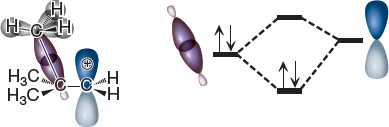
Hyperconjugation can involve σ bonding orbitals other than those from C—H bonds. Redraw Figure 7-11b and 7-11c to describe the hyperconjugation that takes place in the 2,2-dimethylpropyl cation, (CH3)3CCH2+.
SHOW ANSWERHIDE ANSWER
More information
Diagram of molecular orbital states. The structure is a three carbon chain, the first and second carbon show overlapping purple p orbitals, the third carbon shows blue p orbital not overlapping. The orbital diagram shows a bottom energy state, one above it to the left, another one slightly above the second on the right, and then one on top. The bottom orbital is filled with an up and down arrow, the orbital slightlying higher on the left is filled with an up and down arrow, and the other two orbitals are empty. The overlapping p orbitals are on the left, and blue orbital is on the right.