Determine the side of an elementary step that is favored by charge stability and by total bond strength.
Predict the side of an elementary step that is favored when the factors of charge stability and bond strength disagree.
So far, our focus on elementary steps has been on how they occur, using curved arrows to account for bonds breaking and bonds forming. But why should these elementary steps occur in the first place? That is, what is their driving force?
The driving force for a reaction reflects the extent to which the reaction favors products over reactants, which, as we learned in Section 6.4, is associated with the reaction’s Gibbs free energy change (see Recall box). That tendency to favor products increases with increasing stability of the products relative to the reactants. Thus, understanding a reaction’s driving force is a matter of identifying and evaluating the factors that help stabilize the products, destabilize the reactants, or both.
◀ RECALL
In Section 6.4, we saw that the Gibbs free energy (G) of a species corresponds to its stability: A lower G indicates greater stability, and a higher G indicates less stability. Therefore, as the Gibbs free energy change (ΔG) for a reaction becomes more negative (less positive), the reaction is more product favored. As ΔG becomes less negative (more positive), the reaction is more reactant favored.
Although various factors dictate the stability of a species, we can often make reasonable predictions about a reaction’s driving force by examining just two factors. One is charge stability (see Recall box, p. 340), and the other is total bond energy:
Major Contributions to Driving Force
A reaction’s driving force generally increases with:
Greater charge stabilization in the products relative to the reactants.
Greater total bond energy in the products relative to the reactants.
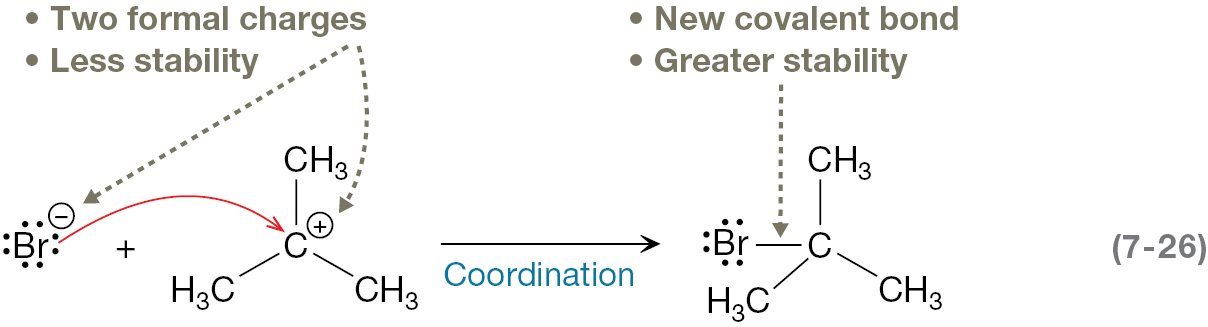
With this in mind, we can see that a coordination step like that in Equation 7-26 is unambiguously driven toward products.
More information
A chemical reaction compares the charge and stability of a compound before and after coordination. The reaction shows bromine anion carrying four lone pairs of electron reacting with a compound having a central carbon atom, further carrying a positive charge surrounded by three methyl groups linked by a single bond each. A curved arrow points from the bromine anion toward the central carbon atom. Two bullet points above the structure read, “Two formal charges; less stability.” It is followed by a rightward arrow denoting coordination to show a condensed structural formula of a compound highlighting an addition of a bromine atom carrying three lone pairs of electrons to the central carbon atom carrying three methyl groups. Two bullet points above the structure read, “New covalent bond; greater stability.”
Charge stability heavily favors the products in this reaction because there are two formal charges in the reactants but no formal charges in the products. Furthermore, total bond energy favors the products because, during the course of the reaction, a covalent bond is formed, giving carbon an octet, and no bonds are broken.
Charge stability and bond energy do not always work in the same direction. Consider the proton transfer step in Equation 7-27.
More information
A chemical reaction represents a change in bond energy and charge stability during proton transfer. The chemical reaction shows a nitrogen atom of an amino group carrying two lone pairs of electrons and a negative charge reacting with hydrogen chloride, with chlorine carrying three lone pairs of electrons. A curved arrow points from a nitrogen atom toward the hydrogen atom of hydrogen chloride. Another curved arrow points from a single bond between hydrogen and chlorine toward chlorine. The text above the reactants read, single bond between hydrogen and chlorine is broken and is stronger than the single bond between hydrogen and nitrogen. It is followed by a rightward arrow denoting proton transfer to show an addition of a hydrogen atom to the nitrogen atom by a single bond, and the release of chlorine anion carrying four lone pairs of electrons. A text reads, “The negative charge is better accommodated on chlorine than nitrogen.” The value of equilibrium constant is equal to 1 times 10 to the power of 43.
◀ RECALL
Chapter 6 discussed how to assess charge stability according to the CARDIN-al rule: The charge of the species; the type of atom holding the charge; resonance delocalization of the charge; and inductive effects from substituents attached to the charged atom. Recall also that each covalent bond in a species contributes to the species’ stability. (Review bond energies in Tables 1-2 and 1-3 on pp. 10–11.)
In this case, a negative charge appears in both the reactants and the products. In the reactants, the negative charge is on N, whereas in the products, it is on Cl. Because Cl is significantly larger (i.e., lower in the periodic table) than N, the negative charge is better accommodated on Cl than on N, so we say that charge stability favors the products. Bond energy, however, favors the reactants because the H—Cl bond that appears on the reactant side (431 kJ/mol) is stronger than the H—N bond that appears on the product side (389 kJ/mol). Despite the disagreement, notice that the products are heavily favored (Keq= 1043), because HCl (pKa=–7) is a much stronger acid than NH3 (pKa= 36).
The previous example leads to the following general rule:
When charge stability and bond energy favor opposite sides of a chemical reaction, charge stability usually wins.
YOUR TURN 7.28
Consider the proton transfer reaction shown here. The product side is heavily favored because H2O (pKa = 14) is a much stronger acid than NH3 (pKa = 36). (a) Which side of the reaction exhibits greater charge stability? (b) Which side of the reaction exhibits greater total bond energy? Hint: Use Table 1-2 on p. 10 to find the H—O and H—N bond energies. (c) Do your answers to parts (a) and (b) agree? If not, which factor appears to be more important?
SHOW ANSWERHIDE ANSWER
(a) The product side, because O is more electronegative than N and can
better handle a negative charge. (b) The reactant side, because the bond
energy of O═H is 460 kJ/mol while that of N═H is 389 kJ/mol.
(c) These two factors do not agree. Charge stabilization is the more
important factor.
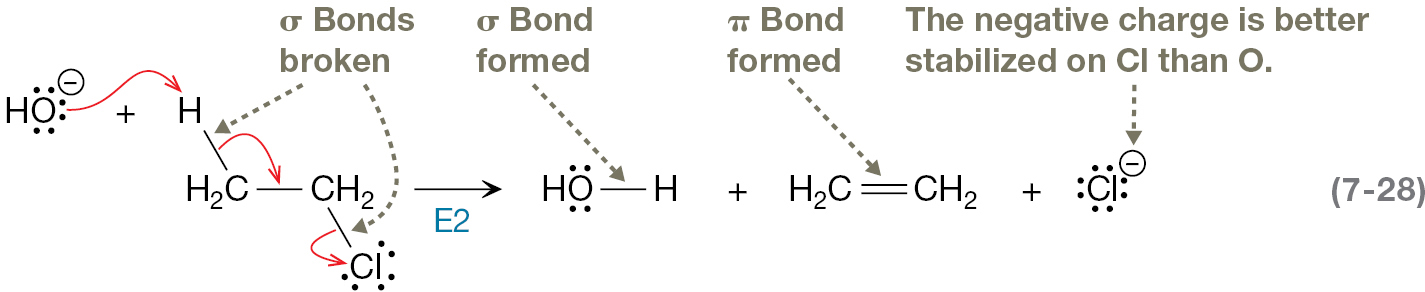
The greater importance of charge stability compared to bond energy is evident in the E2 step in Equation 7-28:
More information
A chemical reaction represents the formation of bonds and charge stability during E 2 step. The reaction shows the oxygen atom of a hydroxyl group carrying two lone pairs of electrons and a negative charge; two C H 2 group linked by a single bond with the left group linked to a hydrogen atom by a single bond while the right group is linked to a chlorine ion carrying three lone pairs of electrons by a single bond. The bond between C H 2 and hydrogen; and between C H 2 and chlorine are labeled sigma bonds formed. A curved arrow points from an oxygen atom of hydroxyl group toward hydrogen atom while another curved arrow points from a single bond between C H 2 and hydrogen toward single bond between two C H 2 groups. A third curved arrow is drawn, pointing from a single bond between C H 2 and chlorine toward chlorine. It is followed by a rightward arrow denoting E 2, to show an addition of a hydrogen atom to the hydroxyl group by a single bond, with the oxygen atom carrying two lone pairs of electrons. The single bond is labeled, sigma bond formed. It also shows the formation of a double bond between two C H 2 groups and labeled pi-bond formed; and release of a chlorine anion carrying four lone pairs of electrons, labeled the negative charge is better stabilized on chlorine than oxygen.
Charge stability favors the products because the negative charge is better accommodated on Cl than on O. Bond energy, however, favors the reactants because, on the product side, a σ and a π bond are formed, while two σ bonds are broken. Effectively, there is a net loss of one σ bond and a net gain of one π bond and, as we learned in Chapter 3, a σ bond is generally stronger. Experiments have shown that the product side of the reaction is heavily favored, in agreement with the prediction obtained from charge stability.
SOLVED PROBLEM 7.6
How to determine the favored side of an elementary step
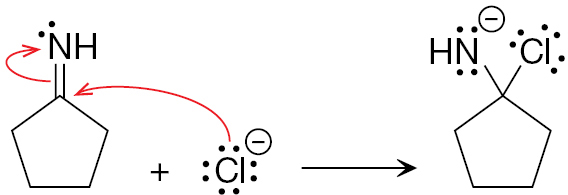
Break It Down Which side of this nucleophilic addition step is favored?
More information
A chemical reaction shows a nucleophilic addition with chloride. The reaction shows a closed five-ring structure. Carbon 1 is linked to N H with a double bond. There is also a chloride ion that has four lone electron pairs and is marked with a negative charge. An arrow points from the chloride ion to carbon 1. A second arrow points from the double bond to the nitrogen atom. The resultant is a closed five-ring structure with carbon 1 linked to H N and to a chlorine atom by single bonds. The H N is marked with a negative charge.
Think
Solve
On the two sides of the reaction, is there a difference in charge stability?
➤
The negative charge is on Cl in the reactants and on N in the product. Because Cl is the larger atom, the charge is better accommodated on Cl, so charge stability favors the reactant side.
Is there a substantial difference in total bond energy on the two sides of the reaction?
➤
During the course of the reaction, the π bond from C═N breaks and a C—Cl σ bond forms. A σ bond tends to be stronger than a π bond, in which case bond energy would favor the product side.
Do the answers to the above two questions agree? If not, which factor wins?
➤
Charge stability favors the reactant side, but bond energy favors the product side. When the two factors disagree like this, charge stability usually wins, in which case we would predict that the reaction favors the reactant side.
Try ItDetermine which side of each elementary step is favored.
More information
There are two chemical reactions showing different nucleophilic additions. Reaction a shows a nucleophilic addition with a methyl group. There is a closed five-ring structure with carbon 1 linked to an oxygen atom by a double bond. There is also a C H 3 marked with a negative charge. An arrow points from the C H 3 to carbon 1. A second arrow points from the double bond to the oxygen atom. The resultant shows a new closed five-ring structure. Carbon 1 is linked to a methyl group and to an oxygen atom by single bonds. The oxygen atom as three lone pairs of electrons and is marked with a negative charge. Reaction b shows a nucleophilic addition with water. It shows a water molecule and a three carbon chain. Carbon 1 is linked to N H 2 by a single bond. An arrow points from a lone pair of electrons on the oxygen in water to carbon 1. A second arrow points from the bond between the nitrogen and the carbon to the nitrogen. The resultant shows a three carbon chain with H 2 O linked to carbon 1 by a single bond. The oxygen is marked with a positive charge. N H 2, marked with a negative charge, is released.
Using charge stability and total bond energy to predict the outcome of a reaction is generally quite reliable, but some exceptions exist. For example, the product side of a reaction might be favored, but an excessively large energy barrier can prevent the reaction from forming products; the rate would be too small. Alternatively, charge stability and bond energy can heavily favor the reactant side, but the reaction might still proceed if other factors, such as entropy or stabilization from the solvent, favor products. We will discuss cases like these in later chapters when they become relevant.
a thermodynamic concept (not an actual force) describing the extent to which a reaction favors products over reactants under a particular set of conditions; it tends to increase with increasing stability (lower energy) of products relative to reactants; charge stability and total bond energy are important contributors.