- An Introduction to Valence Bond Theory and σ Bonds: An Example with H2
- Valence Bond Theory and Tetrahedral Electron Geometry: Alkanes and sp3 Hybridization
- Valence Bond Theory and Lone Pairs of Electrons
- Valence Bond Theory and Trigonal Planar Electron Geometry: Double Bonds, sp2 Hybridization, π Bonds, and Carbocations
- Valence Bond Theory and Linear Electron Geometry: Triple Bonds and sp Hybridization
- Strategies for Success: Quickly Identifying Hybridization and the Number of σ and π Bonds from a Lewis Structure
- Bond Rotations about Single and Double Bonds: Cis and Trans Configurations
- Strategies for Success: Molecular Modeling Kits, Bond Rotations, and Extended Geometries
- Hybridization, Bond Characteristics, and Effective Electronegativity
- A Deeper Look: Molecular Orbital Theory and the Wave Nature of Electrons
- A Deeper Look: Hybrid Atomic Orbitals and a Combined Molecular Orbital–Valence Bond Model
3Valence Bond Theory and Molecular Orbital Theory
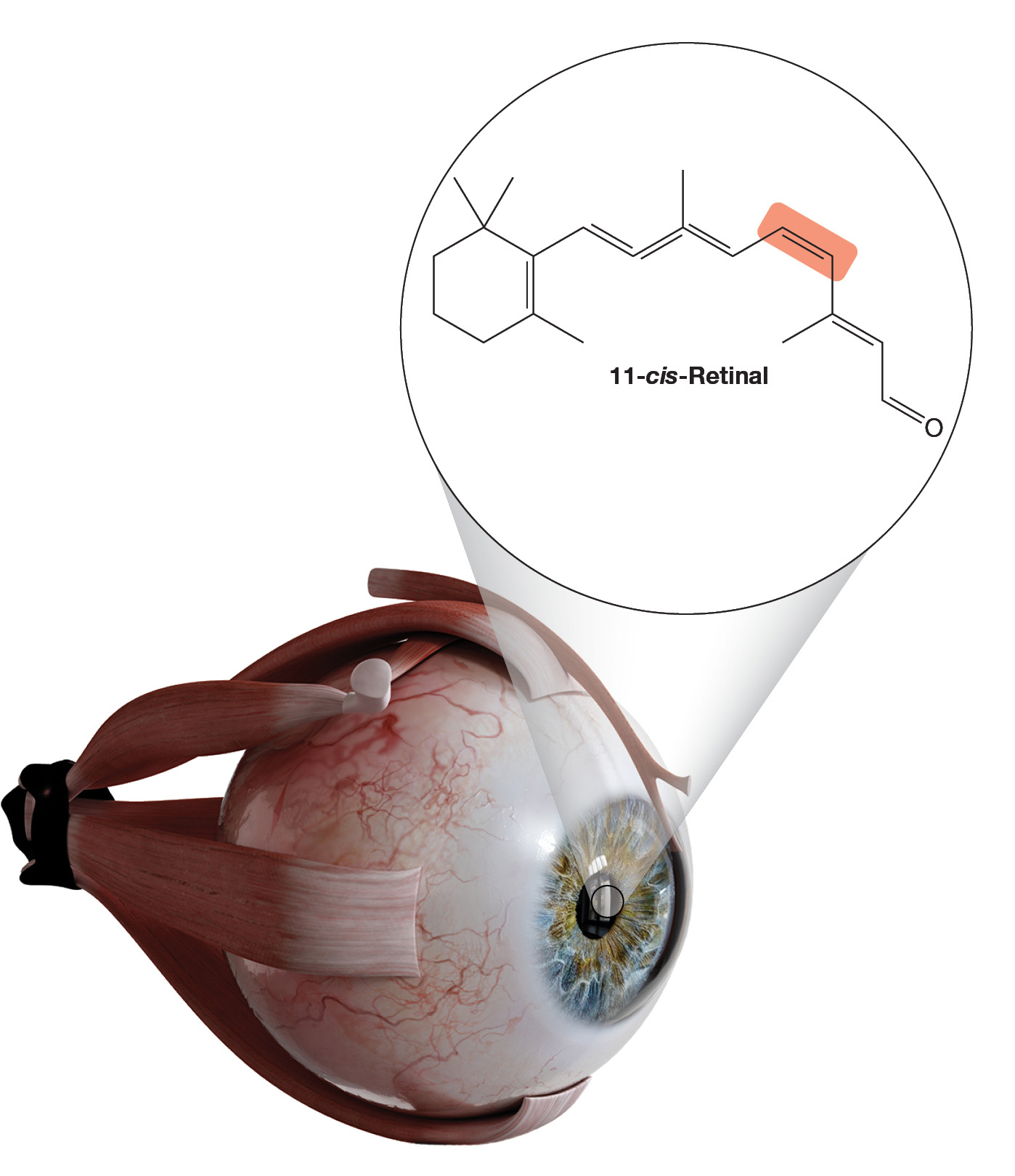
More information
A realistic illustration of an eye. A subset, emerging from the iris, shows the simplified structural formula of 11 cis retinal. There is a six member closed ring. Carbon 1 is linked by single bonds to two methyl groups. Carbon 2 is linked to a nine carbon chain. Carbon 3 is linked to a methyl group. The nine carbon chain has the double bond between carbons 5 and 6 highlighted. There is an oxygen at the end of the nine carbon chain.
Chapter Outline
In Chapters 1 and 2, we reviewed Lewis structures and valence shell electron pair repulsion (VSEPR) theory: two very useful models that help us describe molecular structure. Lewis structures describe the connectivity of the atoms (i.e., which atoms are bonded together and whether they are connected by single, double, or triple bonds), whereas VSEPR theory allows us to make reliable predictions of the geometries about the atoms.
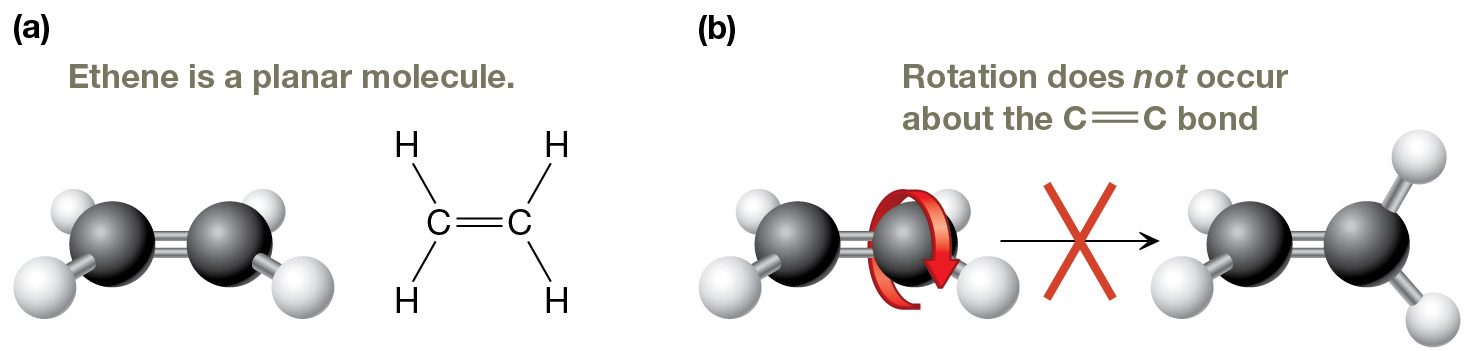
Despite their usefulness, Lewis structures and VSEPR theory have significant limitations. Neither model explains certain important experimental findings, such as why a molecule of ethene (H2C═CH2, Figure 3-1), is entirely planar (that is, why all six of its atoms lie in the same plane) without the CH2 groups rotating relative to each other.
More information
Part A shows the ball-and-stick model and condensed structural formula of ethene. The structure shows two carbon atoms bonded together by a double bond. Each carbon atom is bonded to two hydrogen atoms. The ball and stick model shows that the two carbon atoms and the four hydrogen atoms all lie in the same plane. A label reads Ethene is a planar molecule. Part B shows rotation does not occur about the carbon to carbon double bond. The ball and stick model of ethene in part A is shown. A red arrow indicates the rotation of one of the carbon atoms. The result is the two hydrogen atoms linked to that carbon no longer lie in the same plane. A red X is marked over this transition indicating that the rotation does not happen.
This chapter presents models of bonding that go beyond the limitations of Lewis structures and VSEPR theory. To better explain molecular geometry and bond rotations, we introduce the concepts of hybridization and valence bond theory. Then, toward the end of this chapter, we delve into the model of molecular orbital theory, which, as will be seen in later chapters, provides insights into the dynamics of chemical reactions (Chapter 7), resonance stabilization (Chapter 14), and spectroscopy (which deals with how molecules interact with light; Chapters 16 and 17).