Section 3.6 Objectives
You will be able to:
- Quickly derive the hybridization of an atom from a Lewis structure.
- Quickly determine the number of σ and π bonds from a Lewis structure.
We developed the basic ideas of VB theory in Section 3.1. Then, in Sections 3.2–3.5, we applied those ideas toward drawing the VB pictures of molecules containing atoms with various geometries and in which the valence electrons belong to single bonds, double bonds, triple bonds, or lone pairs. Along the way, we arrived at some generalizations that we will find very useful throughout the rest of this book. We devote this section to reviewing those generalizations and applying them to molecular species without completely drawing the VB picture.
Strategies for Success: Quickly Identifying Hybridization and the Number of σ and π Bonds from a Lewis Structure
One important lesson we learned from previous sections of this chapter, summarized in Table 3-1, relates an atom’s electron geometry to its hybridization.
|
Table 3-1 The Relationship between Hybridization and VSEPR Theory |
||||
|
Number of e- groups |
Electron Geometry in VSEPR Theory |
Atom’s Hybridization |
Orientation of Hybrid Orbitals |
Bond Angles |
|
2 |
Linear |
sp |
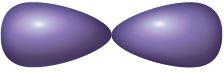 |
180° |
|
3 |
Trigonal planar |
sp2 |
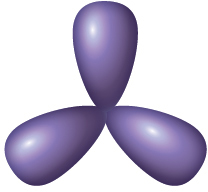 |
120° |
|
4 |
Tetrahedral |
sp3 |
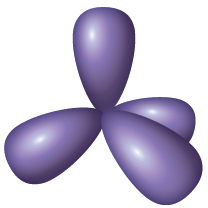 |
109.5° |
Another important lesson comes from the types of bonds that make up single, double, and triple bonds:
With these lessons in mind, we can quickly determine the hybridization of an atom in a Lewis structure, and we can also quickly determine the total number of σ and π bonds. Solved Problem 3.6 takes you through an example.
SOLVED PROBLEM 3.6
How to quickly determine atom hybridization and the total number of σ and π bonds from a Lewis structure
Break It Down What is the hybridization of each non-hydrogen atom in this molecule? How many total σ and π bonds are there?
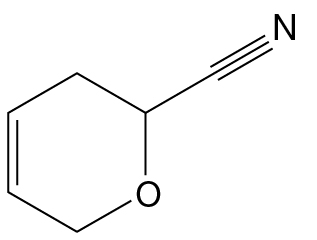
A structural formula is shown. There is a closed six member ring with five carbon atoms and one oxygen atom. There is one double bond between two carbons in the ring. In the ortho position relative to the oxygen, a C N is linked by a single bond to the ring. The carbon and nitrogen are connected by a triple bond.
|
Think |
Solve |
|
|
What is the electron geometry of each non-hydrogen atom? What hybridization is associated with that geometry? |
➤ |
To answer questions about electron geometry, it helps to draw all the C—H bonds and all lone pairs, as shown here. Knowing the number of electron groups surrounding each atom, we can then determine the electron geometry and hybridization. 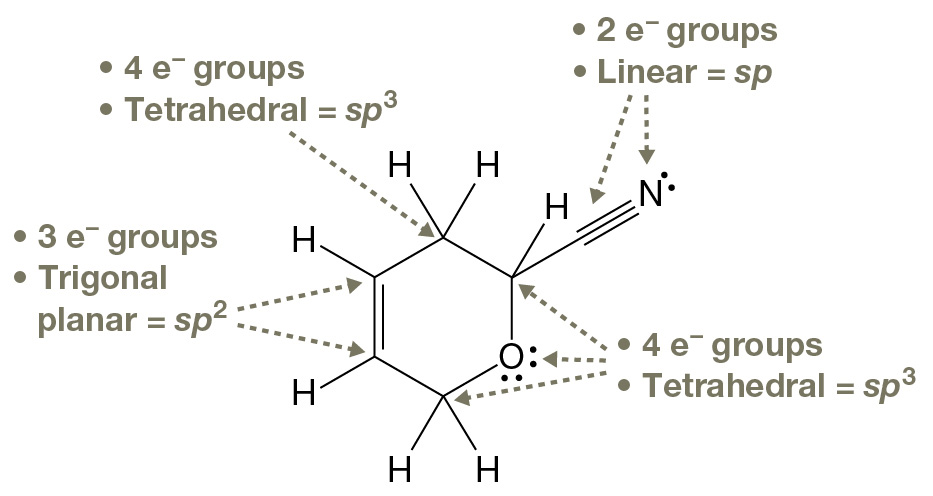
More informationA structural formula is shown with all the carbon hydrogen bonds shown. There is a closed six member ring with five carbon atoms and one oxygen atom. The oxygen has two lone pairs of electrons. There is a double bond between carbons 3 and 4. In the ortho position relative to the oxygen, a C N is linked by a single bond to carbon 1. The carbon and nitrogen are connected by a triple bond. The nitrogen has a lone pair of electrons. Carbon 1 also is single bonded to a hydrogen atom. Carbons 2 and 5 are each single bonded to two hydrogen atoms. Carbons 3 and 4 are each single bonded to one hydrogen. Atoms are labeled with the number of e minus groups, their electron geometry, and their hybridization. The nitrogen and the carbon in the C N group both have 2 e minus groups, are linear, and have s p hybridization. Carbons 3 and 4 both have 3 e minus groups, are trigonal planar, and have s p 2 hybridization. Carbon 1, carbon 2, carbon 5, and the oxygen each have 4 e minus groups, are tetrahedral, and have s p 3 hybridization. |
|
What types of bonds make up single, double, and triple bonds? How many single, double, and triple bonds are there in the molecule? |
➤ |
There are 13 single bonds (σ bonds). As shown here, there is one double bond (consisting of one σ and one π bond) and one triple bond (consisting of one σ bond and two π bonds). In total, there are 15 σ bonds and three π bonds. 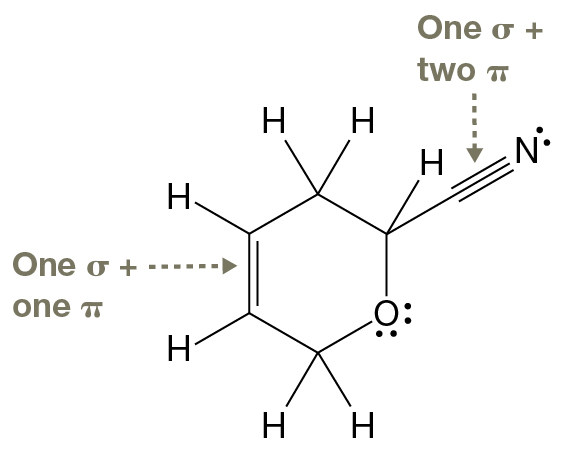
More informationA structural formula is shown with the types of bonds labeled. There is a closed six member ring with five carbon atoms and one oxygen atom. The oxygen has two lone pairs of electrons. There is a double bond between carbons 3 and 4. The double bond is labeled as one sigma and one pi. In the ortho position relative to the oxygen, a C N is linked by a single bond to carbon 1. The carbon and nitrogen are connected by a triple bond. The nitrogen has a lone pair of electrons. The triple bond is labeled as one sigma and two pi. |
|
Try ItIn each of the following molecular species, determine the hybridization of each non-hydrogen atom and the total number of σ and π bonds. 
More informationThe structural formulas of four molecules are shown. Molecule A shows a five carbon chain. Carbon 1 and 2 are connected by a triple bond. Carbon 4 is linked to an oxygen atom by a double bond. Molecule B shows a closed six membered ring structure. One of the atoms of the ring is a nitrogen and the rest are carbon. There are two double bonds. One next to the nitrogen atom and one directly across from the other. The carbon in the para position relative to the nitrogen is linked by a single bond to a C H 2 C N. The carbon atom and the nitrogen are linked by a triple bond. Molecule C shows a closed five membered ring with four carbons and one oxygen. Carbon 2 in linked by a single bond to a C H 2 group. The C H 2 is marked with a negative charge. Molecule D shows a four carbon chain. Carbon 2 is marked with a positive charge and is linked by a single bond to a methyl group. |
||