3.1 An Introduction to Valence Bond Theory and σ Bonds: An Example with H2
Section 3.1 Objectives
You will be able to:
Use valence bond theory to describe the origin of a bond.
Characterize a σ bond according to the type of overlap from contributing orbitals.
Draw the valence bond picture of a single bond in a diatomic molecule.
Recall that Lewis structures describe a covalent bond as the sharing of valence electrons between two atoms. Valence bond (VB) theory takes this idea further, focusing on the orbitals in which those electrons reside, both before and after bond formation:
Valence Bond (VB) Theory
A covalent bond forms when two half-filled valence orbitals, from two separate atoms, overlap in space.
The overlapping orbitals mix to create a new orbital that is built up in the region between the two atoms.
The new orbital accommodates bonding electrons, allowing them to be shared between the two atoms.
(You may recall from general chemistry that the buildup of the orbitals in an internuclear region is an outcome of electrons behaving as waves, a topic we will discuss in greater detail in Section 3.10.)
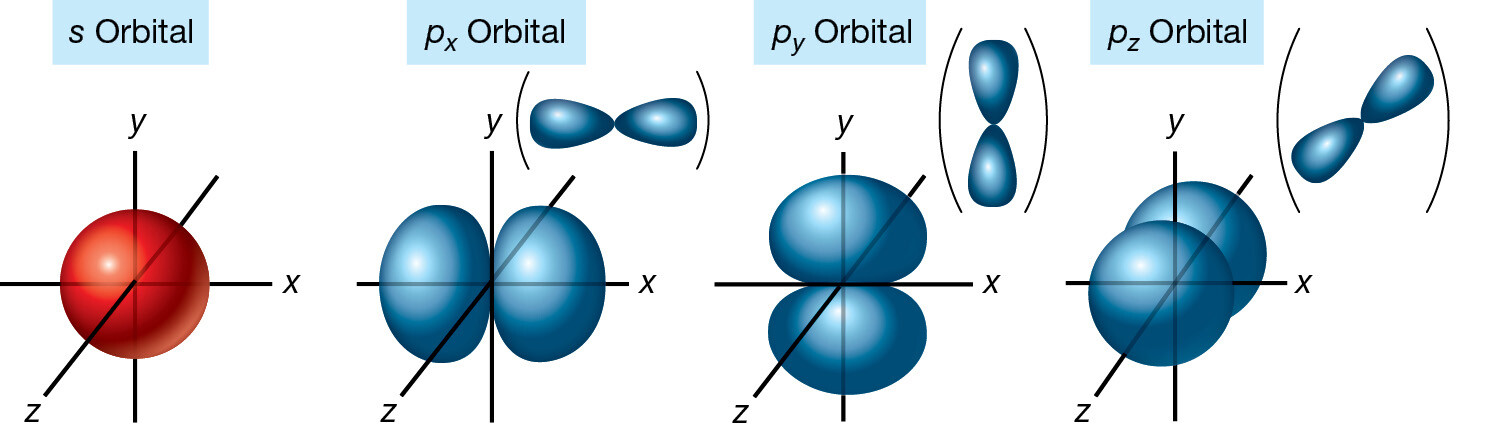
To begin to apply VB theory, we must be familiar with s and p orbitals (Figure 3-2), which make up the valence shells of the atoms that are most common to organic chemistry. Recall from Section 1.3 that the first shell consists of only an s orbital, whereas the second and higher shells have one s and three p orbitals. An s orbital is spherical, whereas the three p orbitals (called px, py, and pz) are dumbbell-shaped and align along the x, y, and z axes, respectively. Often p orbitals are depicted with the streamlined representations shown in parentheses in Figure 3-2.
More information
A four-part illustration shows s, p x, p y, and p z orbitals. All four parts show x, y, and z axes intersecting at the origin. The first part labeled “s orbital” shows a red sphere centered around the origin. The second part labeled “p x orbital” shows a blue dumbbell shaped structure aligned along the x axis. In parentheses above is a horizontal dumbbell orbital. The third part labeled “pi orbital” shows a blue dumbbell shaped structure aligned along the y axis. In parentheses above is a vertical dumbbell orbital. The fourth part labeled “p z orbital” shows a blue dumbbell shaped structure aligned along the z axis. In parentheses above is a diagonal dumbbell orbital.
FIGURE 3-2s and p Orbitals An s orbital is spherical, whereas a p orbital consists of two lobes and is dumbbell-shaped. A p orbital can be aligned along the x, y, or z axis, characterizing it as a px, py, or pz orbital, respectively. The depictions in parentheses are streamlined representations of p orbitals.
CONNECTIONS 3.1
Molecular hydrogen and its uses H2 (Fig. 3-3) has a wide variety of uses industrially, including the processing of fossil fuels and the production of ammonia, NH3. It is also used as a reducing agent in the synthesis of chemicals and as a fuel source in the hydrogen fuel cells that power electric cars.
More information
A photo shows a white colored car that has fuel cell written on the side.
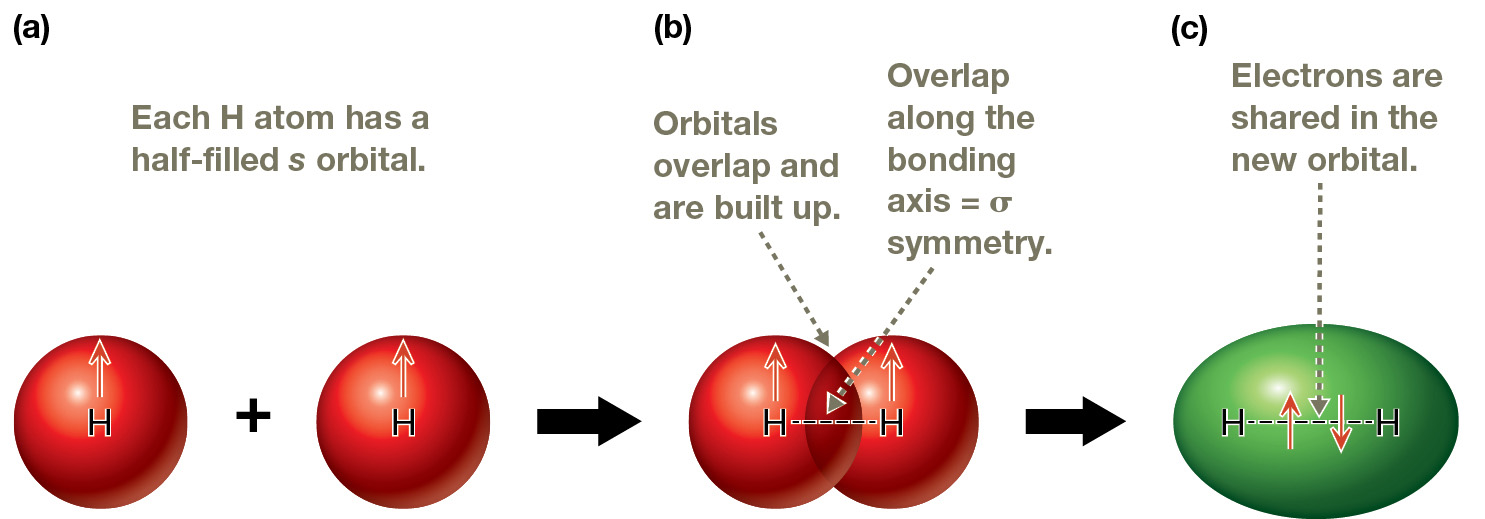
Let’s now apply VB theory to the simplest molecule, H2. The two hydrogen atoms are held together by a single covalent bond, so the Lewis structure is simply H—H, and we can envision the molecule being constructed from two isolated H atoms. The electron configuration of an isolated H atom is 1s1, so the 1s orbital of each atom is a half-filled valence orbital (Figure 3-3a). When the H atoms come together, the two 1s orbitals overlap (Fig. 3-3b), and the new orbital that is produced (Fig. 3-3c) ends up with both electrons.
More information
A three-part illustration shows the formation of a molecular orbital through the valence bond theory. The first part shows two hydrogen atoms. Each has a small nucleus surrounded by a spherical orbital. A label reads each H atom has a half-filled s orbital. The second part shows the two orbitals overlapping creating a darker region. The overlapping section is labeled orbitals overlap and are build up. A dashed line connects the two nuclei. A label points to the line and reads overlap along the bonding axis equals sigma symmetry. The third part shows an elliptical orbital with two nuclei. A horizontal dashed line connects the two nuclei. On top of the dashed line is an arrow pointing up and an arrow pointing down. A label reads electrons are shared in the new orbital.
FIGURE 3-3Valence bond theory applied to H2 (a) Each separate H atom has a half-filled valence s orbital. (b) When the two H atoms come together in space, the orbitals overlap. (c) This overlap produces a new orbital that belongs to both nuclei simultaneously. The overlap of the orbitals along the bonding axis (black dashed line) gives the new orbital σ symmetry, and the bond is a σ bond.
Symmetry is an important property of new orbitals that are produced by overlapping orbitals from different atoms. The most common type is σ(sigma) symmetry:
An orbital having σ symmetry will be produced when orbitals from different atoms overlap along the bonding axis, which is the line connecting the two nuclei.
A pair of electrons occupying an orbital with σ symmetry is called a σ bond.
The H—H single bond in H2 is an example of a σ bond. This simple example reflects a general outcome:
All single bonds are σ bonds, regardless of the molecule in which they are found.
Solved Problem 3.1 takes us through another example.
SOLVED PROBLEM 3.1
How to use valence bond theory to describe a single bond
Break It Down The H and Cl atoms in HCl are held together by a single covalent bond. Apply VB theory to describe that bond. What type of symmetry does that bond have?
Think
Solve
What is the electron configuration of each isolated atom? What valence orbitals are half-filled?
➤
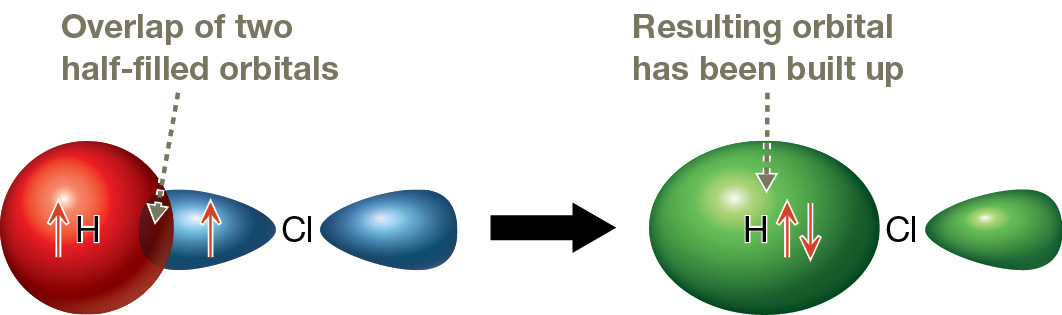
The electron configuration of the isolated H atom is 1s1, so the 1s orbital is half-filled. The electron configuration of the Cl atom is 1s22s22p63s23p5. One of the three 3p orbitals, therefore, is half-filled.
How do those orbitals overlap to form a new orbital that would allow the electrons of the bond to be shared?
➤
When the orbitals overlap as shown here, a new orbital results, which has been built up in the overlap region.
More information
A two part illustration shows the formation of the orbitals of H C l. The first part shows H with a spherical orbital and a small up arrow inside. C l has a dumbbell shaped orbital with two lobes on opposite sides. The left side has a small up arrow inside. The left side of the dumbbell overlaps with the orbital of H. A label reads overlap of two half-filled orbitals. An arrow points from the first part of the illustration to the second part. The second part shows a large egg shaped orbital around H. There are a small up arrow and a small down arrow inside. A label reads resulting orbital has been built up. Next to the oval is C l. On the right side of C l is one half of a normal dumbbell orbital.
Do the orbitals overlap along the bonding axis? What type of symmetry, therefore, is the resulting bond?
➤
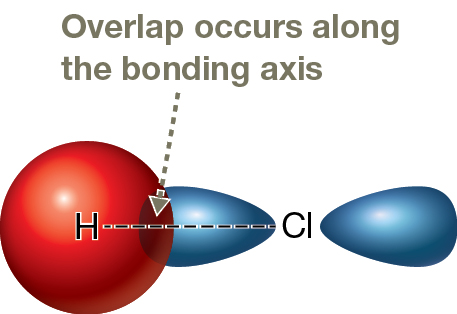
The 1s orbital of hydrogen overlaps the 3p orbital from Cl along the bonding axis, so the resulting orbital has σ symmetry and the resulting bond is a σ bond.
More information
An illustration of the bonding axis of H C l. H is surrounded by a spherical orbital and a small up arrow inside. C l has a dumbbell shaped orbital with two lobes on opposite sides. The left side has a small up arrow inside. The left side of the dumbbell overlaps with the orbital of H. There is a dashed line between H and C l. A label reads overlap occurs along the bonding axis.
Try ItThe two Cl atoms in Cl2 are held together by a covalent single bond. Apply VB theory to describe that bond. What type of symmetry does that bond have?
Answers to all Try It exercises can be found in the Solutions Manual.
The examples in this section deal only with σ symmetry. Another common type of symmetry is π (pi) symmetry, which we will discuss in Section 3.4.
the symmetry of a molecular orbital that is generated by the overlap of atomic orbitals along a bonding axis. A σ bond occurs when two electrons occupy a σ bonding MO. (Ch. 3)
a bond in which a pair of electrons occupies a bonding molecular orbital of σ symmetry; that is, a molecular orbital in which the overlap of atomic orbitals takes place along a bonding axis. A single bond in a Lewis structure is generally a σ bond. (Ch. 3)