Section 1.3 Objectives
You will be able to:
- Specify the number of protons and electrons in an atom or atomic ion.
- Write the ground state electron configuration of an atom or atomic ion.
- Distinguish valence electrons from core electrons.
In Section 1.2, we saw that carbon’s bonding characteristics give rise to the large variety of organic molecules. Those bonding characteristics, and the bonding characteristics of all atoms, are governed by the atom’s electrons.
In this section, we consider the nature of electrons in atoms. We’ll first review the basic structure of an atom, including the role of orbitals and shells. Then we’ll review some rules governing electron configurations, distinguishing between valence electrons, which can be used for bonding, and core electrons.
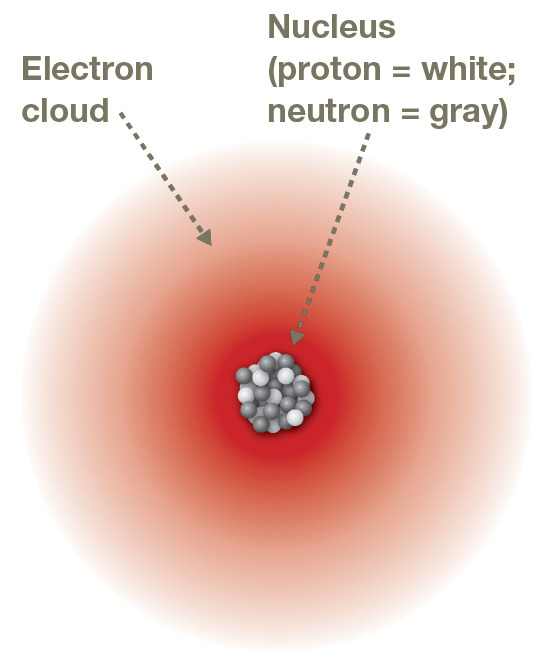
Basic structure of the atom, which includes a nucleus that is surrounded by a cloud of electrons. The nucleus includes protons and neutrons. The caption reads, Basic structure of the atom: Atoms are composed of a nucleus surrounded by a cloud of electrons. Protons, in white, and neutrons, in gray, make up the nucleus. This figure is not to scale. If it were, the size of the electron cloud, which is much larger than the size of the nucleus, would have a radius on the order of 500 meters!
At the center of an atom (Figure 1-4) is a positively charged nucleus, composed of protons and neutrons. Surrounding the nucleus is a cloud of negatively charged electrons, attracted to the nucleus by simple electrostatic forces (the interactions by which opposite charges attract one another and like charges repel one another). Individual electrons are incredibly small, much smaller than the nucleus, but the space that electrons occupy (i.e., the electron cloud) is much larger than the nucleus. In other words:
Table 1-1 lists the mass and charge of each elementary particle. Notice that the masses of the proton and neutron are significantly greater than that of the electron, so the mass of an atom is essentially the mass of just the nucleus.
|
TABLE 1-1 Charges and Masses of Subatomic Particles |
||||
|
Particle |
Charge (e)a |
Mass (u)b |
||
|
Proton (p+) |
+1 |
~1 |
||
|
Neutron (n) |
0 |
~1 |
||
|
Electron (e–) |
–1 |
~0.0005 |
||
|
ae = Elementary charge. bu = Unified atomic mass unit. |
||||
An atom, by definition, has no net charge, so the number of electrons in an atom must equal the number of protons. The number of protons in the nucleus, called the atomic number (Z), defines the element. For example, a nucleus that has six protons has an atomic number of 6 and can only be a carbon nucleus.
If the number of protons and the number of electrons are unequal, then the entire species (that particular combination of protons, neutrons, and electrons) bears a net charge and is called an ion. A negatively charged ion, an anion (pronounced AN-eye-on), results from an excess of electrons. A positively charged ion, a cation (pronounced CAT-eye-on), results from a deficiency of electrons.
Chemistry with Chicken Wire
Some of the most exciting chemistry today involves extended frameworks of only carbon, as shown in Figure 1-5. Graphene, for example, is a framework of carbon atoms arranged in a single flat layer resembling molecular chicken wire. Wrapped around to form a cylinder, a graphene sheet forms what is called a carbon nanotube. Pure carbon can even take the form of a soccer ball: the so-called buckminsterfullerene.
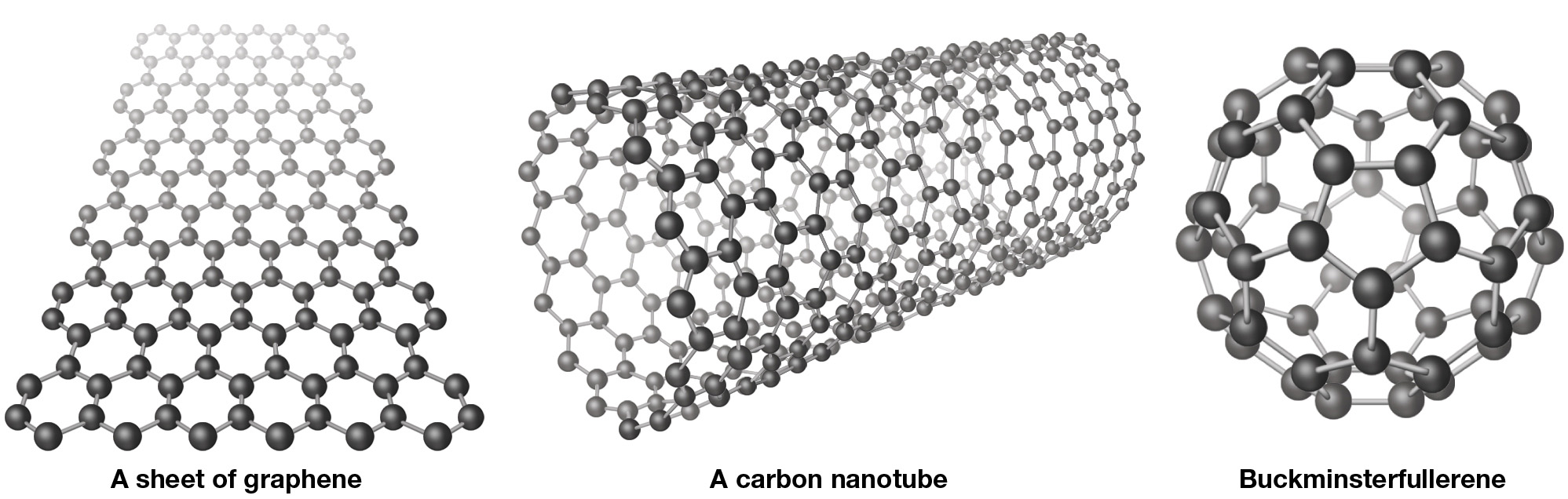
Three ball-and-stick models of structures made only of carbon: grapheme, a carbon nanotube, and Buckminsterfullerene. The first illustration shows the structure of graphene, which has a flat, sheet-like framework formed by hexagonal rings made up of six carbon atoms connected together. The second shows the structure of a carbon nanotube, which is cylindrical in shape and is also formed by hexagonal rings made up of six carbon atoms connected together. The third illustration shows the spherical structure of Buckminsterfullerene formed by pentagonal rings made up of five carbon atoms and hexagonal rings made up of six carbon rings connected together.
These structures have quite interesting electronic properties, giving them a bright future in nanoelectronics. Moreover, carbon nanotubes and buckminsterfullerenes have high tensile strength, making them useful for structural reinforcement in concrete, sports equipment, and body armor. Chemical modification gives these structures an even wider variety of potential uses. Graphene oxide, for example, has promising antimicrobial activity, and attaching certain molecular groups to the surface of a carbon nanotube or buckminsterfullerene has potential for use as drug carriers for cancer therapeutics.
SOLVED PROBLEM 1.1
How to determine the number of protons and electrons in an atomic ion
Break It Down How many protons and electrons does a cation of the carbon atom have if its net charge is +1?
Every Solved Problem in this book uses a Think/Solve strategy to guide you through the solution. After you consider a question posed on the Think side of the table, read the answer on the Solve side.
|
Think |
Solve |
|
|
How many protons are there in the nucleus of a carbon atom? |
➤ |
A carbon atom’s nucleus has six protons. |
|
Does a cation have more protons than electrons, or vice versa? |
➤ |
A cation must have more protons (positive charges) than electrons (negative charges). |
|
What does the net charge tell you about the relative numbers of protons and electrons? |
➤ |
The +1 charge indicates that there is one more proton than there are electrons, so the ion must have five electrons. |
|
Try It(a) How many protons and electrons does an anion of the carbon atom have if its net charge is –1? (b) How many protons and electrons does a cation of the oxygen atom have if its net charge is +1? (c) How many protons and electrons does an anion of the oxygen atom have if its net charge is –1? |
||
|
Answers to all Try It exercises can be found in the Solutions Manual. |
||
Electrons in an isolated atom reside in orbitals. As we will see, the exact location of an electron can never be pinpointed. An orbital, however, describes the region of space where the probability of finding a given electron is high. More simplistically, we can view orbitals as “rooms” that house electrons. Orbitals are examined in greater detail in Chapter 3; for now, it will suffice to review some of their more basic properties.
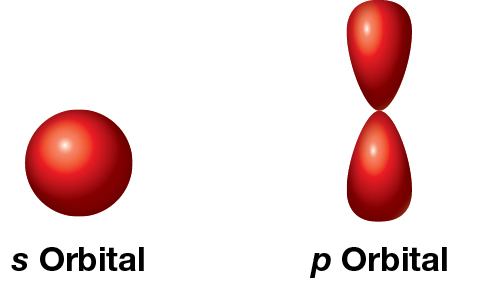
An illustration shows the space-filling models of a spherical s orbital and a dumbbell-shaped p orbital. The caption reads, “Orbitals: Orbitals represent regions in space where an electron is likely to be. An s orbital is spherical, and a p orbital is a dumbbell.”
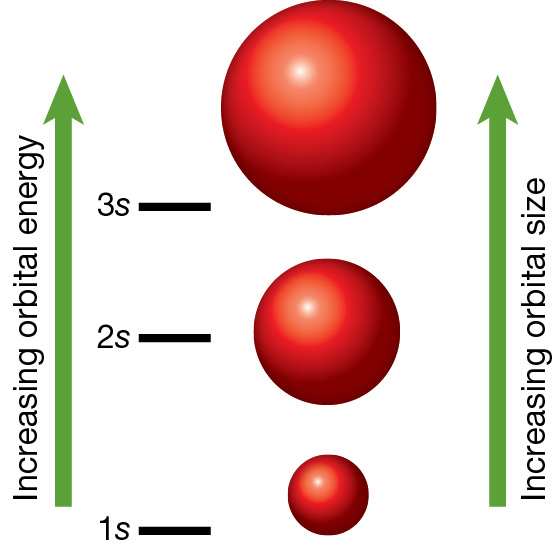
An illustration shows space-filling models of the 1 s, 2 s, and 3 s orbitals in order of increasing orbital size and orbital energy. The 1 s orbital is the smallest in size and has the least orbital energy. The 2 s orbital is larger and has more orbital energy than the 1 s orbital. The 3 s orbital, which is the largest of these three, has the most orbital energy. The caption reads, “Relationship between principal quantum number, orbital size, and orbital energy: As the shell number of an orbital increases, its size and energy increase, too. The horizontal black lines indicate each orbital’s energy.”
The way in which electrons are arranged in orbitals is called the atom’s electron configuration. The most stable (i.e., the lowest energy) electron configuration is called the ground state configuration. Knowing an atom’s ground state configuration provides insight into the atom’s chemical behavior, as we will see.
With the relative energies of orbitals established, an atom’s ground state electron configuration can be obtained by applying the following three rules:
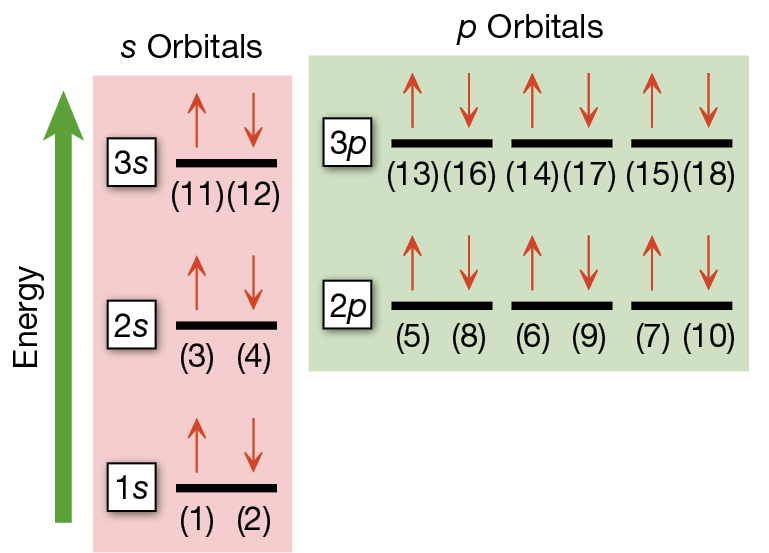
An energy diagram shows the order in which the first eighteen electrons fill into the s orbitals and p orbitals. An upward arrow indicates increasing energy levels. Beside the arrow is a block representing the s orbitals in order of increasing energy, with the 1 s orbital at the lowest end, the 2 s orbital above it, and the 3 s orbital further above. Beside this block is another representing the p orbitals, with three 2 p orbitals located slightly above the level of the 2 s orbital, and three 3 p orbitals located slightly above the level of the 3 s orbital. The first two electrons occupy the 1 s orbital and the next two occupy the 2 s orbital. The fifth, sixth, and seventh electrons occupy each of the three 2 p orbitals in order, and the eighth, ninth, and tenth electrons pair up with the three previous electrons respectively. The eleventh and twelfth electrons occupy the 3 s orbital, and the thirteenth, fourteenth, and fifteenth electrons occupy each of the three 3 p orbitals in order. The sixteenth, seventeenth, and eighteenth electrons pair up with the three previous electrons respectively. Each electron pair is represented by a pair of opposing vertical arrows. The caption reads, “Energy diagram of orbitals for the first 18 electrons: The order of electron filling is indicated in parentheses. Each horizontal black line represents a single orbital. Each successive electron fills the lowest energy orbital available. Notice in the 2 p and 3 p sets of orbitals that no electrons are paired up until the addition of the fourth electron.”
According to these three rules, the first 18 electrons fill orbitals as indicated in Figure 1-8. Each arrow represents an electron, and the direction of the arrow (up or down) represents the electron’s spin.
YOUR TURN 1.1
In Figure 1-8, draw a box around all of the electrons that occupy orbitals in the second shell and draw a circle around the electrons that occupy orbitals in the third shell.
The 2s and 2p orbitals are in the second shell. The 3s and 3p orbitals are in the third shell. Box electrons (3)–(10) in Figure 1-8, and circle electrons (11)–(18).
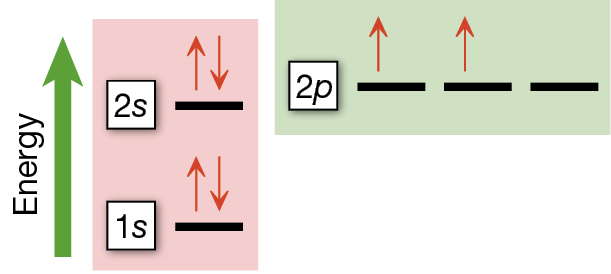
An energy diagram shows how the six electrons in a carbon atom fill the s orbitals and p orbitals. An upward arrow indicates increasing energy levels. Beside the arrow is a block representing the s orbitals in order of increasing energy, with the 1 s orbital at the lowest end and the 2 s orbital above it. Beside this block is another representing the p orbitals, with three 2 p orbitals located slightly above the level of the 2 s orbital. The first two electrons occupy the 1 s orbital and the next two occupy the 2 s orbital. The fifth and sixth electrons occupy two of the three 2 p orbitals in order. Each electron pair is represented by a pair of opposing vertical arrows, and the fifth and sixth electrons are each represented by an upward arrow. The caption reads, “Energy diagram for the ground state electron configuration of the carbon atom: This configuration is abbreviated 1 s 2 2 s 2 2 p 2.”
In the ground state, the six electrons found in a carbon atom would fill the orbitals as shown in Figure 1-9, with two electrons in the 1s orbital, two electrons in the 2s orbital, and one electron in each of two different 2p orbitals (it doesn’t matter which two). The shorthand notation for this electron configuration is 1s22s22p2.
Knowing the ground state electron configuration of an atom, we can distinguish valence electrons from core electrons:
Valence electrons are important because, as we will discuss in Section 1.5, they participate in covalent bonds. As we can see in Figure 1-9, for example, carbon has four valence electrons and two core electrons, so bonding involving carbon is governed by those four valence electrons.
YOUR TURN 1.2
In Figure 1-9, draw a circle around the valence electrons and label them. Draw a box around all of the core electrons and label them.
The valence electrons are in the second shell, 2s2 and 2p2, and the core electrons are in the first shell, 1s2.
We can use the periodic table (a copy of which appears inside the book’s front cover) to quickly determine how many valence electrons an atom has:
The number of valence electrons in an atom is the same as the atom’s group number.
Carbon is located in group 4A, consistent with its four valence electrons, whereas chlorine (group 7A) has seven. According to its ground state electron configuration (1s22s22p63s23p5), chlorine’s valence electrons occupy the third shell.
Elements in group 8A have a special property:
Atoms that have a completely filled valence shell, such as helium and neon, are particularly stable and are called the noble gases (group 8A).
Noble gases are so stable that they rarely form bonds to make molecules. Although the specific origin of this “extra” stability is beyond the scope of this book, the consequences are the basis for the octet and duet rules we routinely use when drawing Lewis structures (Section 1.5).
SOLVED PROBLEM 1.2
How to determine the ground state electron configuration of an atom
Break It Down Write the ground state electron configuration of the nitrogen atom. How many valence electrons does it have? How many core electrons does it have?
|
Think |
Solve |
|
|
How many total electrons are there in a nitrogen atom? |
➤ |
Nitrogen has seven total electrons (Z = 7 for N). |
|
In what order are nitrogen’s orbitals filled (see Fig. 1-8)? |
➤ |
The first two electrons are placed in the 1s orbital and the next two in the 2s orbital, leaving one electron for each of the three 2p orbitals. The electron configuration is 1s22s22p3. |
|
What is nitrogen’s valence shell and where do its core electrons reside? |
➤ |
Nitrogen’s valence shell is the second shell, so there are five valence electrons. The remaining two electrons occupying the first shell are core electrons. |
|
Try ItWrite the ground state electron configuration of the oxygen atom. How many valence electrons and how many core electrons are there? |
||