Section 1.2 Objectives
You will be able to:
- Describe how the diversity in the structure of organic molecules is an outcome of carbon’s ability to form four bonds.
- Explain the role of bond strength in the stability of organic molecules.
Why does the carbon atom play such a central role in the chemistry of life? First of all, carbon is capable of forming incredibly diverse compounds. As will be explained in Section 1.6, the carbon atom can form four covalent bonds to other atoms, especially other carbon atoms.
Consequently, carbon atoms can link together in chains of almost any length (Figure 1-2a) as well as in rings of various sizes. Moreover, each carbon atom is capable of forming not only single bonds but also double and triple bonds (Fig. 1-2b). Finally, the ability to form four bonds means that branching can occur at each carbon (Fig. 1-2c). These characteristics make possible a tremendous number of compounds, even with a relatively small number of carbon atoms. Indeed, to date, tens of millions of organic compounds are known, and the list is growing rapidly as we continue to discover or synthesize new compounds.
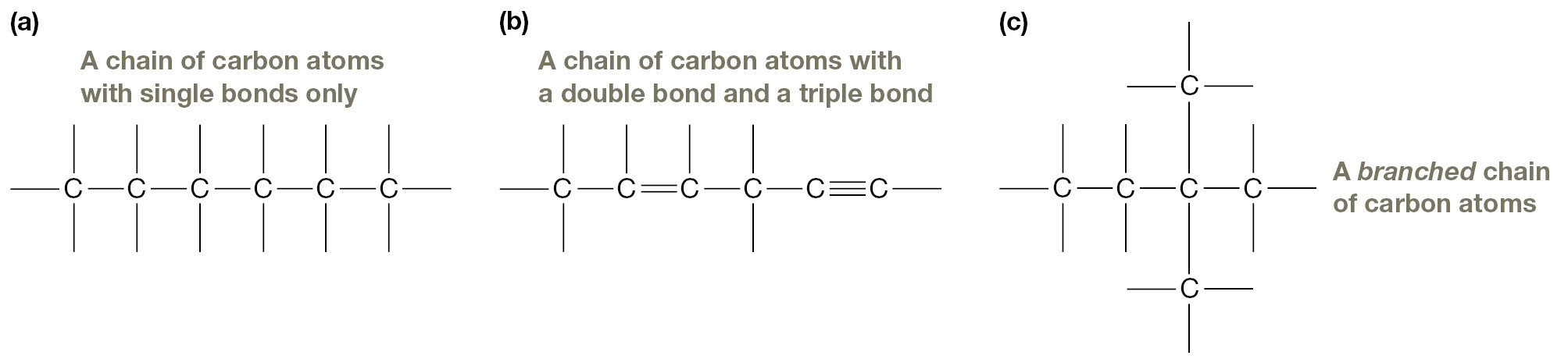
A three-part illustration shows three carbon atom chains with each carbon atom surrounded by four bonds. The first part shows a linear chain of 6 carbon atoms connected by single bonds only. The second shows a linear chain of 6 carbon atoms with a double bond between carbons 5 and 6 and a triple bond between carbons 1 and 2. The third part shows a branched chain where four carbon atoms are connected by single bonds in a linear manner. The carbon atom in the second position is connected to other carbon atoms, one above and one below, by single bonds.
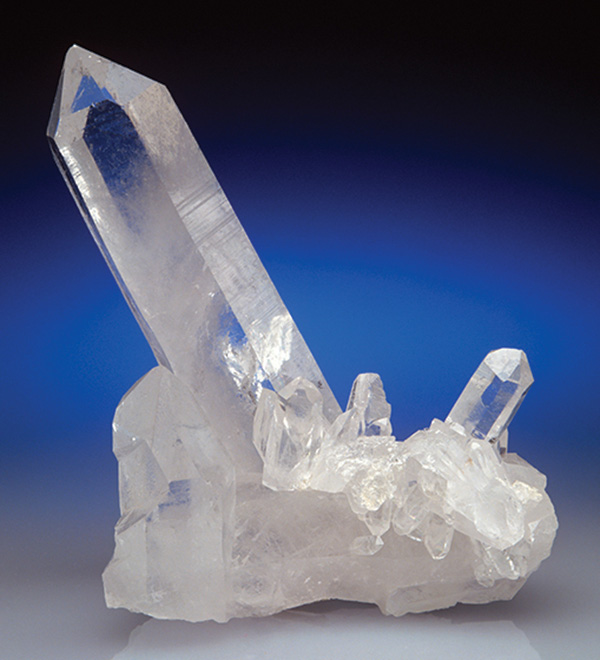
A photo shows the crystalline form of silicon dioxide, known as quartz. The caption reads, “Quartz crystal: Quartz (silicon dioxide) is the silicon analog of carbon dioxide. Whereas carbon dioxide is gaseous, silicon dioxide is a solid.”
If carbon works so well, then why not silicon, which appears just below carbon in the periodic table? Elements in the same group (column) of the periodic table tend to have similar chemical properties, so silicon, too, can form four covalent bonds, giving it the same potential for diversity as carbon. The answer is stability. As we will see in Section 1.4, a bond formed between silicon atoms has about half the strength of a bond formed between carbon atoms, making it much easier to break a bond between silicon atoms. Thus, compounds based on silicon would be much less stable.
Let’s entertain the idea of silicon atoms replacing carbon atoms in biomolecules such as glucose (C6H12O6). Glucose is broken down by our bodies through cellular respiration to extract energy, according to the overall reaction in Equation 1-2. One of the by-products is carbon dioxide, a gas, which is exhaled from the lungs. If the molecules of life were based on silicon, the glucose analog would be Si6H12O6, and its by-product would be silicon dioxide (SiO2), as shown in Equation 1-3. Silicon dioxide, a solid, is the main component of sand; in its crystalline form, it is known as quartz (Figure 1-3).
C6H12O6(s) + 6 O2(g) → 6 CO2(g) + 6 H2O(l) (1-2)
Si6H12O6(s) + 6 O2(g) → 6 SiO2(s) + 6 H2O(l) (1-3)