Section 1.6 Objectives
You will be able to:
- Specify the most common number of bonds and lone pairs exhibited by atoms that form organic molecules.
- Complete a Lewis structure of a molecule quickly, given its connectivity.
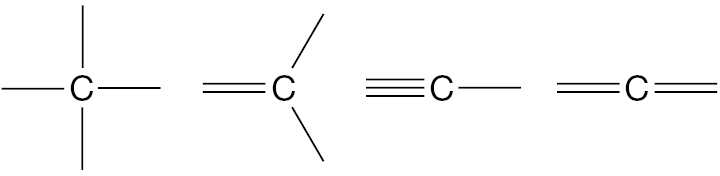
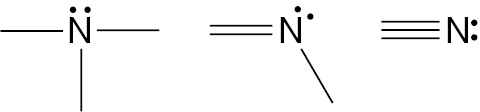
After you’ve used the systematic steps (p. 12) to construct Lewis structures of several species, you may begin to notice that each type of atom tends to form a specific number of bonds and to have a specific number of lone pairs of electrons. Table 1-4 summarizes these patterns. What you will learn later is that those are the number of bonds and lone pairs for atoms that bear no formal charge. Atoms that are charged have combinations of bonds and lone pairs that are different from those in Table 1-4.
The patterns shown in Table 1-4 are really helpful when drawing Lewis structures of relatively large molecules, as shown in Solved Problem 1.5.
Strategies for Success: Drawing Lewis Dot Structures Quickly
|
Table 1-4 Common Numbers of Covalent Bonds and Lone Pairs for Selected Uncharged Atoms |
|||
|
Atom |
Number of Bonds |
Number of Lone Pairs |
Examples |
|
H |
1 |
0 |
⸺H |
|
C |
4 |
0 |
 |
|
N |
3 |
1 |
 |
|
O |
2 |
2 |
 |
|
X (X = F, Cl, Br, I) |
1 |
3 |
 |
|
Ne |
0 |
4 |
 |
SOLVED PROBLEM 1.5
How to complete a Lewis structure quickly
Break It Down Complete the Lewis structure for the compound whose skeleton is shown here. Assume that all atoms are uncharged.
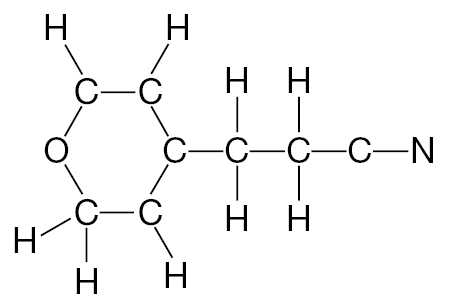
A condensed structural formula of a molecule. The condensed structural formula has a hexagonal ring with a long chain. The ring is composed of five carbon atoms and one oxygen atom. The first, second, and fourth carbon atom are single bonded to hydrogen atoms each. The third carbon atom is single bonded to a chain of two carbons, of which the first carbon atom is single bonded to two hydrogen atoms and the second carbon atom is single bonded to two hydrogen atoms and a cyanide group. The fifth carbon atom of the ring is single bonded to two hydrogen atoms.
|
Think |
Solve |
|
|
Which atoms (other than hydrogen) have an octet and which atoms don’t? |
➤ |
The atoms not shown with an octet are highlighted in red below on the left. |
|
How many bonds and lone pairs are typical for each element? |
➤ |
According to Table 1-4, we need to add two lone pairs to O, convert two C—C single bonds of the ring into double bonds, convert the C—N single bond into a triple bond, and add a lone pair to N. The completed Lewis structure is shown below on the right. 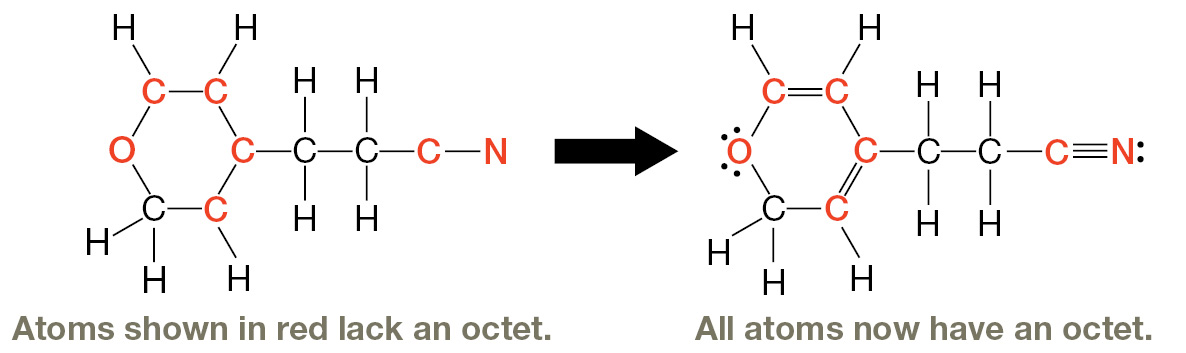
More informationA two-part illustration shows the conversion of a molecule from no octet to full octet state. The first illustration shows the condensed structure of the molecule with atoms having no octet. It has a hexagonal ring attached to a chain of two carbon atoms. The ring is composed of five carbon atoms and one oxygen atom. The carbon atoms in the second, third, and fifth positions are single bonded to hydrogen atoms. The fourth carbon atom is single bonded to a chain of two carbons, of which the first carbon is single bonded to two hydrogen atoms and the second carbon is single bonded to two hydrogen atoms and a cyanide group. The carbon atom in the sixth position of the ring is single bonded to two hydrogen atoms. The carbon atoms in the second, third, fourth, and fifth positions and the cyanide group are marked as no octet. In the second illustration all atoms of the molecule have octet. The oxygen atom of the ring carries two lone pairs of electrons. There are double bonds between the carbon atoms in the second and third positions and between the carbons in the fourth and fifth positions. The single bond between the carbon and nitrogen atoms of the cyanide group becomes a triple bond and the nitrogen atom carries a lone pair of electrons. |
|
Try ItComplete the Lewis structure for the molecule with the connectivity shown here. Assume that all atoms have the number of bonds and lone pairs listed in Table 1-4. 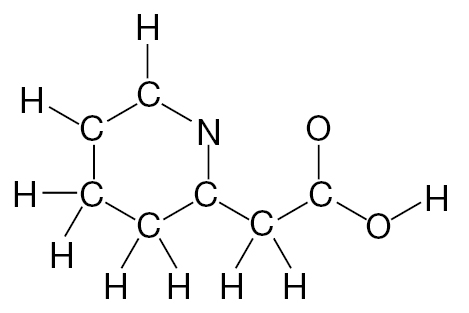
More informationA condensed structural formula of a molecule. The condensed structural formula has a hexagonal ring with a chain of two carbon atoms. The ring is composed of five carbon atoms and one nitrogen atom. The first atom is nitrogen, single bonded to the first carbon atom and fifth carbon atom. The second atom is carbon, single bonded to a chain of two carbon atoms, of which the first carbon is single bonded to two hydrogen atoms and the second carbon is single bonded to an oxygen atom and a hydroxyl group. The third and fourth atoms of the ring are carbon, each single bonded to two hydrogen atoms. The fifth and sixth atoms are carbon, each single bonded to a hydrogen atom. |
||