- Valence Shell Electron Pair Repulsion (VSEPR) Theory: Three-Dimensional Geometry
- Dash–Wedge Notation
- Strategies for Success: The Molecular Modeling Kit
- Net Molecular Dipoles
- Physical Properties, Functional Groups, and Intermolecular Interactions
- Melting Points, Boiling Points, and Intermolecular Interactions
- Solubility
- Strategies for Success: Ranking Boiling Points and Solubilities of Structurally Similar Compounds
- Protic and Aprotic Solvents
- An Introduction to Lipids
2 Three-Dimensional Geometry, Intermolecular Interactions, and Physical Properties
More information
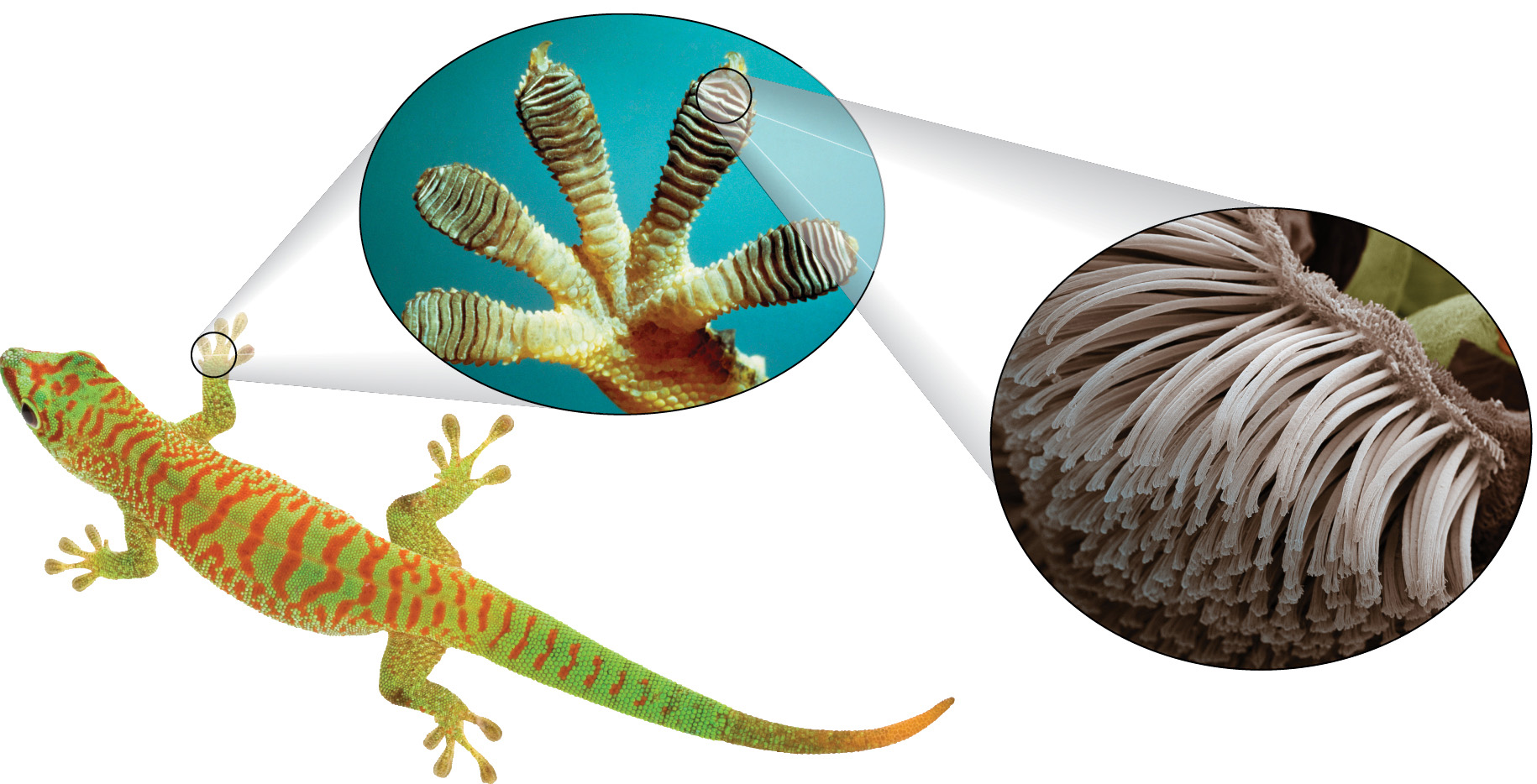
A photo shows a gecko with one of its feet magnified to reveal fine hairs on its surface. The gecko is green with red patterning. A photo shows a gecko with one of its feet magnified to reveal fine hairs on its surface. There are five toes with lines on them. A photo shows a gecko with one of its feet magnified to reveal fine hairs on its surface.
Chapter Outline
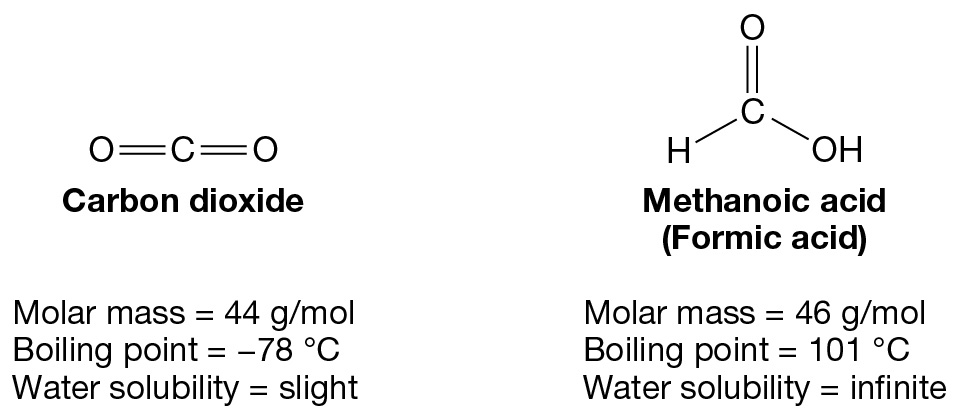
Carbon dioxide (CO2) and methanoic acid (HCO2H), also called formic acid, are similar in their chemical makeup, but as shown in Figure 2-1, the boiling point of CO2 is –78 °C, whereas that of HCO2H is 101 °C. Moreover, CO2 is only slightly soluble in water, whereas HCO2H is soluble in any proportion (infinitely soluble) in water. Why are their physical properties so vastly different?
More information
Condensed structural formulas of carbon dioxide and methanoic acid. The structure of carbon dioxide shows a central carbon atom bonded to two oxygen atoms on either side by double bonds. A note below reads: “Molar mass equals 44 grams per mol. Boiling point equals negative 78 degrees Celsius. Water solubility equals slight.” The structure of methanoic acid shows a central carbon atom bonded to a hydrogen atom and a hydroxyl group by single bonds, and to an oxygen atom by double bonds. A note below reads: “Molar mass equals 46 grams per mol. Boiling point equals 101 degrees Celsius. Water solubility equals infinite.”
As we discuss here in Chapter 2, compounds such as CO2 and HCO2H behave differently because they undergo different intermolecular interactions. Those intermolecular interactions are governed, in turn, by a variety of factors, including the three-dimensional shapes of the molecules and the functional groups they contain. We begin, therefore, with a review of the factors that determine molecular geometry, and then we discuss the different types of intermolecular interactions that are important in organic chemistry.
Molecular geometry and intermolecular interactions explain many phenomena of organic chemistry. Toward the end of this chapter, for example, you will learn that intermolecular interactions determine how soaps function. You will also learn how the properties of cell membranes are governed by intermolecular interactions. In Chapter 5, we will explain how molecular geometry is central to the important concept of chirality—that is, whether a molecule is different from its mirror image. And, in Chapter 9, we will explain how intermolecular interactions can have a dramatic effect on the outcome of chemical reactions.