Explain the roles that entropy and intermolecular forces play in the solubility of a compound.
Describe what solvation is, and explain the importance of solvation in the solubility of an ionic compound.
Predict the more soluble of two compounds in a particular solvent, given only their structures.
The general rule of solubility is that “like dissolves like.” This means that polar compounds tend to be soluble in polar solvents but insoluble in nonpolar solvents, whereas nonpolar compounds tend to be soluble in nonpolar solvents but insoluble in polar solvents. These tendencies are outcomes of two major factors: (1) entropy and (2) intermolecular interactions at play in the pure solute, the pure solvent, and the mixture of the two (the solution).
Let’s first discuss how entropy impacts solubility. As you may recall from general chemistry, entropy is a thermodynamic quantity that increases with the number of equivalent ways the energy in a system can be arranged. Many people think of entropy as a measure of disorder. A system with greater entropy (i.e., one that is more disordered) tends to be more favored than a system with less entropy. Importantly, two substances have greater entropy when they are mixed. Therefore:
An increase in entropy provides the driving force for two substances to mix.
If entropy were the only factor, then a given solute would be soluble in any solvent. How do we account for situations in which a solute remains insoluble in a solvent? To answer this question, we need to consider the intermolecular interactions present in both the mixed and unmixed states:
Substances tend not to mix if the intermolecular interactions in the pure solute and pure solvent are sufficiently stronger than those in the hypothetical solution.
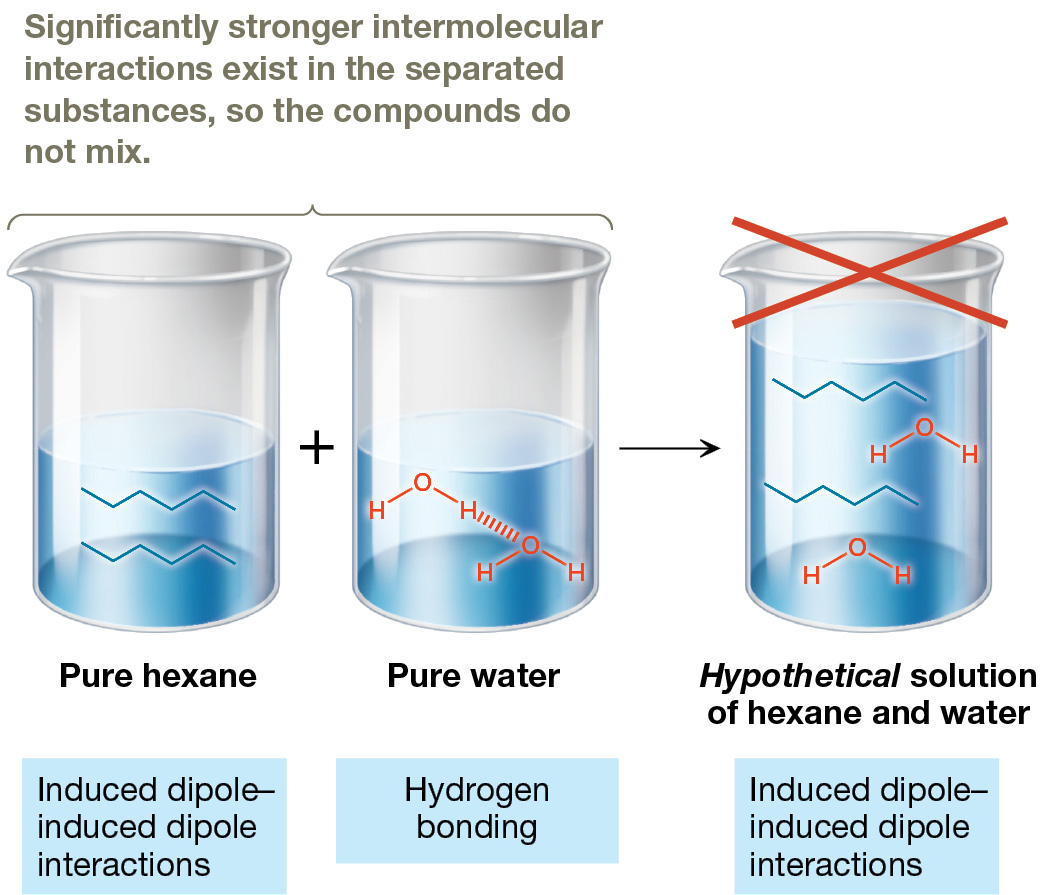
Consider, for example, that hexane (CH3CH2CH2CH2CH2CH3), a nonpolar compound, is essentially insoluble in water. As shown in Figure 2-20, induced dipole–induced dipole interactions dominate in pure hexane, whereas hydrogen bonding dominates in pure water. In the hypothetical solution that would result if hexane were to dissolve in water, induced dipole–induced dipole interactions would dominate. The much stronger hydrogen bonding that exists in the unmixed state prevents the solute and solvent from mixing.
More information
Illustrations of the formation of a hypothetical solution of hexane and water shows three beakers. Two beakers with a plus sign between them are each half-filled with a liquid. The first beaker contains pure hexane with induced dipole-induced dipole interactions, as represented by zigzag line structures with three crests and three troughs. The second beaker contains water, as represented by the structural formulas showing an oxygen atom bonded to two hydrogen atoms, with hydrogen bonds between two molecules. A note above these beakers reads, “Significantly stronger intermolecular interactions exist in the separated substances, so the compounds do not mix.” An arrow from these two beakers leads to a third beaker that is nearly filled with a hypothetical solution of hexane and water with induced dipole-induced dipole interactions. There is a large red X over the third beaker. The caption reads, “Intermolecular interactions and the insolubility of hexane in water: The dominant intermolecular interactions present in pure hexane are induced dipole—induced dipole interactions. The dominant intermolecular interaction in pure water is hydrogen bonding. When we consider the hypothetical solution, induced dipole—induced dipole interactions remain but hydrogen bonding is diminished. This favors the pure substances on the left, which explains why hexane is insoluble in water.”
FIGURE 2-20Intermolecular interactions and the insolubility of hexane in water The dominant intermolecular interactions present in pure hexane are induced dipole–induced dipole interactions. The dominant intermolecular interaction in pure water is hydrogen bonding. When we consider the hypothetical solution that would result if hexane were to dissolve in water, induced dipole–induced dipole interactions would remain but hydrogen bonding would be diminished. Because the stronger hydrogen bonding in pure water is preferred, mixing does not occur.
CONNECTIONS 2.11
Toluene and its uses Toluene (Solved Problem 2.4) is an important organic solvent, but it is also a precursor in the production of 2,4,6-trinitrotoluene (TNT) and other industrial compounds. In biochemistry, red blood cells can be lysed by toluene to extract hemoglobin.
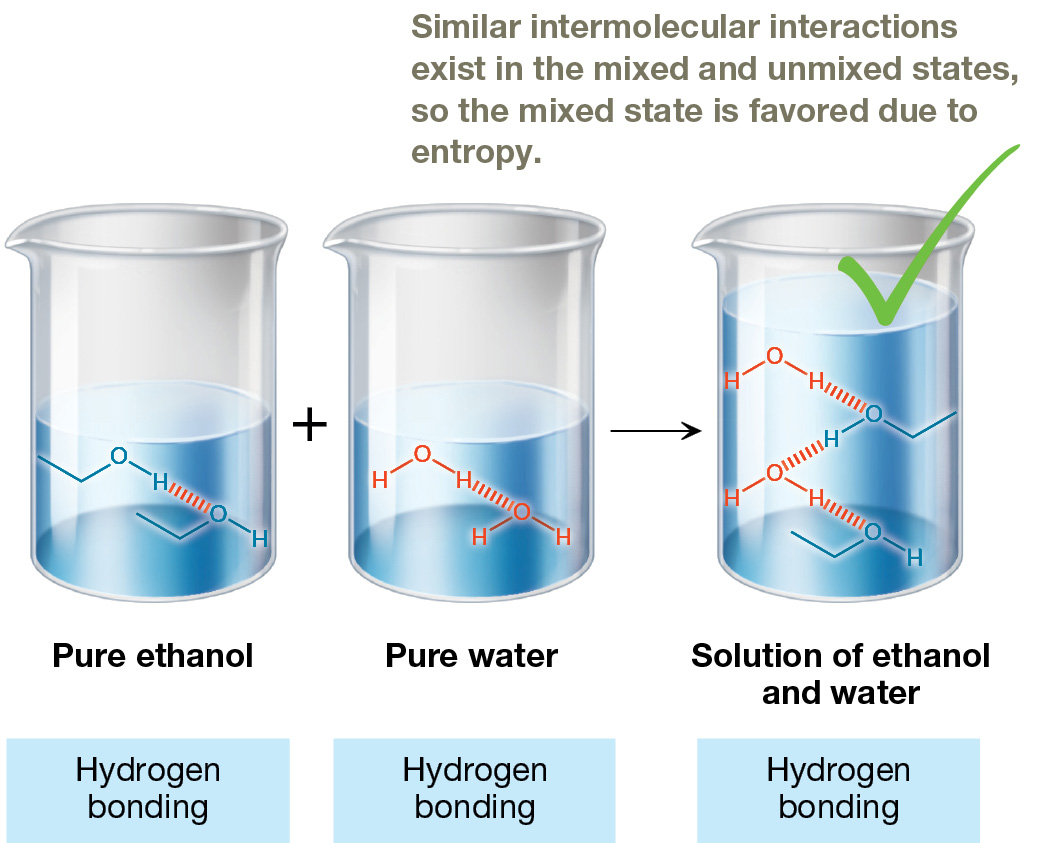
The story changes when the solute and solvent are both polar or both nonpolar. Ethanol (CH3CH2OH), for example, is infinitely soluble in water. As shown in Figure 2-21, the strongest intermolecular interaction that exists in the pure separated substances is hydrogen bonding (both in water and in ethanol). Substantial hydrogen bonding also occurs between the solute and solvent molecules in the ethanol–water solution, so the intermolecular interactions are similar in strength in the mixed and unmixed states. In this case, the intermolecular interactions in the unmixed state do not overcome the driving force for the substances to mix due to entropy, so the substances mix and form the solution.
More information
Illustrations of the formation of a solution of ethanol and water shows three beakers. Two beakers with a plus sign between them are each half-filled with a liquid. The first beaker contains pure ethanol, as represented by the structural formulas showing a hydroxyl group bonded to an inverted V, with hydrogen bonds between two molecules. The second beaker contains water, as represented by the structural formulas showing an oxygen atom bonded to two hydrogen atoms, with hydrogen bonds between two molecules. An arrow from these two beakers leads to a third beaker that is nearly filled with a solution of ethanol and water with hydrogen bonding between the molecules. There is a large green check mark over the third beaker, and a note that reads, “Similar intermolecular interactions exist in the mixed and unmixed states, so the mixed state is favored due to entropy.” The caption reads, Intermolecular interactions and the solubility of ethanol in water: Hydrogen bonding exists in pure ethanol, shown in blue, and in pure water, shown in red. Substantial hydrogen bonding also exists between molecules of water and ethanol in a solution, allowing the two substances to dissolve readily and in any proportion.
FIGURE 2-21Intermolecular interactions and the solubility of ethanol in water Hydrogen bonding exists in pure ethanol (blue) and in pure water (red). Substantial hydrogen bonding occurs between molecules of water and ethanol in a solution, allowing the two substances to dissolve readily and in any proportion.
SOLVED PROBLEM 2.4
How to predict the more soluble compound
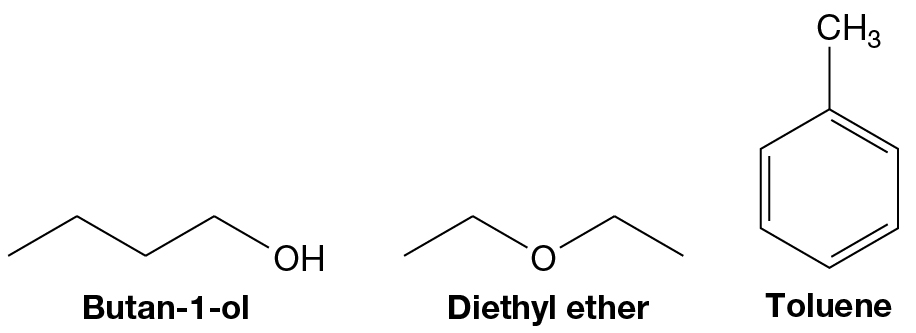
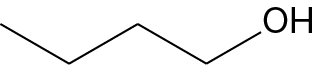
Break It Down Would you expect butan-1-ol or diethyl ether to be more soluble in toluene (C6H5CH3)? Explain.
More information
Skeletal structural formulas of butan-1-ol, diethyl ether, and toluene. The structure of butan-1-ol shows a zigzag four-carbon chain with a hydroxyl group at the first position. The structure of diethyl ether shows an oxygen atom bonded to two ethyl groups. The structure of toluene shows a benzene ring bonded to a methyl group.
Think
Solve
What are the most important intermolecular interactions in the pure solutes? In the pure solvent? What is the strongest intermolecular interaction that would be lost on mixing?
➤
The most important intermolecular interactions are:
hydrogen bonding for butan-1-ol
dipole–dipole interactions for diethyl ether
dispersion forces for toluene
Of these, hydrogen bonding is the strongest that would be lost on mixing.
What is the most important intermolecular interaction that would be present in each mixed state?
➤
Toluene is nonpolar, so relatively weak dispersion forces are the only interactions that would exist between toluene and each of the given compounds.
For which solute is there a more favorable trade-off of intermolecular interactions on mixing with the solvent?
➤
Because each mixed state would have only weak dispersion forces, the most favorable trade-off would occur with the solute that loses the weakest intermolecular interactions: diethyl ether. Diethyl ether is therefore more soluble in toluene.
Try ItWhich compound, A or B, do you expect to be more soluble in H2O? Which compound, C or D, would you expect to be more soluble in toluene (C6H5CH3)? Explain.
More information
Four skeletal structural formulas show four different molecules. Structures A and B are each shown as a zigzag line with three crests and three troughs. The position at the end of the line in the structure B is occupied by an amine group. Structure C shows a benzene ring bonded to a carboxyl group. Structure D shows a benzene ring bonded to a carbon atom, which is bonded by a double bond to an oxygen atom and by a single bond to another oxygen atom, which is bonded to a sodium atom.
2.7a The Solubility of Ionic Compounds: Ion–Dipole Interactions and Solvation
Based on what we’ve discussed so far, it might seem peculiar that an ionic compound such as sodium methanoate (sodium formate, Na+HCO−2) dissolves in a polar solvent like water, because it would require the loss of ion–ion interactions, the strongest of the intermolecular forces. Yet sodium methanoate does dissolve in water, and its water solubility (like that of most ionic compounds) is quite high (Table 2-4, p. 78). Why?
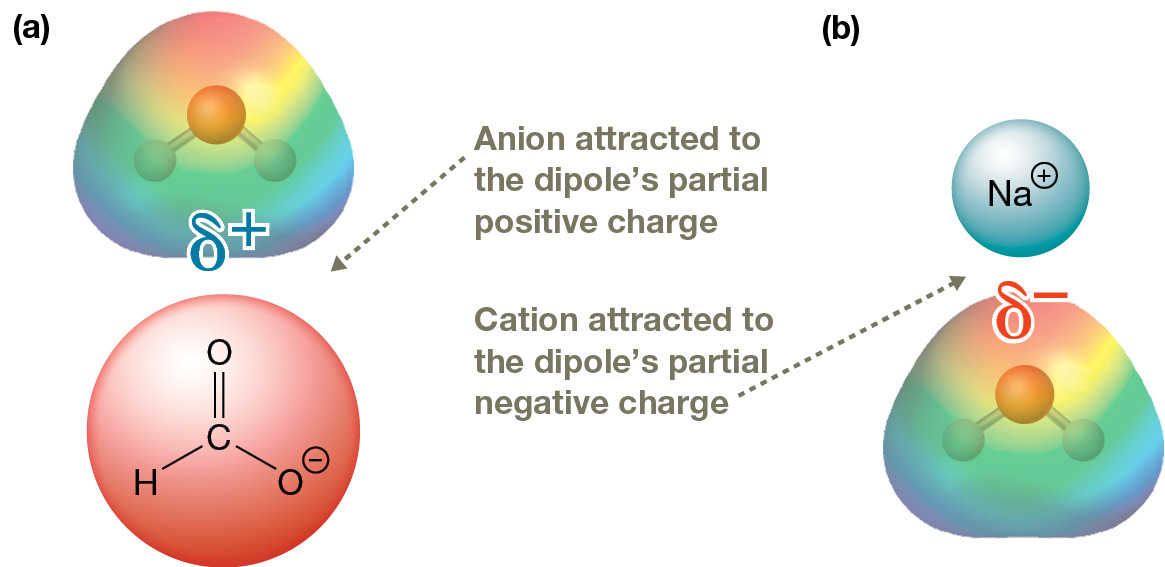
When an ionic compound like sodium methanoate dissolves in water, it does so as its individual ions, Na+ and HCO−2, not as uncharged formula units. These free ions can interact with water molecules through ion–dipole interactions, a different kind of intermolecular interaction from the ones we have examined thus far. In this example, the positive end of water’s dipole attracts a HCO−2 anion and the negative end attracts a Na+ cation (Figure 2-22).
More information
Two illustrations show the interactions between an ion and a dipole. The first illustration shows the condensed structural formula of a methanoate ion below an electrostatic potential map of a water molecule, represented by a ball-and-stick model. The structure of the ion shows a central carbon atom bonded to an oxygen atom by a double bond, and to a hydrogen atom and an oxygen atom carrying a negative charge by single bonds. The ion is enclosed in a red circle. The triangular electrostatic map of water is shaded in red at the upper end representing the oxygen atom, and in blue at the two lower ends, each representing a hydrogen atom. The central portion is shaded in yellow, green, and turquoise from top to bottom. The lower end of the electrostatic map shows a partial positive charge. An arrow with a note, “Anion attracted to the dipole’s partial positive charge,” points to this illustration. The second illustration shows a positively charged sodium ion above an electrostatic potential map of a water molecule, represented by a ball-and-stick model. The triangular electrostatic map of water is shaded in the same manner as in the first illustration. Here, the upper end shows a partial negative charge. An arrow with a note, “Cation attracted to the dipole’s partial negative charge,” points to this illustration. The caption reads, “Ion—dipole interactions: a. An ion—dipole interaction between HCO22and H2O.The anion interacts with the positive end of water’s dipole. b. An ion—dipole interaction between Na1 and a molecule of water. The cation interacts with the negative end of water’s dipole.”
FIGURE 2-22Ion–dipole interactions (a) An ion–dipole interaction between the methanoate anion, HCO2−, and H2O. The anion interacts with the positive end of water’s dipole. (b) An ion–dipole interaction between the sodium cation, Na+, and H2O. The cation interacts with the negative end of water’s dipole.
Notice that an ion–dipole interaction involves a full charge and a partial charge. The concentration of charge involved in an ion–dipole interaction is generally less than in an ion–ion interaction but more than in a dipole–dipole interaction. Consequently:
The strength of an ion–dipole interaction is intermediate between that of an ion–ion interaction and that of a dipole–dipole interaction.
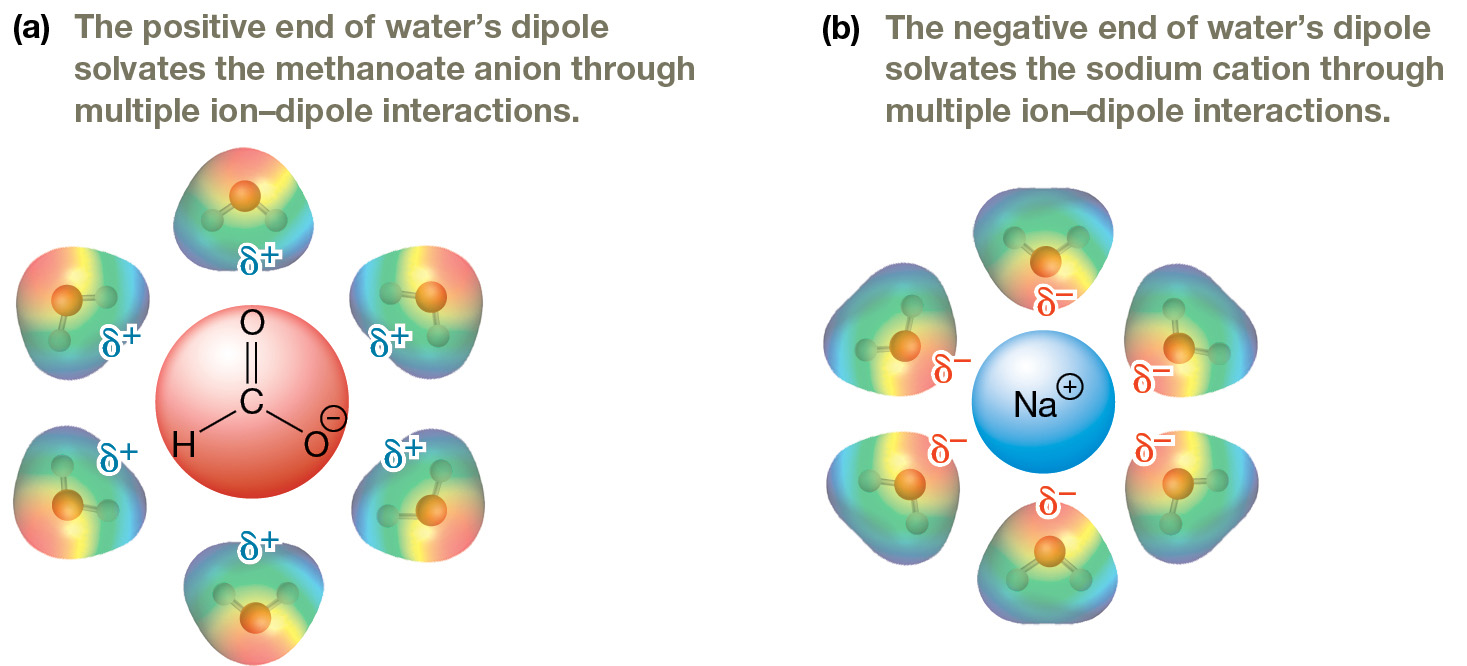
How, then, are ion–dipole interactions capable of overcoming the stronger ion–ion interactions to dissolve an ionic compound? A major factor is solvation, depicted in Figure 2-23, in which an individual ion participates in multiple ion–dipole interactions with the solvent. When this occurs, the ions are said to be solvated. The collective stability from all of these ion–dipole interactions can be substantially greater than that of the ion–ion interactions in an ionic compound, thus favoring the mixture (that is, the mixture is more stable).
More information
Two illustrations show the interactions between an ion and a dipole when ionic compounds dissolve in water. The first illustration shows the condensed structural formula of a methanoate ion surrounded by electrostatic potential maps of six water molecule, each represented by a ball-and-stick model. The structure of the ion shows a central carbon atom bonded to an oxygen atom by a double bond, and to a hydrogen atom and an oxygen atom carrying a negative charge by single bonds. The ion is enclosed in a red circle. The triangular electrostatic map of each water molecule is shaded in red at the upper end representing the oxygen atom, and in blue at the two lower ends, each representing a hydrogen atom. The central portion is shaded in yellow, green, and turquoise from top to bottom. The blue ends of each electrostatic map show a partial positive charge and point toward the central ion. A note above this illustration reads, “The positive end of water’s dipole solvates the methanoate anion through multiple ion—dipole interactions.” The second illustration shows a positively charged sodium ion surrounded by electrostatic potential maps of six water molecule, each represented by a ball-and-stick model. The triangular electrostatic map of each water molecule is shaded in the same manner as in the first illustration. Here, the red end of each electrostatic map shows a partial negative charge, and points toward the central ion. A note above this illustration reads, “The negative end of water’s dipole solvates the sodium cation through multiple ion—dipole interactions.” The caption reads, Solvation: Ionic compounds can dissolve in water as a result of solvation of the respective ions. a. The positive end of water’s dipole solvates the HCO2 anion. b. The negative end of water’s dipole solvates the sodium ion.
FIGURE 2-23Solvation Ionic compounds can dissolve in water as a result of solvation of the respective ions. (a) The positive end of water’s dipole solvates the anion, HCO2−. (b) The negative end of water’s dipole solvates the cation, Na+.
YOUR TURN 2.17
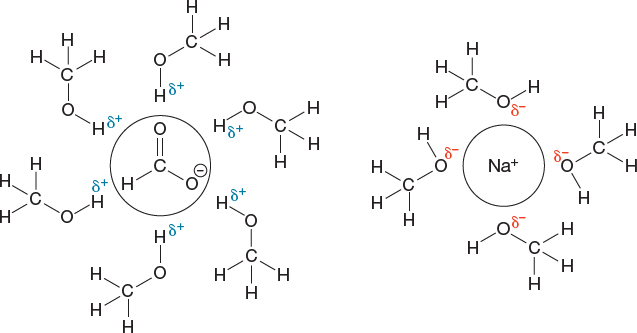
Redraw Figure 2-23, using methanol (CH3OH) as the solvent instead of water. Draw just the Lewis structures, not the space-filling models, but do include the symbols for the relevant partial charges.
SHOW ANSWERHIDE ANSWER
More information
Condensed structures of attracted molecules. Encircled is a central carbon bonded to an oxygen with a negative charge and double bonded to a different oxygen. Surrounding are six molecules of structure central carbon bonded to a hydroxyl group and three hydrogens. The hydrogen of the hydroxyl groups has a partial positive charge. Another structure has encircled a positively charged sodium ion. It is surrounded by four molecules of the same structure as above, but instead the oxygen of the hydroxyl group has a positive negative charge.
The strength of an individual ion–dipole interaction depends on the polarity of the solvent molecule, so the collective stability provided by solvation does, too (see Solved Problem 2.5). This is important because, as we will discuss in Chapter 9, a solvent’s ability to solvate ions can have a dramatic effect on the outcome of reactions.
SOLVED PROBLEM 2.5
How to predict the relative solubility of an ionic compound in different solvents
Break It Down In which solvent would you expect NaCl to be more soluble: diethyl ether (CH3CH2OCH2CH3) or propanal (CH3CH2CH═O)?
Think
Solve
What are the most important intermolecular interactions that would be disrupted on dissolving?
➤
Very strong ion–ion interactions are disrupted when NaCl dissolves.
What intermolecular interactions would be gained in the solution?
➤
Both diethyl ether and propanal are polar molecules, so ion–dipole interactions would occur in solution with both solvents.
In which solvent are those intermolecular interactions stronger?
➤
Propanal has a much larger dipole than diethyl ether (compare the dipole magnitudes of ethanal and dimethyl ether in Table 2-4, p. 78), so propanal will better solvate the Na+ and Cl– ions.
Try ItNaCl is more soluble in methanol (CH3OH) than in propan-1-ol (CH3CH2CH2OH). Which solvent is better at solvating ions?
2.7b The Effect of Hydrocarbon Groups on Solubility
The types of functional groups present in a molecule have a direct effect on its solubility in various solvents, because the functional groups determine the kinds of intermolecular interactions that are available to the molecule. Alcohols, for example, can always form hydrogen bonds with water due to the presence of the hydrophilic (“water-loving”) OH group. Thus, small alcohols like methanol (CH3OH), ethanol (CH3CH2OH), and propan-1-ol (CH3CH2CH2OH) are infinitely soluble in water, as shown in Table 2-6.
Table 2-6 shows that the water solubility of an alcohol decreases as the size of the R group (the hydrocarbon portion of the molecule) increases. This is because R groups are highly nonpolar; they are hydrophobic (“water-fearing”). We can generalize this trend as follows:
A species behaves more like a nonpolar alkane as the size of its alkyl group increases.
Table 2-6 Water Solubility of Some Simple Alcohols (R—OH)
Alcohol
Water Solubility (g/100 g of H2O)
CH3OH
Methanol
Infinitely soluble
CH3CH2OH
Ethanol
Infinitely soluble
Propan-1-ol
Infinitely soluble
Butan-1-ol
7.7
Pentan-1-ol
2.7
Hexan-1-ol
0.6
Heptan-1-ol
0.1
YOUR TURN 2.18
Which functional groups in Table 1-6 (p. 35) would be considered hydrophilic? Which would be considered hydrophobic?
SHOW ANSWERHIDE ANSWER
Hydrophilic functional groups include the ones characteristic of alkyl fluorides, alcohols, hemiacetals, nitriles, ketones, aldehydes, and carboxylic acids. They also include the functional groups in amines and amides if at least one H atom is bonded to the N atom. Hydrophobic functional groups include the ones characteristic of alkenes, alkynes, arenes, phenols, alkyl halides other than fluorides, thiols, ethers, acetals, epoxides, and esters. They also include the functional groups in amines and amides if no H atoms are bonded to the N atom.
Monoalcohols (i.e., alcohols with one OH group) are generally considered insoluble in water if they contain six or more carbons. The effect of the alkyl group, however, can be overcome by increasing the number of hydrophilic functional groups:
Molecules are generally very water-soluble if the ratio of their total number of carbon atoms to the number of hydrophilic functional groups is less than about 3:1.
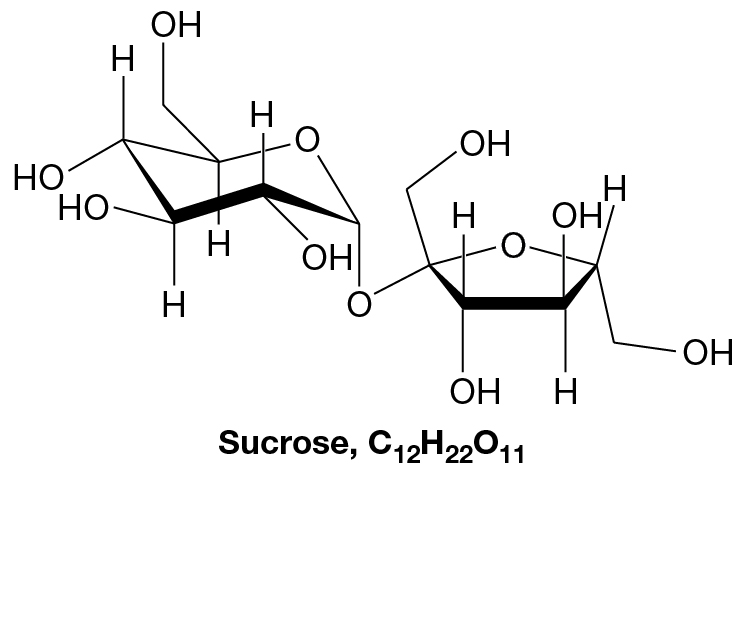
Sucrose (table sugar), for example, is highly soluble in water even though it has 12 carbon atoms (Figure 2-24). Sucrose is soluble because it contains eight hydrophilic OH groups, so its ratio of carbon atoms to hydrophilic groups is 12∶8 = 1.5∶1, which is less than 3∶1.
More information
Condensed structural formula of sucrose, C 12 H 22 O 11. The structure shows a chair-shaped six-membered ring, constituted by five carbon atoms, numbered from 1 to 5, and an oxygen atom, bonded via a connecting oxygen atom to a pentagonal, five-membered ring, constituted by four carbon atoms, numbered from 8 to 11, and an oxygen atom. Carbons 2, 3, and 4 in the chair-shaped ring are each bonded to a hydrogen atom and a hydroxyl group. Carbon 5 is bonded to carbon 6, which is bonded to a hydroxyl group. Carbon 1 is bonded to the connecting oxygen atom, which is bonded on the other side to carbon 8 in the pentagonal ring. Carbon 8 is bonded to carbon 7, which is bonded to a hydroxyl group. Carbons 9 and 10 are each bonded to a hydrogen atom and a hydroxyl group in reverse. Carbon 11 is bonded to a hydrogen atom and to carbon 12, which is bonded to a hydroxyl group. The caption reads, The water solubility of sucrose: The large number of hydroxyl groups compared to carbon atoms makes sucrose soluble in water.
FIGURE 2-24The water solubility of sucrose The large number of OH groups compared to C atoms makes sucrose soluble in water.
CONNECTIONS 2.12
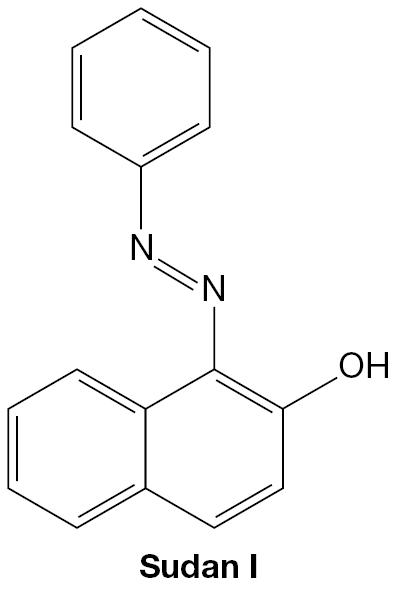
2-Naphthol and dyes 2-Naphthol (molecule C in Solved Problem 2.6) is widely used as a precursor in the production of dyes, such as Sudan I.
More information
An illustration shows the skeletal structural formula of a Sudan I molecule. The structure shows a benzene ring fused with another hexagonal, six-membered ring. In the second ring, double bonds exist between atoms 1 and 2, and atoms 3 and 4. A hydroxyl group is bonded to the atom in the second position in the second ring. Carbon 1 is bonded by a single bond to a nitrogen atom, which is bonded by a double bond to another nitrogen atom. This atom is bonded to a benzene ring.
SOLVED PROBLEM 2.6
How to predict a compound’s water solubility
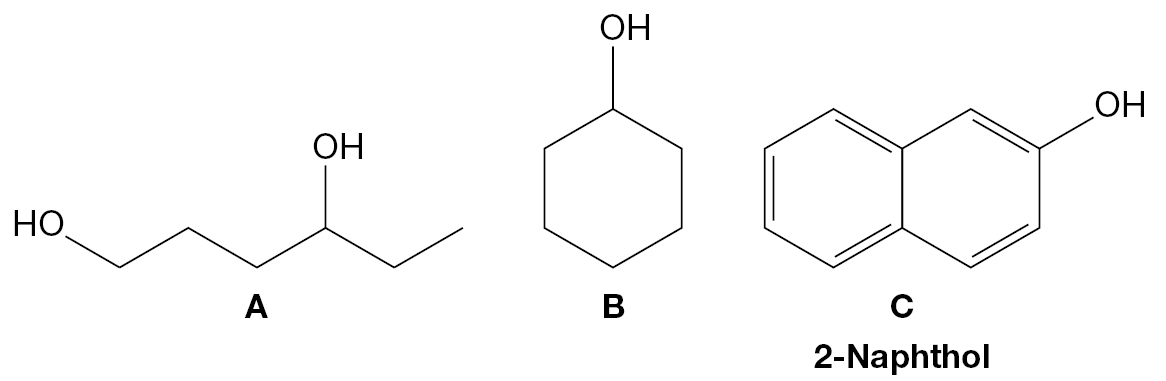
Break It Down Would you expect each of the following compounds to be soluble in water? Why or why not?
More information
The skeletal structural formulas of three molecules, labeled A, B, and C. The third is a molecule of 2-naphthol. The first structure shows a zigzag line with four crests and three troughs. A hydroxyl group is bonded to the atom at the third position, and another hydroxyl group occupies the seventh position. The second structure shows a hexagonal six-membered ring with a hydroxyl group bonded to one of the atoms. The third structure is a molecule of 2-naphthol, which shows a benzene ring fused with another hexagonal, six-membered ring. In the second ring, double bonds exist between atoms 1 and 2, and atoms 3 and 4. A hydroxyl group is bonded to the atom in the second position in the second ring.
Think
Solve
What is the ratio of alcohol groups to the number of carbon atoms in each molecule?
➤
Molecule A contains six carbons and two hydrophilic OH groups, giving it a ratio of 3∶1. For molecules B and C, the ratios are 6∶1 and 10∶1, respectively.
How does each ratio compare to the 3∶1 cutoff?
➤
Molecule A matches the 3∶1 cutoff, so we expect A to be highly water-soluble. Molecules B and C exceed the cutoff, so we expect the nonpolar groups in B and C to dominate the intermolecular interactions, causing the molecules to be insoluble in water.
Try ItLike alcohols, aldehydes (R—CH═O) become less soluble in water as the number of carbon atoms in the alkyl group R increases. Do you think the maximum number of carbon atoms for water-soluble aldehydes will be greater than or less than that for water-soluble alcohols? Explain.
a thermodynamic quantity that increases with the number of equivalent ways the energy in a system can be arranged. Many people like to think of entropy as a measure of disorder; a system with greater entropy (i.e., one that is more disordered) tends to be more likely to occur than a system with less entropy. (Ch. 2)
attraction between a positive or negative ion and a net molecular dipole; the intermolecular interaction whereby free ions can interact with the molecules of a polar solvent like water. (Ch. 2)
the phenomenon wherein an individual ion participates in multiple ion–dipole interactions with its solvent. When this occurs, the ion is said to be solvated. (Ch. 2)