Section 2.9 Objectives
You will be able to:
- Identify a solvent as either protic or aprotic.
- Explain why ionic compounds tend to be more soluble in protic solvents than in aprotic solvents.
As we learned in Section 2.7, ionic compounds can have very high solubility in a polar solvent such as water, due to the strong solvation set up by ion–dipole interactions in the resulting solution. For example, about 35 g of sodium chloride (NaCl) dissolves in 100 mL of water. The magnitude of the water’s dipole (1.9 D), however, is not the only factor influencing solubility. For instance, dimethyl sulfoxide [DMSO, (CH3)2S═O] is even more polar (magnitude = 4.0 D) than water, but it dissolves only about 0.4 g of NaCl.
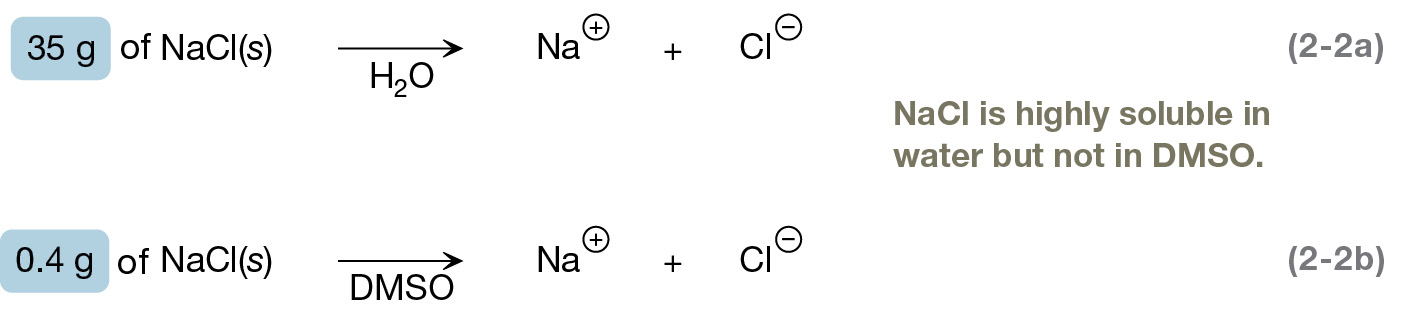
Two equations showing the solubility of sodium chloride in water or H 2 O, and in dimethyl sulfoxide or D M S O. The first equation, numbered (2-2a), shows 35 grams of solid N a C l being dissolved in H2O to give sodium cations and chloride anions. The second equation, numbered (2-2b), shows 0.4 grams of solid N a C l being dissolved in D M S O to give sodium cations and chloride anions. An accompanying note reads, “N a C l is highly soluble in water but not in D M S O.”
What also comes into play is how close the partial charges of the polar solvent molecule can get to the ions. As shown in Figure 2-28, the partial negative and partial positive charges of water are well exposed to the Na+ and Cl– ions, respectively, so these partial charges and the ions can get rather close to each other. Thus, the solvation of each ion is relatively strong.
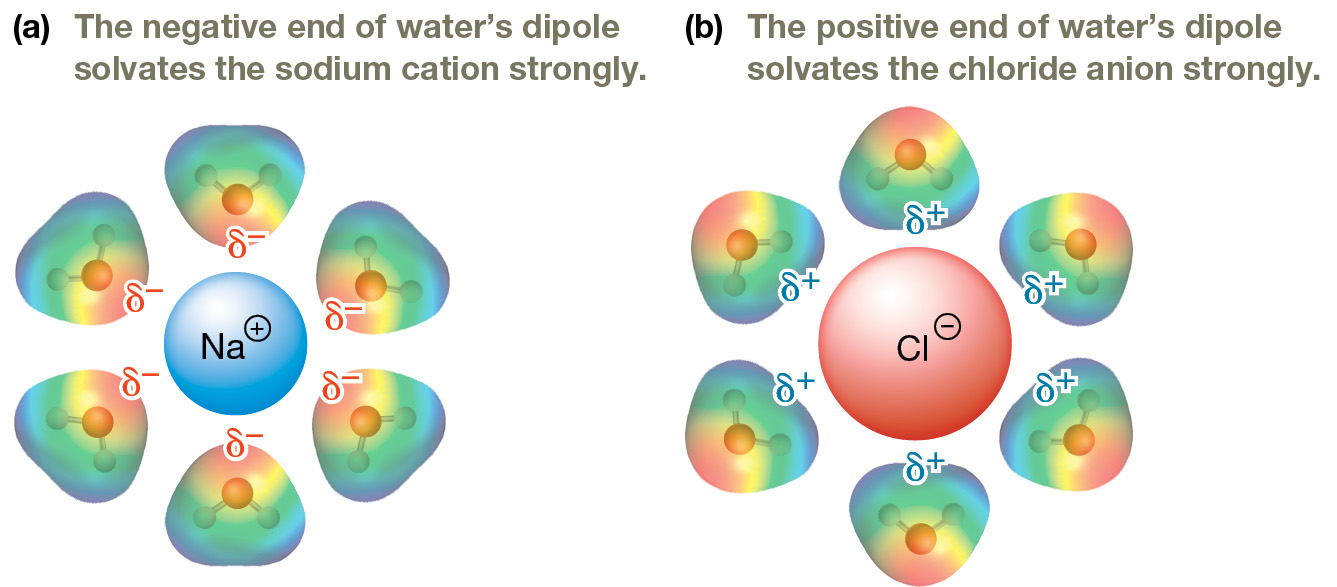
Two illustrations show the interactions between sodium cation and chloride anion when salt dissolves in water. The first illustration shows a sodium cation enclosed in a blue circle and surrounded by electrostatic potential maps of six water molecule, each represented by a ball-and-stick model. The triangular electrostatic map of each water molecule is shaded in red at the upper end representing the oxygen atom, and in blue at the two lower ends, each representing a hydrogen atom. The central portion is shaded in yellow, green, and turquoise from top to bottom. The red end of each electrostatic map shows a partial negative charge, and points toward the central ion. A note above this illustration reads, “The negative end of water’s dipole solvates the sodium cation strongly.” The second illustration shows a chloride anion enclosed in a red circle and surrounded by electrostatic potential maps of six water molecule, each represented by a ball-and-stick model. The triangular electrostatic map of each water molecule is shaded in the same manner as in the first illustration. Here, the blue ends of each electrostatic map show a partial positive charge and point toward the central ion. A note above this illustration reads, “The positive end of water’s dipole solvates the chloride anion strongly.” The caption reads, Solvation of Na Cl in water: a. The sodium ion is strongly solvated because the partial negative charge of water is well exposed. The chloride ion is strongly solvated because the partial positive charge of water is well exposed.
CONNECTIONS 2.13
DMSO in chemistry and medicine In addition to being an important solvent in chemistry, DMSO (Fig. 2-29) has a variety of medicinal uses. It is used topically to treat some chronic inflammatory conditions and, because it was discovered to penetrate organs without damaging them, it can be used to deliver some drugs into biological systems. Interestingly, when DMSO contacts the skin, some people taste garlic in the mouth.
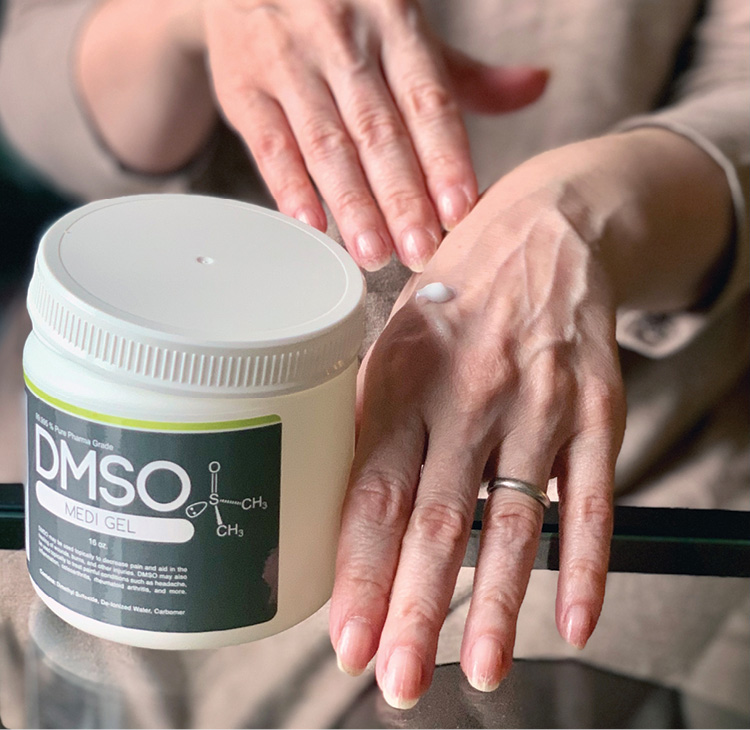
A person showing their hand next to a container with a label that says D M S O. They appear to be applying what is in the container to the back of their hand.
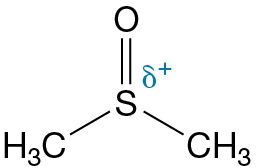
Now let’s examine the solvation of NaCl in DMSO. As we can see in Figure 2-29a, the partial negative charge of DMSO is well exposed, so Na+ is strongly solvated by DMSO, just as it is strongly solvated by water. The partial positive charge of DMSO, however, is flanked by two bulky CH3 groups, which makes it difficult for the partial positive charge to approach the Cl– ion (Fig. 2-29b). The obstruction due to the bulkiness of the methyl groups in this instance is an example of steric hindrance. Thus, Cl– is not solvated very strongly and NaCl is less soluble.
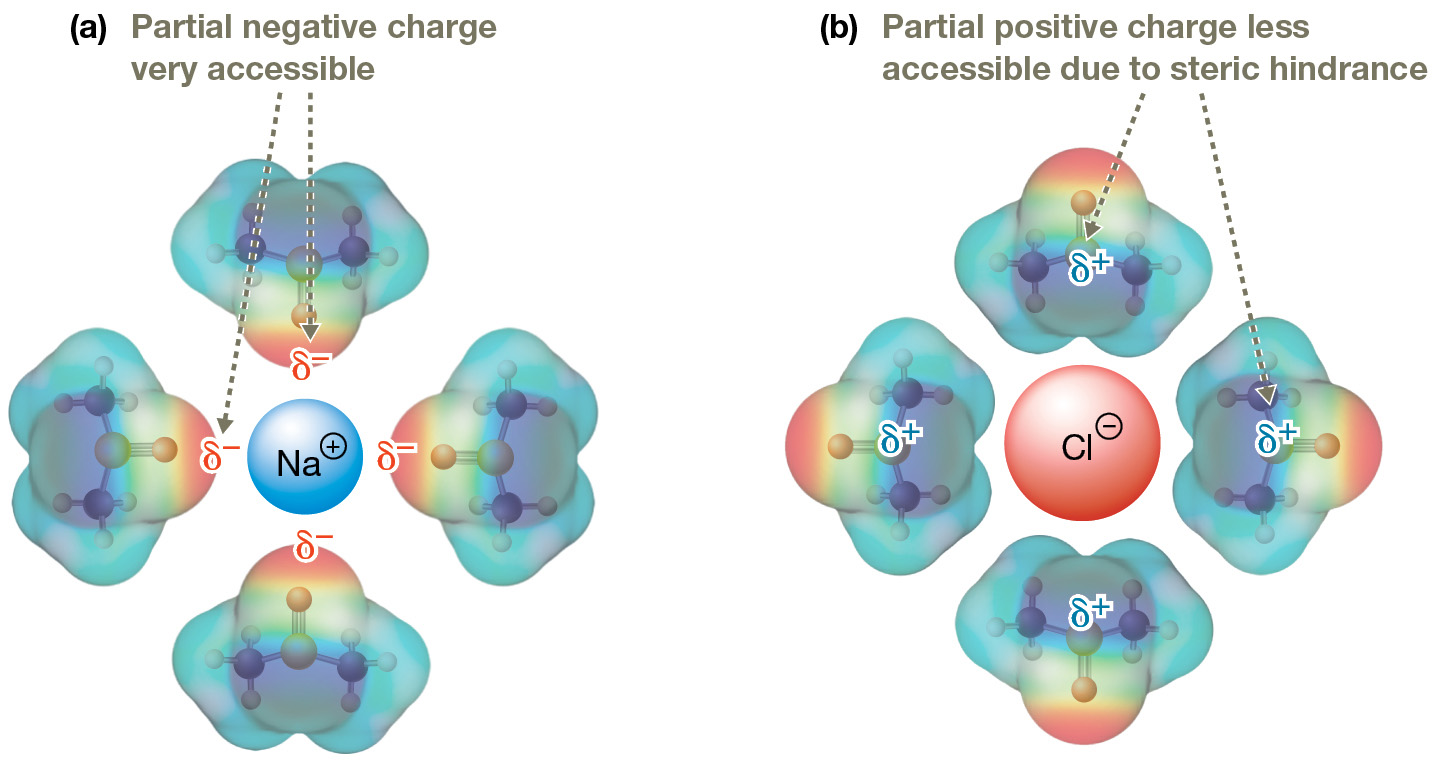
Two illustrations show the interactions between sodium cation and chloride anion when salt dissolves in dimethyl sulfoxide or DMSO. The first illustration shows a sodium cation enclosed in a blue circle and surrounded by four D M S O molecules, each represented a space-filling model. The models show a central sulfur atom bonded to two methyl groups by single bonds and to an oxygen atom by a double bond. The oxygen atom in each D M S O molecule carries a partial negative charge, and points toward the central ion. A note pointing to these partial negative charges, “Partial negative charge very accessible.” The second illustration shows a chloride anion enclosed in a blue circle and surrounded by four D M S O molecules. The central sulfur atom in each D M S O molecule carries a partial positive charge, and points toward the central ion. A note pointing to these partial negative charges, “Partial positive charge less accessible due to steric hindrance.” The caption reads, Solvation in D M S O: a. Sodium ion is solvated strongly in D M S O because the partial negative charge of DMSO is well exposed. b. Chloride ion is not solvated very strongly by D M S O, because D M S O’s partial positive charge is buried inside the molecule.
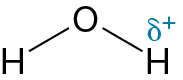
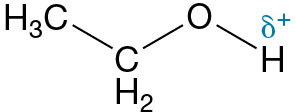
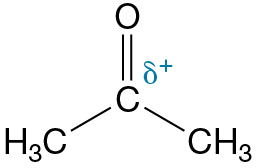
Water is a particularly good solvent for ionic compounds because it has a H-bond donor (in this case, an O—H covalent bond), which classifies water as a protic solvent. DMSO has no H-bond donors, so it is an aprotic solvent. Other examples of polar protic solvents and polar aprotic solvents are shown in Table 2-7.
|
Table 2-7 Common Polar Protic Solvents and Polar Aprotic Solvents |
|||
|
POLAR PROTIC SOLVENTS |
POLAR APROTIC SOLVENTS |
||
|
Structure |
Name |
Structure |
Name |
 |
Water |
 |
Dimethyl sulfoxide (DMSO) |
 |
Ethanol |
 |
Propanone (Acetone) |
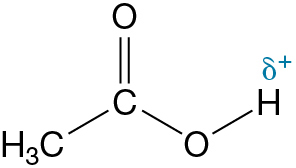 |
Ethanoic acid (Acetic acid) |
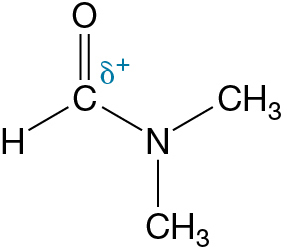 |
N,N-Dimethyl-formamide (DMF) |
YOUR TURN 2.20
In Table 2-7, circle and label each potential hydrogen-bond donor.
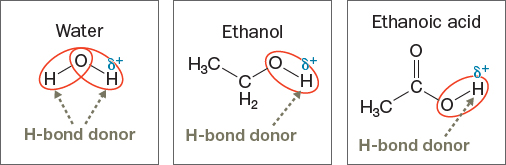
Condensed structure of water, ethanol, and ethanoic acid. Water shows a central oxygen bonded to two hydrogens labeled as h bond donor, one hydrogen has a partial positive charge. Ethanol is a two carbon chain bonded to a hydroxyl group labeled as h bond donor, the oxygen of the hydroxyl group has a partial positive charge. Ethanoic acid is a two carbon chain, the second carbon is double bonded to oxygen and single bonded to a hydroxyl group labeled as h bond donor, the hydrogen of which has a partial positive charge.
Like water, all polar protic solvents have easily accessible partial negative and positive charges. Polar aprotic solvents, on the other hand, have well-exposed partial negative charges, but their partial positive charges tend not to be very accessible. Therefore:
▶ LOOKING AHEAD
In Chapter 9, we will study the competition between four reactions, called SN1, SN2, E1, and E2. One factor that impacts which reaction dominates is how strongly solvated the reactant and product ions are. The strength of solvation depends not only on the nature of the ions but also on whether the solvent is protic or aprotic.
The importance of these attributes extends far beyond understanding the solubilities of ionic compounds. As we will see in Chapter 9, the solvation characteristics of protic and aprotic solvents play a major role in governing the outcomes of reactions (see Looking Ahead box).