2.6 Melting Points, Boiling Points, and Intermolecular Interactions
Section 2.6 Objectives
You will be able to:
Identify the following types of intermolecular interactions in a pair of interacting species: ion–ion, dipole–dipole, hydrogen bonding, or London dispersion.
Determine the dominant type of intermolecular interaction between a pair of interacting species.
Evaluate the relative strengths of intermolecular interactions in different pairs of interacting species when each pair has the same dominant type of interaction.
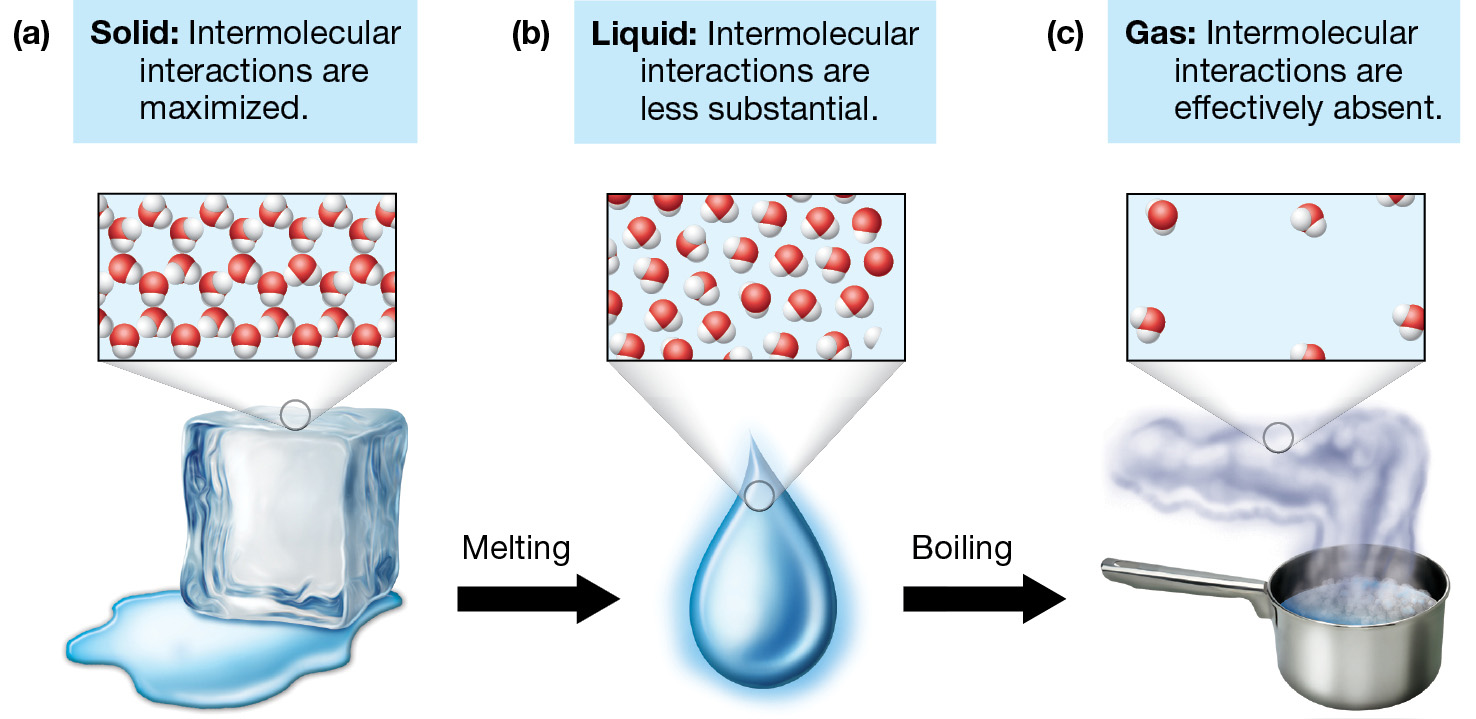
Melting points and boiling points can provide a wealth of information about intermolecular interactions. To help you see why, review the molecular-level representations of solid, liquid, and gas in Figure 2-11 (next page).
More information
A three-part illustration shows the molecular arrangement in the three different states of water. The first part shows a block of ice with a microscopic view depicting closely spaced molecules of water. A note above it reads, “Solid: Intermolecular interactions are maximized.” An arrow labeled “Melting” leads to the next part of the illustration. The second part shows a droplet of water with a microscopic view depicting loosely spaced molecules of water. A note above it reads, “Liquid: Intermolecular interactions are less substantial.” An arrow labeled “Boiling” leads to the final part of the illustration. The third part shows water boiling in a pan with a microscopic view depicting the molecules of water dispersed widely. A note above it reads, “Gas: Intermolecular interactions are effectively absent.” The caption reads, Microscopic structure of the three phases of matter: a. In a crystalline solid, molecules or ions form a well-ordered structure called a crystal lattice, in which movement is limited to vibration and intermolecular forces are maximized. b. In a liquid, molecules are free to move around, because intermolecular forces are somewhat less substantial. c. In the gas phase, molecules are so far apart that intermolecular forces are effectively absent.
FIGURE 2-11Molecular-level representations of the three phases of matter (a) In a crystalline solid, molecules or ions form a well-ordered structure called a crystal lattice, in which movement is limited to vibration and intermolecular forces are maximized. (b) In a liquid, molecules are free to move around, because intermolecular forces are somewhat less substantial. (c) In the gas phase, molecules are so far apart that intermolecular forces are effectively absent.
Solid. The atoms, ions, or molecules that make up the compound are in contact with one another and are essentially immobile. This allows intermolecular interactions to be maximized.
Liquid. The species that make up the compound are in close contact, but they can rotate and slide past one another, so intermolecular interactions are less substantial than in a solid.
Gas. The species that make up the compound are far apart and are effectively isolated from one another, so they can move freely. Intermolecular interactions are essentially nonexistent.
Melting, therefore, decreases the intermolecular interactions that exist in the solid phase, and boiling disrupts the remaining intermolecular interactions that exist in the liquid phase. Consequently, as the strength of the intermolecular interactions that exist in a particular substance increases, more energy (in the form of heat) is required for the substance to melt or boil:
Melting points increase as the intermolecular interactions in a solid increase.
Boiling points increase as the intermolecular interactions in a liquid increase.
Let’s now apply these ideas to interpret the relative strengths of various types of intermolecular interactions.
2.6a Ion–Ion Interactions
Of all the compounds in Table 2-4 on page 78, sodium methanoate (sodium formate, Na+–OCH═O) has the highest melting point and boiling point, suggesting that it has particularly strong intermolecular attractions in both its solid and liquid phases. Sodium methanoate is an ionic compound, composed of Na+ and HCO−2 ions, held together (as we saw in Section 1.8) by the electrostatic attraction of oppositely charged ions (that is, by ionic bonds) or, more generally, by ion–ion interactions:
Ion–ion interactions are the strongest type of intermolecular interaction because ions have very high concentrations of positive and negative charge.
2.6b Dipole–Dipole Interactions
Referring again to Table 2-4, notice that the compounds with significant dipoles—methanoic acid (formic acid), ethanol, ethanal (acetaldehyde), and methoxymethane (dimethyl ether)—have boiling points and melting points that are significantly higher than those of the remaining compounds, which are essentially nonpolar:
Polar molecules are attracted to each other more strongly than similar nonpolar molecules.
More information
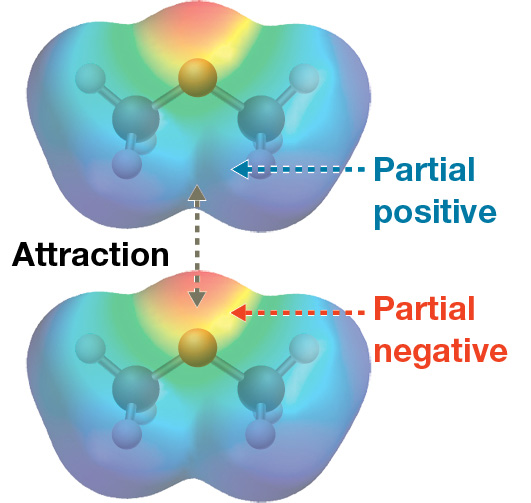
Electrostatic potential map shows the attraction between two dimethyl ether molecules. The two molecules are placed one above the other, and each molecule is represented by a ball-and-stick model in an electrostatic cloud. The structure of each molecule shows an oxygen atom bonded to two methyl groups, one on each side in a bent fashion. The electrostatic map is shaded red at the central upper portion representing the oxygen atom, and blue at the lower ends representing the hydrogen atoms. The central portion, from top to bottom, is shaded in yellow, green, and turquoise. An arrow labeled “partial positive” points to the blue regions of the first molecule, and an arrow labeled “partial negative” points to the red region of the second molecule. A two-way arrow labeled “attraction” connects these two regions. The caption reads, “Dipole—dipole interaction: The dominant intermolecular force between two molecules of dimethyl ether is a dipole—dipole interaction. The positive end of one ether molecule attracts the negative end of the other.”
FIGURE 2-12Dipole–dipole interaction The dominant intermolecular force between two molecules of dimethyl ether is a dipole–dipole interaction. The positive end of one ether molecule attracts the negative end of the other.
The stronger attractions among polar molecules are due to dipole–dipole interactions. Dipole–dipole interactions arise because the positive end of one molecule’s net dipole is attracted to the negative end of another molecule’s net dipole, as shown in Figure 2-12. Therefore:
All other factors being equal, the strength of dipole–dipole interactions increases as the magnitude of the dipole increases.
Notice in Table 2-4, for example, that the highly polar ethanal (CH3CH═O) has a higher melting point and a higher boiling point than the less polar dimethyl ether (CH3OCH3).
YOUR TURN 2.11
The boiling point of CH3CH2F is −37.1 °C. How does this compare to the boiling point of CH3CH═O? Which compound, therefore, is more polar?
SHOW ANSWERHIDE ANSWER
Dipole–dipole interactions are the dominant intermolecular interaction for both CH3CH2F and CH3CH═O . CH3CH═O has a higher boiling point than CH3CH2F (+20 °C vs. –37.1 °C), so CH3CH═O must be more polar.
Although dipole–dipole interactions can be quite strong, they involve the attraction of partial charges, which are smaller in magnitude than the full charges in ion–ion interactions. Therefore:
Dipole–dipole interactions are generally much weaker than ion–ion interactions.
As a result, compounds such as ethanal (acetaldehyde) melt and boil at lower temperatures than ionic compounds.
SOLVED PROBLEM 2.2
How to determine relative melting points of an ionic versus a covalent compound
Break It Down Which compound has the higher melting point, NaOCH2CH3 or CH3CH═O?
Think
Solve
What is the strongest intermolecular interaction in NaOCH2CH3?
➤
NaOCH2CH3 is an ionic compound. It consists of Na+ and CH3CH2O–, which are held together by ion–ion interactions.
What is the strongest intermolecular interaction in CH3CH ═ O?
➤
CH3CH ═ O is a polar covalent compound, so it experiences dipole–dipole interactions.
Which type of interaction is stronger? How does that affect the melting point?
➤
Ion–ion interactions are stronger than dipole–dipole interactions, so the melting point of NaOCH2CH3 is higher than the melting point of CH3CH═ O.
Try ItWhich compound in each pair has the higher melting point? (a) NaSCH3 or CH3CH2OH; (b) (CH3)2C═NCH3 or (CH3)2C═NK
2.6c Hydrogen Bonding
CONNECTIONS 2.9
More information
A photo shows a person applying hand sanitizer. They are using a pump dispenser.
Ethanol and its uses Ethanol (Table 2-4) is probably most commonly known as the alcohol found in alcoholic beverages, but it is also an important organic solvent, fuel, and antiseptic.
Dipole–dipole interactions alone cannot account for some of the data for polar compounds in Table 2-4. Methanoic acid (formic acid, HCO2H) and ethanol (CH3CH2OH), for example, have substantially higher melting points and boiling points than ethanal (acetaldehyde, CH3CH═O), even though ethanal’s net dipole is the largest of the three. These apparent anomalies arise because methanoic acid and ethanol can form hydrogen bonds, whereas acetaldehyde cannot.
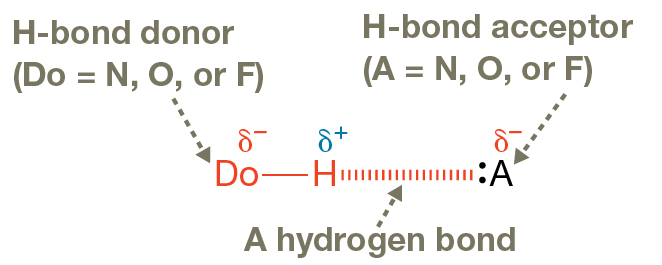
Each hydrogen bond (H-bond) requires a hydrogen-bond donor and a hydrogen-bond acceptor, as shown in Figure 2-13.
More information
An illustration shows a hydrogen bond donor and a hydrogen bond acceptor. The illustration shows an atom “Do” carrying a delta negative charge bonding with a hydrogen atom carrying a delta positive charge. A hashed line connects the hydrogen atom to another atom “A” carrying a delta negative charge. The atom “A” has a lone pair of electrons. An arrow pointing to atom “Do” has a note that reads: “Hydrogen-bond donor (Do equals nitrogen, oxygen, or fluorine)” An arrow pointing to atom “A” has a note that reads: “Hydrogen-bond acceptor (A equals nitrogen, oxygen, or fluorine)” The caption reads, Hydrogen bonds: A hydrogen bond consists of a hydrogen-bond donor Do and a hydrogen-bond acceptor A with a lone pair. If the Do and A atoms are uncharged, they must be nitrogen, oxygen, or fluorine for the hydrogen bond to be substantial.
FIGURE 2-13Hydrogen bonds A hydrogen bond consists of a hydrogen-bond donor (Do─H) and a hydrogen-bond acceptor (A). If the Do and A atoms are uncharged, they must be nitrogen, oxygen, or fluorine for the hydrogen bond to be substantial.
A hydrogen-bond donor is a covalent bond, Do—H, where Do (donor) is a highly electronegative atom, such as N, O, or F.
A hydrogen-bond acceptor, A, can be any atom with a large concentration of negative charge and a lone pair of electrons. For the hydrogen bond to be substantial, an uncharged H-bond acceptor must be F, O, or N.
The high electronegativity of the F, O, or N atom ensures that the Do—H covalent bond is highly polar, giving the H atom a large partial positive charge. This sets up a strong attraction between the H atom and the oppositely charged acceptor.
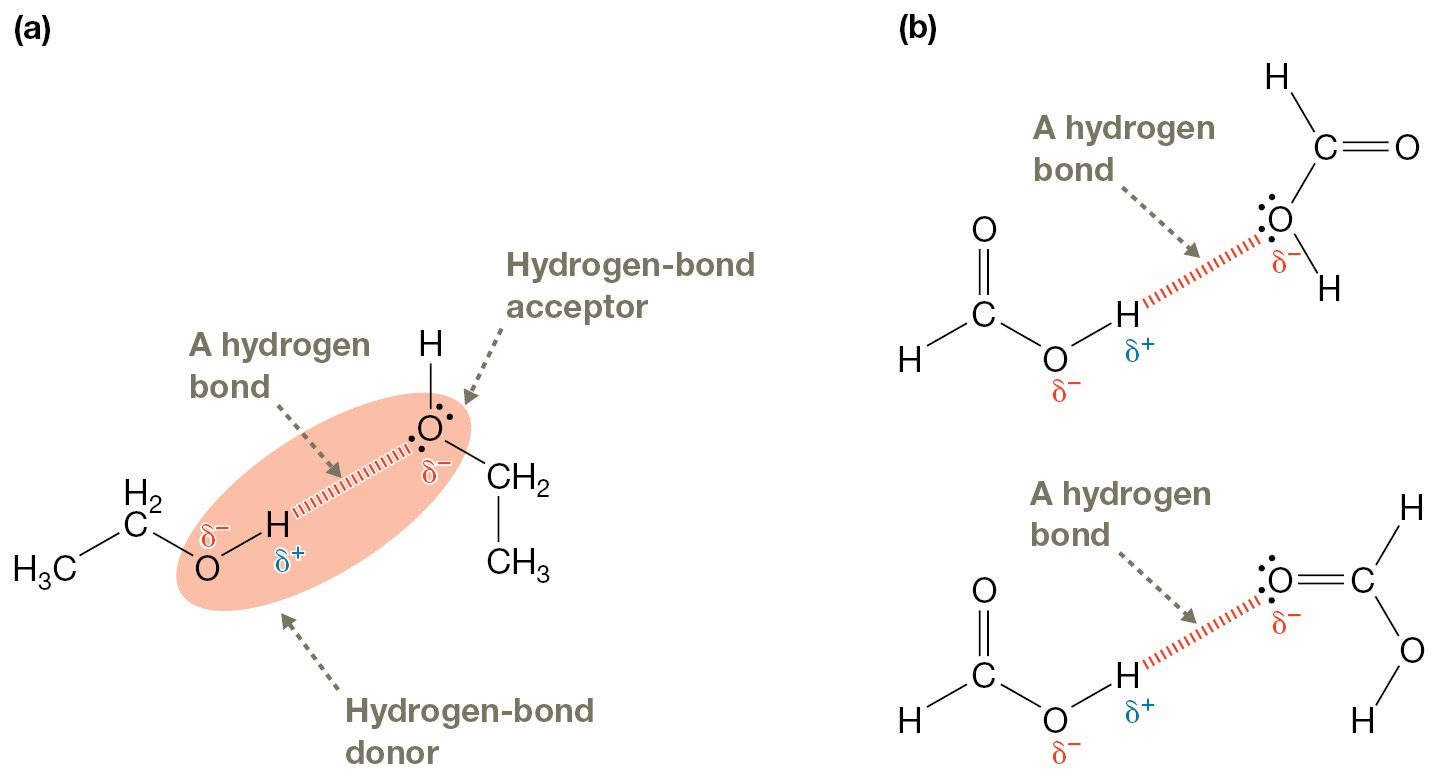
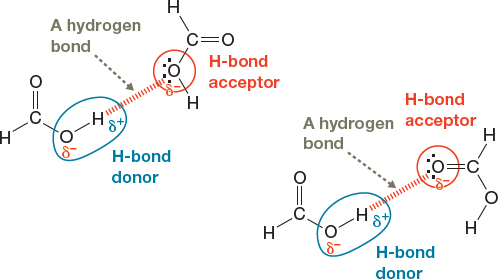
The actual H-bond is created when a lone pair of electrons on the H-bond acceptor is shared with the hydrogen atom of the H-bond donor. In this book, the H-bond is depicted by a red hashed line. Figure 2-14 (next page) shows how hydrogen bonding might be depicted between two molecules of ethanol (Fig. 2-14a) and between two molecules of methanoic acid (Fig. 2-14b). Notice that either O atom in methanoic acid can serve as a H-bond acceptor.
More information
Lewis structures show the hydrogen bonding between two ethanol molecules and two methanoic acid molecules. The first illustration shows two ethanol molecules. Each consists of two carbon atoms bonded by a single bond. Carbon 1 is bonded to two hydrogen atoms and a hydroxyl group, and carbon 2 is bonded to three hydrogen atoms. In the first molecule, the oxygen atom in the hydroxyl group carries a partial negative charge, and the hydrogen atom in the group carries a partial positive charge. In the second molecule, the oxygen atom in the hydroxyl group carries a partial negative charge and has two lone pairs of electrons. A hashed line labeled “a hydrogen bond” connects this oxygen atom with the hydrogen in the hydroxyl group of the first molecule. The oxygen atom in the first molecule is the hydrogen-bond donor, and the oxygen with the lone pairs in the second molecule is the hydrogen-bond acceptor. The second illustration shows two sets of two methanoic acid molecules. Each molecule consists of a carbon atom bonded to a hydrogen atom and a hydroxyl group by single bonds and to an oxygen atom by a double bond. In the first molecule of the first set, the oxygen atom in the hydroxyl group carries a partial negative charge, and the hydrogen atom in the group carries a partial positive charge. In the second molecule of the first set, the oxygen atom in the hydroxyl group carries a partial negative charge and has two lone pairs of electrons. A hashed line labeled “a hydrogen bond” connects this oxygen atom with the hydrogen in the hydroxyl group of the first molecule. In the first molecule of the second set, the oxygen atom in the hydroxyl group carries a partial negative charge, and the hydrogen atom in the group carries a partial positive charge. In the second molecule of the second set, the oxygen atom double-bonded to the carbon carries a partial negative charge and has two lone pairs of electrons. A hashed line labeled “a hydrogen bond” connects this oxygen atom with the hydrogen in the hydroxyl group of the first molecule. The caption reads, Hydrogen bonding between ethanol molecules and between methanoic acid molecules: a. A hydrogen bond can form between two molecules of ethanol because the H atom is covalently bonded to an O atom in one molecule and is attracted to the second molecule’s O atom, which has a lone pair of electrons and a significant partial negative charge. The H bond is indicated by a dashed line. b. Two different H bonds between two molecules of methanoic acid (formic acid).
FIGURE 2-14Hydrogen bonding between ethanol molecules and between methanoic acid molecules (a) A hydrogen bond can form between two molecules of ethanol because the H atom is covalently bonded to an O atom in one molecule and is attracted to the second molecule’s O atom, which has a lone pair of electrons and a significant partial negative charge. The H-bond is indicated by a red hashed line. (b) Two different H-bonds are shown between two molecules of methanoic acid (formic acid).
YOUR TURN 2.12
Circle and label the H-bond donor and H-bond acceptor in each H-bond shown in Figure 2-14b.
SHOW ANSWERHIDE ANSWER
More information
Condensed structure of hydrogen bonding. Four molecules have a central carbon bonded to a hydroxyl group and double bonded to an oxygen. A dashed red line between the hydrogen of the hydroxyl group, labeled h bond donor, and the oxygen of a hydroxyl group on another molecule, labeled h bond acceptor, is labeled hydrogen bond. Another molecule’s hydroxyl group is connected to the double bonded oxygen of the fourth molecule by a dashed red line labeled hydrogen bond. The hydroxyl group is labeled h bond donor, the oxygen is labeled h bond acceptor.
Hydrogen bonding in uncharged species involves only partial charges, so like dipole–dipole interactions:
Hydrogen bonding is weaker than ion–ion interactions.
Hydrogen bonds, however, are distinct from dipole–dipole interactions for two main reasons: (1) fluorine, oxygen, and nitrogen are highly electronegative, so the partial charges involved are large; and (2) the hydrogen atom is very small, which allows the partial positive charge on hydrogen to be very close to the partial negative charge on the H-bond acceptor. For these reasons:
Hydrogen bonding is often (but not always) stronger than dipole–dipole interactions.
It is important to be able to gauge the extent of hydrogen bonding among molecules of a particular compound—that is, the collective strength of all the hydrogen bonds present. As a general rule:
The extent of hydrogen bonding increases as the total number of potential H-bond donors and acceptors increases between the species involved.
With more potential donor–acceptor pairs involving two molecules, there are more ways in which hydrogen bonding can take place.
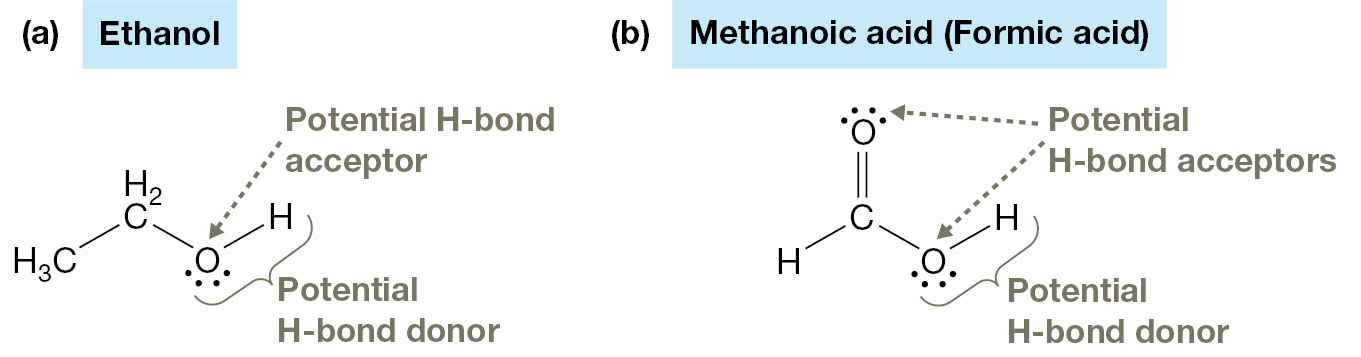
The extent of hydrogen bonding explains why methanoic acid (formic acid) has a higher boiling point and melting point than ethanol. As shown in Figure 2-15a, a single molecule of ethanol has one potential H-bond donor and one potential H-bond acceptor. In an intermolecular interaction between a pair of ethanol molecules, there are therefore two potential donors and two potential acceptors. In a single molecule of methanoic acid (formic acid, Fig. 2-15b), on the other hand, there is one potential donor and there are two potential acceptors. Thus, in a pair of methanoic acid molecules there are two potential donors and four potential acceptors. As a result, there are more ways in which hydrogen bonding can take place in methanoic acid than in ethanol.
More information
Lewis structures show an ethanol molecule and a methanoic acid molecule. The structure of ethanol consists of two carbon atoms bonded by a single bond. Carbon 1 is bonded to two hydrogen atoms and a hydroxyl group, and carbon 2 is bonded to three hydrogen atoms. The oxygen atom in the hydroxyl group has two lone pairs of electrons. An arrow labeled “potential H-bond acceptor” points to the oxygen atom, and the O-H bond is labeled “potential H-bond donor.” The structure of methanoic acid, also known as formic acid, shows a carbon atom bonded to a hydrogen atom and a hydroxyl group by single bonds and to an oxygen atom by a double bond. Each oxygen atom has two lone pairs of electrons and are labeled “potential H-bond acceptors.” The O-H bond is labeled “potential H-bond donor.” The caption reads, Potential hydrogen bond donors and acceptors: a. In a molecule of ethanol, the OH bond is a potential H-bond donor and the O atom is a potential H-bond acceptor. b. In a molecule of formic acid, the OH bond is a potential H-bond donor and each O atom is a potential H-bond acceptor.
FIGURE 2-15Potential hydrogen-bond donors and acceptors (a) In a molecule of ethanol, the OH bond is a potential H-bond donor and the O atom is a potential H-bond acceptor. (b) In a molecule of methanoic acid (formic acid), the OH bond is a potential H-bond donor and each O atom is a potential H-bond acceptor.
YOUR TURN 2.13
Which functional groups in Table 1-6 (p. 35) possess at least one H-bond acceptor but no H-bond donors? Which functional groups possess at least one H-bond donor and one H-bond acceptor? Which functional groups possess no H-bond donors and no H-bond acceptors?
SHOW ANSWERHIDE ANSWER
Functional groups that possess at least one H-bond acceptor but no H-bond donors include the ones characteristic of alkyl fluorides (but not other alkyl halides), ethers, acetals, epoxides, nitriles, ketones, aldehydes, and esters. Also included are the functional groups in amines and amides if no H atoms are bonded to the N atom. Functional groups that contain at least one H-bond donor and one H-bond acceptor include the groups characteristic of alcohols, phenols, hemiacetals, and carboxylic acids. Also included are the functional groups in amines and amides if at least one H atom is bonded to the N atom. Functional groups that contain no H-bond donors and no H-bond acceptors include the ones characteristic of alkyl halides other than fluoride, alkenes, alkynes, arenes, and thiols.
SOLVED PROBLEM 2.3
How to evaluate hydrogen bonding to determine the higher boiling compound
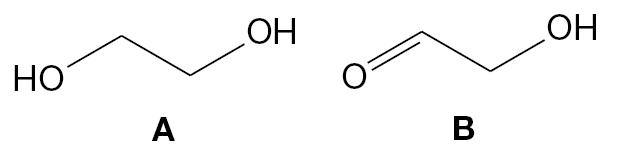
Break It Down 1,2-Ethanediol (ethylene glycol, A) is used as an automotive antifreeze. Hydroxyacetaldehyde (B) is believed to be an intermediate in the metabolism of proteins and carbohydrates. Which of these compounds would you expect to have a higher boiling point? Why?
More information
Skeletal structural formula of two molecules labeled A and B. The first structure shows a two-carbon chain where each carbon is bonded to a hydroxyl group. The second structure a two-carbon chain where one carbon is bonded to a hydroxyl group by a single bond and the other carbon is bonded to an oxygen atom by a double bond.
Think
Solve
What is the most important intermolecular interaction that will occur between two molecules of A? Between two molecules of B?
➤
Both A and B are polar molecules, so each should experience dipole–dipole interactions. Both are also subject to hydrogen bonding, because each molecule contains at least one potential H-bond donor (an OH bond) and at least one potential H-bond acceptor (an O atom). Hydrogen bonding is often stronger than dipole–dipole interactions, so hydrogen bonding is the most important intermolecular interaction for both molecules.
How many potential H-bond donors and H-bond acceptors are there for each pair of molecules?
➤
In a molecule of A, there are two potential donors (each OH bond) and two potential acceptors (each O atom), so there are four of each in a pair of A molecules. In a molecule of B, there is one potential donor (the OH bond) and there are two potential acceptors (each O atom), so there are two potential donors and four potential acceptors in a pair of B molecules.
Which compound will undergo more extensive hydrogen-bonding interactions, and how would it affect the boiling points of A and B?
➤
We would expect compound A to have more extensive hydrogen bonding because there are more potential donor–acceptor interactions. Thus, we expect A to have the higher boiling point.
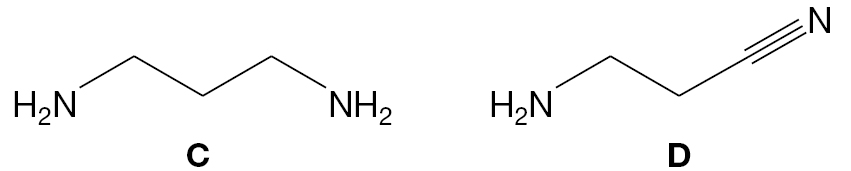
Try ItWhich compound, C or D, would you expect to have a higher boiling point? Why?
More information
Skeletal structural formula of two molecules labeled C and D. The first structure shows a three-carbon chain where carbon atoms 1 and 3 are each bonded to an amine group. The second structure a two-carbon chain where one carbon is bonded to an amine group by a single bond and the other carbon is bonded to a nitrogen atom by a triple bond.
More information
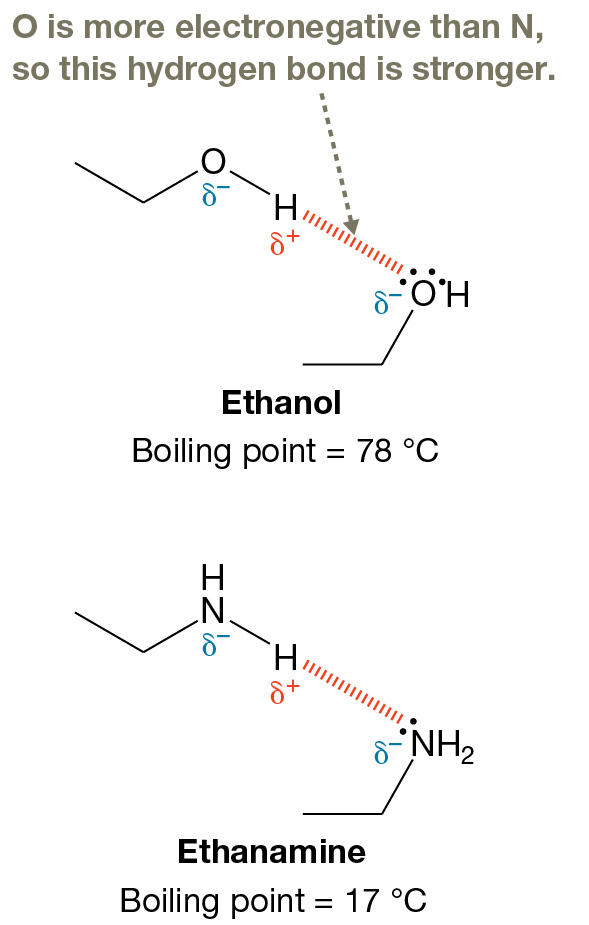
A two-part illustration shows hydrogen bonding in ethanol and ethanamine. The first part shows the hydroxyl group segments of two ethanol molecules, bonded to the two-carbon chain. The oxygen atom in the hydroxyl group of the first molecule carries a partial negative charge, while the hydrogen atom in the group carries a partial positive charge. The oxygen atom in the hydroxyl group of the second molecule carries a partial negative charge and has two lone pairs of electrons. A hashed line representing a hydrogen bond connects this oxygen atom with the hydrogen in the hydroxyl group of the first molecule. An arrow with a note, “O is more electronegative than N, so this hydrogen bond is stronger,” points to the hashed line. A note below this part of the structure reads, “Ethanol: Boiling point equals 78 degrees Celsius.” The second part shows the amine group segments of two ethanamine molecules, bonded to the two-carbon chain. The nitrogen atom in the amine group of the first molecule carries a partial negative charge, while one of the hydrogen atoms in the group carries a partial positive charge. The nitrogen atom in the amine group of the second molecule carries a partial negative charge and has one lone pair of electrons. A hashed line representing a hydrogen bond connects this nitrogen atom with the hydrogen in the amine group of the first molecule. A note below this part of the structure reads, “Ethanamine: Boiling point equals 17 degrees Celsius.” The caption reads, “Hydrogen bonding and electronegativity: Hydrogen bonding is stronger in ethanol than in ethanamine because O is more electronegative than N, thus giving rise to larger concentrations of positive and negative charges. As a result, the boiling point of ethanol is higher than the boiling point of ethanamine.”
FIGURE 2-16Hydrogen bonding and electronegativity Hydrogen bonding is stronger in ethanol than in ethanamine because O is more electronegative than N, thus giving rise to larger concentrations of positive and negative charges. As a result, the boiling point of ethanol is higher than the boiling point of ethanamine.
The strength of hydrogen bonding also depends on the concentrations of charge in the H-bond donors and H-bond acceptors. Ethanamine (CH3CH2NH2), for example, has a lower boiling point than ethanol (CH3CH2OH) because N is less electronegative than O, resulting in smaller concentrations of charge in ethanamine than in ethanol (Figure 2-16).
YOUR TURN 2.14
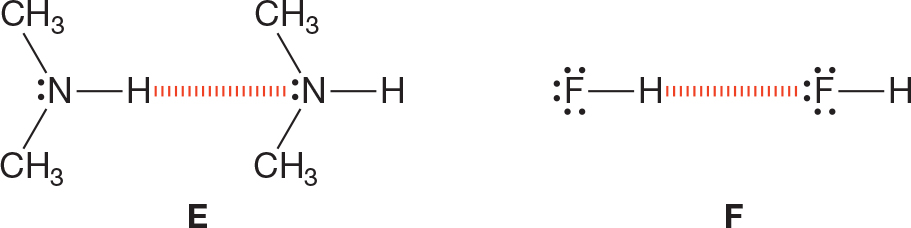
Which H-bond would you expect to be stronger, E or F? Why?
More information
Lewis structures of two pairs of molecules labeled E and F. The first pair shows two molecules, each with a nitrogen atom carrying a lone pair of electrons bonded to a hydrogen atom and two methyl groups. A hashed line representing a hydrogen bond connects the nitrogen atom in the second molecule with the hydrogen atom in the first. The second pair shows two molecules, each with a fluorine atom carrying three lone pairs of electrons bonded to a hydrogen atom. A hashed line representing a hydrogen bond connects the fluorine atom in the second molecule with the hydrogen atom in the first.
SHOW ANSWERHIDE ANSWER
The F─HF hydrogen bond should be stronger than the N─HN hydrogen bond because F is more electronegative than N. Therefore, the attraction between opposite charges is stronger in the F─HF hydrogen bond.
Nonpolar molecules must attract each other through intermolecular interactions; otherwise, nonpolar compounds could never condense from gas to liquid. Induced dipole–induced dipole interactions, or London dispersion forces, are responsible for the attractions among nonpolar molecules.
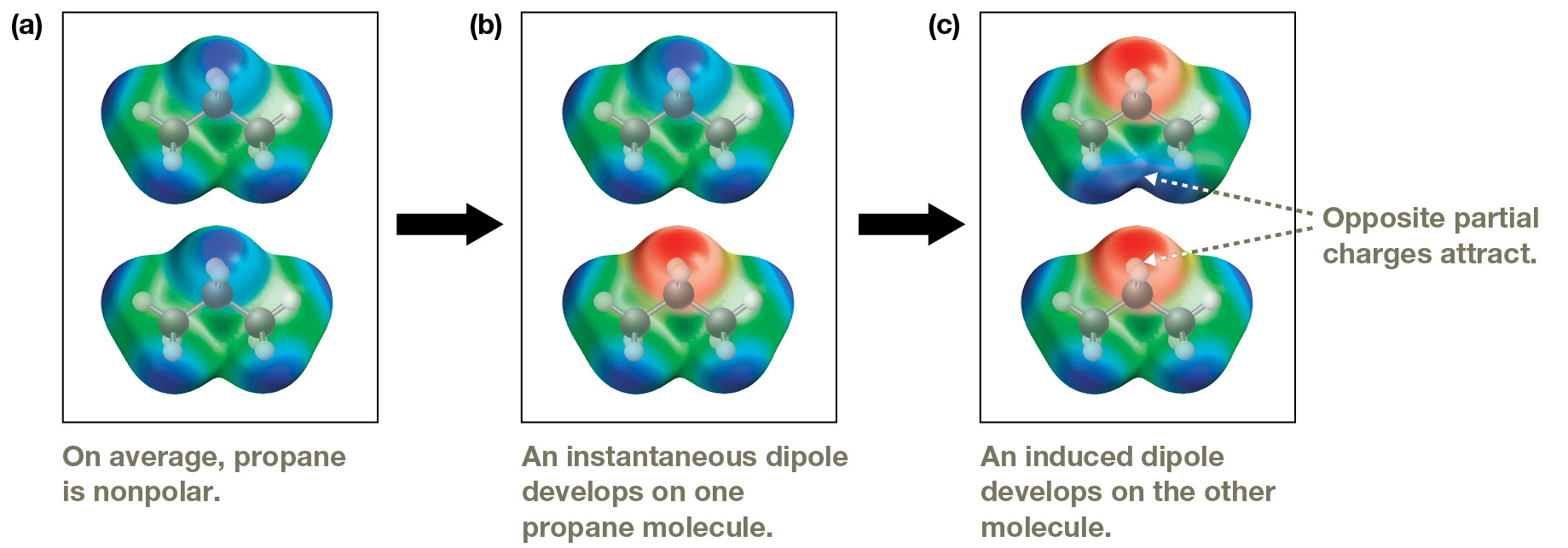
How do induced dipole–induced dipole interactions arise? Although the average electron distribution in a molecule such as propane (CH3CH2CH3) does not give rise to a significant permanent dipole (Figure 2-17a), any electron cloud can be distorted; that is, any electron cloud is polarizable. Electrons are constantly moving around, and at some instant in time, there may be more electrons on one side of the molecule than there are on the other side. The extra electrons on that one side give rise to an instantaneous dipole (Fig. 2-17b), which can alter the electron distribution on a second molecule by repelling or attracting nearby electrons. The second molecule then develops an induced dipole that is attracted to the first molecule (Fig. 2-17c).
More information
Electrostatic potential maps show the three stages in formation of an induced dipole-induced dipole interaction in two propane molecules. The illustration is divided into three parts, each shown in a box. Each part shows the ball-and-stick models of two propane atoms placed one over the other, enclosed in an electrostatic cloud each. In the first part, the cloud for both the molecules is shaded in blue around the vertices representing the carbon atoms, and green in the central portion. A note below the box reads, “On average, propane is nonpolar.” In the second part, the electrostatic cloud for the first molecule is shaded in blue around the vertices representing the carbon atoms, and green in the central portion. The map for the second molecule is shaded in red at the upper portion, representing the central carbon atom. The areas around the other carbon atoms are shaded in blue, and the central portion is green. A note below the box reads, “An instantaneous dipole develops on one propane molecule.” In the third part, the cloud for both the molecules is shaded in red at the upper portion, representing the central carbon atom. The areas around the other carbon atoms are shaded in blue, and the central portion is green. Two arrows, both labeled “opposite partial charges attract,” point to the red upper portion of the second molecule and the blue lower portion of the first. A note below the box reads, “An induced dipole develops on the other molecule.” The caption reads, Induced dipole—induced dipole interaction: a. On average, two isolated molecules of propane are nonpolar. b. Electrons are not static, however, so electron density can build up on one side of a molecule at some instant in time, resulting in a temporary dipole. c. That temporary dipole, in turn, can alter the electron distribution of a second, adjacent molecule, giving the second molecule an induced dipole. The oppositely charged ends of these induced dipoles attract one another.
FIGURE 2-17Induced dipole–induced dipole interaction (a) On average, two isolated molecules of propane are nonpolar. (b) Because electrons are not static, electron density can build up on one side of a molecule at some instant in time, resulting in a temporary dipole. (c) That temporary dipole, in turn, can alter the electron distribution of a second, adjacent molecule, giving the second molecule an induced dipole. The oppositely charged ends of these induced dipoles attract one another.
Although they are most important in nonpolar molecules, induced dipole–induced dipole interactions are present when any two species interact.
To gain a sense of the relative strength of induced dipole–induced dipole interactions, notice in Table 2-4 (p. 78) that the nonpolar compounds tend to have the lowest boiling points and melting points. The low boiling points and melting points suggest that:
Induced dipole–induced dipole interactions are generally the weakest of all intermolecular forces.
However, the strength of induced dipole–induced dipole interactions is highly variable and can even be stronger than other intermolecular interactions, depending on the polarizability of the species involved:
Polarizability, which can be thought of as the ease with which the electron cloud of a species can be distorted, tends to increase as the number of total electrons increases.
CONNECTIONS 2.10
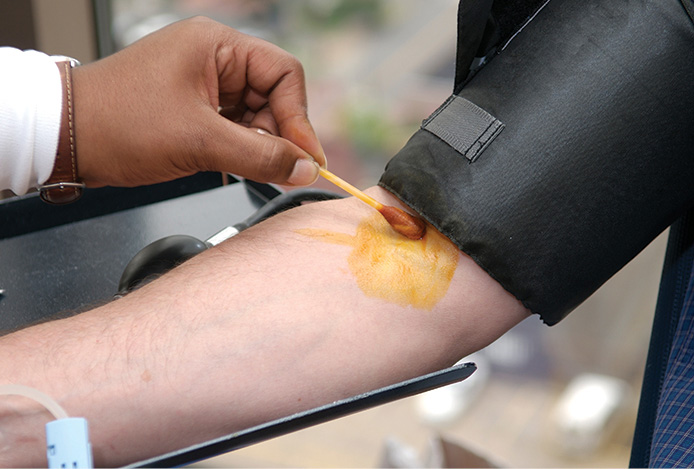
Iodine and its uses Elemental iodine (Table 2-5) dissolved in water, which is yellow-brown, is commonly used as a disinfectant. In nonpolar solvents, I2 has a deep violet color, and its reactivity with compounds such as alkenes makes it useful in analytical chemistry to determine end points of titrations.
More information
A photo of a doctor rubbing iodine on a patient’s skin. The patient is wearing a blood pressure cuff. The iodine is being applied below the cuff where blood is typically drawn.
A small species like CH4 has just 10 total electrons, so it is not very polarizable. Therefore, the induced dipole–induced dipole interactions in a sample of CH4 are rather weak, giving rise to a low melting point (–182 °C) and a low boiling point (–161 °C), as shown in Table 2-5. On the other hand, pentane (CH3CH2CH2CH2CH3), with 42 electrons, is significantly more polarizable, giving it a higher melting point (–130 °C) and boiling point (36 °C). Iodine (I2) has 106 electrons, so its melting point (114 °C) and boiling point (184 °C) are higher still. Notice that I2 melts above 0 °C, which is the melting point of water, indicating that the induced dipole–induced dipole interactions in I2 are even stronger than the hydrogen bonding in water!
Table 2-5 Melting Points and Boiling Points of Nonpolar Compounds
Molecule
Total Number of Electrons
Melting Point (°C)
Boiling Point (°C)
CH4
Methane
10
–182
–161
CH3CH3
Ethane
18
–183
–89
Propane
26
–188
–42
Cl2
Chlorine
34
–101
–34
Butane
34
–138
–1
Dimethylpropane
42
–17
10
Pentane
42
–130
36
Br2
Bromine
70
–7
59
I2
Iodine
106
114
184
YOUR TURN 2.15
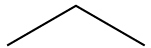
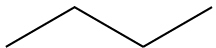
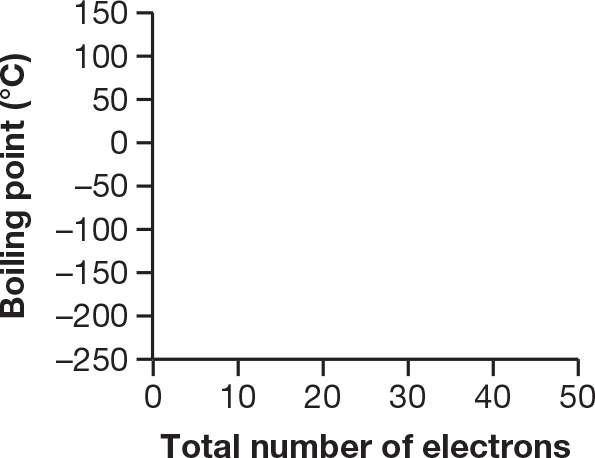
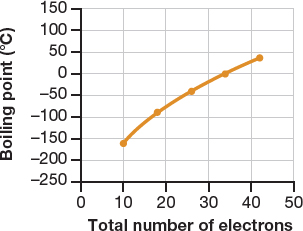
On the graph provided, plot boiling point as a function of total number of electrons for the straight-chain alkanes in Table 2-5 (i.e., methane, ethane, propane, butane, and pentane). What do you notice?
More information
A graph showing boiling point in degrees Celsius along the vertical axis and total number of electrons along the horizontal axis. The vertical axis is numbered from negative 250 to 150, in intervals of 50, and the horizontal axis is numbered from 0 to 50 in intervals of 10.
SHOW ANSWERHIDE ANSWER
As the total number of electrons increases, so does boiling point and the strength of the London dispersion forces.
More information
A graph showing boiling point in degrees Celsius along the vertical axis and total number of electrons along the horizontal axis. The vertical axis is numbered from negative 250 to 150, in intervals of 50, and the horizontal axis is numbered from 0 to 50 in intervals of 10. There are points at about (10,-150), (18, -85), (26, -40), (34, 0), and (42,40). These points are connected by a slightly curved line.
Climbing Like Geckos
More information
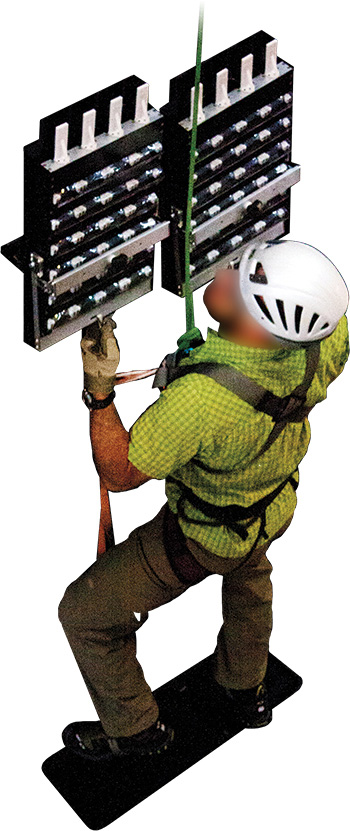
A photo shows a climber in a helmet and climbing harness using adhesive pads that look like large black boxes to scale a surface.
FIGURE 2-18
We noted in opening this chapter that dispersion forces are responsible for the astonishing ability of geckos to effortlessly climb up just about any surface. Geckos have a specialized hierarchical structure in their toes, culminating in large numbers of very small hairs less than 200 nm in diameter, called setae (see again the image on p. 68). Setae extensively increase the contact surface area of each toe, giving a gecko’s foot an adhesive pressure of up to 30 pounds per square inch on glass. This means that the gecko can, in principle, cling to glass by just one toe.
Scientists have known the gecko’s secret for many years but were unable to harness it until recently, when Professors Duncan Irschick and Alfred Crosby of the University of Massachusetts Amherst unveiled Geckskin in 2014. Geckskin is made from polydimethylsiloxane, a common polymer, and the adhesive pad mimics the structure of the gecko’s toe to maximize its contact surface area. One of the keys to the success of Geckskin is that it is woven into a synthetic tendon to maintain both stiffness and rotational freedom. And successful it is. A piece about the size of an index card has been shown to hold 700 pounds on a smooth wall and is easily removed without leaving any residue. Inspired by this, the Defense Advanced Research Projects Agency (DARPA) developed a system that enables an adult human weighing more than 200 pounds to scale a 25-foot vertical glass wall (Figure 2-18).
Contact surface area between molecules is another important factor governing the strength of induced dipole–induced dipole interactions:
Induced dipole–induced dipole interactions tend to increase in strength as the contact surface area increases.
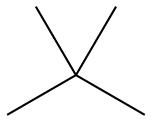
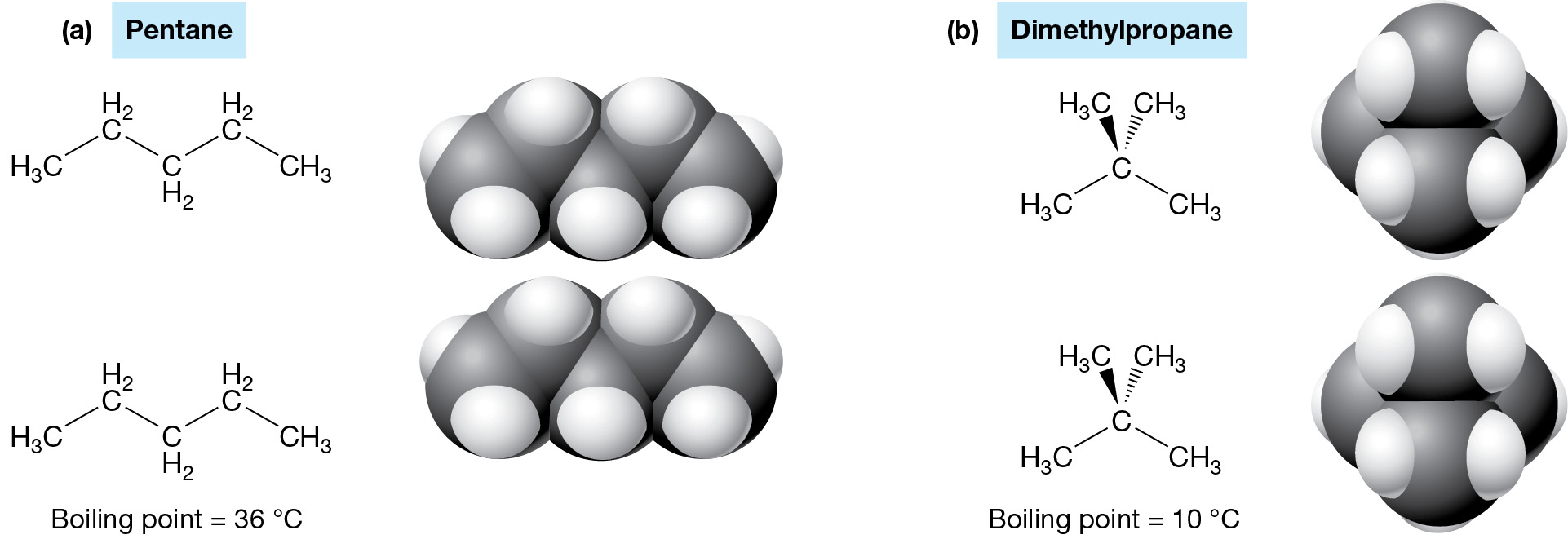
For instance, pentane [CH3(CH2)3CH3] and dimethylpropane [neopentane, C(CH3)4] have the same molecular formula (C5H12), and thus the same number of electrons, but pentane has a more extended shape than the relatively compact dimethylpropane. As a result, two molecules of pentane have a greater surface area available for interaction than two molecules of dimethylpropane do, as shown in Figure 2-19. Greater contact surface area means that pentane has more effective induced dipole–induced dipole interactions and a higher boiling point than dimethylpropane.
More information
Two illustrations show the condensed structural formulas and space-filling models of a pair of pentane molecules and dimethylpropane molecules. The first illustration shows the structure of two molecules of pentane, one above the other, with the space-filling models to the right. The structure shows a five-carbon chain with carbons 1 and 5 each bonded to three hydrogen atoms, and carbons 2, 3, and 4 each bonded to two hydrogen atoms. The boiling point is 36 degrees Celsius. The second illustration shows the structure of two molecules of dimethylpropane, one above the other, with the space-filling models to the right. The structure shows a three-carbon chain with carbons 1 and 3 each bonded to three hydrogen atoms, and carbon 2 bonded to two methyl groups, one pointing away from the reader and one pointing toward. The boiling point is 10 degrees Celsius. The caption reads, “Contact surface area and induced dipole—induced dipole interactions: The contact surface area between two molecules of pentane a is greater than that between two molecules of dimethylpropane b. The result is stronger induced dipole—induced dipole interactions in pentane and a correspondingly higher boiling point.”
FIGURE 2-19Contact surface area and induced dipole–induced dipole interactions The contact surface area between (a) two molecules of pentane is greater than that between (b) two molecules of dimethylpropane. The result is stronger induced dipole–induced dipole interactions in pentane and a correspondingly higher boiling point.
YOUR TURN 2.16
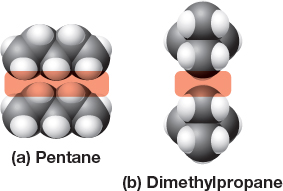
In Figure 2-19, shade in the contact surface area for each pair of molecules. What do you notice?
SHOW ANSWERHIDE ANSWER
As shown in red, pentane has a greater intermolecular contact surface area than dimethylpropane.
More information
3D structure of pentane and dimethylpropane. Structure a, pentane, shows two pentane molecules with 5 carbons each represented by white spheres. A red rectangle between them shows the contact surface area. Structure b, dimethylpropane, shows two dimethylpropane molecules, a smaller red rectangle than in a is between them showing the contact surface area.
(sometimes called H bond) an intermolecular interaction that involves a hydrogen-bond donor (NH, FH, or OH) and a hydrogen-bond acceptor (typically N, O, or F). (Ch. 2)
(also known as London dispersion forces) the source of attraction between nonpolar molecules resulting from the temporary distortion of their electron distributions. (Ch. 2)