Section 1.8 Objectives
You will be able to:
- Predict whether an atom pairing will undergo ionic or covalent bonding on the basis of electronegativity.
- Identify ionic compounds that contain polyatomic ions.
When elements in a compound have large enough differences in electronegativity, the more electronegative atom can acquire electrons given up by the less electronegative atom, forming oppositely charged ions. The electrostatic attraction between the positively charged cation and the negatively charged anion describes ionic bonding.
An ionic bond typically occurs when the electronegativity difference between two atoms is greater than about 1.7. Sodium chloride (NaCl), for example, consists of sodium cations (Na+) and chloride anions (Cl–), and the electronegativity difference between Na (0.93) and Cl (3.16) is 2.23. Large electronegativity differences like this tend to occur when one atom is a metal from the left side of the periodic table and the other is a nonmetal from the right side of the periodic table. Consequently:
Most ionic compounds (e.g., NaCl and MgBr2) consist of a metal and a nonmetal, whereas most covalent compounds (e.g., CH4) consist of nonmetals only.
While covalent compounds are generally found as discrete uncharged molecules, the ions in an ionic solid are arranged in a regular pattern, called a crystal lattice, as shown for NaCl in Figure 1-22.
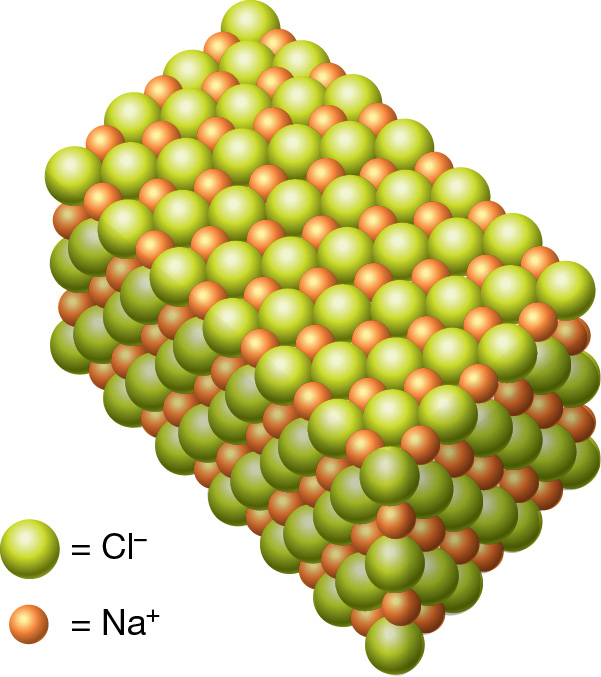
An illustration shows a crystal lattice of solid sodium chloride. The crystal lattice of sodium chloride is in the shape of a cuboid. It consists of tightly packed large spheres, denoting chloride ion and small spheres, denoting sodium ions. Both the spheres are shown arranged alternatively on each face of the shape. The caption reads, “Representation of the solid crystal structure of solid sodium chloride. The sodium cation and chlorine anion are held together by electrostatic forces, called ionic bonds, whereby opposite charges attract. As a solid, the ions form a regular array called a crystal lattice.”
YOUR TURN 1.7
It was previously mentioned that MgBr2 is an ionic compound, whereas CH4 is a covalent compound. Calculate the difference in electronegativity between the elements in each compound. What do you notice?
MgBr2 _________________________ CH4 _________________________
ΔEN for MgBr2 is 2.96 – 1.31 = 1.65, and ΔEN for CH4 is 2.55 – 2.20 = 0.35. ΔEN is large for ionic compounds and small for covalent ones.
Polyatomic ions, such as the hydroxide (HO–), methoxide (CH3O–), and methylammonium (CH3NH3+) ions shown in Figure 1-23, contain more than one atom. Polyatomic ions usually consist only of nonmetals, and their atoms are held together by covalent bonds.
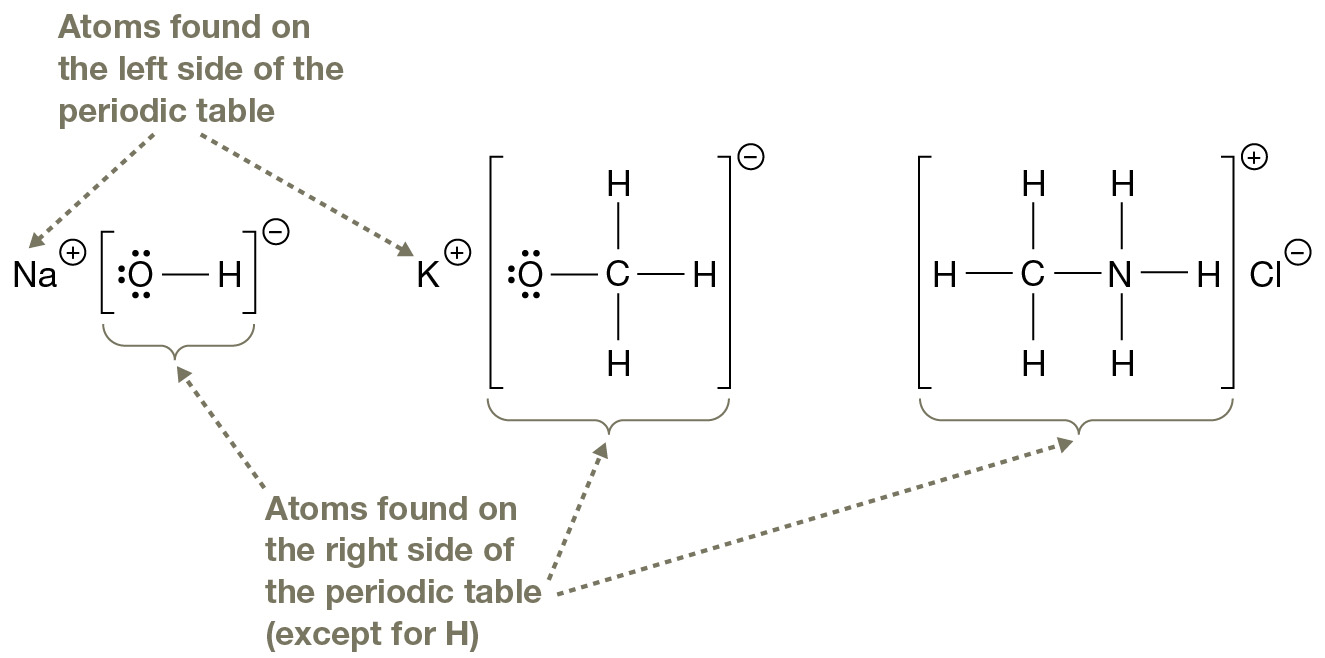
Three condensed structural formulae of polyatomic ions in ionic compounds and the covalent bonds that form between them. The first condensed structural formula shows sodium cation with a hydroxide ion bearing a negative charge. The oxygen of the hydroxide ion carries three lone pairs of electrons and is single bonded to a hydrogen atom. The second condensed structural formula shows a potassium cation with a methoxide ion bearing a negative charge. The methoxide ion consists of a central carbon atom, single bonded to three hydrogen atoms, and an oxygen atom carrying three lone pairs of electrons. The third condensed structural formula shows a chloride anion with a methylammonium ion bearing a positive charge. The methylammonium ion consists of a carbon atom, single bonded to a nitrogen atom. Each carbon and nitrogen atom is single bonded to three hydrogen atoms. The sodium and potassium cations consist of the atoms found on the left side of the periodic table. The hydroxide ion, methoxide ion, and methylammonium ion consist of the atoms found on the right side of the periodic table, except for hydrogen atoms. The caption reads, “Polyatomic ions in ionic compounds: Polyatomic ions are usually composed of nonmetal elements from the right-hand side of the periodic table. Those elements have similar electronegativities, allowing covalent bonds to form between them.”
Figure 1-23 also shows that polyatomic ions can be either anions (HO– and CH3O–) or cations (CH3NH3+). As will be explained in Section 1.9, most polyatomic cations possess a nitrogen atom participating in four covalent bonds (another common example is ammonium ion, NH4+). Interestingly, the existence of these kinds of polyatomic cations makes possible the formation of ionic compounds composed entirely of nonmetals (e.g., CH3NH3Cl and NH4Br).
SOLVED PROBLEM 1.7
How to identify ionic versus covalent compounds
Break It Down Identify each of the following as either an ionic compound (i.e., one containing ionic bonds) or a covalent compound (i.e., one containing only covalent bonds): (a) NH4CHO2; (b) LiOCH2CH3; (c) CH3CH2CH2OH. (In these condensed formulas, which are discussed in Section 1.12, you may assume that each hydrogen appearing immediately to the right of a non-hydrogen atom forms a covalent bond to that non-hydrogen atom.)
|
Think |
Solve |
|
|
Which compounds contain elements from both the left and right sides of the periodic table? |
➤ |
In LiOCH2CH3, Li is a metal and the remaining elements are nonmetals. Therefore, LiOCH2CH3 is an ionic compound in which Li exists as Li+, and the remaining nonmetals make up the negatively charged ion (OCH2CH3)–. |
|
Which compounds contain recognizable polyatomic ions? |
➤ |
In NH4CHO2, the four H atoms appearing immediately to the right of N are all bonded to N, which makes up the polyatomic ion NH4+. The remaining nonmetals must therefore make up a negatively charged ion, (CHO2)–, so NH4CHO2 is an ionic compound. |
|
Which compounds have neither of these features? |
➤ |
CH3CH2CH2OH consists of only nonmetals and has no recognizable polyatomic ions, so it is a covalent compound. |
|
Try ItWhich of the following are ionic compounds (i.e., ones containing ionic bonds) and which are covalent compounds (i.e., ones containing only covalent bonds)? 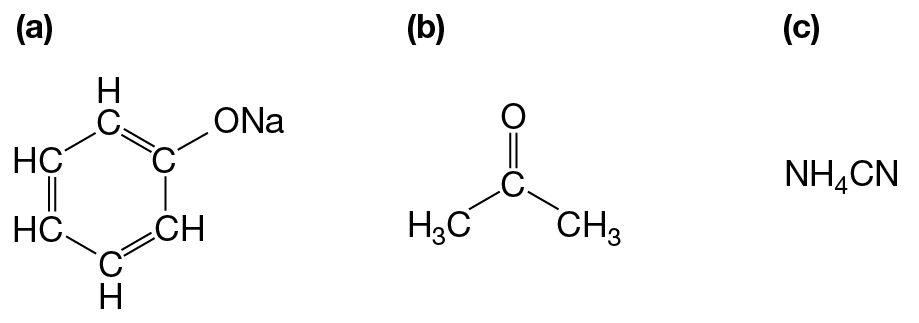
More informationCondensed structural formulae of two compounds labeled A and B, and chemical formula of one compound labeled C. The first condensed structure has a hexagon ring with alternating single and double bonds inside. One of the carbon atoms is bonded to an oxygen atom, which is further bonded to a sodium atom. The rest of the five carbon atoms are bonded to a hydrogen atom each. The second condensed structure shows a central carbon atom, single bonded to two methyl groups and double bonded to an oxygen atom. The chemical formula reads, N H 4 C N. |
||