Section 2.4 Objectives
You will be able to:
- Explain how molecules with polar covalent bonds can be nonpolar overall.
- Determine whether a molecule with polar covalent bonds will be polar or nonpolar.
Recall from Section 1.7 that a polar covalent bond arises when atoms having different electronegativities are bonded together, and the resulting bond dipole points toward the more electronegative atom. If there is only one polar covalent bond in the entire molecule, as in HF (Figure 2-9a), then the molecule will have a net molecular dipole, or permanent dipole. That is, one end of the molecule bears a partial positive charge and the other end bears a partial negative charge of equal magnitude. In HF, the partial negative charge builds up on the side with the fluorine atom (electronegativity = 3.98; see Fig. 1-18, p. 16), while the partial positive charge is left in the vicinity of the hydrogen atom (electronegativity = 2.20), so the net molecular dipole points toward F and the entire molecule is polar (see Looking Ahead box).
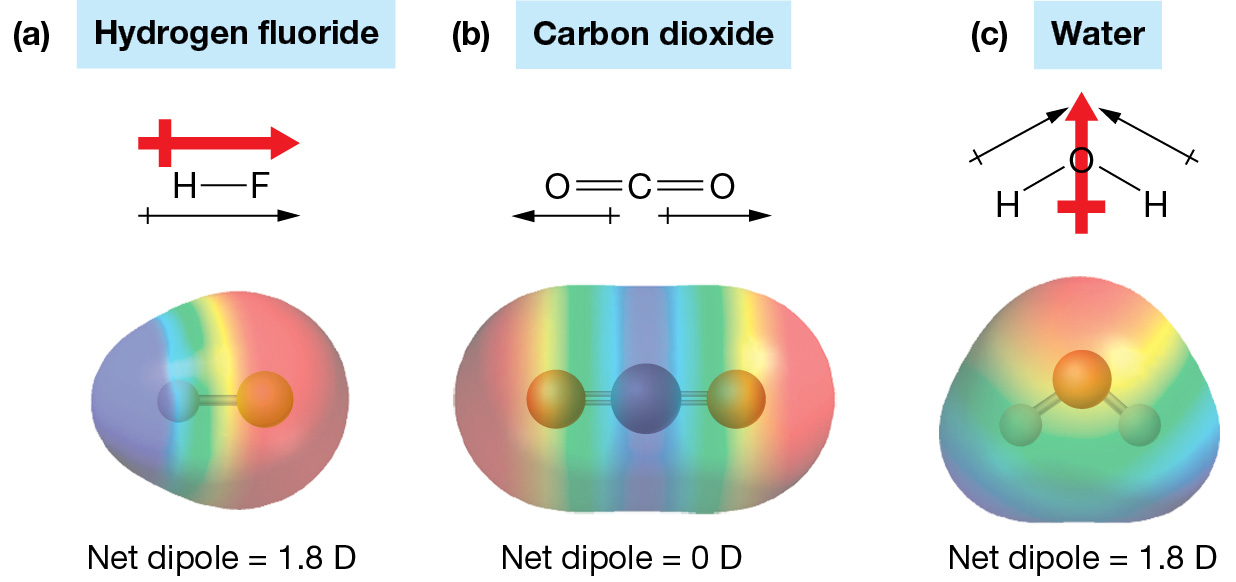
Condensed structural formulas and electrostatic potential maps of three molecules, F H, C O 2, and H 2 O. The first condensed structure is of hydrogen fluoride. The structure shows a hydrogen atom single-bonded to a fluorine atom. A thick red arrow and a think black arrow both point from the hydrogen atom in the direction of the fluorine atom. The electrostatic potential map shows the ball-and-stick model of FH in an egg-shaped cloud, shaded in blue on the right, turquoise, green, and yellow in the center, and red on the right. A note below reads, “Net dipole equals 1.8D.” The second condensed structure of carbon dioxide shows central carbon atom, double bonded to two oxygen atoms. Two thin black arrows from the central carbon lead away from it toward each oxygen atom. The electrostatic potential map shows the ball-and-stick model of C O 2 in a dumbbell-shaped cloud, shaded in red on both ends representing oxygen atoms. On moving from the center to either side of the model, the region is shaded in the order, blue, turquoise, green, and yellow. A note below reads, “Net dipole equals 0D.” The third condensed structure of water or H 2 O shows a central oxygen atom single-bonded to a hydrogen atom on each side in a bent fashion. Two thin black arrows from each of the hydrogen atoms lead toward the central oxygen atom. A thick red arrow pointing upward passes through the oxygen atom. The electrostatic potential map shows the ball-and-stick model of H 2 O in a triangular cloud, shaded in red at the upper end representing the oxygen atom, and in blue at the two ends representing the hydrogen atoms. The central portion, from top to bottom, is shaded in yellow, green, and turquoise. A note below reads, “Net dipole equals 1.8D.” The caption reads, Bond dipole moments and net molecular dipole moments: Bond dipole moments are shown as thin black arrows and net molecular dipole moments as thick red arrows. a. HF is a polar molecule, with a net dipole moment of 1.8 D pointing toward the F atom. b. C O 2 is nonpolar, because the two C double bond O dipoles point in exactly opposite directions and completely cancel by vector addition. c. Water is a polar molecule, with a net dipole moment of 1.8 D pointing from the point midway between the H atoms toward the O atom.
▶ LOOKING AHEAD
As we will learn in Chapter 7, the distribution of charge within a molecule, which describes polarity, is a major factor that controls how molecules participate in chemical reactions. Specifically, we will see that many reactions are driven by the attractive force between sites that have opposite charges.
The magnitude of a dipole is reported in units of debyes (D). To get a feel for this type of unit, it helps to know that the dipole for a molecule of HF, which is quite polar, has a magnitude of 1.8 D. Strictly nonpolar molecules, such as H2, have a dipole magnitude of 0 D.
A dipole is a vector, which has both magnitude and direction, so we arrive at the net dipole of a molecule by adding the vectors of the bond dipoles together. CO2 (Fig. 2-9b), for example, is nonpolar, despite having two polar covalent bonds. CO2 is linear and symmetrical, so the two C═O bond dipoles point in exactly opposite directions, resulting in complete cancellation. Water (Fig. 2-9c), on the other hand, is polar because its two bond dipoles do not point in exactly opposite directions.
YOUR TURN 2.8
Like CO2, BeH2 is a linear nonpolar molecule. Using the structure shown, draw dipole arrows above each Be—H bond. (For the necessary electronegativity values, see Fig. 1-18, p. 16.)
H—Be—H

Condensed structure showing movement of charge. A central beryllium atom is bonded to two hydrogens. Two separate arrows start at the beryllium, one points left towards one hydrogen, the other points right towards the second hydrogen.
The examples of CO2 and H2O illustrate the general property of polarity:
Bond dipoles will completely cancel if they are of equal magnitude and are arranged in one of the highly symmetric geometries from Table 2-2 (i.e., linear, trigonal planar, or tetrahedral).
CONNECTIONS 2.4
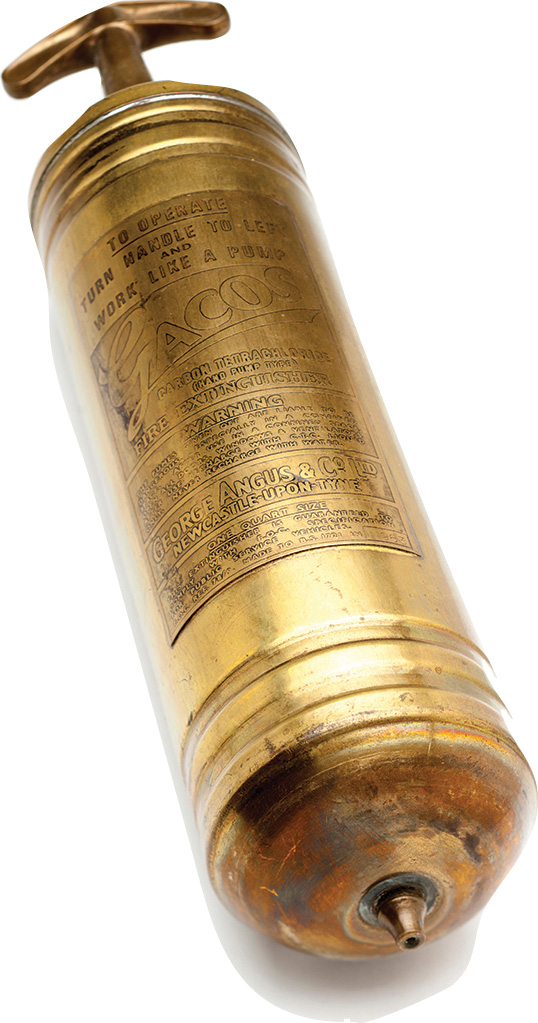
Tetrachloromethane and its uses in the past Historically, CCl4 (Fig. 2-10a) was a common organic solvent and was also used widely as a pesticide and in fire extinguishers like this one. We now know, however, that substantial exposure to CCl4 causes acute liver failure and other severe health problems, including cancer, so these uses have largely been phased out.
CONNECTIONS 2.5
Dichloromethane and its uses CH2Cl2 (Fig. 2-10b), commonly called methylene chloride, has uses as a paint stripper and degreaser and has been used in the food industry to decaffeinate coffee. Because of its low boiling point, it is used as the liquid inside the “drinking bird” toy.

A photo shows a drinking bird toy with its beak dipping into a glass of water. The bottom of the bird is filled with a red liquid.
We can see how this idea applies to CCl4, CH2Cl2, and CH3Cl (all of which are tetrahedral molecules) as shown in Figure 2-10. Only CCl4 (Fig. 2-10a) is nonpolar because the four C—Cl bond dipoles are equal in magnitude and are arranged in a tetrahedron. By contrast, the bond dipoles of the polar C—Cl bonds in CH2Cl2 (Fig. 2-10b) and CH3Cl (Fig. 2-10c) do not completely cancel. In CH2Cl2, the two C—Cl bonds are arranged in a bent geometry, and CH3Cl has just one bond with significant polarity, the C—Cl bond.
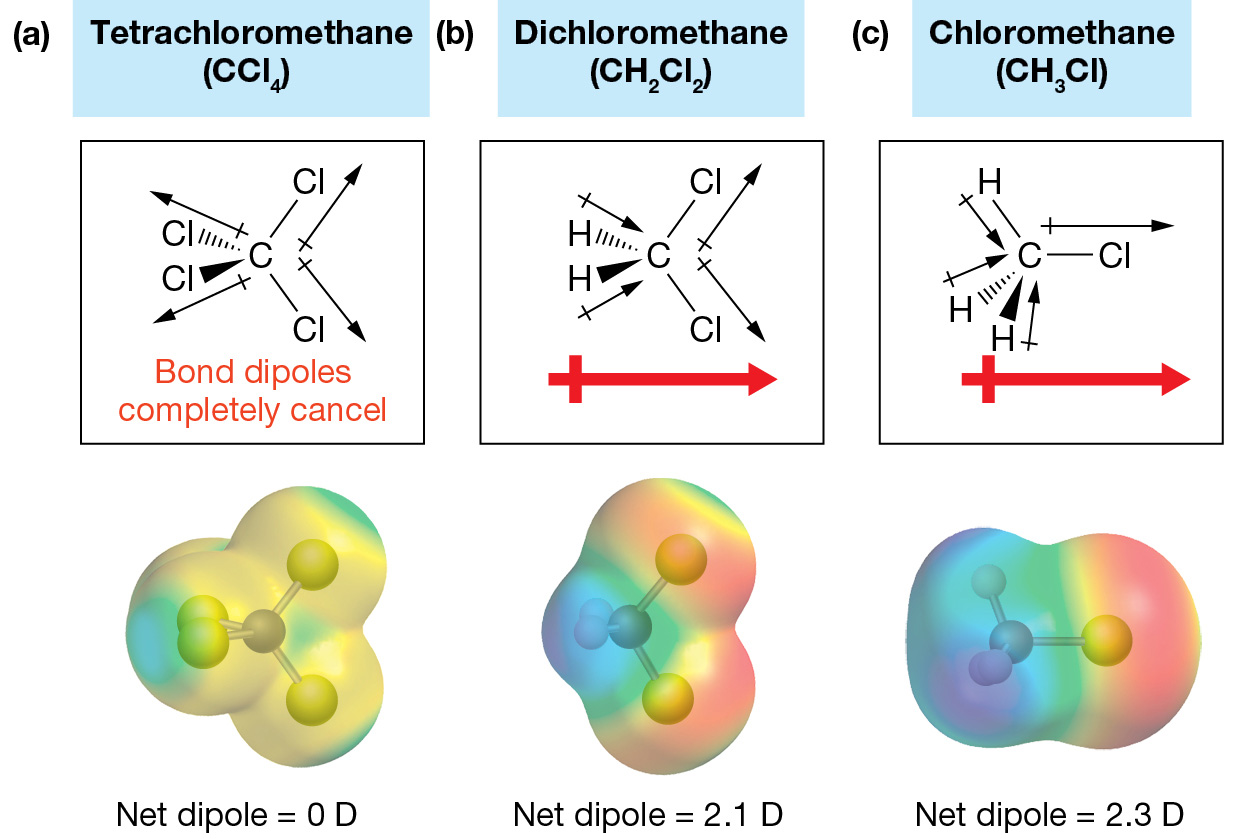
An illustration shows the steps involved in the vector addition of tetrachloromethane, dichloromethane, and chloromethane. The illustration is divided into three columns, one for tetrachloromethane C C l 4, the second for dichloromethane C H 2 C l 2, and the third for chloromethane C H 3 C l. Each column has a box with the structural formula and showing individual bond dipoles and net dipoles for the molecule. Below the box in each column is an electrostatic potential map of the molecule. The condensed structural formula of tetrachloromethane shows a central carbon atom bonded to two chlorine atoms on its upper right and lower right sides by solid lines, to a third chlorine atom on its lower left side by a solid wedge, and to a fourth chlorine atom on its upper left side by a dashed wedge. Four thin black arrows, each point from the central carbon to the chlorine atoms. A note reads, “Bond dipoles completely cancel.” The electrostatic potential map of tetrachloromethane shows a triangular cloud with green portions around the chlorine atoms and yellow in the center. The condensed structural formula of dichloromethane shows a central carbon atom bonded to two chlorine atoms on its upper right and lower right sides by solid lines, to a hydrogen atom on its lower left side by a solid wedge, and to another hydrogen atom on its upper left side by a dashed wedge. Two thin black arrows, each point from the central carbon to the chlorine atoms, and two thin black arrows, each point toward the central carbon atom from the hydrogen atoms. Below the structure a long, thick red arrow is pointing to the right. The electrostatic potential map of dichloromethane shows a triangular cloud shaded in red around the areas representing the chlorine atoms, and in blue around the areas representing the hydrogen atoms. The central portion, from left to right, is shaded in turquoise, green, and yellow. The condensed structural formula of chloromethane shows a central carbon atom bonded to a chlorine atom on its right by a solid line, to a hydrogen atom on its upper left by a solid line, and to two hydrogen atoms on its lower left by a solid wedge and a dashed wedge. A thin black arrow points from the central carbon to the chlorine atom, and three thin black arrows, each point toward the central carbon atom from the hydrogen atoms. Below the molecule a long, thick red arrow is pointing to the right. The electrostatic potential map of chloromethane shows a dumbbell-shaped cloud shaded in red around the areas representing the chlorine atom, and in blue around the areas representing the hydrogen atoms. The central portion, from left to right, is shaded in turquoise, green, and yellow.
YOUR TURN 2.9
A molecule of CF4 is shown with dash–wedge notation. Draw the bond dipoles along each of the C—F bonds and determine whether the molecule is polar.
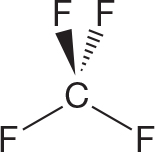
An illustration uses dash-wedge representation to show the structure of a C F 4. The CF4 molecule has a central carbon atom bonded to two fluorine atoms in the plane of the paper, one fluorine atom pointing away from the reader, and one fluorine atom pointing toward. The bonds on the plane of the paper are represented by solid lines, the bond pointing away from the reader is represented by a dashed wedge, and the bond pointing toward is represented by a solid wedge.
Thin black arrows indicate the individual bond dipoles. They are equal in magnitude and are arranged in a tetrahedron, so they perfectly cancel. The molecule is nonpolar.

Condensed structure showing polarity. A central carbon is bonded to four fluorine atoms, one is bonded on a solid wedge and another is bonded on a dashed wedge. Four arrows at each fluorine indicating polarity start at the carbon and end at the respective fluorine.
CONNECTIONS 2.6
Chloromethane and its uses CH3Cl (Fig. 2-10c) was once used as a refrigerant, but this is no longer the case due to its toxicity and flammability. Nowadays, it finds use as a local anesthetic and as an herbicide.