- Mechanisms as Predictive Tools: The Proton Transfer Step Revisited
- Bimolecular Nucleophilic Substitution (SN2) Steps
- Bond-Forming (Coordination) and Bond-Breaking (Heterolysis) Steps
- Nucleophilic Addition and Nucleophile Elimination Steps
- Bimolecular Elimination (E2) Steps
- Electrophilic Addition and Electrophile Elimination Steps
- Carbocation Rearrangements: 1,2-Hydride Shifts and 1,2-Alkyl Shifts
- The Driving Force for Chemical Reactions
- Carbocations and Charge Stability
- Keto–Enol Tautomerization: An Example of Bond Energies as the Major Driving Force
7An Overview of the Most Common Elementary Steps
More information
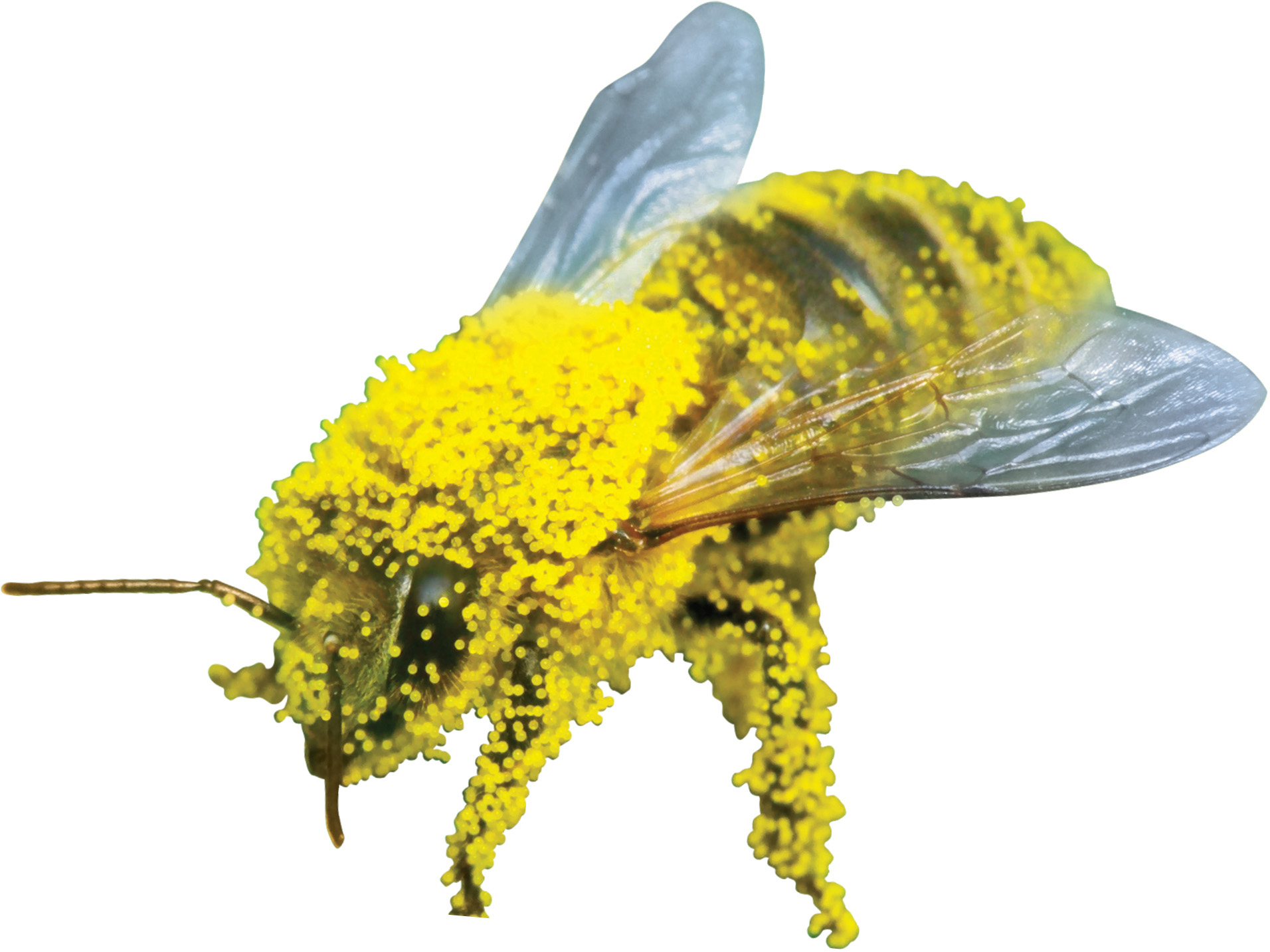
A bee covered with pollens attracted through an electric charge. The pollen covers most of its body and legs.
Pollen sticks to this bee due to electrostatic attraction. When it flies, a bee loses electrons and builds up a positive electrical charge. The flower’s pollen, on the other hand, is negatively charged, so when the bee lands, the pollen experiences a driving force from the flower to the bee. Similarly, the elementary steps we examine here in Chapter 7 are driven by the flow of electrons from a site with excess negative charge toward a site with excess positive charge.
Chapter Outline
In Chapter 6, we learned that a proton transfer is an elementary step: it occurs as a single event. The proton transfer steps we saw throughout Chapter 6 were considered in isolation from other steps. Frequently, however, a proton transfer makes up one step of a multistep mechanism, something we will discuss more extensively in Chapter 8.
There are a handful of other quite common elementary steps, too, which can be combined in various ways to produce mechanisms for numerous reactions. Chapter 7 provides an overview of nine of these elementary steps:
The nine new elementary steps we learn here in
Chapter 7, along with the proton transfer step (10 in all), make up nearly all of the reaction mechanisms you will encounter through Chapter 25.Knowing that the same 10 elementary steps make up the mechanisms for a large number of reactions, you can be confident that mechanisms simplify organic chemistry. Therefore, the time and effort you spend mastering these elementary steps will be very worthwhile as you continue to learn reactions throughout the rest of this book.
Each of the nine elementary steps introduced here in Chapter 7 (in Sections 7.2–7.7) can be depicted using curved arrow notation, much as proton transfer steps were depicted in Chapter 6. However, it is not enough to merely describe how each step takes place; it is important to know why the step would (or would not) take place. Therefore, two sections of this chapter are devoted to developing this understanding: Section 7.1 shows how the curved arrow notation for each step represents a natural direction of electron flow, and Section 7.8 deals with the driving force for elementary steps.
Keep in mind that this chapter serves to provide an overview of the common elementary steps; later chapters describe in more detail the central roles these elementary steps play in more complex mechanisms. For now, your goal is to learn just three aspects of each elementary step: (1) the types of species that are required as reactants and products, (2) the curved arrows that describe the electron movement (bonds forming and breaking), and (3) the driving force.
To help you see the similarities and differences among the various elementary steps:
General forms of all 10 elementary steps are described in the chapter summary on pages 350–351.
Think of the Chapter 7 summary as a reference to be revisited frequently, not only as you first make your way through this chapter but also when you encounter these elementary steps in reaction mechanisms in later chapters.