7.4 Nucleophilic Addition and Nucleophile Elimination Steps
SECTION 7.4 OBJECTIVES
You will be able to:
Identify a nucleophilic addition or nucleophile elimination step when given the reactants and products.
Draw the curved arrow notation, transition state, and products for a nucleophilic addition or nucleophile elimination step when given the reactants.
Describe how the reactants of a nucleophilic addition step behave as a nucleophile and an electrophile.
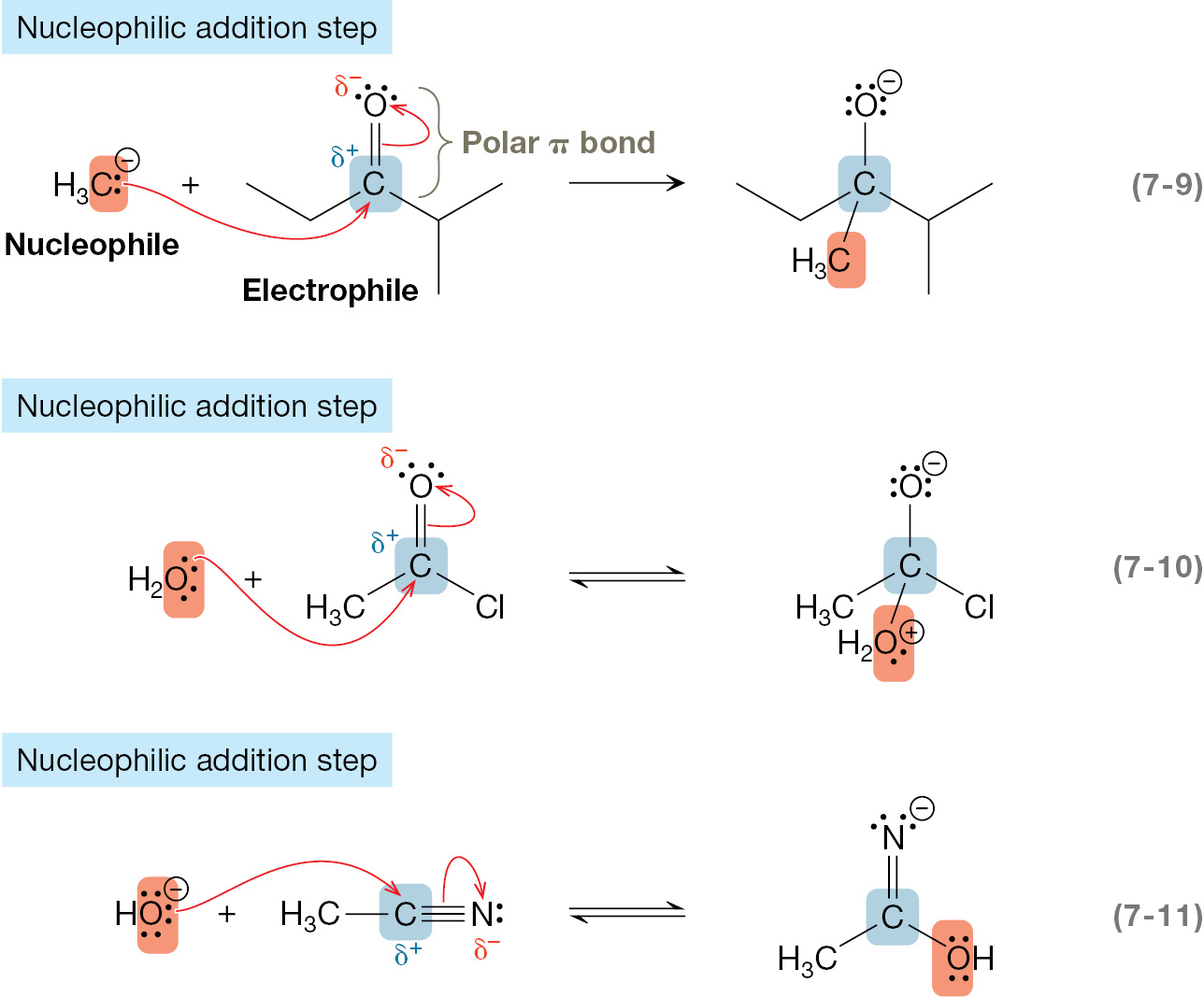
Section 7.2 introduced the SN2 step, in which a nucleophile forms a bond to an atom containing a suitable leaving group. A nucleophile can also form a bond to an atom that is initially involved in a polarπbond; that is, a π bond that is part of a double or triple bond connecting atoms with significantly different electronegativities, such as those in carbonyl groups (C═O), imine groups (C═N), and cyano groups (C≡N). Specifically, as shown in Equations 7-9 through 7-11, the nucleophile forms a bond to the less electronegative atom and the π bond breaks, becoming a lone pair on the more electronegative atom. A nucleophile adds to the polar π bond in these steps, so they are called nucleophilic addition steps.
Elementary Step
Nucleophilic Addition
More information
Three chemical reactions to show nucleophilic addition step by the addition of a polar pi-bond. The first chemical reaction shows a carbon atom of methyl group carrying two lone pairs of electrons and a negative charge, acting as a nucleophile reacting with a compound carrying carbonyl group at the third position in the chain acting as a electrophile. The carbon atom of the carbonyl group is labeled delta plus while the oxygen atom double-bonded to the carbon atom carries two lone pairs of electrons, labeled delta minus. A curved arrow points from the carbon atom of methyl group toward carbon atom of the carbonyl group while another curved arrow points from a double bond in the carbonyl group toward the oxygen atom, labeled polar pi-bond. The resultant shows an addition of a methyl group to the carbon atom of the carbonyl group by a single bond, replacement of double bond in the carbonyl group by a single bond, and the presence of three lone pairs of electrons and a negative charge on the oxygen atom. The second chemical reaction shows the oxygen atom of a water molecule carrying two lone pairs of electrons reacting with a compound, with a central carbon atom, labeled delta plus, linked to a methyl group and a chlorine atom by a single bond and an oxygen atom carrying two lone pairs of electrons, labeled delta minus by a double bond. A curved arrow points from the oxygen atom of a water molecule toward carbon atom of the carbonyl group while another curved arrow points from a double bond in the carbonyl group toward the oxygen atom. It is followed by a reversible arrow to read a condensed structural formula of a compound, with a central carbon atom linked to an oxygen atom carrying three lone pairs of electrons and a negative charge, a chlorine atom, a water molecule carrying a lone pair of electrons and a positive charge, and a methyl group linked by a single bond each. The third reaction shows an oxygen atom of the hydroxyl group carrying three lone pairs of electrons and a negative charge reacting with a compound shown as a central carbon atom, labeled delta plus, linked to a methyl group by a single bond and a nitrogen atom carrying a lone pair of electrons, labeled delta minus, by a triple bond. A curved arrow points from the oxygen atom of the hydroxyl group toward the carbon atom while another curved arrow points from the triple bond between the carbon atom and nitrogen atom toward nitrogen atom. It is followed by a reversible arrow to read a condensed structural formula of a compound, with a central carbon atom linked to a nitrogen atom carrying two lone pairs of electrons and a negative charge by a double bond, a hydroxyl group with oxygen carrying two lone pairs of electrons, and a methyl group, by a single bond each.
YOUR TURN 7.11
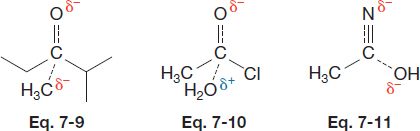
For each of the nucleophilic addition steps in Equations 7-9 through 7-11, draw the transition state, taking into account the partial bonds and partial charges.
SHOW ANSWERHIDE ANSWER
More information
Transition states for three structures. Eq 7-9 is a central carbon bonded to a ethyl group on the left, an isopropyl group on the right, a methyl group with a partial negative charge on a dashed bond, and double bonded to oxygen by one solid and one dashed bond, the oxygen has a partial negative charge. Eq 7-10 is a central carbon bonded to a methyl group, a chlorine atom, a water molecule with a partial positive charge on a dashed bond, and double bonded to an oxygen with a partial negative charge with one solid and one dashed bond. Eq 7-11 is a central carbon bonded to a methyl group, a hydroxide group with a partial negative charge on a dashed bond, and triple bonded to a nitrogen with a partial negative charge by two solid bonds and one dashed.
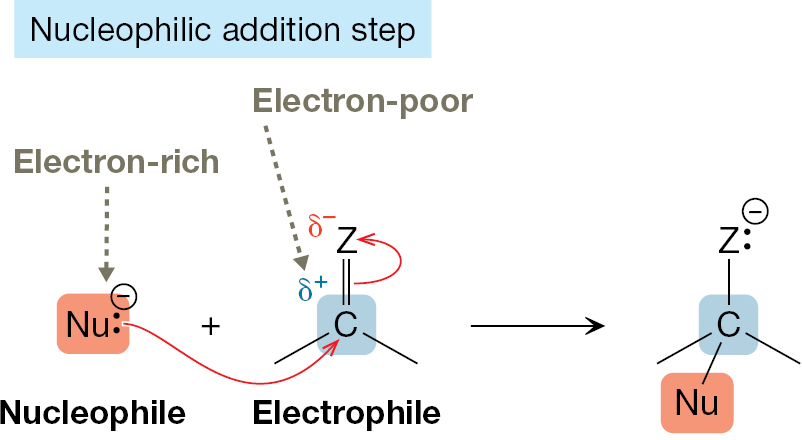
The electron-rich to electron-poor nature of a nucleophilic addition step is fairly straightforward. As shown in Figure 7-7, the nucleophile in a nucleophilic addition step, which has an excess of negative charge, is relatively electron-rich. The electrophile is the less electronegative atom of the polar π bond because it is relatively electron-poor. Thus, the curved arrow drawn from the electrons on the nucleophile to the polar π bond represents the flow of electrons from an electron-rich site to an electron-poor site. The second curved arrow, drawn from the center of the double (or triple) bond to the electronegative atom (Z), is necessary to avoid exceeding an octet on the less electronegative atom (C).
More information
A chemical reaction shows an example of a nucleophilic addition step. It shows an electron-rich nucleophile, Nu containing a lone pair of electrons, and marked with a negative charge. This is reacting with an electron-poor electrophile shown as a carbonyl group shown as a central carbon atom, marked delta plus having two vacant single bonds, and linked to Z, marked delta minus by a double bond. A curved arrow from the nucleophile is shown to point toward the central carbon atom of the carbonyl group while another curved arrow from a double bond between a carbon atom and Z is shown to point toward Z. The resultants show a central carbon atom having four single bonds arranged in a tetrahedral arrangement, with a nucleophile and a Z group attached to two of the four single bonds. The Z is marked with a negative charge.
FIGURE 7-7Electron-rich and electron-poor sites in nucleophilic addition
YOUR TURN 7.12
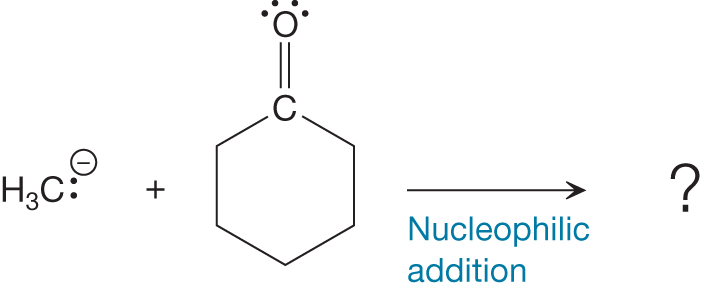
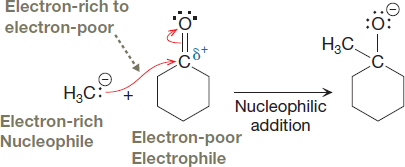
For the following nucleophilic addition step, label the pertinent electron-rich and electron-poor sites and label each reactant as either the nucleophile or the electrophile. Add the appropriate curved arrows and draw the product. Identify the curved arrow that is drawn from the electron-rich site to the electron-poor site.
SHOW ANSWERHIDE ANSWER
More information
Arrow pushing mechanism reaction. The electron rich nucleophile is a negatively charged methyl group. The electron poor electrophile is a cyclohexane ring double bonded to oxygen. An arrow starts at the negative methyl group and ends at the carbon double bonded to oxygen. Another arrow starts at the double bond and ends at the oxygen. The reaction arrow is labeled nucleophilic addition. The final product is cyclohexane ring bonded to a methyl group and negative oxygen.
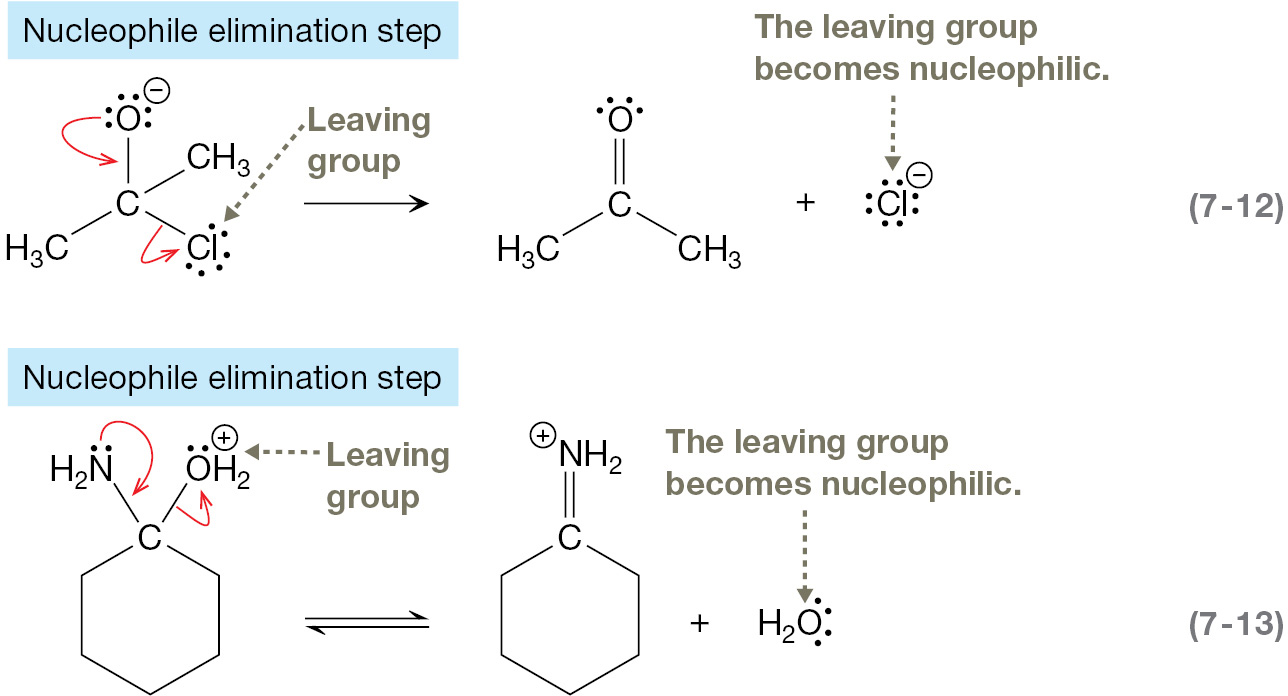
The reverse of nucleophilic addition (Eqs. 7-12 and 7-13), nucleophile elimination, is also commonly encountered in organic chemistry.
Elementary Step
Nucleophilie Elimination
More information
Two chemical reactions to show an example of a nucleophile elimination step. The first reaction shows a condensed structural formula of a compound with a central carbon atom linked to an oxygen atom carrying three lone pairs of electrons and a negative charge; two methyl groups; and a chlorine atom carrying three lone pairs of electrons by a single bond each, arranged in a tetrahedral arrangement. The chlorine is labeled as the leaving group. A curved arrow points from the oxygen atom toward a single bond connecting it to the central carbon atom while another curved arrow points from a single bond between the central carbon atom and chloride toward chloride. The resultants show a compound with a central carbon atom linked to an oxygen atom carrying two lone pairs of electrons by a double bond and two methyl groups by a single bond arranged in a trigonal planar arrangement. It also shows a chloride anion carrying four lone pairs of electrons, labeled the leaving group becomes nucleophilic. The second reaction shows a condensed structural formula of a compound as a six-ring structure, with carbon atom at its ipso-position linked to an amino group with the nitrogen atom of amino group carrying a lone pair of electrons; and a water molecule, with oxygen of a water molecule carrying a lone pair of electrons and a positive charge by a single bond each. The water molecule is labeled as the leaving group. It is followed by a reversible arrow to read a condensed structural formula of a compound as a six-ring structure, with the carbon atom at its ipso-position linked to an N H 2 group by a double bond carrying a positive charge. It also shows a water molecule, with the oxygen atom in the water molecule carrying two lone pairs of electrons labeled, the leaving group becomes nucleophilic.
▶ LOOKING AHEAD
Nucleophilic addition steps are often part of multistep mechanisms that also contain proton transfer steps (Chapter 18 and 19). Substitution can take place when nucleophilic addition and nucleophile elimination steps occur back-to-back (Chapter 22 and 23). Many biochemical reactions involve nucleophilic addition and nucleophile elimination steps, too (Chapter 19 and 23).
In both of these examples, a lone pair of electrons from a more electronegative atom forms a π bond to a less electronegative atom. A leaving group is simultaneously expelled to avoid exceeding an octet on the less electronegative atom. In the products, the leaving group’s atom that was involved in the initial bond ends up with a lone pair of electrons and an excess of negative charge, both of which are characteristics of a nucleophile. As a result, we call these nucleophile elimination steps (see Looking Ahead box).
YOUR TURN 7.13
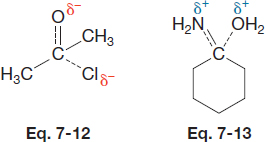
For each of the nucleophile elimination steps in Equations 7-12 and 7-13, draw the transition state, taking into account the partial bonds and partial charges.
SHOW ANSWERHIDE ANSWER
More information
Transition states for two structures. Eq 7-12 is a central carbon bonded to two methyl groups, a chlorine atom with a partial negative charge on a dashed bond, and double bonded to an oxygen with partial negative charge with one dashed bond and one solid bond. Eq 7-13 is a cyclohexane ring with a carbon bonded to a water molecule with a partial positive charge by a dashed bond and double bonded to an amine group with a partial positive charge by a solid and dashed bond.
YOUR TURN 7.14
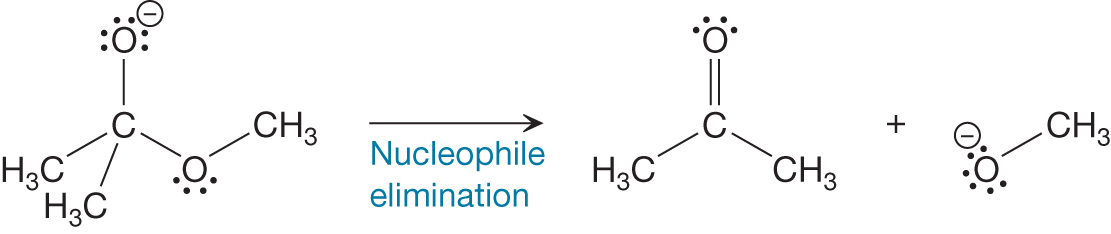
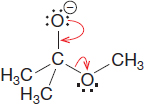
Add the appropriate curved arrows to the following nucleophile elimination step.
SHOW ANSWERHIDE ANSWER
More information
Arrow pushing mechanism. The structure is a central carbon bonded to a methoxy group, two methyl groups, and a negative oxygen atom. An arrow starts at the negative oxygen and ends at the bond with the carbon. Another arrow starts at the bond between carbon and the methoxy group and ends at the oxygen.
YOUR TURN 7.15
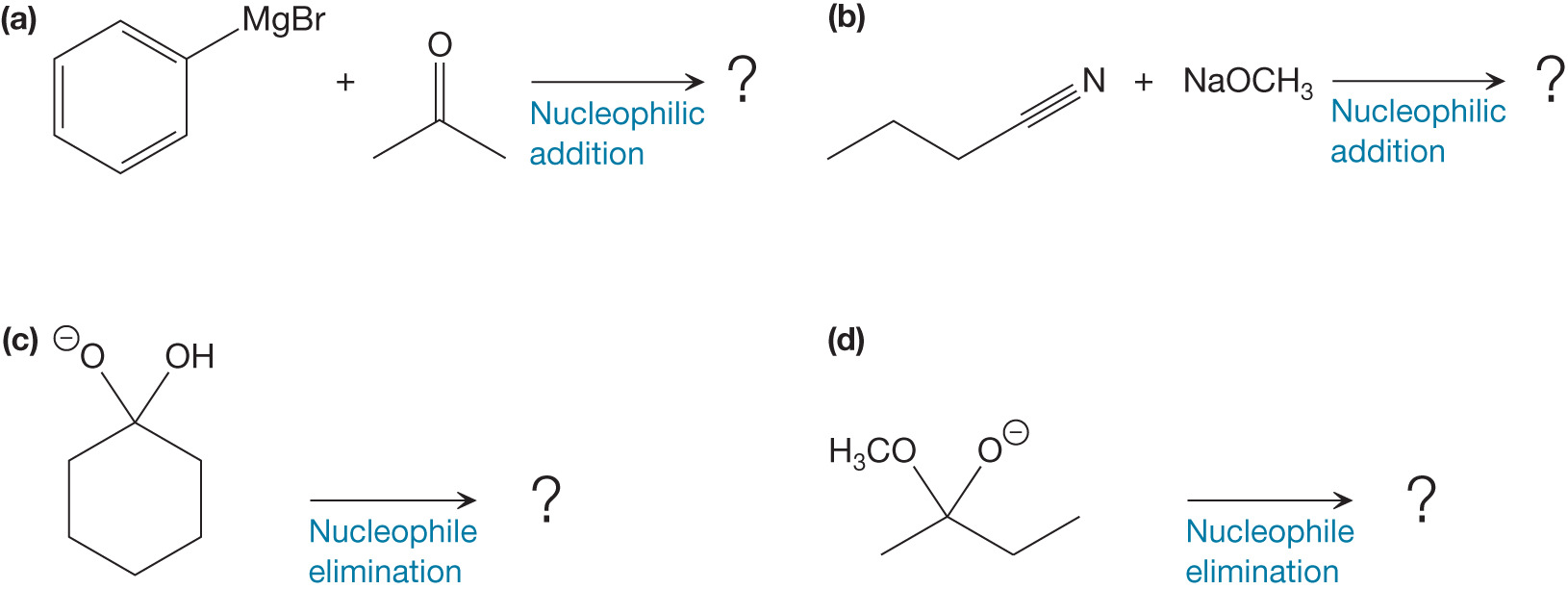
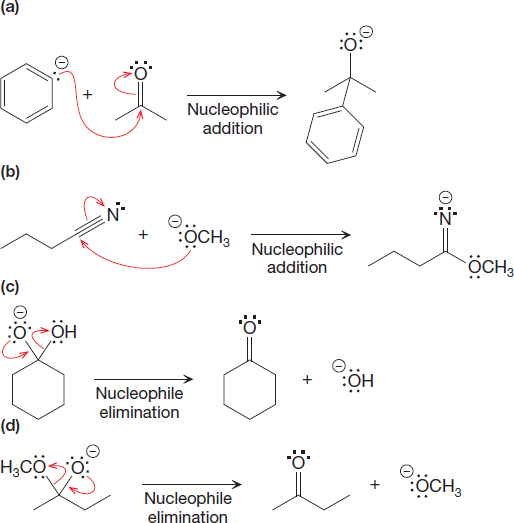
Draw the appropriate curved arrows and the products for each of the following elementary steps, as indicated below the reaction arrows. If electron pairs involved in the reaction are not shown, you must draw them in. Hint: Consider simplifying the electron-rich species.
SHOW ANSWERHIDE ANSWER
More information
Arrow pushing mechanism reaction. Reaction a has a benzene ring with a lone pair of electrons and a negative charge, the second reactant is a three carbon chain with the second carbon double bonded to oxygen. An arrow starts at the lone pair of electrons and ends at the second carbon, another arrow starts at the double bond and ends at the oxygen. The reaction arrow is labelled nucleophilic addition. The final product is a benzene ring, it is bonded to an isopropyl group which is further bonded to a negative oxygen. Reaction b is a four carbon chain, the first carbon is triple bonded to a nitrogen, the second reactant is a negative oxygen bonded to a methyl group. An arrow starts at the oxygen and ends at the carbon of the triple bond, another arrow starts at the triple bond and ends at the nitrogen. The reaction arrow is labelled nucleophilic addition. The final product is a four carbon chain, the first carbon is double bonded to a negative nitrogen and single bonded to a methoxy group. Reaction c is a cyclohexane ring bonded to a negative oxygen and a hydroxyl group. An arrow starts at the negative oxygen and ends at its bond, another arrow starts at the bond with the hydroxyl and ends at the oxygen of the hydroxyl. The reaction arrow is labelled nucleophile elimination. The final products are a cyclohexane ring double bonded to oxygen and a negative hydroxide ion. Reaction d is a four carbon chain, the second carbon is bonded to a methoxy group and a negative oxygen. An arrow starts at the bond with methoxy and ends at its oxygen, another arrow starts at the negative oxygen and ends at its bond.
an elementary step wherein a new π bond is produced and the eliminated leaving group, in turn, has the characteristics of a nucleophile; the reverse of a nucleophilic addition step.