Identify an SN2 step when given the reactants and products.
Draw the curved arrow notation, transition state, and products for an SN2 step when given the reactants.
Identify nucleophiles and substrates (electrophiles) that can participate in SN2 steps.
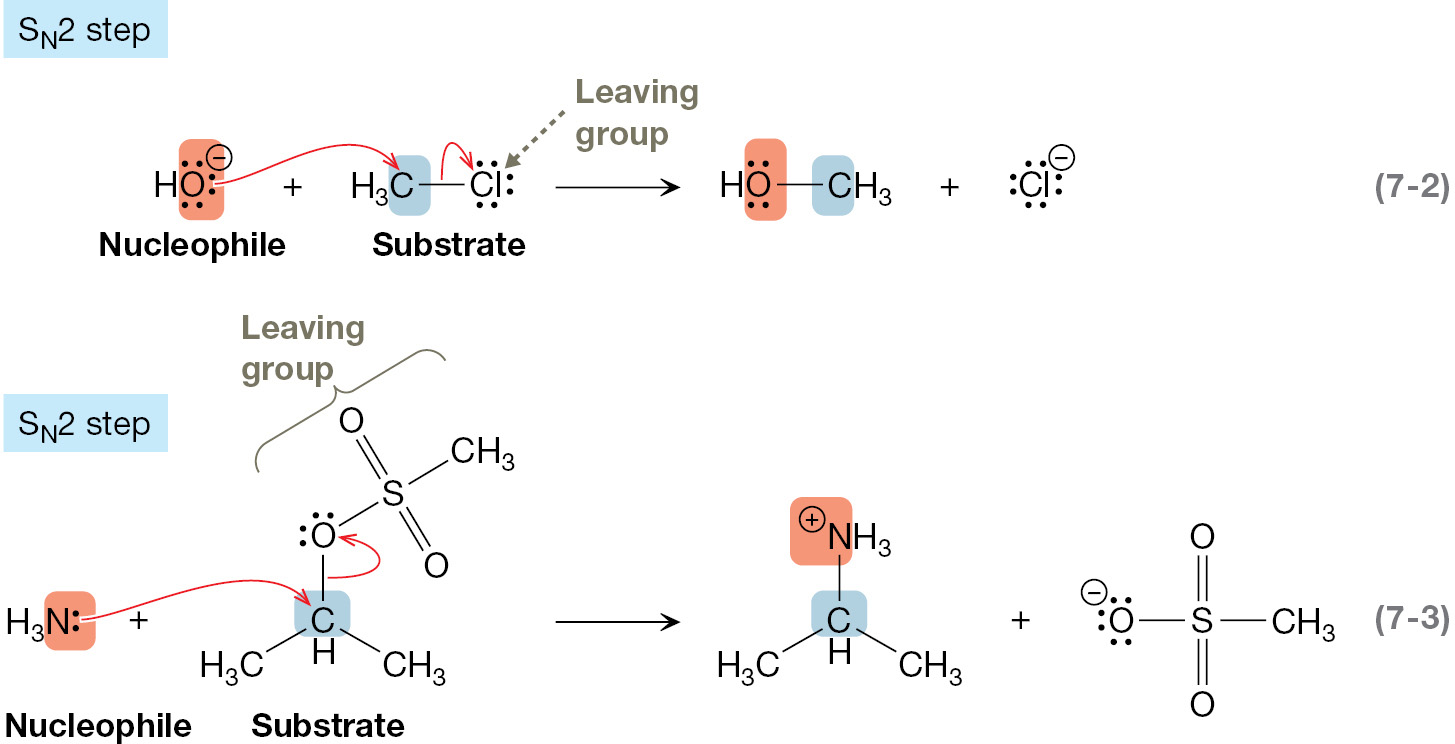
In a bimolecular nucleophilic substitution (SN2) step, a molecular species, called a substrate, undergoes substitution in which one atom or group of atoms is replaced by another. Examples are shown in Equation 7-2, where HO– substitutes for Cl–, and in Equation 7-3, where H3N substitutes for CH3SO−3 (see Looking Ahead box).
Elementary Step
Bimolecular Nucleophilic Substitution (SN2)
More information
An illustration shows two chemical reactions representing an example of bimolecular nucleophilic substitution (S N 2) step. The first example shows a nucleophile, hydroxyl group in which an oxygen atom, containing three lone pairs of electrons carrying a negative charge reacts with a substrate shown as a methyl group single-bonded to a chloride, labeled “leaving group.” A curved arrow drawn from an oxygen atom of a hydroxyl group is shown to point toward a carbon atom of a methyl group. Another curved arrow beginning from a single bond between the methyl group and chloride, point toward chloride. The resultants show oxygen atom of hydroxyl group single-bonded to the carbon atom of the methyl group and a chloride anion containing four lone pairs of electrons. The second example shows a nucleophile, amine group, with a negatively charged nitrogen atom, containing a lone pair of electrons linked to three hydrogen atoms reacting with a substrate shown as a central carbon hydrogen atom linked to two methyl groups and an oxygen atom, containing two lone pairs of electrons by a single bond each. The oxygen atom is further single-bonded to the sulfur of the leaving mesylate group, which further connects to two oxygen atoms by double bonds each and a methyl group by a single bond. A curved arrow from a nitrogen atom of amine group is shown to point toward carbon atom of the carbon-Hydrogen bond. Another curved arrow beginning from the single bond between carbon-Hydrogen bond and oxygen, point toward oxygen. The resultants show a positively charged nitrogen atom of amine group single-bonded to a central carbon atom, which further connects to two methyl groups in bent position and a mesylate group shown as a central sulfur atom single-bonded to a negatively-charged oxygen atom, containing two lone pairs of electrons, and two oxygen atoms double-bonded to the central atom each, and a methyl group attached to it by a single bond.
▶ LOOKING AHEAD
Reactions involving SN2 steps are really important in organic chemistry, especially in organic synthesis (Chapter 10). The product of an SN2 reaction might be the compound you want to synthesize. Alternatively, an SN2 reaction might be used to alter the reactivity of a molecule in ways that make further reactions possible. Because of this central role in synthesis, we revisit SN2 reactions in Chapters 8–11.
During the course of the SN2 steps in Equations 7-2 and 7-3, a nucleophile (which we will define shortly) forms a bond to the substrate at the same time a bond to the leaving group (the group that is displaced) is broken. The step is said to be bimolecular because it contains two separate reacting species in an elementary step. In other words, the step’s molecularity is 2. It is called nucleophilic simply because the reaction involves a nucleophile as a reactant.
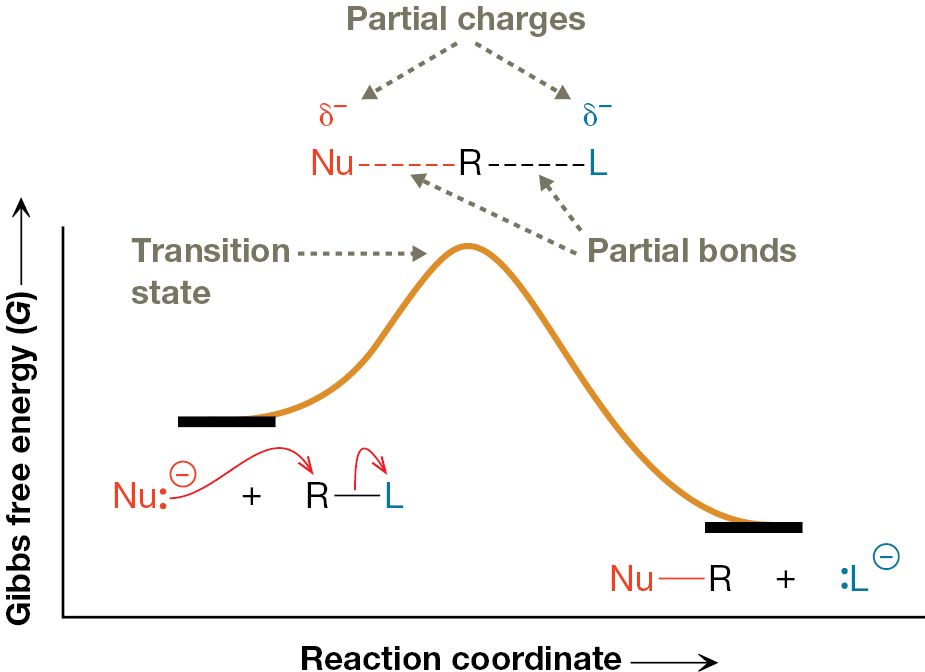
Just as we saw with proton transfer steps, an SN2 step is an elementary step, meaning that the reactants are converted into products in a single event. In other words, the reaction proceeds through a single transition state, as shown in the energy diagram in Figure 7-4 for a generic nucleophile Nu– and a generic substrate R—L. Notice, in particular, that both the Nu—R and R—L bonds are partial bonds in the transition state, as those are the bonds that undergo forming or breaking in the reaction. Also notice that the –1 charge disappears from Nu and appears on L as the reaction proceeds, so a partial negative charge appears on both Nu and L in the transition state (see top Looking Ahead box, p. 326).
More information
A free energy diagram for an S N 2 step. The x axis is labeled reaction coordinate with an arrow pointing from left to right. The y axis is labeled Gibbs free energy with an arrow pointing up. The initial state consists of a generic negatively charged nucleophile with a lone pair of electrons and a generic substrate R single bonded to L. From this state a line curves upward to a transition state which is at the peak free energy of the reaction. The transition state shows R connected to the nucleophile and the L by partial bonds. The nucleophile and the L both have partial negative charges. From there the line curves downward to a final state which has less free energy than the initial state. This final state shows the nucleophile single bonded to R and a negatively charged L with a lone pair of electrons.
FIGURE 7-4Free energy diagram for an SN2 step An SN2 step proceeds through a single transition state because the process is an elementary step. The Nu—R bond forms at the same time the R—L bond breaks, so both bonds are partially formed in the transition state. During the course of the reaction, the –1 charge disappears from Nu and appears on L, so a partial negative charge appears on both Nu and L in the transition state.
YOUR TURN 7.3
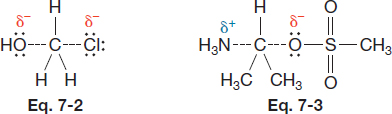
For each of the SN2 steps in Equations 7-2 and 7-3, draw the transition state by replacing Nu, R, and L in Figure 7-4 with the actual molecular fragments appearing in the reaction.
SHOW ANSWERHIDE ANSWER
More information
Two structures with partial charges. The first structure, labeled eq 7-2, is a central carbon bonded to three hydrogens, a hydroxyl group on a dashed bond, and a chlorine atom on a dashed bond. Both the hydroxyl and chlorine atom have partial negative charges. The second structure, labeled eq 7-3, is a central carbon bonded to a hydrogen and two methyl groups, a N H 3 group via a dashed bond, and an oxygen via a dashed bond. The N H 3 group has a partial positive charge, and the oxygen has a partial negative charge.
Equations 7-2 and 7-3 show the leaving group coming off in the form of a negatively charged species. Common leaving groups are able to accommodate that negative charge well (see Recall box). Applying what we learned in Sections 6.8 and 6.9, we can say that:
Leaving groups are typically conjugate bases of strong acids.
▶ LOOKING AHEAD
We can use the strategy presented here to depict the general structure of a transition state, but the exact geometry will depend on how the reactants approach each other (stereochemistry) and whether ΔG for the reaction is positive or negative. We will cover these topics in Chapter 9.
Common leaving groups therefore include Cl–, Br–, and I– (conjugate bases of the strong acids HCl, HBr, and HI, respectively) because, in each case, the negatively charged atom is either relatively large or electronegative (see bottom Looking Ahead box). Common leaving groups also include anions in which there is substantial resonance and inductive stabilization of the negative charge, such as an alkylsulfonate anion, RSO−3 (the conjugate base of RSO3H). Water and alcohols (ROH) are common leaving groups, too, because they are the conjugate bases of strong acids (H3O+ and ROH+2, respectively).
A nucleophile tends to donate a pair of electrons to form a bond to an electron-poor non-hydrogen atom.
◀ RECALL
A charged species is stabilized when the formal charge appears on different atoms of the resonance structures (Section 6.8d). Moreover, inductive effects stabilize an anion when electron-withdrawing groups appear near the atom bearing the negative charge (Section 6.8e). In both cases, the outcome is a decrease in the concentration of charge within the species.
The term nucleophile literally means “nucleus loving” (derived from Greek). It is given this name because the nucleus of an atom bears a positive charge, the type of charge we might find on an electron-poor atom to which a nucleophile is attracted.
How can we recognize common nucleophiles?
Species that act as nucleophiles in SN2 steps generally have an atom with the following two features:
A full negative charge or a partial negative charge.
A lone pair of electrons.
▶ LOOKING AHEAD
Chapter 9 will examine a broader range of leaving groups and deal with the idea of leaving group ability, which is the tendency of a leaving group to depart from a substrate.
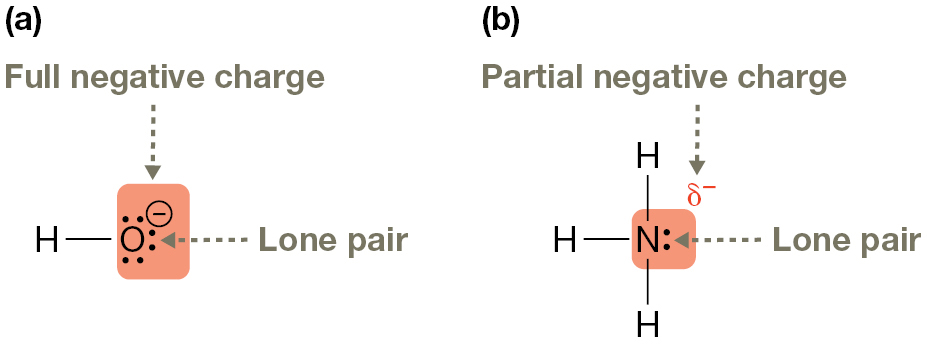
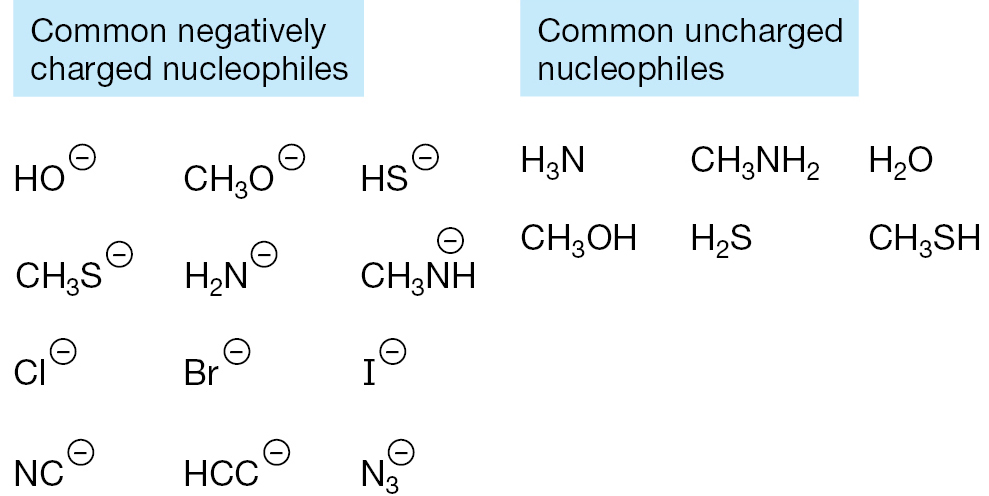
The full or partial negative charge makes the nucleophile electron-rich, and the lone pair of electrons is used to form a new bond to an atom in the substrate, as shown in Figure 7-5. In the HO– nucleophile in Equation 7-2, for example, the O atom has a full negative charge and three lone pairs of electrons (Fig. 7-5a). The H3N nucleophile in Equation 7-3 has a N atom bearing a partial negative charge and one lone pair of electrons (Fig. 7-5b). These and other common nucleophiles, both negatively charged and uncharged, are shown in Figure 7-6.
More information
An illustration represents a full negative charge hydroxyl group and a partial negative charge on an amine group. Part a shows an oxygen atom of full negative charge on hydroxyl group carrying three lone pairs of electrons. Part b shows a nitrogen atom carrying partial negative charge on the amine group, marked with delta minus, containing a lone pair of electrons.
FIGURE 7-5Common features of nucleophiles (a) In this nucleophile, the O atom has a full negative charge and three lone pairs of electrons. (b) In this nucleophile, the N atom has a partial negative charge and one lone pair of electrons.More information
The list of common negatively charged nucleophiles includes hydroxide, methoxide, hydrosulfide, thiomethoxide, aminyl, C H 3 N H, chloride, bromide, iodide, cyanide, ethynyl, and azide. The list of common uncharged nucleophiles includes ammonia, methylamine, water, methanol, hydrogen sulfide, and methanethiol.
FIGURE 7-6Common negatively charged and uncharged nucleophiles
SOLVED PROBLEM 7.4
How to identify a species that can act as a nucleophile in an SN2 step
Break It Down Can CH4 act as a nucleophile in an SN2 step? Why or why not?
Think
Solve
Does CH4 have an atom that carries a partial or full negative charge?
➤
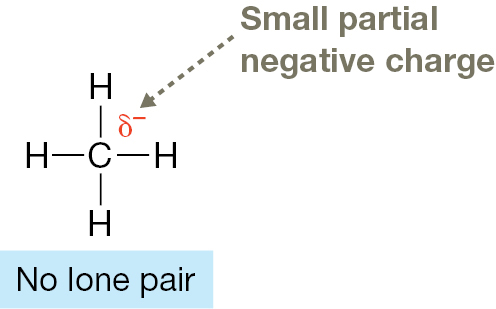
Draw the Lewis structure for CH4. We see that the C atom has a formal charge of 0 but has a small partial negative charge because C is slightly more electronegative than H.
More information
Lewis structure of methane. The structure shows a central carbon atom marked delta minus, labeled “small partial negative charge” surrounded by four single-bonded hydrogen atoms. The structure is labeled “no lone pair.”
Does that atom have a lone pair of electrons that can be used to form a bond to another atom?
➤
The C atom does not possess a lone pair of electrons that can be used to form a bond with another atom. Therefore, CH4 would not act as a nucleophile in an SN2 step.
Try ItWhich of the following species can behave as a nucleophile in an SN2 step? Explain. (a) SiH4; (b) NaSCN; (c) NH4+; (d) CH3Li
YOUR TURN 7.4
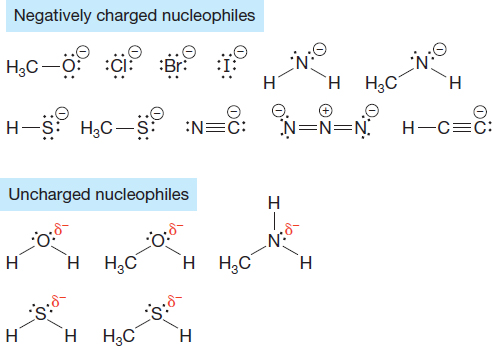
Draw the complete Lewis structures for three of the negatively charged nucleophiles (other than HO−) and for three of the uncharged nucleophiles (other than H3N) listed in Figure 7-6. Include all lone pairs. For each of the uncharged nucleophiles, write “δ−” next to the atom bearing a partial negative charge.
SHOW ANSWERHIDE ANSWER
More information
Structures of differently charged nucleophiles. Negatively charged nucleophiles: a methyl group bonded to a negative oxygen atom, a negative chlorine atom, a negative bromine atom, a negative iodine atom, a negative nitrogen atom bonded to two hydrogens, a negative nitrogen bonded to a methyl group and a hydrogen, a negative sulphide bonded to a hydrogen, a negative sulphide bonded to a methyl group, a negative carbon triple bonded to a nitrogen, a negative nitrogen double bonded to a positive nitrogen which is further double bonded to another negative nitrogen, and a negative carbon triple bonded to another carbon which is further bonded to a hydrogen. Uncharged nucleophiles: a water molecule with a partial negative charge on oxygen, a hydroxide group bonded to a methyl group where they oxygen has a partial negative charge, a central nitrogen with a partial negative charge bonded to two hydrogens and a methyl group, a sulphur with a partial negative charge bonded to two hydrogens, and a sulphur with a partial negative charge bonded to a methyl group and a hydrogen.
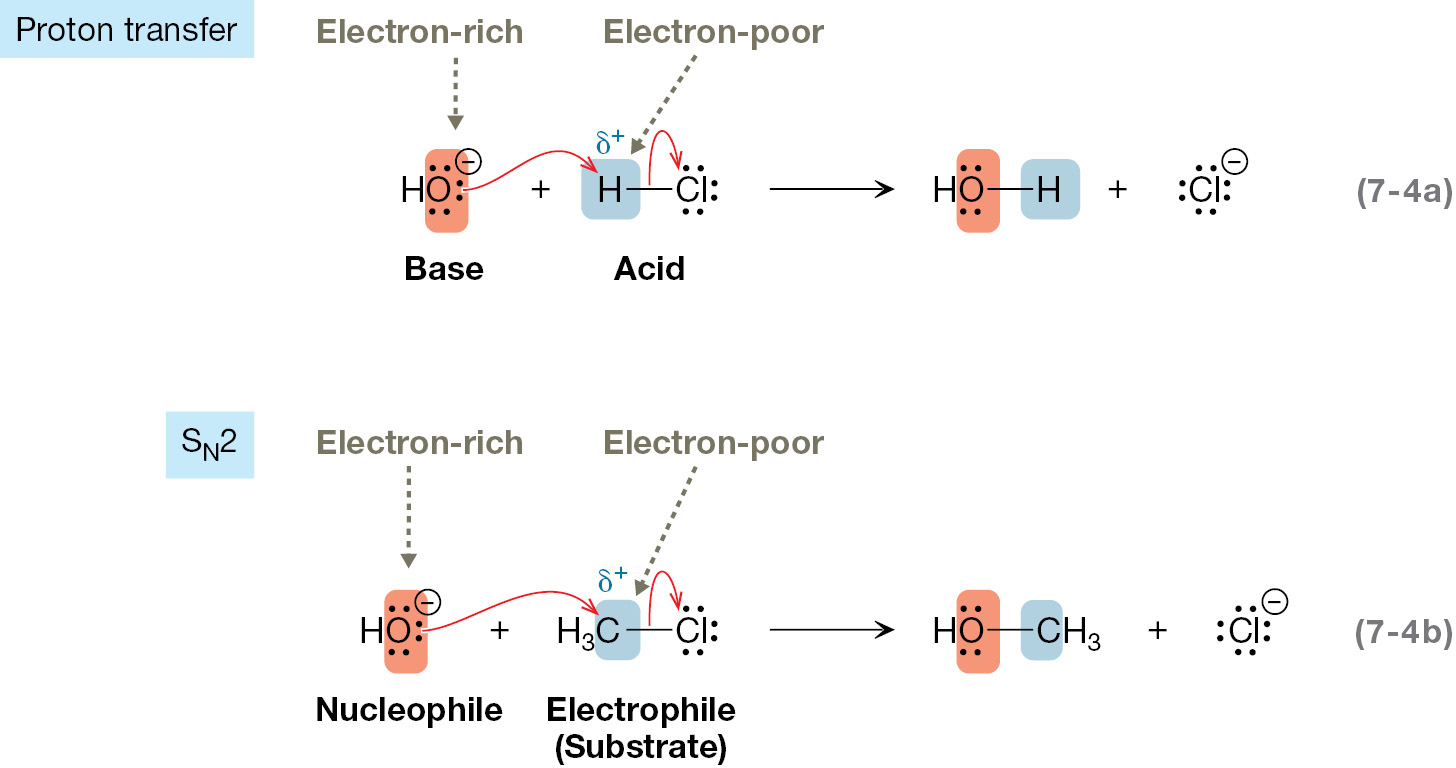
Recall from Section 7.1a that the electrons in an elementary step tend to flow from an electron-rich site to an electron-poor site. In the proton transfer in Equation 7-1 (shown again in Eq. 7-4a), for example, where HO– acts as a base, a curved arrow is drawn from a lone pair on the O in HO– to the H in HCl. A second curved arrow is drawn to show the initial bond to H being broken, with its electrons becoming a lone pair on Cl–.
More information
An illustration shows a proton transfer and S N 2 step to represent the flow of electrons from electron-rich to electron-poor site. The illustration on top is titled “proton transfer,” which shows an oxygen atom of hydroxyl group containing two lone pairs of electrons. It is marked with a negative sign, labeled “electron-rich,” acting as a base. It reacts with a hydrogen atom, marked delta plus, labeled “electron-poor” of the hydrochloride ion, with chloride ion containing three lone pairs of electrons. This is acting as an acid. A curved arrow is drawn from an oxygen atom of the hydroxyl group with its head pointing toward the hydrogen atom single-bonded to a chlorine atom. Another curved arrow is drawn from a single bond between a hydrogen atom and a chloride with its head pointing toward chloride. The resultant shows an oxygen atom of hydroxyl group linked to a hydrogen atom by a single bond; and a negatively-charged chloride ion containing four lone pairs of electrons. The illustration at the bottom is titled “S N 2” shows an oxygen atom of a hydroxyl group containing two lone pairs of electrons carrying a negative charge and labeled “electron-rich,” acting as a nucleophile. It reacts with a methyl group, with the carbon atom marked delta plus and labeled “electron-poor”, that is single-bonded to a chloride ion containing three lone pairs of electrons. This is labeled as the electrophile or substrate. A curved arrow from an oxygen atom of the hydroxyl group is drawn with its head pointing toward the carbon atom of the methyl group. Another curved arrow from the single bond between the methyl group and chloride is drawn with its head point toward chloride. The resultant shows an oxygen atom of the hydroxyl group linked to the carbon atom of the methyl group by a single bond; and a negatively-charged chloride ion containing four lone pairs of electrons.
Similarly, in the SN2 step in Equation 7-4b, HO– is still relatively electron-rich, but the C atom of CH3Cl is relatively electron-poor because it carries a partial positive charge. Therefore, HO– acts as a nucleophile, and a curved arrow is drawn from a pair of electrons on O to the C atom to signify bond formation. Because five bonds would exceed the C atom’s octet, a second curved arrow shows that the pair of electrons initially making up the C—Cl bond becomes a lone pair on Cl.
In a proton transfer step (Eq. 7-4a), the electron-poor species acts as an acid because it is donating a proton. In an SN2 step (Eq. 7-4b), on the other hand, the electron-poor substrate is not behaving as an acid (it is not donating a proton) but rather is behaving as an electrophile:
An electrophile is an electron-poor species to which a nucleophile forms a bond.
The term means “electron-loving,” because an electron bears a negative charge, the kind of charge to which an electrophile tends to be attracted.
Now that we have defined nucleophile and electrophile, we can restate a general lesson from Section 7.1a regarding the flow of electrons from an electron-rich species to an electron-poor species:
A nucleophile (electron-rich) will tend to form a bond to an electrophile (electron-poor).
So far, we have seen how this applies to an SN2 step. Throughout the rest of this chapter, we will see how it applies to other elementary steps, too.
YOUR TURN 7.5
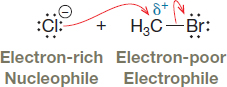
The following SN2 step is similar to the one in Equation 7-4b:
Draw in the curved arrows and label the appropriate reacting species as “electron-rich” or “electron-poor.” Also label each reacting species as “nucleophile” or “electrophile.”
SHOW ANSWERHIDE ANSWER
More information
Arrow pushing mechanism reaction. The first reactant is a chlorine anion with four pairs of electrons, it is an electron rich nucleophile, the second reactant is a methyl group bonded to bromine atom, it is an electron poor electrophile. An arrow starts at the chlorine and ends at the methyl group which has a positive partial charge, another arrow starts at the bond between methyl and bromine and ends at bromine.
SOLVED PROBLEM 7.5
How to draw a reasonable SN2 step when the reactants are given
Break It Down Draw the SN2 step that would occur between C6H5CH2I and CH3SNa.
Think
Solve
Can any portions of the reactants be treated as spectator ions?
➤
CH3SNa has a metal atom, Na+, that can be treated as a spectator ion and can thus be ignored. The reactive species is therefore CH3S−.
What are the general characteristics of a nucleophile for an SN2 step? Which reactant species has those characteristics?
➤
Nucleophiles that participate in SN2 steps generally have an electron-rich atom with a lone pair of electrons. The negatively charged S atom has those characteristics, so CH3S− will behave as the nucleophile.
What are the general characteristics of a substrate for an SN2 step? Which species has those characteristics?
➤
The substrate for an SN2 step should have a suitable leaving group. C6H5CH2I has a recognizable leaving group, the I atom, which will depart as I−. The C atom to which I is attached is electron-poor, so C6H5CH2I is an electrophile and can bond with the nucleophile.
With the nucleophile and substrate (electrophile) identified, how should the curved arrows be drawn for the SN2 step?
➤
An SN2 step requires two curved arrows. The first curved arrow begins from the lone pair of the electron-rich species (the nucleophile) and points to the electron-poor C atom of the substrate (the electrophile). To avoid five bonds to C, the initial bond to the leaving group must break, which is indicated by the curved arrow drawn from the center of the bond that attaches the leaving group and points toward the leaving group.
More information
An illustration represents a nucleophilic reaction between C 6 H 5 C H 2 I and C H 3 S N a. The reaction shows a methyl group single bonded to a sulfur atom carrying three lone pairs of electrons with negative charge. It reacts with C 6 H 5 C H 2 I shown as a condensed structural formula representing a benzene ring, with a C H 2 group, marked delta plus, linked to carbon atom at ortho-position by a single bond. It further connects to iodine containing three lone pairs of electrons. A curved arrow from sulfur is shown to point toward partially-positive charged carbon atom of carbon hydrogen 2 group. Another curved arrow between C H 2 group and iodine is shown to point toward iodine. The resultants show the condensed structural formula of a molecule represented as a benzene ring, with a C H 2 group, linked to carbon atom at ortho-position by a single bond. It further connects to a sulfur atom, containing three lone pairs of electrons, which is further single-bonded to a methyl group; and a negatively-charged iodine atom, containing four lone pairs of electrons.
Try ItDraw the SN2 step that would occur between these two compounds.
More information
A chemical reaction represents a S N 2 reaction between two compounds. The reaction shows two reactants. The condensed structural formula of the first compound shows a central C H group single-bonded to carbon hydrogen 2 group which is further single-bonded to a chloride. The C H 2 group is further shown double bonded to a C H, which further connects to a methyl group by a single bond. It is shown to react with K C N, followed by a rightward arrow to read a question mark.
a molecular species that undergoes a particular reaction with an attacking species; in nucleophilic substitution or elimination, the species that contains the leaving group.
a “nucleus–loving” species (usually with a lone pair of electrons) that seeks a substrate with a full or partial positive charge to stabilize its full or partial negative charge.