7.1 Mechanisms as Predictive Tools: The Proton Transfer Step Revisited
SECTION 7.1 OBJECTIVES
You will be able to:
Identify electron-rich and electron-poor sites within a species.
Articulate how the curved arrow notation for a proton transfer step represents the flow of electrons from an electron-rich site to an electron-poor site.
Identify organometallic reagents and hydride reagents as sources of carbanions and hydride, respectively.
A reaction mechanism can be very helpful as a predictive tool. In this section, we revisit curved arrow notation for a proton transfer step to see how it can be used to make predictions about bond formation and bond breaking. Pay close attention to the main lessons in this section because we will be applying them to other elementary steps described in later sections of this chapter.
7.1a Curved Arrow Notation: Electron-Rich to Electron-Poor
Curved arrow notation was introduced in Section 6.1 as a means for keeping track of valence electrons in an elementary step. It can be far more powerful than that, though, if we recall two concepts:
Opposite charges attract; like charges repel.
Atoms in the first and second rows of the periodic table must obey the duet and octet rules, respectively.
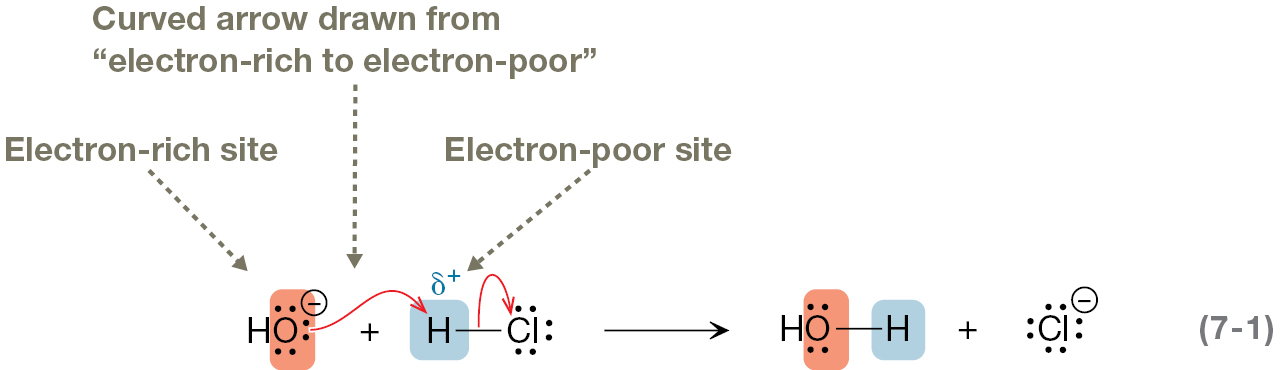
With these ideas in mind, examine Equation 7-1, which shows the curved arrows for the proton transfer between HCl and HO−:
Elementary Step
More information
A two-part illustration shows the flow of electron from an electron-rich site, a hydroxyl group to an electron-poor site, a hydrogen atom of hydrogen chloride, through a curved arrow notation. The first part shows an electron-rich site, hydroxyl group, with oxygen of the hydroxide anion containing three lone pairs of electrons, representing a negative charge interacting with the hydrogen atom of hydrochloride. The hydrogen atom of hydrochloride group is marked delta plus, which is single bonded to the chloride group, marked with three lone pairs of electrons. A curved arrow beginning from the oxygen atom of a hydroxyl group is pointing toward the hydrogen atom of hydrochloride is labeled curved arrow drawn from electron-rich to electron-poor. Another curved arrow is marked from a single bond between a hydrogen atom and chloride ion of hydrogen chloride pointing toward chloride ion. The second part shows an oxygen atom of a hydroxyl group containing two lone pairs of electrons single bonded to a hydrogen atom and a chloride anion containing four lone pairs of electrons.
Video: Proton Transfer
Notice that HO– bears a full negative charge. This excess electron density on O means the electrons on O are somewhat destabilized due to their mutual repulsion. The proton on HCl bears a partial positive charge, δ+, because Cl is more electronegative than H. As a result, the electrons on O are attracted to the proton on HCl. This simultaneous charge repulsion among the electrons on O and their attraction to H facilitates the flow of electrons from O to H and results in the formation of the new O—H bond.
Equation 7-1 illustrates one of the most important guidelines for drawing curved arrows:
In an elementary step, electrons tend to flow from an electron-rich site to an electron-poor site.
An electron-rich atom typically has a full or partial negative charge.
An electron-poor atom typically has a full or partial positive charge or lacks an octet.
In Equation 7-1, the HO– anion is relatively electron-rich, denoted by the light red screen, and the H atom on HCl is relatively electron-poor, denoted by the light blue screen. (This is the same color scheme used in electrostatic potential maps to represent areas of more and less electron density, respectively.) To help you keep track of those atoms, we have kept the red and blue screens the same in the products.
Having identified the key electron-rich and electron-poor sites in HO– and HCl, we can now see that the curved arrow on the left in Equation 7-1 represents the flow of electrons from an electron-rich site to an electron-poor site, as well as the formation of a new bond to H. The curved arrow on the right represents the breaking of the initial H—Cl bond, which is necessary to avoid having two bonds to H.
YOUR TURN 7.1
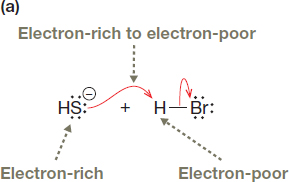
Consider the proton transfer step shown here. (a) Identify the electron-rich and electron-poor sites, and label the curved arrow that connects the two as “electron-rich to electron-poor.” (b) Explain why the curved arrow notation would be faulty if the curved arrow on the right were not drawn.
SHOW ANSWERHIDE ANSWER
More information
Arrow pushing mechanism reaction. The first reactant is a negative hydrogen sulphide ion with three lone pair of electrons, it is electron rich. The second reactant is hydrogen bromide with three lone pair of electrons, the hydrogen is electron poor. An arrow starting at one of sulphide lone pair of electrons and ends at the hydrogen of hydrogen bromide, it is electron rich to electron poor. A second arrow starts at the bond between hydrogen and bromine and ends at bromine.
(b) Without the curved arrow on the right, the H═Br bond would
remain unbroken and H would have two bonds, exceeding its duet.
SOLVED PROBLEM 7.1
How to determine the proper electron flow and outcome for a proton transfer
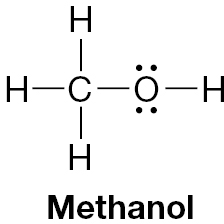
Break It Down Identify the electron-poor H atom in methanol. Draw the mechanism by which methanol acts as an acid in a proton transfer reaction with H2N−.
More information
Condensed structural formula of methanol. The condensed structural formula of methanol consists of a carbon atom single bonded to three hydrogen atoms and an oxygen atom carrying two lone pairs of electrons. The oxygen atom is further attached to a hydrogen atom by a single bond.
Every Solved Problem in this book uses a Think/Solve strategy to guide you through the solution. After you consider a question posed on the Think side of the table, read the answer on the Solve side.
Think
Solve
What kinds of charges characterize electron-poor atoms? Which H in methanol bears that kind of charge?
➤
An electron-poor atom tends to have a partial or full positive charge. Because the O atom in methanol is highly electronegative, the attached H bears a substantial partial positive charge and is therefore electron-poor.
Should H2N– be considered electron-rich or electron-poor?
➤
The negative charge on H2N– indicates it is electron-rich.
When H2N– and CH3OH are combined, how do we draw a curved arrow to depict the flow of electrons from an electron-rich site to an electron-poor site?
➤
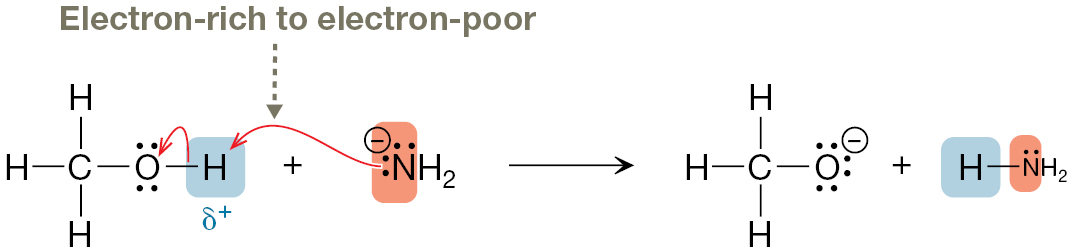
A curved arrow is drawn from the electrons on N to H, indicating the flow of electrons from an electron-rich site (denoted by the red screen) to an electron-poor site (blue screen). That arrow also indicates the formation of a new N—H bond.
More information
A chemical reaction shows an equation representing transfer of protons between electron-rich, amino group and electron-poor, methanol. The first part of the equation shows a condensed structural formula of methanol, consisting of a central carbon atom single bonded to three hydrogen atoms and an oxygen atom carrying two lone pairs of electrons. Further, the oxygen atom is single-bonded to a hydrogen atom, marked delta plus. The methanol is shown to react with an amino group, with nitrogen anion of an amino group containing two lone pairs of electrons, marked with a negative charge. A curved arrow from negatively charged nitrogen is shown pointing toward the positively charged hydrogen atom of methanol, labeled electron-rich to electron-poor. Another curved arrow marked on a single bond between and an oxygen atom and a positively charged hydrogen atom of methanol, point toward a lone pair of electrons present on the oxygen atom. The second part shows a condensed structural formula of a molecule, with a central atom single-bonded to three hydrogen atoms and an oxygen anion containing two lone pairs of electrons and a hydrogen atom single-bonded to the nitrogen atom, containing a lone pair of electrons of the amino group.
When that curved arrow is drawn to depict bond formation, do any other bonds have to break?
➤
The H in methanol gains a new bond, but there cannot be two bonds to H, so the initial O—H bond must break. A curved arrow from the O—H bond to the O represents the breaking of that bond. The O on the product side picks up that pair of electrons and ends up with a –1 formal charge.
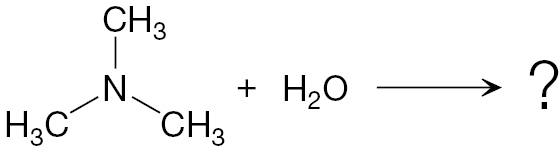
Try ItIdentify the electron-rich and electron-poor sites in the reactant molecules shown here. Draw the curved arrows and the products for the proton transfer between these two molecules, and label the curved arrow that represents the flow of electrons from an electron-rich site to an electron-poor site. Hint: Are all the relevant electron pairs shown?
More information
An illustration shows an equation to check for electron-rich and electron-poor sites. The equation shows a condensed structural formula of trimethylamine, represented as a central nitrogen atom single-bonded to three methyl groups each, arranged in a trigonal planar geometry, shown reacting with a water molecule. It is followed by a rightward arrow to read a question mark.
Answers to all Try It exercises can be found in the Solutions Manual.
7.1b Simplifying Assumptions Regarding Electron-Rich and Electron-Poor Species
Contrary to what is suggested in Equation 7-1, we cannot simply add hydroxide anion (HO–) to HCl to carry out a proton transfer reaction, because of the following restriction:
Anions do not exist in the solid or liquid phase without the presence of cations, and vice versa, because the charges must balance.
CONNECTIONS 7.1
More information
A photo shows the head of a fish.
Your nose knows trimethylamine Trimethylamine [(CH3)3N, Solved Problem 7.1, Try It] is a gas that is often associated with the odor of rotting fish. Sensors have been developed to test for trimethylamine to assess the freshness of fish.
We can, however, add a source of HO–, such as NaOH; NaOH is an ionic compound, so in solution it dissolves as Na+ and HO–.
Dealing with NaOH rather than just HO– may at first seem to complicate the picture, because Na+ is electron-poor. Wouldn’t Na+ react with an electron-rich site of another species? As it turns out, Na+ behaves as a spectator ion, meaning that it does not take part in a chemical reaction in solution:
In general, group 1A metal cations (i.e., Li+, Na+, and K+) tend to behave as spectator ions in solution, due to their stable noble gas electron configurations.
Consequently, we can disregard these metal cations when we envision the flow of electrons from an electron-rich site to an electron-poor site.
SOLVED PROBLEM 7.2
How to simplify an ionic compound with a group 1A metal in a proton transfer
Break It Down Draw the necessary curved arrows for the proton transfer between KOCH3 and HCN in solution.
Think
Solve
In KOCH3, what can be treated as a spectator ion?
➤
KOCH3 is ionic, made of K+ and −OCH3. We can treat K+ as a spectator ion because it is a group 1A metal cation.
What reactive species remains in solution? Should it be considered electron-rich or electron-poor?
➤
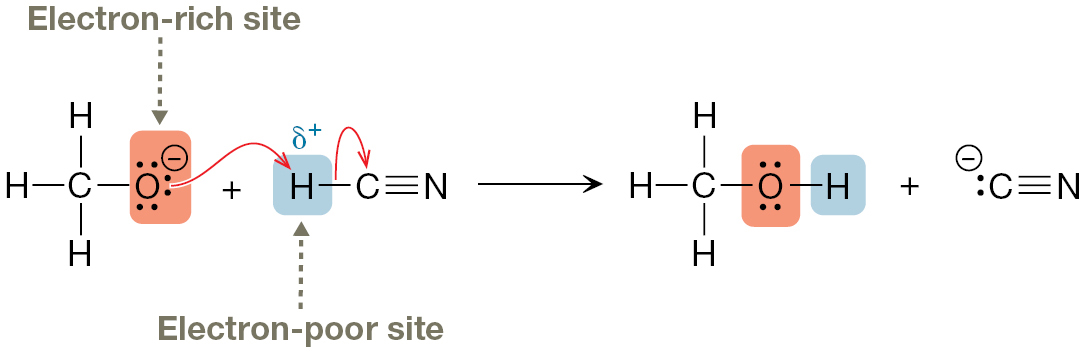
By disregarding K+, we consider just −OCH3 as the reactive species that remains in solution. It bears a full negative charge, so we should consider it as an electron-rich species.
Which H should be considered electron-poor? How should the curved arrows be added?
➤
HCN has an electron-poor H atom due to the high effective electronegativity of the sp-hybridized C atom and due to the high electronegativity of N. Therefore, we draw a curved arrow from the electrons of the electron-rich O of −OCH3 to the electron-poor H of HCN. We draw a second curved arrow to show that the H—C bond breaks because there cannot be two bonds to H.
More information
An illustration shows an equation representing proton transfer between electron-rich and electron-poor sites in a reaction between methoxide and hydrogen cyanide in a solution. The first part shows a condensed structural formula of methoxide, with a negatively charged oxygen atom labeled electron-rich site and a condensed structural formula of hydrogen cyanide showing a central carbon atom single-bonded to a hydrogen atom, marked delta plus and labeled electron-poor site which is further triple-bonded to a nitrogen atom. A curved arrow is drawn from a negatively charged oxygen atom with its head pointing toward the partially positively charged hydrogen atom. Another curved arrow is drawn from a single bond between hydrogen and carbon with its head pointing toward the carbon atom of hydrogen cyanide. The second part of the equation shows a condensed structural formula of a molecule representing a central carbon atom single-bonded to three hydrogen atoms and an oxygen atom, containing two lone pairs of electrons. The oxygen atom is further single-bonded to a hydrogen atom. There is also a negatively charged carbon atom, containing a lone pair of electrons is attached to a nitrogen atom by a triple bond.
Try ItDraw the necessary curved arrows for the proton transfer between NaSH and CH3CO2H.
Analogously, we can make simplifying assumptions for reactions involving organometallic compounds, which contain a metal atom bonded directly to a carbon atom. Examples of organometallic compounds include alkyllithium (R—Li); alkylmagnesium halide (R—MgX, where X = Cl, Br, or I), also called a Grignard reagent; and lithium dialkyl cuprate [Li+(R—Cu—R)–]. These kinds of organometallic compounds are useful reagents for forming new carbon–carbon bonds (discussed in Chapter 11).
More information
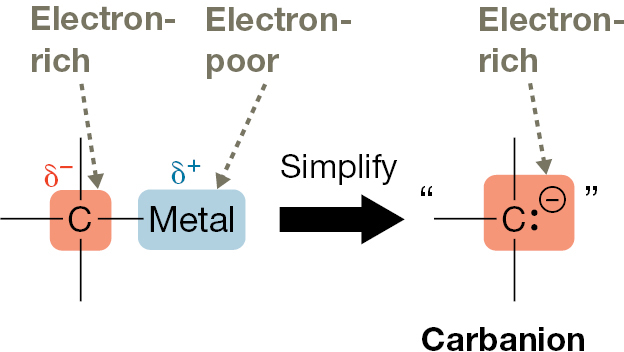
A two-part illustration shows a simplification of organometallic compound resulting in the formation of a carbanion. The first part shows a condensed structural formula showing a central carbon atom, marked delta minus, labeled electron-rich, and surrounded by three vacant single bonds with a metal attached to the fourth one. The metal ion is marked delta plus and labeled electron-poor. It is followed by a rightward arrow labeled “simplify” leading to the second part. The second part shows a condensed structural formula of carbanion with a central carbon atom, labeled electron rich, containing a lone pair of electrons and a negative charge surrounded by three vacant single bonds. There are quotation marks around the structural formula of the carbanion.
FIGURE 7-1Simplifying assumptions in organometallic compounds (Left) Because of the high polarity in a C—Metal bond, organometallic compounds contain an electron-rich site on C and an electron-poor site on the metal. (Right) We can usually ignore the reactivity of the metal-containing portion and treat the organometallic compound simply as a carbanion, which is electron-rich. The quotation marks remind us that the carbanion does not actually exist in solution.
Consider that the C—Metal bond in an organometallic compound is a polar covalent bond. The carbon atom’s electronegativity (2.55) is significantly greater than that of the metal (Li = 0.98, Mg = 1.31, and Cu = 1.90), so there is a large partial negative charge on carbon (making it electron-rich) and a large partial positive charge on the metal atom (making it electron-poor), as shown in Figure 7-1.
In most reactions involving organometallic compounds, the product that we are interested in isolating contains the organic portion of the organometallic compound and not the metal-containing portion. Therefore, even though the C—Metal bond of an organometallic compound is covalent, we can think of the bond as ionic [that is, as C:– and +(Metal)] and in effect ignore the metal-containing portion. So, in much the same way as we did with the group 1A metal cations:
When we consider organometallic compounds in the flow of electrons from an electron-rich site to an electron-poor site, we can often treat the metal-containing portion as a spectator.
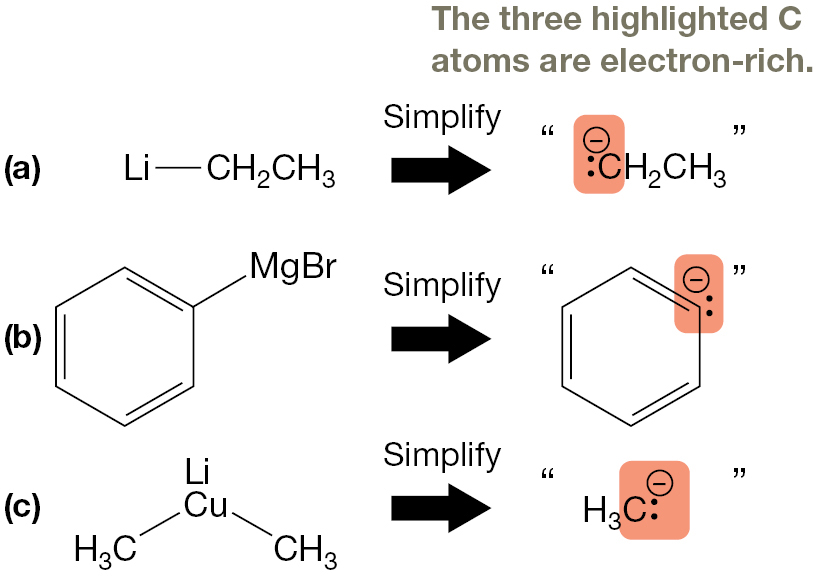
This simplifying assumption allows us to treat organometallic compounds as electron-rich carbanions, compounds in which a negative formal charge and a lone pair of electrons appear on C (Fig. 7-1). Thus, as shown in Figure 7-2, we can treat CH3CH2Li as a source of CH3CH−2, C6H5MgBr as a source of C6H−5, and (CH3)2CuLi as a source of CH−3 (see Looking Ahead box, p. 324).
More information
A three-part illustration shows a simplification of three compounds highlighting an electron-rich carbon atom. All simplified compounds are framed by quotation marks. The first part shows a simplification of organometallic compound L i single-bonded to C H 2 C H 3 into C H 2 C H 3, where a carbon atom linked to H 2 contains a lone pair of electrons carrying a negative charge and is designated as electron-rich. The second part shows a simplification of phenyl-magnesium bromide. It shows a condensed structural formula represented as an aromatic benzene ring, with a carbon atom at ortho-position linked to M g B r. It is simplified into a benzene anion, shown as a benzene aromatic ring, with a carbon atom at ortho-position containing a lone pair of electrons and a negative charge. That carbon atom is designated as electron-rich. The third part shows a condensed structural formula of a compound L i C u single-bonded to two methyl groups each, arranged in a bent. It is simplified into a methyl group, with carbon atom, containing a lone pair of electrons and marked negatively charged. That carbon atom is designated as electron-rich.
FIGURE 7-2Simplifying some specific organometallic compounds (a) LiCH2CH3 is simplified to –CH2CH3. (b) C6H5MgBr is simplified to C6H5−. (c) (CH3)2 CuLi is simplified to H3C–.
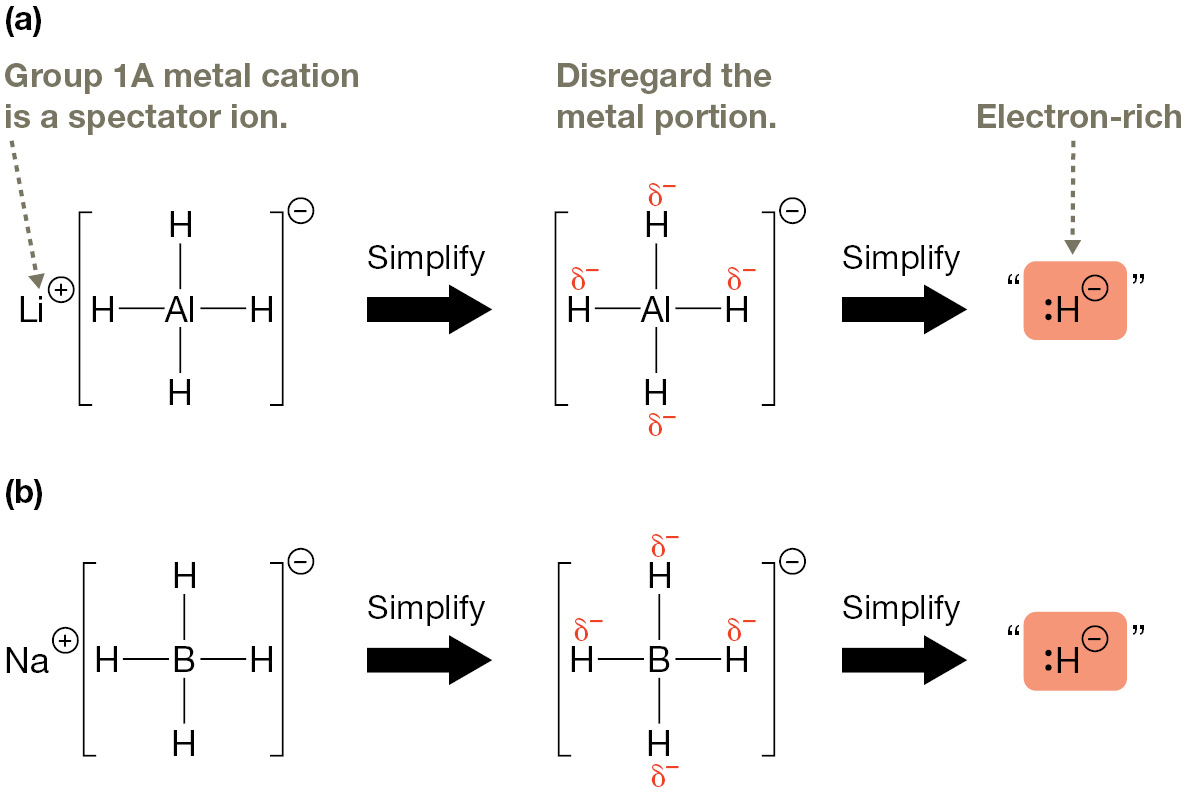
The strategy for simplifying organometallic compounds also works for simplifying hydride reagents, such as lithium aluminum hydride (LiAlH4) and sodium borohydride (NaBH4), which are commonly used as reducing agents (discussed in Chapter 18). LiAlH4 consists of Li+ ions and AlH−4 ions, as shown on the left in Figure 7-3a. We can treat Li+ as a spectator ion because it is a group 1A metal cation, which leaves AlH−4 as the reactive species (Fig. 7-3a, middle). The Lewis structure of AlH−4 shows the H atoms bonded to an Al metal atom. Those Al—H bonds are covalent, but because the electronegativity of H (2.20) is higher than that of Al (1.61), each Al—H bond is polar and each H bears a δ– charge. As we did for organometallic compounds, if we think of these Metal—H bonds as ionic [that is, as H:– and +(Metal)] then we can disregard the metal portion as indicated on the right of Figure 7-3a. In other words:
A two-part illustration shows a two-step simplification of hydride reagents, lithium aluminum hydride, and sodium borohydride. The first part shows a condensed structural formula of lithium aluminum hydride as a lithium cation, labeled “Group 1, A metal cation is a spectator ion” linked to a negatively charged unit of aluminum hydride shown as a central aluminum atom linked to four hydrogen atoms by a single bond each. Next step titled, “disregard the metal portion” shows a negatively charged unit of aluminum hydride as a central aluminum atom linked to four partially-negatively charged hydrogen atoms by a single bond each. It is further simplified to show an electron-rich hydrogen atom, containing a lone pair of electrons, marked with a negative charge, and framed by quotation marks. The second part shows a condensed structural formula of sodium borohydride as sodium cation, linked to a negatively charged unit of borohydride, shown as a central boron atom linked to four hydrogen atoms by a single bond each. Next step shows negatively charged unit of borohydride as a central boron atom linked to four partially-negatively charged hydrogen atoms by a single bond each. It is further simplified to show an electron-rich hydrogen atom, containing a lone pair of electrons, marked with a negative charge, and framed by quotation marks.
FIGURE 7-3Simplifying assumptions in hydride reagents (a) Lithium aluminum hydride, LiAlH4, consists of Li+ and AlH4– ions. The reactive species is AlH4– (middle), which can be treated simply as H:–. The quotation marks indicate that H:– does not actually exist in solution. (b) Sodium borohydride, NaBH4, consists of Na+ and BH4– ions. The reactive species is BH4– (middle), which can be treated as H:–, too.
Figure 7-3b shows how to apply similar arguments to NaBH4. Therefore:
We can also treat NaBH4 simply as a source of hydride anion (H:−).
▶ LOOKING AHEAD
The simplifications that allow us to treat organometallic compounds as R− (Fig. 7-2) are convenient, and so are the simplifications that allow us to treat hydride reagents as H− (Fig. 7-3). However, the nature of the covalent bond that we simplify can be important. As you will learn in Chapter 18, for example, RLi, RMgBr, and R2CuLi behave substantially differently, as do LiAlH4 and NaBH4.
SOLVED PROBLEM 7.3
How to simplify an organometallic compound when drawing curved arrows
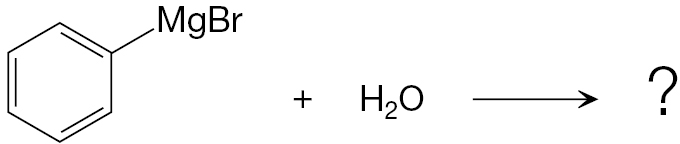
Break It Down What are the products of the proton transfer step between C6H5MgBr and H2O?
More information
A chemical reaction shows reaction between phenyl-magnesium bromide and water to represent proton transfer. The reaction shows a condensed structural formula consisting of an aromatic benzene ring with a carbon atom at its ortho-position, linked to magnesium bromide. It is shown to react with a water molecule followed by a rightward arrow to read a question mark.
Think
Solve
Can any species be treated as having spectator ions? If so, how can the species be simplified?
➤
C6H5MgBr is organometallic because it has a C—Mg bond. We simplify the compound by treating the metal-containing portion (MgBr)+ as a spectator ion, leaving just C6H5− to consider as the reactive species.
After we simplify the organometallic compound, should it be considered electron-rich or electron-poor? What kind of site will it seek out?
➤
The simplified version of the organometallic compound, C6H5−, has a negative charge and a lone pair on a C atom, so we treat it as electron-rich. It will seek out an electron-poor site, such as the partially positive H atom on H2O.
What curved arrow can be drawn to signify electron flow from electron-rich to electron-poor? What curved arrow is necessary to avoid having too many bonds to any one atom?
➤
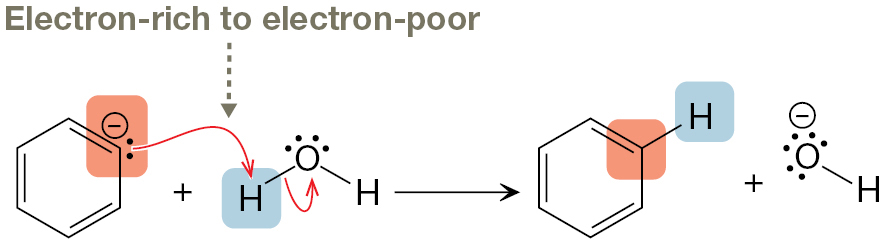
A curved arrow drawn from the electrons on C∶− to the H of water represents the flow of electrons from electron-rich (red screen) to electron-poor (blue screen). It also signifies the formation of a new bond to H, so a second curved arrow is needed to indicate the breaking of the initial H—O bond.
More information
A chemical representation of proton transfer when phenyl-magnesium bromide reacts with water is shown. It shows a condensed structural formula consisting of an aromatic benzene ring, with a carbon atom at ortho-position containing a lone pair of electrons and a negative charge reacting with a molecule, shown as central oxygen atom single-bonded to two hydrogen atoms in bent position, with the oxygen atom, containing two lone pairs of electrons. A curved arrow is drawn from the carbon atom of the benzene ring with its head pointing to one of the hydrogen atoms bonded to the oxygen atom and labeled electron-rich to electron-poor. It is followed by a rightward arrow to show linkage of a hydrogen atom to the ortho-carbon atom of the benzene ring by a single bond and an oxygen atom, containing two lone pairs of electrons carrying a negative charge, single bonded to another hydrogen atom.
Try ItUse curved arrow notation to show the proton transfer step that occurs between CH3Li and CH3OH. Predict the products of this reaction.
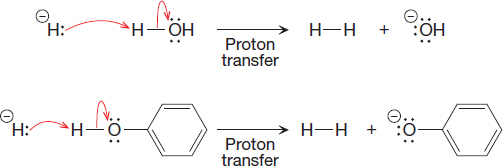
YOUR TURN 7.2
Use curved arrow notation to show the proton transfer step that takes place between LiAlH4 and water. Predict the products of the reaction. Do the same for the proton transfer step between NaBH4 and phenol (C6H5OH).
SHOW ANSWERHIDE ANSWER
LiAlH4 and NaBH4 have been simplified to :H−.
More information
Two arrow pushing mechanism reactions. The reactants of the first reaction are a negative hydrogen with a lone pair of electrons and a water molecule. An arrow starts at the lone pair of electrons on the hydrogen and ends at a hydrogen on the water molecule, another arrow starts at the bond of the hydrogen to the water and ends at the oxygen. The reaction arrow is labeled proton transfer. The products are two hydrogens bonded to each other and a negative hydroxide ion. The reactants of the second reaction are a negative hydrogen with a lone pair of electrons and a benzene ring bonded to a hydroxyl group. An arrow starts at the lone pair of electrons on the hydrogen and ends at the hydrogen on hydroxyl group, another arrow starts at the bond between hydrogen and oxygen and ends at oxygen. The reaction arrow is labeled proton transfer. The products are two hydrogens bonded together and a benzene ring bonded to a negative oxygen atom.
an alkylmagnesium halide (R—MgX, where X = Cl, Br, or I) nucleophile that favors direct addition to a polar π bond over conjugate addition. Grignard reagents are often used to make new carbon–carbon bonds.
a reagent that contains or has the tendency to donate hydride. Common hydride reducing agents include lithium aluminum hydride (LiAlH4) and sodium borohydride (NaBH4). Sodium hydride (NaH) is a strong base but a poor nucleophile.