7.7 Carbocation Rearrangements: 1,2-Hydride Shifts and 1,2-Alkyl Shifts
SECTION 7.7 OBJECTIVES
You will be able to:
Identify a 1,2-hydride shift or 1,2-methyl shift when given the reactants and products.
Draw the curved arrow notation, transition state, and product for a 1,2-hydride shift or 1,2-methyl shift when given the reactant.
Carbocations are usually too unstable to exist for a long time because they are extremely electron-deficient due to (1) the carbon atom’s lack of an octet and (2) its +1 formal charge. As we saw in Section 7.3, carbocations commonly behave as Lewis acids to form a bond with an electron-rich Lewis base. Carbocations can also eliminate H+ (Section 7.6) to produce an alkene or alkyne. Given a chance, however, carbocations can also undergo a rearrangement before taking part in one of these steps with another species.
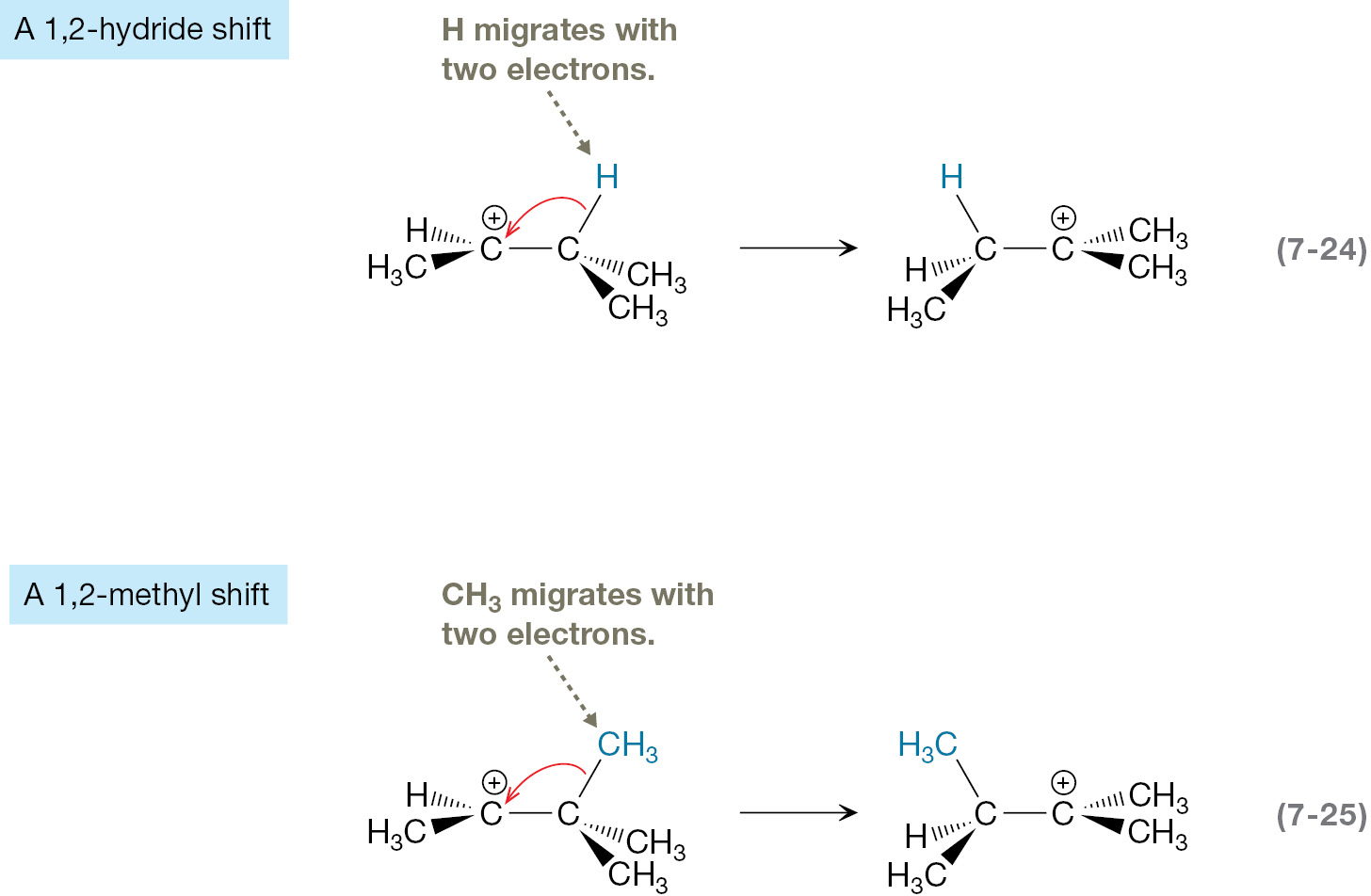
Equations 7-24 and 7-25 show two carbocation rearrangements; as the name suggests, these rearrangements convert one carbocation into another. Equation 7-24 depicts a 1,2-hydride shift. The hydride anion (H–) is said to shift because a hydrogen atom migrates along with the pair of electrons initially making up the C—H bond. The numbering system denotes the number of atoms over which the hydride anion migrates; the atom to which the hydrogen is initially bonded is designated as the number 1 atom, and any adjacent atom can be designated as a number 2 atom. Thus, a “1,2” shift refers to the hydrogen migrating to an adjacent atom.
Elementary Step
Carbocation Rearrangement
More information
Two types of carbocation rearrangements, including 1,2-hydride shift and 1,2-methyl shift are illustrated. The first chemical reaction titled, A 1, 2-hydride shift, shows a condensed structural formula of a compound showing two carbon atoms linked by a single bond, with the left carbon atom carrying a positive charge. It is linked to a hydrogen atom and a methyl group by a single bond each while the right carbon atom is linked two methyl groups and a hydrogen atom by a single bond each. The hydrogen atom is labeled hydrogen migrates with two electrons. A curved arrow points from the hydrogen atom toward the carbon atom carrying a positive charge. The resultant shows an exchange of positive charge and hydrogen between the two carbon atoms. The second reaction titled, A 1, 2-methyl shift, shows a condensed structural formula of a compound showing two carbon atoms linked by a single bond, with the left carbon atom carrying positive charge linked to a hydrogen atom and a methyl group by a single bond each while the right carbon atom is linked to three methyl groups by a single bond each. The first methyl group is labeled C H 3 migrates with two electrons. A curved arrow points from a methyl group toward a carbon atom with a positive charge. The resultant shows an exchange of positive charge and methyl group between the two carbon atoms.
▶ LOOKING AHEAD
Here in Chapter 7, our focus on carbocation rearrangements is limited primarily to drawing the curved arrow notation and the resulting products. In Chapter 8, we will begin to predict when and how carbocation rearrangements participate in multistep mechanisms.
Equation 7-25 shows a 1,2-alkyl shift; more specifically, a methyl group is transferred, so this rearrangement is called a 1,2-methyl shift. Again the numbering system indicates that the migrating group (the methyl group) is transferred to an adjacent atom.
Equations 7-24 and 7-25 have identical curved arrow notation. In both cases, a single curved arrow indicates that the initial bond between the C atom and the migrating group is broken, and those electrons are used to form a bond to the adjacent C. Meanwhile, the C that is left behind by the migrating group loses an octet and ends up with a formal charge of +1, whereas the C that is joined by the migrating group gains a complete octet and ends up with a formal charge of 0 (see Looking Ahead box).
YOUR TURN 7.25
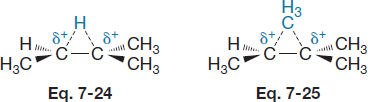
For each of the carbocation rearrangements in Equations 7-24 and 7-25, draw the transition state, taking into account the partial bonds and partial charges.
SHOW ANSWERHIDE ANSWER
More information
Transition state structures. Eq 7-24 is two carbons bonded to each other, the first carbon with a partial positive charge is bonded to a methyl group on a solid wedge and a hydrogen on a dashed wedge, the second carbon is bonded to a methyl group on a solid wedge and a methyl group on a dashed wedge. Both carbons are bonded to the same hydrogen by dashed bonds. Eq 7-25 is two carbons bonded to each other, the first carbon with a partial positive charge is bonded to a methyl group on a solid wedge and a hydrogen on a dashed wedge, the second carbon is bonded to a methyl group on a solid wedge and a methyl group on a dashed wedge, both carbons are bonded to the same methyl group by dashed bonds.
YOUR TURN 7.26
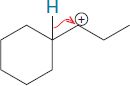
Supply the curved arrow notation for the carbocation rearrangement shown here.
SHOW ANSWERHIDE ANSWER
More information
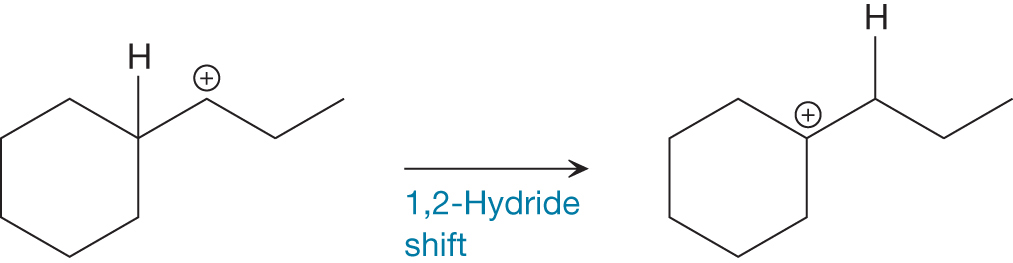
Arrow pushing mechanism. A cyclohexane ring is bonded to a propyl group with a positive charge at the third carbon of the group. A hydrogen is bonded to the first carbon of the ring. An arrow starts at the hydrogen bond and ends at the positive carbon.
YOUR TURN 7.27
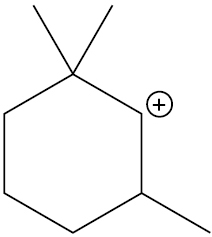
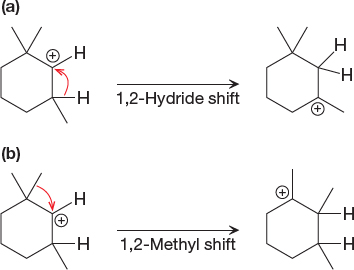
Supply the appropriate curved arrows and draw the product for this carbocation undergoing (a) a 1,2-hydride shift and (b) a 1,2-methyl shift. If atoms or electron pairs involved in the reaction are not shown, you must draw them in.
SHOW ANSWERHIDE ANSWER
More information
Arrow pushing mechanism reaction for a and b. The reactant for both reactions is a cyclohexane ring bonded to two methyl groups at the first carbon, a positive charge on the second carbon, and a methyl group on the third carbon. In reaction a, an arrow starts at the hydrogen of the third carbon and ends at the positive carbon. The reaction arrow is labeled 1,2-Hydride shift. the product is a cyclohexane ring with two methyl groups at the first carbon, and a positive charge on the third carbon which is further bonded to a methyl group. In reaction b, and arrow starts at one of the methyl groups on the first carbon and ends at the positive carbon. The reaction arrow is labeled 1,2-Methyl shift. The product is a cyclohexane ring, the first carbon is positively charged and bonded to a methyl group, the second carbon is bonded to a methyl group, and the third carbon is bonded to a methyl group.