7.3 Bond-Forming (Coordination) and Bond-Breaking (Heterolysis) Steps
SECTION 7.3 OBJECTIVES
You will be able to:
Identify a coordination or heterolysis step when given the reactants and products.
Draw the curved arrow notation, transition state, and products for a coordination or heterolysis step when given the reactants.
Describe how the reactants of a coordination step behave as a nucleophile and an electrophile.
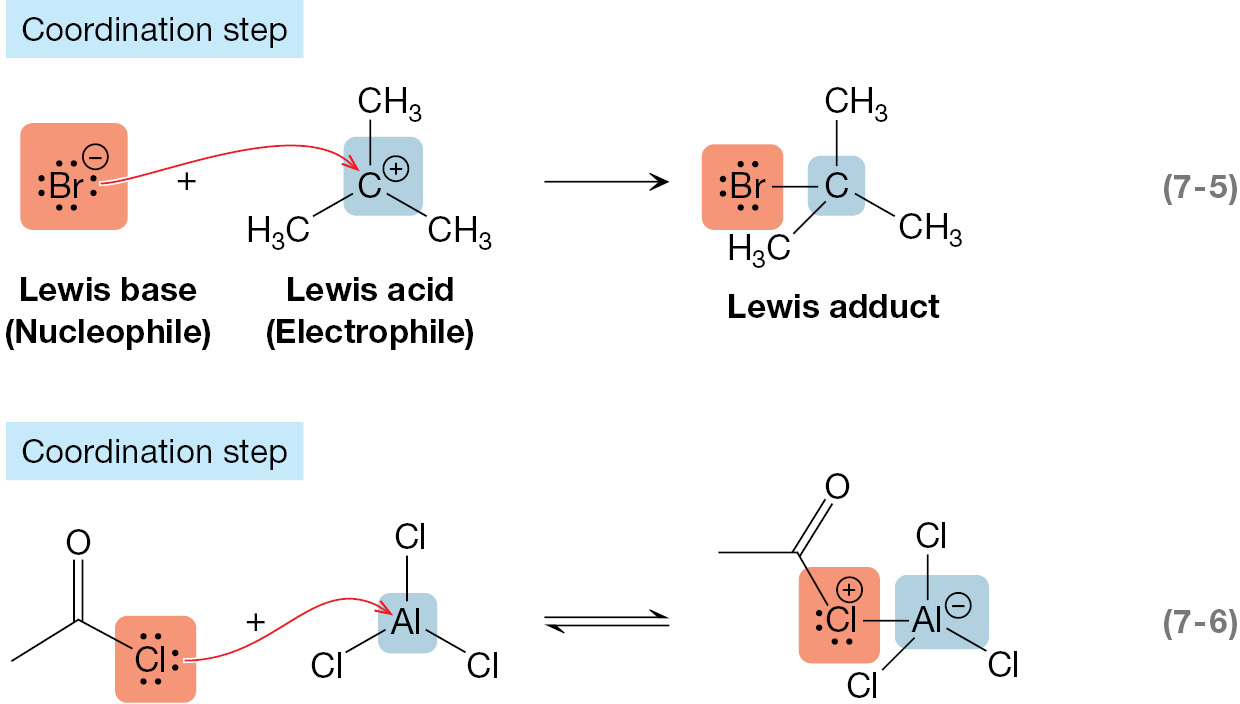
In the proton transfer and SN2 steps we have examined so far, a bond is formed and a separate bond is broken simultaneously. It is possible, however, for bond formation and bond breaking to occur as independent steps. Equations 7-5 and 7-6 are examples of coordination steps, in which a single covalent bond is formed and no bonds are broken.
Elementary Step
Coordination
More information
Two chemical reactions show examples of a coordination step resulting in the formation of a single covalent bond. The first reaction shows bromine carrying four lone pairs of electron and a negative charge, acting as a Lewis base, nucleophile. It is shown to react with a compound, with central carbon atom carrying a positive charge, single-bonded to three methyl groups, acting as a Lewis acid, electrophile. A curved arrow from bromine is shown to point toward central carbon atom. The resultant, labeled Lewis adduct, shows an addition of a bromine atom to the central carbon atom in a tetrahedral arrangement. The second reaction shows a acetyl chloride, with a chlorine atom of acetyl chloride carrying three lone pairs of electrons and a negative charge reacting with a compound having a central aluminum atom surrounded by three chlorides by a single bond each. A curved arrow from chlorine is shown to point toward aluminum. The reaction is a reversible reaction leading to an incorporation of acetyl chloride, with chlorine linked to the central aluminum atom by a single bond.
You may have learned in general chemistry that coordination steps are also called Lewis acid–base reactions. A Lewis acid is an electron-pair acceptor, having an atom that lacks an octet. A Lewis base, on the other hand, is an electron-pair donor. In Equation 7-5, (CH3)3C+ is the Lewis acid and Br– is the Lewis base. The product, Br—C(CH3)3, is called the Lewis adduct.
Notice in Equation 7-5 that the Lewis base is labeled as a nucleophile and the Lewis acid is labeled as an electrophile. That is because the Lewis base is electron-rich and forms a bond to the Lewis acid, which is electron-poor.
YOUR TURN 7.6
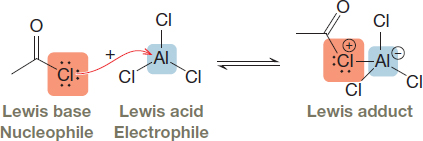
Label each species in Equation 7-6 as a Lewis acid, Lewis base, or Lewis adduct. Also label the nucleophile and the electrophile.
SHOW ANSWERHIDE ANSWER
More information
Arrow pushing mechanism reaction. The lewis base is a nucleophile, it is a two carbon chain bonded to a chlorine and double bonded to oxygen. The lewis acid is an electrophile, it is aluminium bonded to three chlorines. An equilibrium reaction arrow follows. The product is a Lewis adduct, the chlorine and aluminium of the base and acid are bonded together, the chlorine has a positive charge, and the aluminium has a negative charge.
YOUR TURN 7.7
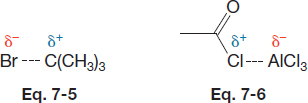
Draw the transition states for the reactions in Equations 7-5 and 7-6, taking into account just the partial bonds and partial charges.
SHOW ANSWERHIDE ANSWER
More information
Structure with partial charges. The first structure, eq 7-5, is a central carbon with a partial positive charge bonded to three methyl groups and a bromine atom with a partial negative charge by a dashed bond.
Notice how the single curved arrow in each coordination step in Equations 7-5 and 7-6 depicts the flow of electrons from an electron-rich site to an electron-poor site (Section 7.1a). In Equation 7-5, Br– is negatively charged and is therefore electron-rich, whereas (CH3)3C+ is electron-poor; it has a C atom that lacks an octet and further has a positive formal charge. In Equation 7-6, the Cl of CH3COCl is electron-rich because it bears a partial negative charge, whereas the Al of AlCl3 lacks an octet and is electron-poor. The Al atom is made even more electron-poor by the attached electron-withdrawing Cl atoms on AlCl3 (Section 6.6e).
Elementary Step
Heterolysis
YOUR TURN 7.8
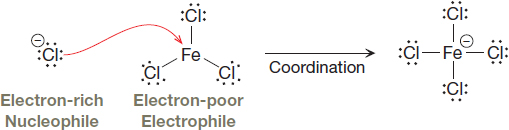
Draw the appropriate curved arrows for the coordination step between FeCl3 and Cl−. Draw the reaction products. Identify which reactant species is electron-rich and which is electron-poor. Identify which reactant is the nucleophile and which is the electrophile.
SHOW ANSWERHIDE ANSWER
More information
Arrow pushing mechanism reaction. The electron rich nucleophile is a chlorine anion, and the electron poor electrophile is an iron atom bonded to three chlorine atoms. An arrow starts at the chlorine anion and ends at the iron. The reaction arrow is labelled coordination. The final product is a negatively charged iron bonded to four chlorines.
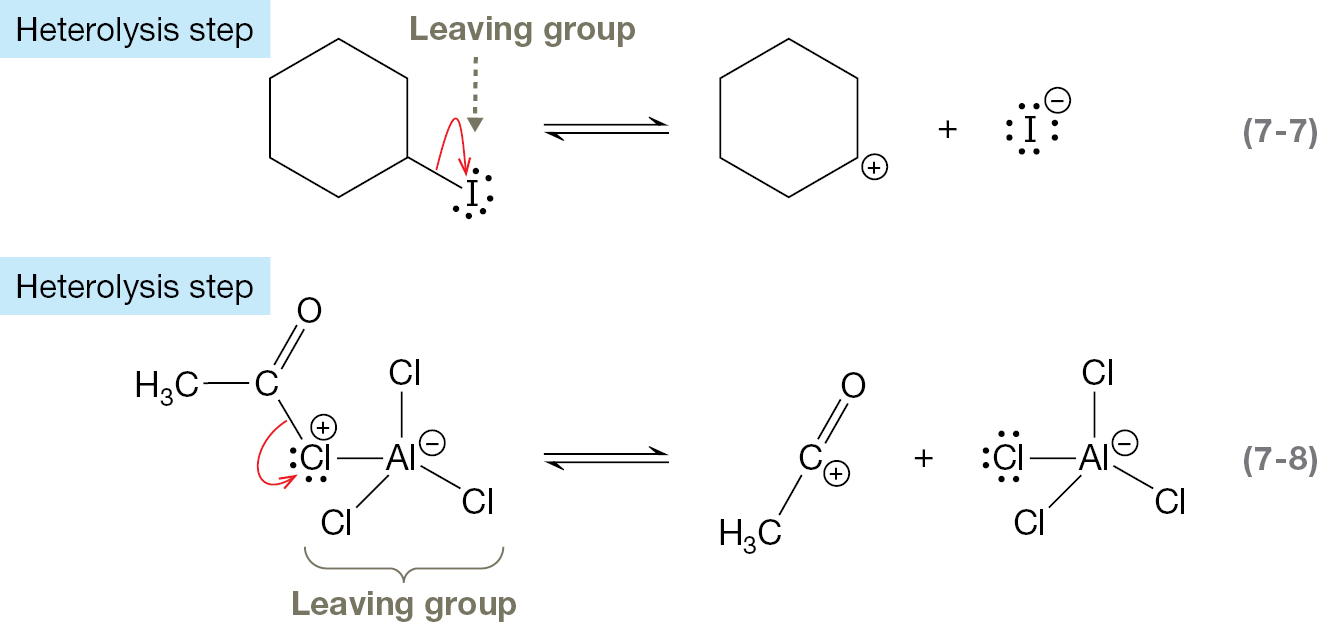
An elementary step can also occur in which only a single bond is broken, which releases a leaving group, as shown in Equations 7-7 and 7-8. In such a heterolytic bond dissociation step, or heterolysis step (hetero= different; lysis= break), both electrons from the broken bond end up on the atom in the leaving group that was initially involved in the bond. The other atom of the original bond is left without an octet. You can think of heterolysis steps as the reverse of coordination steps (see Looking Ahead box).
More information
Two chemical reactions to represent examples of hydrolysis step resulting in the breakage of a single bond. The first reaction shows a closed ring with iodine carrying three lone pairs of electrons present at its meta-position. A curved arrow drawn from a single bond between two carbon atoms at meta-position point toward iodine. The iodine atom is labeled leaving group. It is followed by a reversible arrow to show a closed ring with a positive charge at carbon at the meta-position and an iodine anion carrying four lone pairs of electrons. The second reaction shows a condensed structural formula of a compound, with a central aluminum atom carrying a negative charge surrounded by four chloride ions by a single bond each. This is labeled as the leaving group. The fourth chloride ion carries two lone pairs of electrons and a positive charge, which is further linked to a carbon atom by a single bond. The carbon atom connects to a methyl group by a single bond and an oxygen atom by a double bond. A curved arrow points from a single bond between a carbon atom and chlorine carrying positive charge toward chlorine. It is followed by a reversible arrow to show two compounds. The first compound consists of a central carbon atom carrying positive charge connected to a methyl group by a single bond and an oxygen atom by a double bond. The second compound consists of a central aluminum atom carrying a negative charge surrounded by four single bonded chloride ions with the fourth chloride ion carrying three lone pairs of electrons.
▶ LOOKING AHEAD
Coordination and heterolysis steps usually comprise one step of a mechanism involving two or more elementary steps (a so-called multistep mechanism) because the reactant or product lacking an octet can be highly unstable. We will see, for example, coordination and heterolysis steps as parts of multistep mechanisms in the reactions we learn in Chapter 8, 12, and 24.
YOUR TURN 7.9
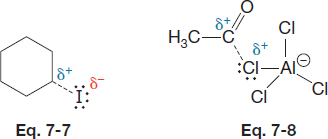
In Equations 7-7 and 7-8, identify all atoms lacking an octet. Also, draw the transition state for each reaction, taking into account the partial bonds and partial charges.
SHOW ANSWERHIDE ANSWER
The positively charged carbon in the product is the only atom lacking an octet in each reaction. The transition states are shown below.
More information
Transition states for two structures. The first structure, eq 7-7, is a cyclohexane ring bonded to an iodine on a dashed bond. The carbon it is bonded to has a partial positive charge and the iodine has a partial negative. The second structure, eq 7-8, shows a central negative aluminium bonded to four chlorines, one of the chlorines is bonded to a carbon by a dashed bond an the carbon that is further double bonded to oxygen has a partial positive charge.
YOUR TURN 7.10
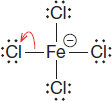
Use curved arrow notation to show the product from Your Turn 7.8 undergoing heterolysis to regenerate FeCl3 and Cl−.
SHOW ANSWERHIDE ANSWER
More information
Arrow pushing mechanism. The structure is a central iron with a negative charge bonded to four chlorine atoms. An arrow starts at a iron chlorine bond and ends at the chlorine atom.