Chapter Summary and Key Terms
- The curved arrow notation for an elementary step reflects the flow of electrons from an electron-rich site to an electron-poor site. (Section 7.1a)
- Metal cations from group 1A of the periodic table behave as spectator ions, so they can be disregarded when identifying electron-rich sites in an elementary step. (Section 7.1b)
- Organometallic reagents, such as alkyllithium reagents (RLi), Grignard reagents (RMgX), and lithium dialkylcuprates (R2CuLi), can be treated as sources of R–, called carbanions. Hydride reagents, such as lithium aluminum hydride (LiAlH4) and sodium borohydride (NaBH4), can be treated as sources of hydride anion (H:−). (Section 7.1b)
- All elementary steps take place in a single event, in which the reactants proceed through one transition state to become products. All bonds that break or form during an elementary step appear as partial bonds in the transition state. All charges that appear or disappear during the step appear as partial charges in the transition state. (Section 7.2)
- Charge stability and total bond energy are two major factors that contribute to a reaction’s driving force. For a reaction or elementary step involving both ions and uncharged molecules, the side that is favored generally exhibits greater charge stability. (Section 7.8)
- In carbocations, the C+ can be stabilized by resonance delocalization of the charge and by attached alkyl groups. Attached alkyl groups are electron-donating via inductive effects and via hyperconjugation, whereby a filled σ bonding MO from the alkyl group interacts with the empty p AO on C+. (Section 7.9)
- When the reactants and products of a reaction are uncharged, the side that is favored generally has the greater bond energies. (Section 7.10)
- In a keto–enol tautomerization, the keto form and enol form, called tautomers, are in rapid equilibrium via proton transfer steps. In general, the keto form is much more stable than, and therefore favored over, the enol form because it has a greater total bond energy. (Section 7.10)
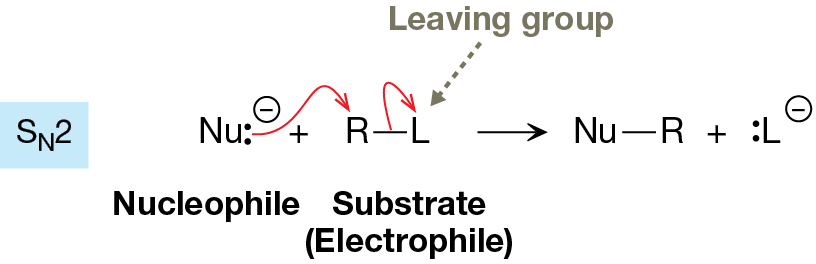
- Bimolecular nucleophilic substitution (SN2) steps. (Section 7.2)
More information
A chemical reaction shows the bimolecular nucleophilic substitution S N 2 steps. A nucleophile with a lone pair of electrons and marked with a negative charge reacts with a substrate electrophile. The electrophile has an R group linked by a single bond to a leaving group. A curved arrow points from the nucleophile to the R group. A second curved arrow points from the single bond to the leaving group. The resultant shows the nucleophile linked to the R group by a single bond. The leaving group is released, has a lone pair of electrons, and is marked with a negative charge.
- A substrate (R—L) contains a leaving group (L). Good leaving groups have strong conjugate acids. A nucleophile that participates in an SN2 step contains an atom that has a full or partial negative charge and possesses a lone pair of electrons.
- The nucleophile is relatively electron-rich. The atom attached to the leaving group is relatively electron-poor and is characterized as an electrophile.
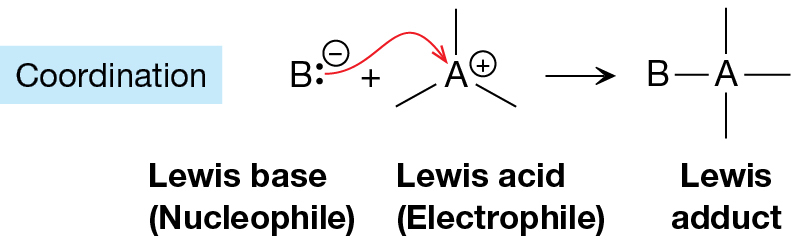
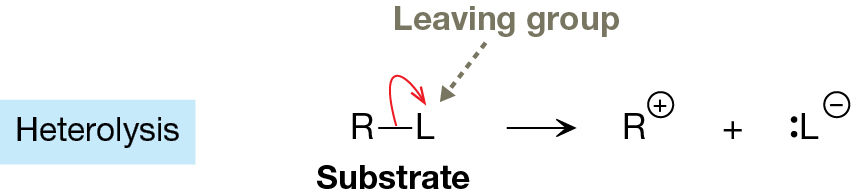
- Coordination steps and heterolytic bond dissociation (heterolysis) steps. (Section 7.3)
More information
A chemical reaction shows the process of a coordination step. It shows a Lewis base which is the nucleophile. The lewis base is a B with a lone pair of electrons and marked with a negative charge. It reacts with a Lewis acid which is the electrophile. The Lewis acid is shown as an A with three methyl groups linked and marked with a positive charge. A curved arrow points from the B to the A. The resultant shows the B linked to the A by a single bond and is labeled the Lewis adduct.
- In a coordination step, the Lewis acid usually lacks an octet, and the Lewis base has an atom with a partial or full negative charge and a lone pair of electrons. The product of such a step is called a Lewis adduct.
- The Lewis base is relatively electron-rich and is the nucleophile, whereas the Lewis acid is relatively electron-poor and is the electrophile.
More information
A chemical reaction shows the process of a heterolytic bond dissociation or heterolysis step. The substrate shows an R group linked to a leaving group by a single bond. A curved arrow points from the single bond to the leaving group. The resultants are the R group marked with a positive charge and the leaving group with a lone pair of electrons and marked with a negative charge.
- In a heterolysis step, the bond between the leaving group and the substrate is broken, and the bonding electrons become a lone pair on the leaving group.
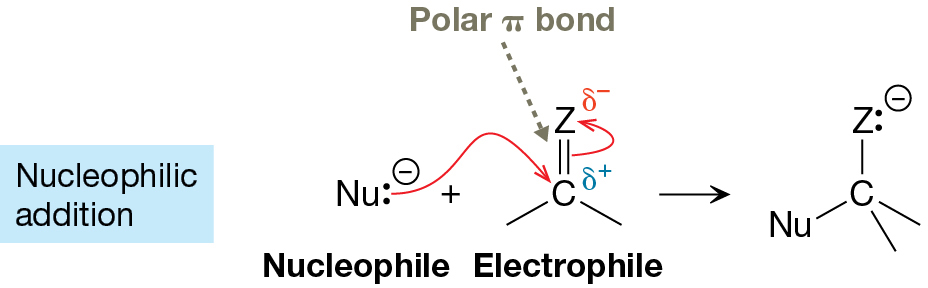
- Nucleophilic addition steps and nucleophile elimination steps. (Section 7.4)
More information
A chemical reaction shows the process of a nucleophilic addition. The reactants are a nucleophile and an electrophile. The nucleophile has a lone pair of electrons and is marked with a negative charge. The electrophile has a carbon atom linked by single bonds to two methyl groups and linked by a double bond to Z. The carbon has a partial positive charge and the Z has a partial negative charge. The double bond is labeled polar pi bond. A curved arrow points from the nucleophile to the carbon. A second curved arrow points from the double bond to Z. The resultant shows the nucleophile linked to the carbon by a single bond. Group Z now has a lone pair of electrons, is marked with a negative charge, and is linked to the carbon atom by a single bond.
- In a nucleophilic addition step, a nucleophile forms a bond to the positive end of a polar C—Z π bond, forcing a pair of electrons from the π bond onto Z.
- The nucleophile is relatively electron-rich. The atom at the positive end of the polar C—Z π bond is relatively electron-poor and acts as the electrophile.
More information
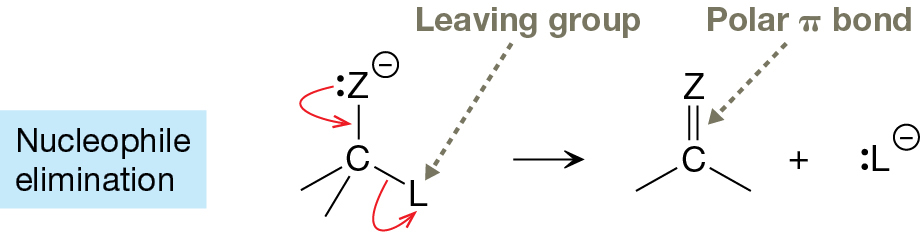
A chemical reaction shows the process of a nucleophilic elimination. A carbon atom is shown linked by single bonds to two methyl group, an X, and a leaving group. The Z has a lone pair of electrons and is marked with a negative charge. A curved arrow points from the Z to the single bond linking it to the carbon atom. A second curved arrow points from the single bond linking the leaving group and the carbon atom to the leaving group. The resultant shows Z linked to the carbon atom by a double bond. The double bond is labeled as a polar pi bond. The leaving group is released and has a lone pair of electrons and is marked with a negative charge.
- In a nucleophile elimination step, a new C—Z π bond is formed at the same time that a leaving group is expelled.
- Bimolecular elimination (E2) steps. (Section 7.5)
More information
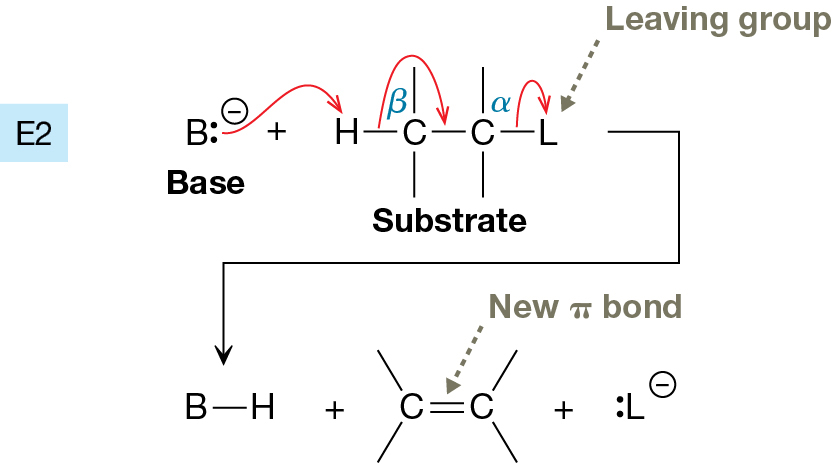
A chemical reaction shows the process of bimolecular elimination E2 steps. A base, represented by a B, has a lone pair of electrons and is marked with a negative charge. It reacts with a substrate that is shown as a two carbon chain with the carbons labeled beta and alpha. The beta carbon is linked by a single bond to a hydrogen atom. The alpha carbon is linked by a single bond to a leaving group. Both carbons are also each linked to two methyl groups by single bonds. A curved arrow points from the base to the hydrogen atom. A second curved arrow points from the bond between the hydrogen and the beta carbon to the bond between the two carbons. A third curved arrow points from the bond between the alpha carbon and the leaving group to the leaving group. The resultants shows B linked to H by a single bond and two carbon atoms linked by a double bond that is labeled new pi bond. The leaving group is released and has a lone pair of electrons and is marked with a negative charge.
- An E2 step is a type of β-elimination. A base deprotonates an atom designated β on the substrate at the same time that a leaving group is expelled from the atom designated α, forming an additional π bond between the α and β atoms.
- The base is relatively electron-rich. The α carbon atom, which is bonded to the leaving group, is relatively electron-poor.
- Electrophilic addition steps and electrophile elimination steps. (Section 7.6)
More information
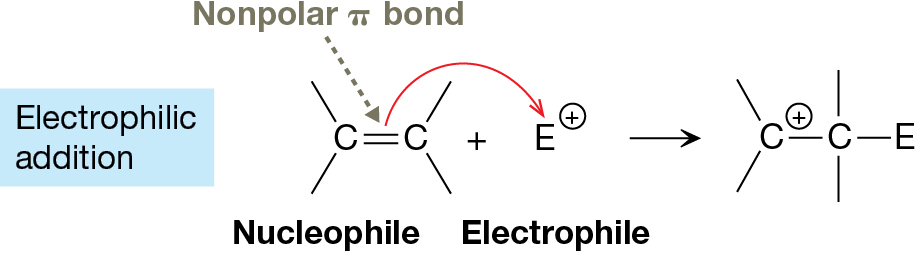
A chemical reaction shows the process of electrophilic addition. The nucleophile is shown as two carbon atoms linked by a double bond that is labeled nonpolar pi bond. Each carbon atom is also linked by single bonds to two methyl groups. The electrophile is shown as an E marked with a positive charge. A curved arrow points from the double bond to the E. The resultant shows the first carbon atom marked with a positive charge, the two carbon atoms linked by a single bond, and the second carbon atom linked by a single bond to the E.
- In an electrophilic addition step, a pair of electrons from a nonpolar π bond forms a bond to an electrophile.
- The nonpolar π bond is relatively electron-rich, so it acts as the nucleophile. The electrophile is relatively electron-poor.
More information
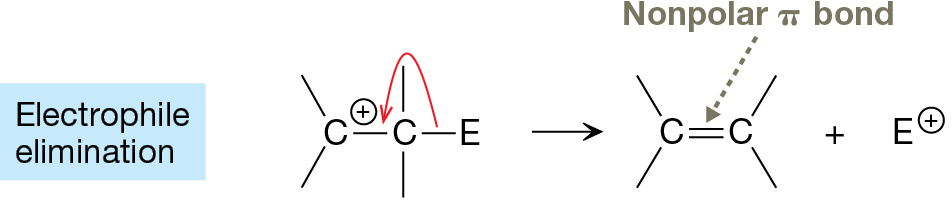
A chemical reaction shows the process of electrophilic elimination. Show are two carbon atoms linked by a single bond. The first carbon is marked with a positive charge and is linked to two methyl groups. The second carbon is linked by single bonds to two methyl groups and an E group. The resultant shows the two carbon atoms linked by a double bond that is labeled nonpolar pi bond. The E group is released and is marked with a positive charge.
- In an electrophile elimination step, an electrophile is eliminated from a carbocation species and a nonpolar π bond is formed simultaneously.
- Carbocation rearrangements. (Section 7.7)
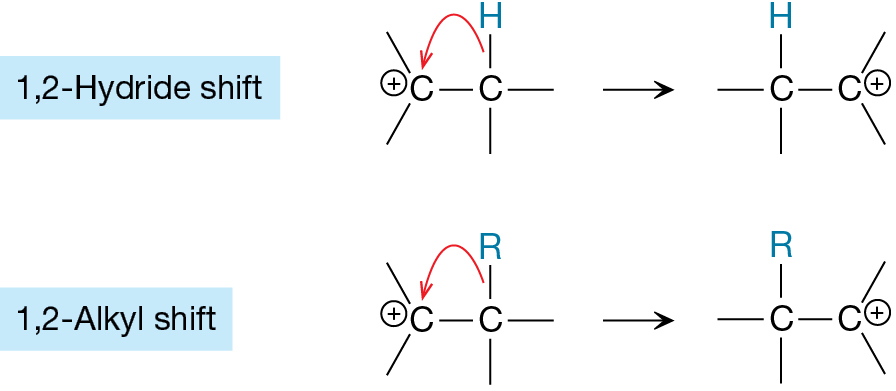
More information
Two chemical reactions show different carbocation rearrangements. The first reaction shows the processes of a 1,2 hydride shift. Two carbon atoms are linked by a single bond. Carbon 1 is linked to two methyl groups and is marked with a positive charge. Carbon 2 is linked by single bonds to two methyl groups and a hydrogen atom. A curved arrow points from the bond between the hydrogen atom and carbon 2 to carbon 1. The resultant shows that now carbon 1 is linked by a single bond to the hydrogen atom and carbon 2 is marked with a positive charge. The second reaction shows the process of a 1,2 Alkyl shift.Two carbon atoms are linked by a single bond. Carbon 1 is linked to two methyl groups and is marked with a positive charge. Carbon 2 is linked by single bonds to two methyl groups and an R group. A curved arrow points from the bond between the R group and carbon 2 to carbon 1. The resultant shows that now carbon 1 is linked by a single bond to the R group and carbon 2 is marked with a positive charge.
- In a 1,2-hydride shift or 1,2-alkyl shift, a C—H or C—C bond adjacent to a C+ is broken, and the bond is re-formed to the C atom that initially carried the positive charge. The positive charge moves to the C atom whose bond was broken.
- A 1,2-methyl shift is a 1,2-alkyl shift in which a methyl group (CH3) migrates.
Glossary
- Spectator Ion
- an ion that is relatively inert in solution and tends not to react.
- Organometallic
- describes compounds that contain a metal atom bonded directly to a carbon atom.
- Grignard reagent
- an alkylmagnesium halide (R—MgX, where X = Cl, Br, or I) nucleophile that favors direct addition to a polar π bond over conjugate addition. Grignard reagents are often used to make new carbon–carbon bonds.
- Carbanions
- an anion in which a negative formal charge appears on carbon.
- Hydride Reagents
- a reagent that contains or has the tendency to donate hydride. Common hydride reducing agents include lithium aluminum hydride (LiAlH4) and sodium borohydride (NaBH4). Sodium hydride (NaH) is a strong base but a poor nucleophile.
- Hydride anion (H:−)
- an anion with a hydrogen nucleus and two electrons. (Ch. 7)
- Bimolecular Nucleophilic Substitution (SN2)
- an elementary step wherein a nucleophile forms a bond to an atom that is attached to a leaving group and displaces the leaving group from that atom.
- Substrate
- a molecular species that undergoes a particular reaction with an attacking species; in nucleophilic substitution or elimination, the species that contains the leaving group.
- Leaving Group
- the substituent displaced or eliminated from the substrate in a reaction.
- Nucleophile
- a “nucleus–loving” species (usually with a lone pair of electrons) that seeks a substrate with a full or partial positive charge to stabilize its full or partial negative charge.
- Electrophile
- a strongly electron-deficient species.
- Coordination Steps
- an elementary step in which a single bond is formed using two electrons from the same atom and no bonds are broken.
- Lewis acid
- an electron-pair acceptor.
- Lewis base
- an electron-pair donor.
- Lewis adduct
- the product of a coordination step.
- Heterolytic Bond Dissociation
- an elementary step in which only a single bond is broken and both electrons from that bond end up on one of the atoms initially involved in the bond.
- Nucleophilic Addition Steps
- an elementary step in which a nucleophile forms a bond to the electron-deficient atom of a polar π bond.
- Nucleophile Elimination Steps
- an elementary step wherein a new π bond is produced and the eliminated leaving group, in turn, has the characteristics of a nucleophile; the reverse of a nucleophilic addition step.
- Bimolecular elimination (E2) step
- an elementary step wherein a proton and a leaving group are eliminated from adjacent atoms, and a double bond or triple bond is formed.
- β Elimination
- reaction in which substituents on adjacent atoms are eliminated from a molecule, resulting in a new π bond between those atoms.
- Electrophilic addition step
- an elementary step in which electrons from a nonpolar π bond (as part of a double or triple bond) are used to form a new σ bond to an electrophile.
- Electrophile elimination step
- an elementary step in which an electrophile is eliminated from a carbocation, generating a new π bond; the reverse of an electrophilic addition step.
- Carbocation rearrangement
- an elementary step in which the connectivity within a carbocation changes. Examples include a 1,2-hydride shift and a 1,2-methyl shift.
- 1,2-Hydride shift
- a carbocation rearrangement wherein a hydride ion (H–) migrates to an adjacent atom.
- 1,2-Alkyl shift
- a carbocation rearrangement wherein an alkyl group migrates to an adjacent atom.
- 1,2-Methyl shift
- a carbocation rearrangement wherein a methyl group migrates to an adjacent atom.
- Driving force
- a thermodynamic concept (not an actual force) describing the extent to which a reaction favors products over reactants under a particular set of conditions; it tends to increase with increasing stability (lower energy) of products relative to reactants; charge stability and total bond energy are important contributors.
- Hyperconjugation
- the delocalization of electrons in a σ bonding molecular orbital into an adjacent orbital of π symmetry.
- Keto form
- a carbonyl compound that has an α hydrogen; the keto form of a molecule is the tautomer of its enol form.
- Enol form
- a compound that has the bonding arrangement C═C – OH; the enol form of a molecule is the tautomer of its keto form.
- Tautomer
- one form of a pair of isomers that exist together in equilibrium.
- Keto–enol Tautomerization
- the transformation of one keto or enol tautomer (isomeric form) into the other; usually the process is an equilibrium.