7.10 Keto–Enol Tautomerization: An Example of Bond Energies as the Major Driving Force
SECTION 7.10 OBJECTIVES
You will be able to:
Draw the keto form of a tautomerization when given the enol form, and vice versa, and explain why the keto form is usually more stable.
Draw the mechanism for a tautomerization under acidic or basic conditions.
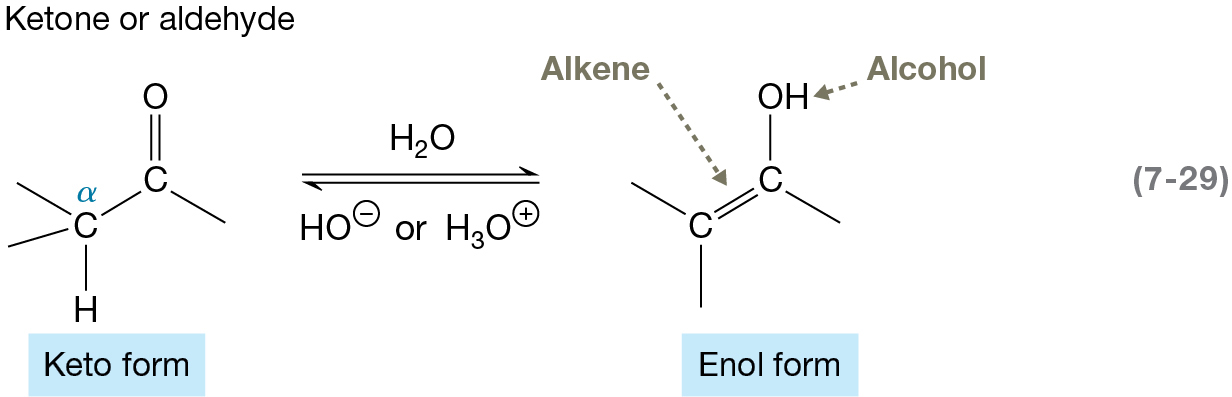
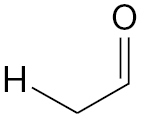
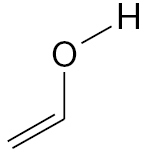
In aqueous basic or acidic conditions, ketones and aldehydes exist in rapid equilibrium with a rearranged form, called an enol:
More information
A chemical reaction represents the transformation of keto-form into enol-form under suitable conditions. It shows a condensed structural formula of a compound in ketone or aldehyde form as two carbon atoms linked by a single bond, with the carbon atom on the left, labeled alpha, carrying two vacant single bonds and a hydrogen atom linked to it by a single bond. The carbon atom on the right is linked to an oxygen atom by a double bond and has a vacant single bond, labeled keto form. It is followed by a reversible arrow denoting a water molecule; a negatively charged hydroxyl group or a negatively charged hydronium group to show enol form represented as carbon double bond carbon, labeled as alkene, with the left carbon atom carrying two vacant single bonds and the right carbon atom carrying an alcoholic group and a vacant single bond.
As a ketone or aldehyde, the species is called the keto form. In the enol form, the species has a carbon atom that is simultaneously part of a C═C bond characteristic of an alkene and is bonded to OH, characteristic of an alcohol. Because the keto and enol forms are constitutional isomers in equilibrium, they are called tautomers (Greek: tauto= same; mer= part), and the equilibrium is called keto–enol tautomerization. In later chapters, we will see that this equilibrium has important consequences in a variety of chemical reactions.
In the equilibrium shown in Equation 7-29, one of the main differences between the keto and enol forms is the location of a hydrogen atom. The keto form has one additional hydrogen atom on the α (alpha) carbon (the carbon atom that is adjacent to the C═O group), whereas in the enol form, the additional hydrogen appears on the oxygen atom instead. Realizing that a proton transfer step serves to add or remove a proton from a particular species, we can account for this transformation with a mechanism consisting of back-to-back proton transfer steps. In one step, the proton must be removed from the α carbon, and in the other step, the proton must add to the oxygen. Which step occurs first, however, depends on the presence of a strong base or strong acid. Because a base is a proton acceptor and an acid is a proton donor:
Under basic conditions, a proton tends to be removed before one is added.
Under acidic conditions, a proton tends to be added before one is removed.
The mechanism for tautomerization reaction (Eq. 7-29) under basic conditions is shown in Equation 7-30. The strong base (HO–) removes a proton from the α carbon in Step 1, producing an enolate anion, which has a resonance-delocalized negative charge. In the resonance structure on the right, the O atom is electron-rich, and in Step 2 of the mechanism, it picks up a proton from water, which acts as the acid.
Mechanism for keto-to-enol tautomerization (Eq. 7-29) under basic conditions
More information
A text box labeled mechanism for keto-to-enol tautomerization (equation 7-29) under basic conditions shows a chemical reaction. The reaction shows an oxygen atom of a hydroxyl group carrying three lone pairs of electrons and a negative charge reacting with keto form in which the oxygen atom of the carbonyl group is shown to carry two lone pairs of electrons. A curved arrow is drawn from an oxygen atom of the hydroxyl group with the head pointing toward hydrogen atom of the keto-form. Another curved arrow is drawn from the single bond between a carbon atom and a hydrogen atom with the head pointing toward the carbon atom linked to it. It is followed by a reversible arrow, marked step 1 and labeled proton transfer, to show an addition of a hydrogen atom to the oxygen of the hydroxyl group carrying two lone pairs of electrons. It also shows a unit compound showing two forms of an enolate anion as a carbon atom linked to two hydrogens carrying a lone pair of electrons with a negative charge in the keto form. A curved arrow points from the carbon atom linked to two hydrogens toward a single bond between two carbon atoms while another curved arrow points from a double bond in the carbonyl group toward the oxygen atom of the carbonyl group. The compound is reversible into another form in which the single bond between two carbon atoms is replaced by a double bond while the oxygen atom of the carbonyl group is shown to carry three lone pairs of electrons and a negative charge. A curved arrow is shown to point from a single bond between a hydroxyl group and hydrogen toward the oxygen atom of the hydroxyl group while another curved arrow points from the carbonyl group carrying three lone pairs of electrons toward hydrogen atom linked to a hydroxyl group. The two forms of enolate anions are labeled resonance structures of the same species. It is further followed by a reversible arrow marked step 2 and labeled proton transfer to show an oxygen atom of a hydroxyl group carrying three lone pairs of electrons and a negative charge and release of enol form of the compound.
Video: Keto-to-Enol/Enol-to-Keto Tautomerization under Basic Conditions
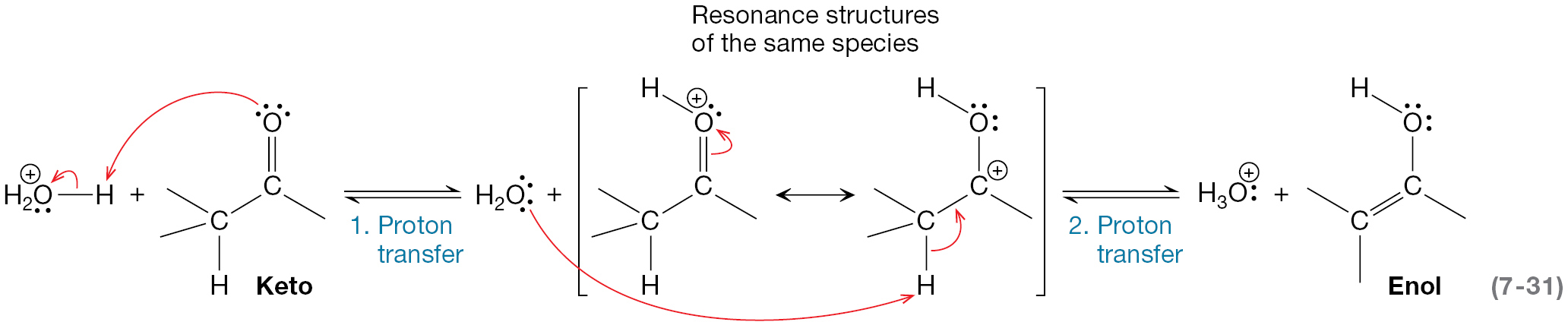
Mechanism for keto-to-enol tautomerization (Eq. 7-29) under acidic conditions
More information
A text box labeled mechanism for keto-to-enol tautomerization (equation 7-29) under acidic conditions shows a chemical reaction. The reaction shows an oxygen atom of a water molecule carrying a lone pair of electrons and a negative charge linked to another hydrogen atom by a single bond. It is shown to react with keto form in which the oxygen atom of the carbonyl group is shown to carry two lone pairs of electrons. A curved arrow points from an oxygen atom of the carbonyl group in the keto form toward hydrogen atom linked to the water molecule while another curved arrow points from a single bond between the water molecule and hydrogen toward the oxygen atom of the water molecule. It is followed by a reversible arrow, marked step 1 and labeled proton transfer to show the oxygen atom of the water molecule carrying two lone pairs of electrons. It also shows a unit compound with two forms of an enolate anion as a hydrogen atom linked to the oxygen atom of the carbonyl group carrying a lone pair of electrons and negative charge in the keto form. A curved arrow points from the double bond of the carbonyl group toward the oxygen atom of the carbonyl group. The compound is reversible into another form in which the double bond of the carbonyl group is replaced by a single bond, with the carbon atom linked to it carrying a positive charge while the oxygen atom carries two lone pairs of electrons. A curved arrow is shown to point from the oxygen atom of the water molecule toward the hydrogen atom of the second species while another curved arrow points from a single bond between carbon and hydrogen toward a single bond between two carbon atoms in the second species. The two forms of enolate anions are labeled resonance structures of the same species. It is further followed by a reversible arrow marked step 2 and labeled proton transfer to show the oxygen atom of hydronium ion carrying a lone pair of electrons and a positive charge and the release of enol form of the compound.
Video: Keto-to-Enol/Enol-to-Keto Tautomerization under Acidic Conditions
The mechanism for the reaction under acidic conditions is shown in Equation 7-31. The strong acid (H3O+) donates a proton to the O atom of the C═O group in Step 1. In Step 2, water (a weak base) removes the proton from the α carbon to produce the uncharged enol product (see Looking Ahead box).
▶ LOOKING AHEAD
The tautomerization mechanisms presented here incorporate two ideas we will revisit in Chapter 8:
A mechanism can differ under acidic versus basic conditions, an idea we will revisit in Section 8.6a.
Species with multiple resonance structures can appear in a mechanism, an idea we will revisit in Section 8.7.
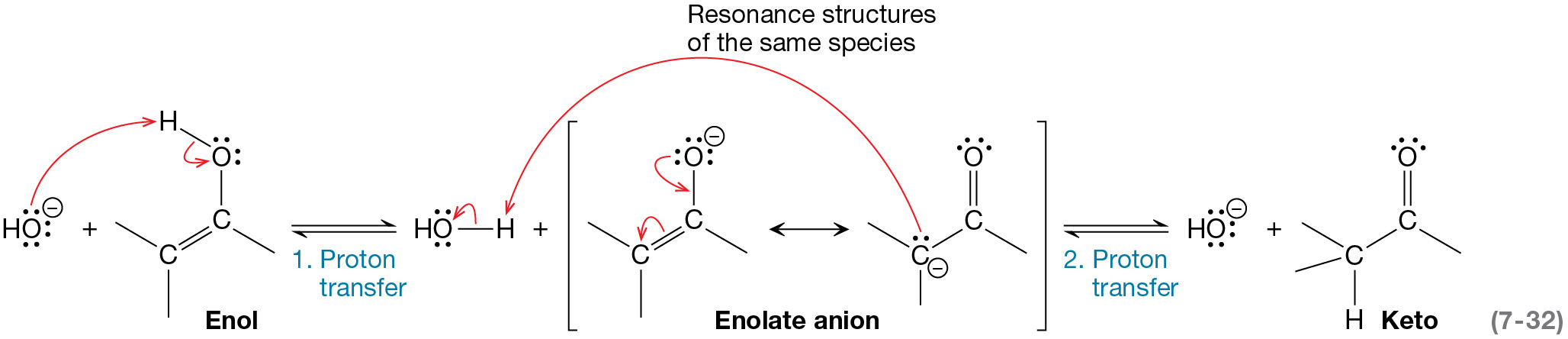
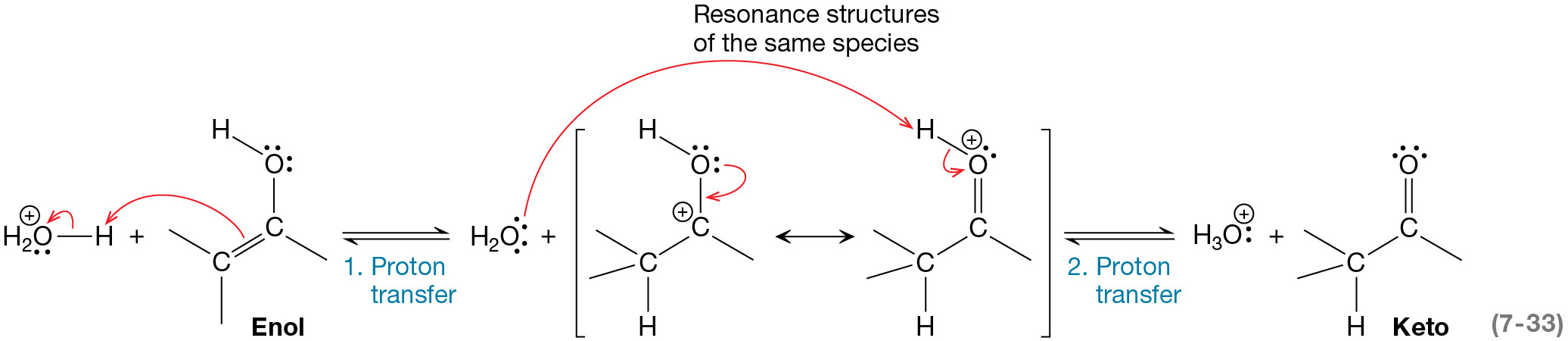
Because it is an equilibrium, the tautomerization reaction in Equation 7-29 takes place in the reverse direction, too. Equations 7-32 and 7-33 are the mechanisms showing how the enol form produces the keto form under basic and acidic conditions, respectively. Notice how the steps in Equations 7-32 and 7-33 are the same as in Equations 7-30 and 7-31, respectively, but in reverse order.
Mechanism for enol-to-keto tautomerization (reverse of Eq. 7-29) under basic conditions
More information
A text box labeled mechanism for enol-to-keto tautomerization (reverse of equation 7-29) under basic conditions shows a chemical reaction. The reaction shows the oxygen atom of hydroxyl group carrying three lone pairs of electrons and a negative charge reacting with enol form in which the oxygen atom of the carbonyl group is shown to carry two lone pairs of electrons. A curved arrow points from an oxygen atom of the hydroxyl group toward hydrogen atom of the enol-form while another curved arrow points from a hydrogen atom linked to an oxygen atom toward oxygen atom carrying two lone pairs of electrons. It is followed by a reversible arrow, marked step 1 and labeled proton transfer to show an addition of a hydrogen atom to the oxygen of the hydroxyl group carrying two lone pairs of electrons. It also shows a unit compound showing two forms of an enolate anion as oxygen atom carrying three lone pairs of electrons and a negative charge in the enol form. A curved arrow points from a double bond between a single bond between two carbon atoms toward carbon atom having two vacant single bonds while another curved arrow points from an oxygen atom toward a single bond between a carbon and an oxygen atom. The compound is reversible into another form in which the double bond between two carbon atoms is replaced by a single bond, with one of the carbon atoms carrying a lone pair of electrons and negative charge while the oxygen atom of the carbonyl group is shown to carry two lone pairs of electrons, with the single bond between carbon and oxygen replaced by a double bond. A curved arrow is shown to point from a single bond between the hydroxyl group and hydrogen toward the oxygen atom of the hydroxyl group while another curved arrow points from a double bond between two carbon atoms toward the carbon atom carrying vacant bonds. A third curved arrow points from an oxygen atom carrying three lone pairs of electrons in the first species toward the single bond linking it to the central carbon atom. A fourth curved arrow points from the negatively charged carbon atom of the second species toward hydrogen atom linked to the oxygen of the hydroxyl group. The two forms of enolate anion are labeled resonance structures of the same species. It is further followed by a reversible arrow marked step 2 and labeled proton transfer, to show the oxygen atom of a hydroxyl group carrying three lone pairs of electrons and a negative charge and a release of keto form of the compound.
Mechanism for enol-to-keto tautomerization (reverse of Eq. 7-29) under acidic conditions
More information
A text box labeled mechanism for enol-to-keto tautomerization (reverse of equation 7-29) under acidic conditions shows a chemical reaction. The reaction shows an oxygen atom of a water molecule carrying a lone pair of electrons and a negative charge linked to another hydrogen atom by a single bond. It is shown to react with enol form in which the oxygen atom of the hydroxyl group is shown to carry two lone pairs of electrons. A curved arrow points from the double bond between a carbon atoms toward hydrogen atom linked to the water molecule while another curved arrow points from the single bond between water molecule and hydrogen toward the oxygen atom of the water molecule. It is followed by a reversible arrow, marked step 1 and labeled proton transfer to show the oxygen atom of the water molecule carrying two lone pairs of electrons. It also shows a unit compound with two forms of an enolate anion, shown as a hydrogen atom linked to the oxygen atom of the carbonyl group carrying two lone pairs of electrons in the enol form while the carbon atom linked to the oxygen is marked positive. A curved arrow points from the oxygen atom toward a single bond between carbon and oxygen. The compound is reversible into another form in which the single bond between carbon and oxygen is replaced by a double bond, with the oxygen atom linked to it carrying a lone pair of electrons and a positive charge. A curved arrow is shown to point from the oxygen atom of the water molecule toward a hydrogen atom of the second species while another curved arrow points from the oxygen atom of first species toward the single bond linking it to the carbon atom. A third curved arrow points from the single bond between hydrogen and positively charged oxygen toward an oxygen atom. The two forms of enolate anions are labeled resonance structures of the same species. It is further followed by a reversible arrow marked step 2 and labeled proton transfer, to show oxygen atom of hydronium ion carrying a lone pair of electrons and a positive charge and the release of keto form of the compound.
Even though tautomerization takes place readily in both the forward and reverse directions:
For most aldehydes and ketones, the tautomerization equilibrium (Eq. 7-29, p. 345) heavily favors the keto form over the enol form.
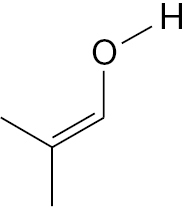
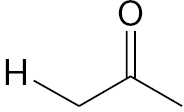
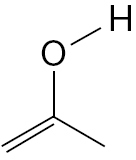
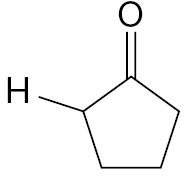
Table 7-1 illustrates this point, showing the relative abundance of keto and enol forms for a variety of tautomers. The enol form is present only in trace amounts, suggesting that the keto form is significantly more stable. In other words, the driving force for these reactions favors the keto form.
Table 7-1 Relative Percentages of Keto and Enol Forms
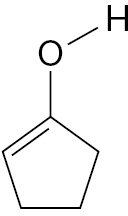
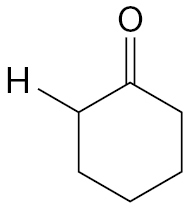
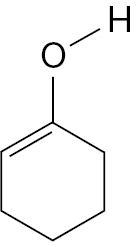
Tautomerization Reaction Keto Enol
99.99994%
0.00006%
99.986%
0.014%
99.9999995%
0.0000005%
99.9999988%
0.0000012%
99.99996%
0.00004%
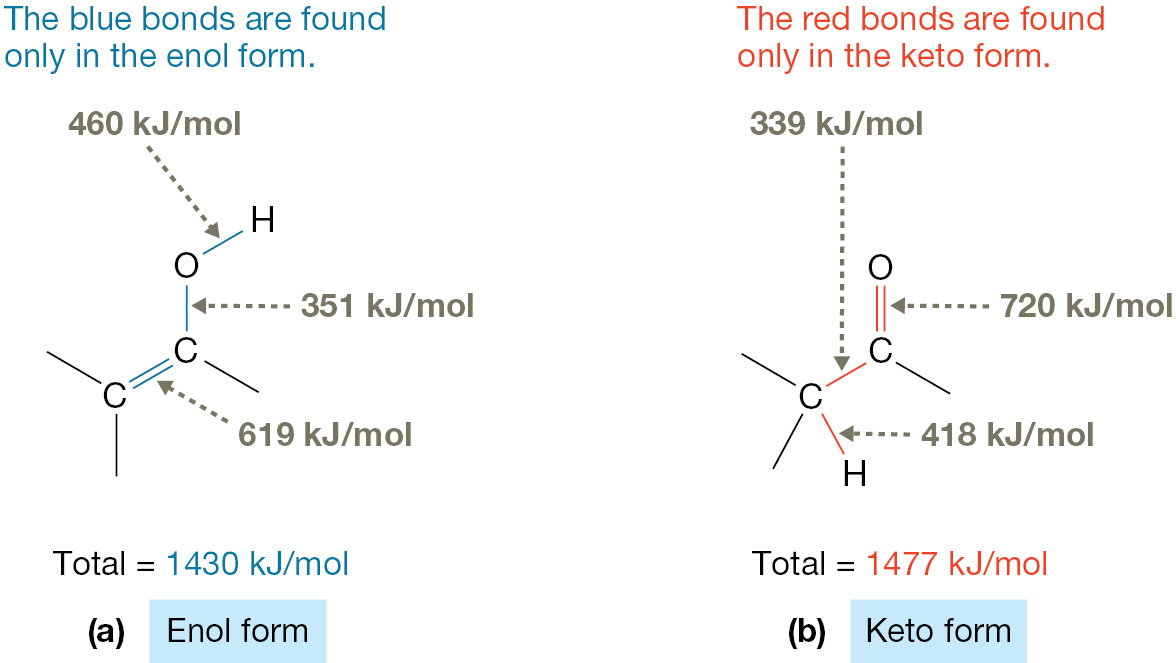
Unlike the reactions we saw in Section 7.9, the reactant and product of the tautomerization equilibrium are both uncharged. Therefore, charge stability cannot contribute to the driving force. Instead, the keto form is favored because it has a greater total bond energy than the enol form. To show that the keto form has a greater total bond energy, Figure 7-12 compares and tallies the energies of the bonds (see Tables 1-2 and 1-3, pp. 10-11) that appear in one form but not the other.
More information
Two illustrations compare the relative stability and bond energy of keto and enol forms. The first condensed structural formula shows the enol form of a compound in which the double bond between a carbon atoms, carbon-oxygen bond and oxygen-hydrogen bond are highlighted in blue and labeled, the blue bonds are different in the keto form. The bond energies of different bonds are as follows. Carbon double bond carbon, 619 kiloJoule per mole; carbon single bond carbon, 351 kiloJoule per mole; and oxygen single bond hydrogen, 460 kiloJoule per mole. The total energy of enol form is 1430 kiloJoule per mole. The second condensed structural formula shows the keto form of a compound in which the double bond of the carbonyl group, carbon-carbon bond, and carbon-hydrogen bond are highlighted in red and labeled, the red bonds are different in the enol form. The bond energies of different bonds are as follows, Carbon double bond oxygen, 720 kiloJoule per mole or 172 kilocalories per mol; carbon single bond carbon, 339 kiloJoule per mole; carbon single bond hydrogen, 418 kiloJoule per mole. The total energy of enol form is 1447 kiloJoule per mole. The caption reads, “Relative stabilities of enol and keto forms (a) Energies of the bonds that appear in the enol form but not in the keto form. The sum of the energies is 1430 kiloJoule per mole (342 kilocalories per mole). (b) Energies of the bonds that appear in the keto form but not in the enol form. The sum of the energies is 1477 kiloJoule per mole. Because of its greater total bond energy, the keto form is more stable than the enol form.”
FIGURE 7-12Relative stabilities of enol and keto forms (a) Energies of bonds that appear in the enol form but not in the keto form. The sum of these energies is 1430 kJ/mol. (b) Energies of bonds that appear in the keto form but not in the enol form. The sum of these energies is 1477 kJ/mol. Because of its greater total bond energy, the keto form is more stable than the enol form.
Although three bonds in the keto form differ from the enol form, the greater stability of the keto form comes primarily from the strength of the C═O bond. Consider Table 7-2, which compares similar bonds in the two forms. Notice that the average C═O bond is 101 kJ/mol stronger than the average C═C bond. The differences are substantially smaller when we compare the strengths of the other bonds.
TABLE 7-2 The Driving Force in Tautomerization
KETO FORM
ENOL FORM
Bond
Bond Energy (kJ/mol)
Bond
Bond Energy (kJ/mol)
Difference in Bond Energy (kJ/mol)
C═O
720
C═C
619
101
C—C
339
C—O
351
–12
C—H
418
O—H
460
–42
YOUR TURN 7.30
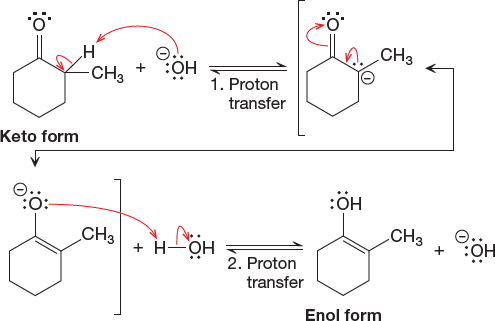
The mechanism for the tautomerization of 2-methylcyclohexanone to its enol form under basic conditions is shown here, but the curved arrows are not shown. (a) Draw the curved arrows that account for all electron movement. (b) Under each reaction arrow, write the name of the elementary step taking place. (c) Label the keto and enol forms.
SHOW ANSWERHIDE ANSWER
More information
Arrow pushing mechanism for keto to enol. The initial keto form is a cyclohexane ring double bonded to an oxygen at the first carbon and a methyl group at the second carbon, the other reactant is a negative hydroxide ion. An arrow starts at the hydroxide ion and ends at the hydrogen of the second carbon. Another arrow starts at the hydrogen bond and ends at the second carbon. The equilibrium reaction arrow is labeled proton transfer. The product is two resonance structures. The first resonance structure is a cyclohexane ring double bonded to oxygen and bonded to a methyl group at the second carbon. The second carbon also has a lone pair of electrons and a negative charge. An arrow starts at the lone pair of electrons and ends at the bond between first and second carbons, another arrow starts at the double bond and ends at the oxygen. The second resonance structure is a cyclohexane ring with a double bond between first and second carbons. The first carbon is bonded to a negative oxygen atom, the second carbon is bonded to a methyl group. The other product is water. An arrow starts at the negative oxygen and ends at a hydrogen on the water, another arrow starts at that hydrogen bonds and ends at the water’s oxygen. The second equilibrium arrow is labeled proton transfer. The final enol form is a cyclohexane ring with a double bond between first and second carbons, the first carbon is bonded to a hydroxyl group and the second carbon is bonded to a methyl group. The second product is a negative hydroxide ion.
YOUR TURN 7.31
Decarboxylation (i.e., elimination of CO2) occurs when a β-keto acid is heated under acidic conditions.
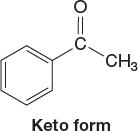
The immediate product of decarboxylation is an enol, which quickly rearranges. Draw the overall product of the rearrangement.
SHOW ANSWERHIDE ANSWER
More information
Structure of keto form. A two carbon chain where the first carbon is bonded to a phenyl group and double bonded to oxygen.
Sugar Transformers: Tautomerization in the Body
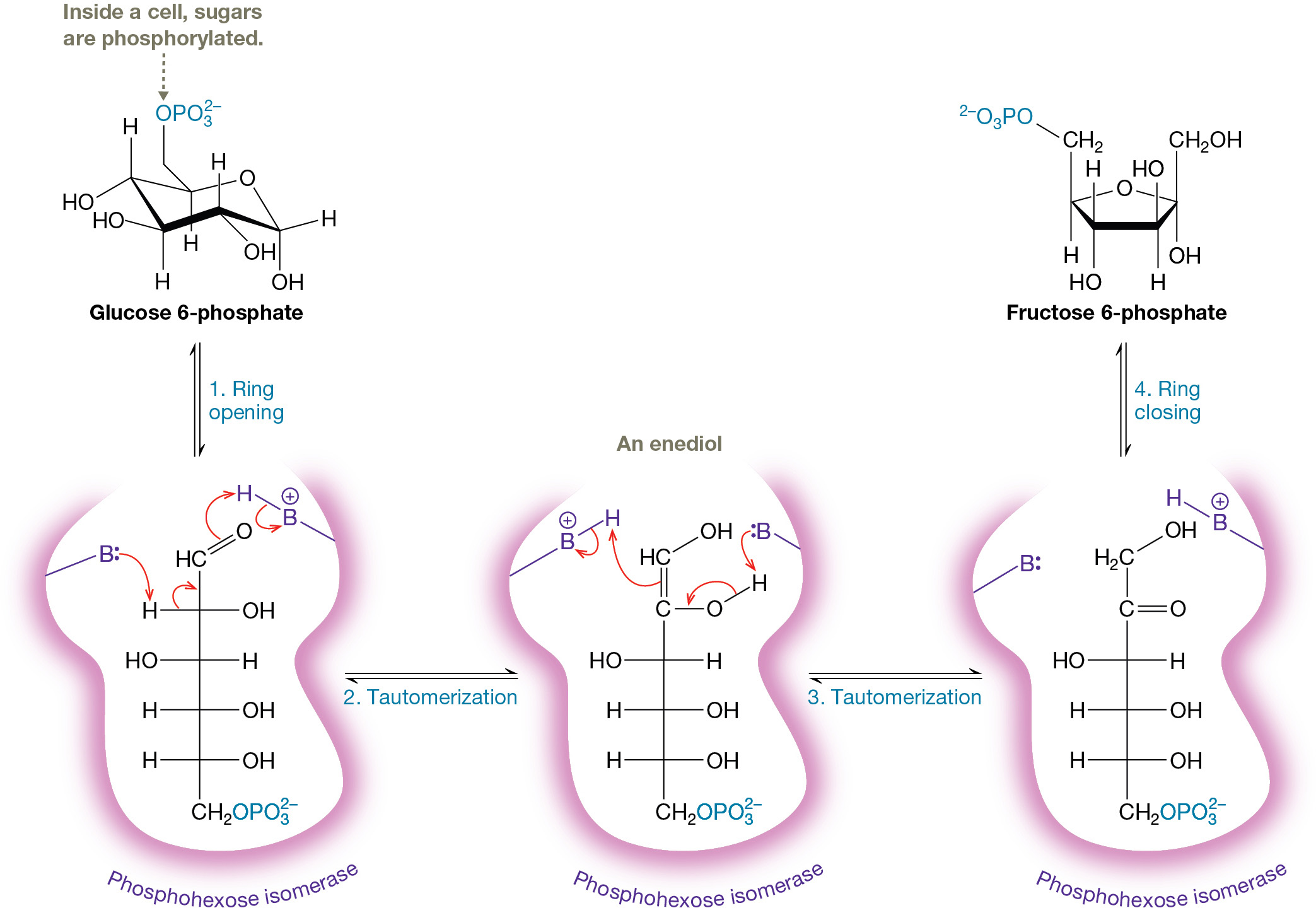
A sugar inside a cell can be different from the one that might be needed for a particular purpose, but the body has developed an elegant way to deal with this: It can transform one sugar into another using keto–enol tautomerization reactions (Section 7.10). This is exemplified in Figure 7-13, which shows a key part of glycolysis, a metabolic pathway that breaks down simple carbohydrates for energy.
More information
An illustration represents a four-step process to explain glycolysis. It shows a condensed structural formula of glucose-6 phosphate, with its phosphate group highlighted in blue and labeled, inside a cell, sugars are phosphorylated. It is followed by a reversible arrow labeled, 1, ring opening, to show a linear chain of six carbon atoms representing phosphohexose isomerase. The carbon atom in the first position is double bonded to an oxygen atom. The carbon atom in the third position is bonded to a hydroxyl group and a hydrogen atom by single bonds. The carbon atom in the second, fourth, and fifth positions are bonded to a hydrogen atom and a hydroxyl group each by single bonds, in reverse to the carbon atom in the third position. The carbon atom in the sixth position is bonded to two hydrogen atoms and a phosphate group. A curved arrow from B carrying a lone pair of electrons point toward hydrogen atom linked to carbon-2 while another curved arrow from carbon-2 and hydrogen bond point toward carbon-2 and carbon-1 bond. A third curved arrow from the double bond point toward an external hydrogen atom linked to a B carrying positive charge by a single bond while the fourth curved arrow from a single bond between hydrogen atom and B carrying positive charge point toward B. It is followed by a reversible arrow labeled, 2, tautomerization, to show an enediol represented as a replacement of bond between a hydroxyl group and carbon-1 toward bond between carbon-1 and 2. The carbon atom in the second position is shown to be linked to an oxygen atom, which is further linked to a hydrogen atom by a single bond each. A curved arrow from the carbon at the first position point toward another hydrogen atom linked to B carrying positive while another arrow from a single bond between the hydrogen atom and B carrying positive charge point toward B. A third arrow from the single bond between hydrogen atom and oxygen atom on carbon-2 point toward single bond between oxygen atom and carbon-2 while a fourth arrow from B carrying a lone pair of electron point toward hydrogen atom linked to an oxygen atom at carbon positioned at 2. It is further followed by a reversible arrow labeled 3, tautomerization, to show a change in the position of carbon-1 and 2. The carbon at the first position is linked to two hydrogen atoms and a hydroxyl group by a single bond. The carbon at the second position is linked to an oxygen atom by a double bond. It is further followed by a reversible arrow labeled, 4, ring closing, to show a condensed structural formula of fructose-6-phosphate, with the phosphate group highlighted in blue.
FIGURE 7-13
When D-glucose enters a cell, it is phosphorylated to become glucose 6-phosphate (shown on the left), in which the hydroxyl group on C-6 (the bottommost carbon in the Fischer projection) has been replaced by a phosphate group (–OPO23−). Before it can be broken down, however, glucose 6-phosphate must be converted into fructose 6-phosphate (shown on the right). This conversion involves back-to-back tautomerization reactions catalyzed by the enzyme phosphohexose isomerase (the active site is shown in purple). The enzyme supplies the basic site (B:) and acidic site (B+—H) necessary for the proton transfer steps. The first tautomerization produces an enol that contains two different OH groups, so it is more precisely called an enediol. The second tautomerization converts the enediol back into a keto form, but on doing so, the C═O bond is part of a different carbon atom than in the initial sugar. The result is a different phosphorylated sugar, known as fructose 6-phosphate.
This process of transforming one sugar into another is not limited to just six-carbon sugars. At a later stage in glycolysis, an enzyme called phosphotriose isomerase converts one three-carbon sugar into another. These kinds of processes truly are a testament to the efficiency of biological organisms.