Section 2.1 Objectives
You will be able to:
- Outline the basic principles of VSEPR theory.
- Predict the electron and molecular geometries of an atom within a given Lewis structure.
Chemists routinely use two different theories to explain molecular geometry: valence shell electron pair repulsion (VSEPR) theory, which we examine in this chapter, and molecular orbital (MO) theory, which we will deal with in Chapter 3. Although MO theory constitutes a more powerful model than VSEPR theory, VSEPR theory remains extremely useful because of its simplicity: Its concepts are easier to grasp, and it allows us to arrive at answers much more quickly.
Valence shell electron pair repulsion (VSEPR) theory is based on the following ideas:
|
Table 2-1 Various Types of Electron Groups in VSEPR Theory |
||
|
Type of Group |
Total Number of e– |
Number of Groups |
|
Lone pair |
2 |
1 |
|
Single bond |
2 |
1 |
|
Double bond |
4 |
1 |
|
Triple bond |
6 |
1 |
CONNECTIONS 2.1

Acetonitrile, acetone, and their uses Acetonitrile (Fig. 2-2a) is a polar organic solvent used in the manufacture of DNA oligonucleotides and numerous pharmaceuticals. Acetone (Fig. 2-2b) is another organic solvent. Acetone can dissolve hardened nail polish, which is why it is the active ingredient in nail polish remover. Ethane (Fig. 2-2c) is a gas that is important in the petrochemical industry.
|
Table 2-2 Correlations between Electron Geometry and Bond Angle in VSEPR Theory |
||
|
Number of Electron Groups |
Electron Geometry |
Approximate Bond Angle |
|
2 |
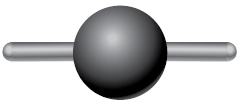 Linear |
180° |
|
3 |
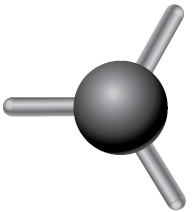 Trigonal planar |
120° |
|
4 |
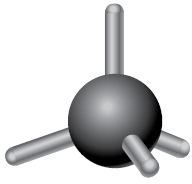 Tetrahedral |
109.5° |
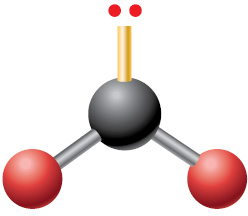
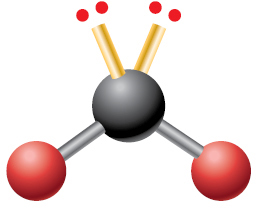
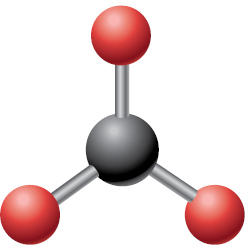
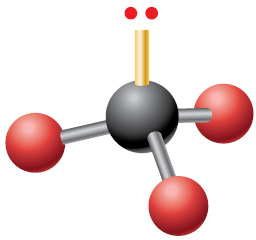
Common molecular geometries are summarized in Table 2-3. Notice the following relationships between a molecule’s electron geometry and its molecular geometry:
|
Table 2-3 Molecular Geometries in VSEPR Theorya |
|||
|
ELECTRON GEOMETRY |
|||
|
Number of Bonded Atoms/Groups |
Linear (180°) |
Trigonal Planar (120°) |
Tetrahedral (109.5°) |
|
2 |
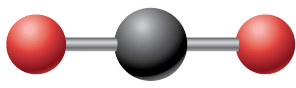 Linear |
 Bent |
 Bent |
|
3 |
 Trigonal planar |
 Trigonal pyramidal |
|
|
4 |
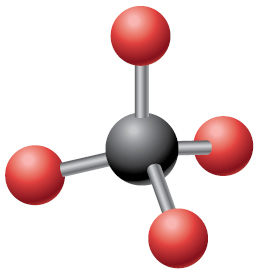 Tetrahedral |
||
|
aBonding electron groups are depicted with gray sticks; nonbonding electron groups are depicted as yellow sticks terminating in a red lone pair. |
|||
Some examples of molecules containing central atoms without lone pairs are shown in Figure 2-2. The electron and molecular geometries of these central atoms are the same.
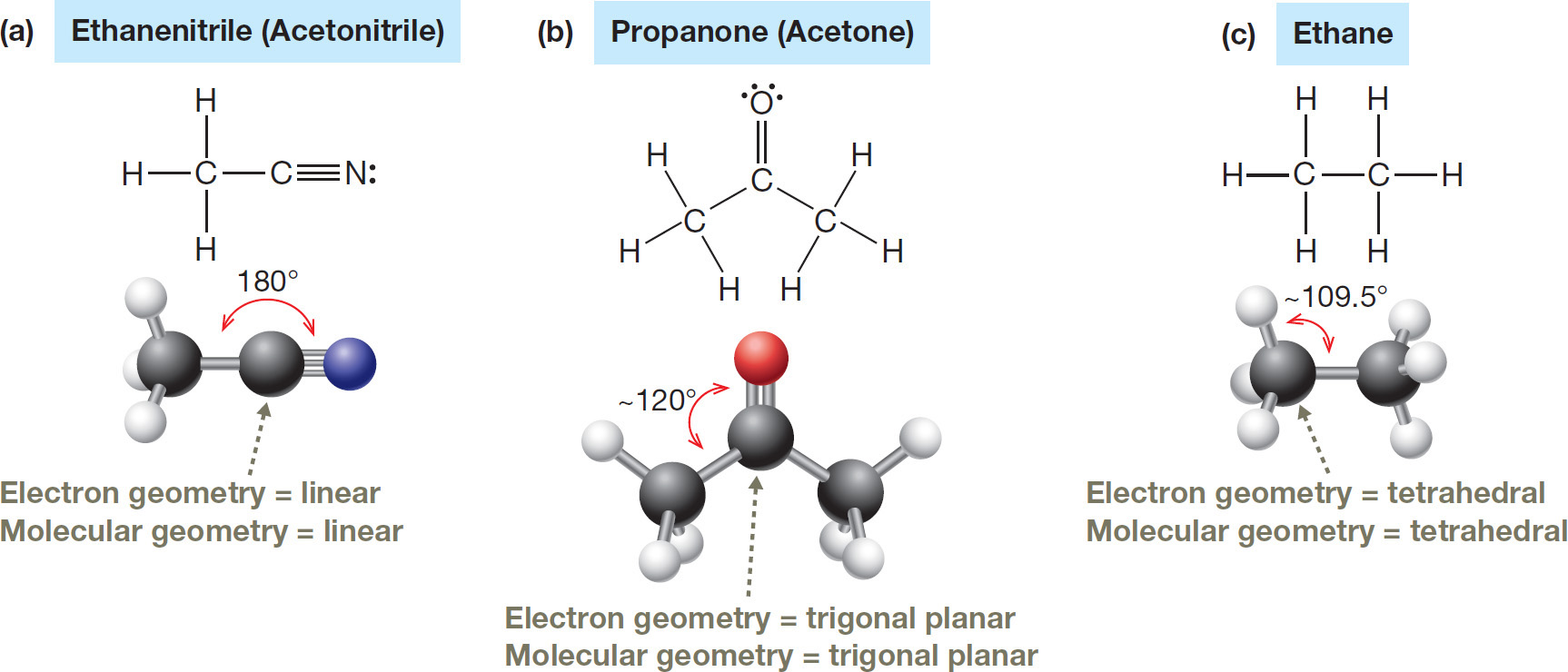
Three illustrations show Lewis structures and ball-and-stick models of ethanenitrile, propanone, and ethane. The structural formulas represent the electron geometry of the compounds, while the ball-and-stick models represent the molecular geometry. The structural formula of ethanenitrile, also known as acetonitrile, shows a linear two-carbon chain where carbon 1 is bonded by a triple bond to a nitrogen atom with a lone pair and carbon 2 is bonded to three hydrogen atoms. The ball-and-stick model of acetonitrile also has a linear orientation, with the angle between the C-C and C-N bonds being 180 degrees. The structural formula of propanone, also known as acetone, shows a central carbon atom bonded by a double bond to an oxygen atom with two lone pairs and to another carbon on each side in a trigonal planar manner. The ball-and-stick model of propanone also has a trigonal planar orientation, with the angle between the C-C and C-O bonds being 120 degrees. The structural formula of ethane shows a linear two-carbon chain where each carbon is bonded to three hydrogen atoms in a tetrahedral manner. The ball-and-stick model of ethane also has a tetrahedral orientation, with the angle between the C-C and C-H bonds being 109.5 degrees approximately. The caption reads, “Compounds in which the central atom lacks lone pairs: Because there are no lone pairs about the central atom, the molecular geometries of acetonitrile, acetone, and ethane are identical to their electron geometries.”
YOUR TURN 2.1
How many electron groups surround (a) the triply bonded C in Figure 2-2a, (b) the central C in Figure 2-2b, and (c) each C atom in Figure 2-2c?
(a) Two groups of electrons. (b) Three groups of electrons. (c) Four groups of electrons.
Notice that each molecule in Figure 2-2 has more than one atom that can be described by an electron geometry and a molecular geometry. This is explored in Your Turn 2.2.
YOUR TURN 2.2
What is the electron geometry that describes the CH3 carbon in ethanenitrile (Fig. 2-2a)? What is that atom’s molecular geometry? What is the approximate H—C—C bond angle?
Electron geometry = tetrahedral. Molecular geometry = tetrahedral. Bond angle ≈ 109.5°.
CONNECTIONS 2.2
2-Aminoethanol and its uses 2-Aminoethanol (Fig. 2-3) is commonly used in the production of a variety of industrial compounds, including shampoos and detergents. It is also used as an injectable treatment for hemorrhoids.
In 2-aminoethanol (ethanolamine, Figure 2-3), the molecular geometries of the N and O atoms are different than their electron geometries. The electron geometry of the N atom is tetrahedral because it is surrounded by four electron groups: three single bonds and one lone pair. Its molecular geometry, however, which describes only the orientation of the atoms at the ends of the three single bonds, is trigonal pyramidal. Likewise, the O atom of the OH group has a tetrahedral electron geometry (two single bonds and two lone pairs), but its molecular geometry is bent.
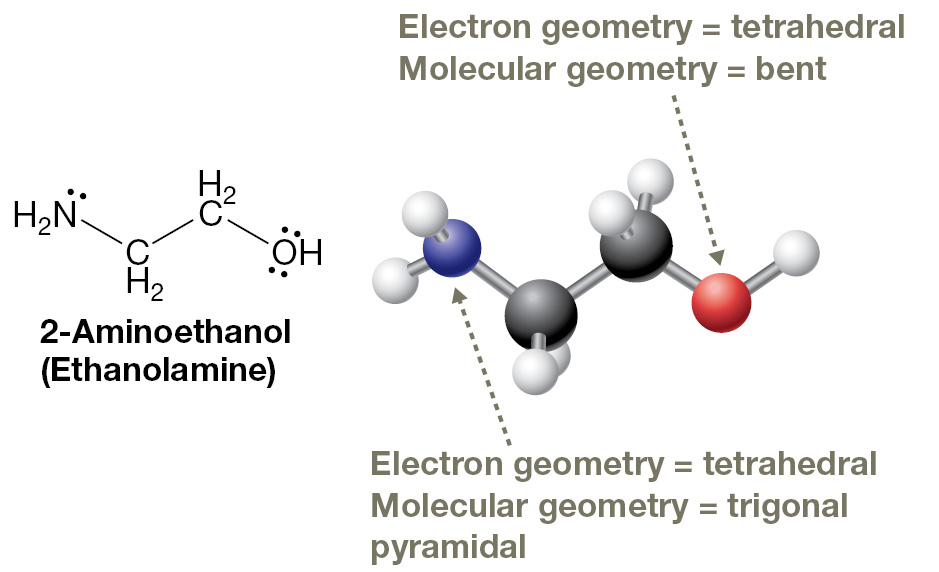
Lewis structure and ball-and-stick model of 2-aminoethanol or ethanolamine. The structural formula represents the electron geometry of the compound, while the ball-and-stick model represents the molecular geometry. The structure shows two carbons bonded in a linear manner. Carbon 1 is bonded in a bent fashion to a hydroxyl group, where the oxygen atom has two lone pairs arranged around it in a tetrahedral orientation. Carbon 2 is bonded in a bent fashion to an amine group, where the nitrogen atom has one lone pair arranged around it in a tetrahedral orientation. The ball-and-stick model of 2-aminoethanol also has a similar structure, except that the molecular geometry of the hydroxyl group is bent and of the amine group is trigonal pyramidal. The caption reads, “Lewis structure and VSEPR geometries about the atoms in 2-aminoethanol: The electron geometries about the NH2 nitrogen and the OH oxygen atoms are both tetrahedral, but they have different molecular geometries because N has one lone pair and O has two.”
SOLVED PROBLEM 2.1
How to determine an atom’s electron geometry and molecular geometry
Break It Down Imines, which are characterized by a C═N double bond, are commonly used as intermediates in organic synthesis. Use VSEPR theory to predict the electron and molecular geometries about the nitrogen atom in the acetone imine molecule shown.
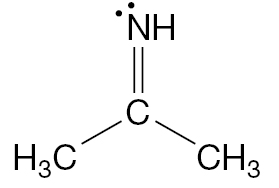
An illustration shows the Lewis structure of an acetone imine molecule. The Lewis structure shows a central carbon atom bonded to two methyl groups by single bonds and an amine group by double bonds. The amine group has a lone pair of electrons.
|
Think |
Solve |
|
|
How many electron groups surround the N atom? What does that suggest about the electron geometry? |
➤ |
Three electron groups surround the nitrogen atom: one double bond, one single bond, and one lone pair. From Table 2-2, we therefore predict a trigonal planar electron geometry. 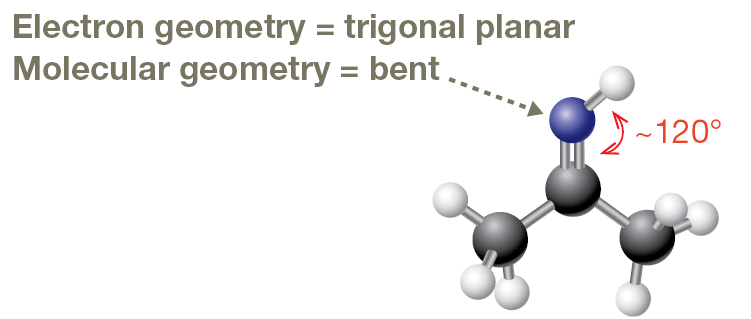
More informationAn illustration shows the ball-and-stick model of a molecule. The model shows a bent three-carbon chain, where the carbon atoms are represented by black spheres. Carbons 1 and 3 are each bonded to three hydrogen atoms, represented by white spheres, and carbon 2 is bonded to an amine group by a double bond. The nitrogen atom in the amine group is represented by a blue sphere. The angle between the double bond and the nitrogen-hydrogen bond is marked as 120 degrees approximately. An arrow pointing to the structure reads, “Electron equals trigonal planar. Molecular equals bent.” |
|
Are any electron groups lone pairs? How does that impact the molecular geometry of N? |
➤ |
One of the electron groups on N is a lone pair, so the molecular and electronic geometries will not be the same. According to Table 2-3, the N atom’s molecular geometry is bent. |
|
Try ItProp-2-yn-1-ol (propargyl alcohol) is used as an intermediate in organic synthesis and can be polymerized to make poly(propargyl alcohol), a polymer that has been studied for use in humidity detectors. Use VSEPR theory to predict the electron and molecular geometries about each nonhydrogen atom in the molecule. 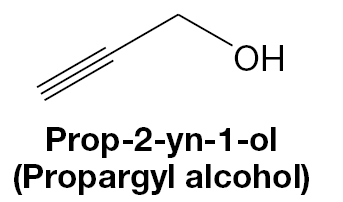
More informationAn illustration shows the line structure of Prop-2-yn-1-ol. The line structure of Prop-2-yn-1-ol, also known as Propargyl alcohol shows an inverted V with one end being longer than the other. The shorter end of the structure is bonded to a hydroxyl group by single bonds and the longer end features triple bonds. |
||
|
Answers to all Try It exercises can be found in the Solutions Manual. |
||
The rules of VSEPR theory apply equally well to ions. Figure 2-4a shows, for example, that the methyl cation, CH+3, has a trigonal planar electron geometry, consistent with a carbon atom that is surrounded by three groups of electrons (i.e., three single bonds). The methyl anion (Fig. 2-4b), on the other hand, is surrounded by four groups of electrons (i.e., three single bonds and a lone pair). Its electron geometry, therefore, is tetrahedral, and its molecular geometry is trigonal pyramidal.
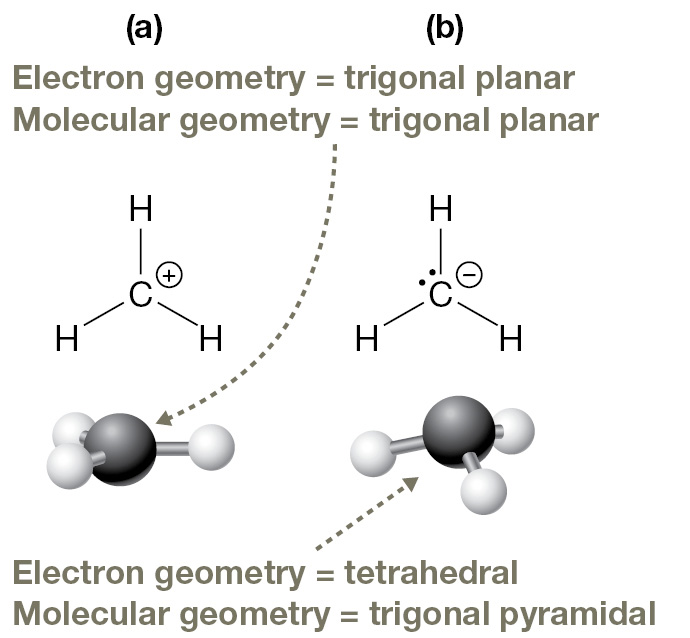
Lewis structure and ball-and-stick model of methyl cation and methyl anion. The structural formula represents the electron geometry of the ion, while the ball-and-stick model represents the molecular geometry. The structure of the methyl cation and anion both show a central carbon atom bonded to three hydrogen atoms. The carbon atom carries a positive charge in the cation, and a negative charge with a lone pair in the anion. The electron geometry and molecular geometry of the methyl cation are both trigonal planar, while in the methyl anion, the electron geometry is tetrahedral and the molecular geometry is trigonal pyramidal. The caption reads, Lewis structures and three-dimensional geometries of the methyl cation and methyl anion: The central C atom in C H 13 is surrounded by three single bonds only with no lone pairs, so its electron and molecular geometries are the same. The central C atom in C H 23, on the other hand, is surrounded by three single bonds and one lone pair, so its electron and molecular geometries are different.
YOUR TURN 2.3
Circle each electron group in the Lewis structures of CH3+ and CH3− in Figure 2-4.
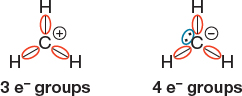
Condensed structure of C H 3 with different charges. A central carbon with a positive charge is bonded to three carbons and labeled as having three electron groups. A different structure shows a central carbon with a negative charge and a lone pair of electrons bonded to three hydrogens and labeled as having four electron groups.