3.5 Valence Bond Theory and Linear Electron Geometry: Triple Bonds and sp Hybridization
Section 3.5 Objectives
You will be able to:
Determine the hybridization of an atom that has a linear electron geometry.
Identify the orbitals that an atom with linear electron geometry contributes to the VB picture of a molecule.
Draw the VB picture of a molecular species that contains atoms with linear electron geometry.
More information
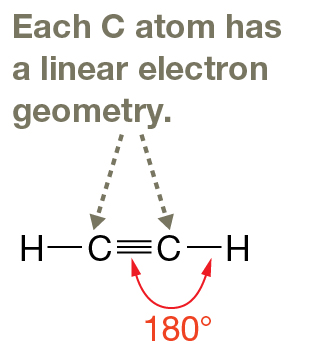
An illustration shows the Lewis structure of ethyne. Two carbon atoms are connected by a triple bond. Each carbon atom is also single bonded to a hydrogen atom. An arrow labeled 180 degrees points from one of the single bonds to the triple bond. A label pointing to both of the carbon atoms reads each C atom has a linear electron geometry.
FIGURE 3-17Lewis structure of ethyne (acetylene)
We have invoked sp3 hybridization to describe atoms with tetrahedral electron geometry (Sections 3.2 and 3.3) and sp2 hybridization to describe atoms with trigonal planar electron geometry (Section 3.4). We now turn to atoms with linear electron geometry, such as the two C atoms in ethyne (acetylene, Figure 3-17).
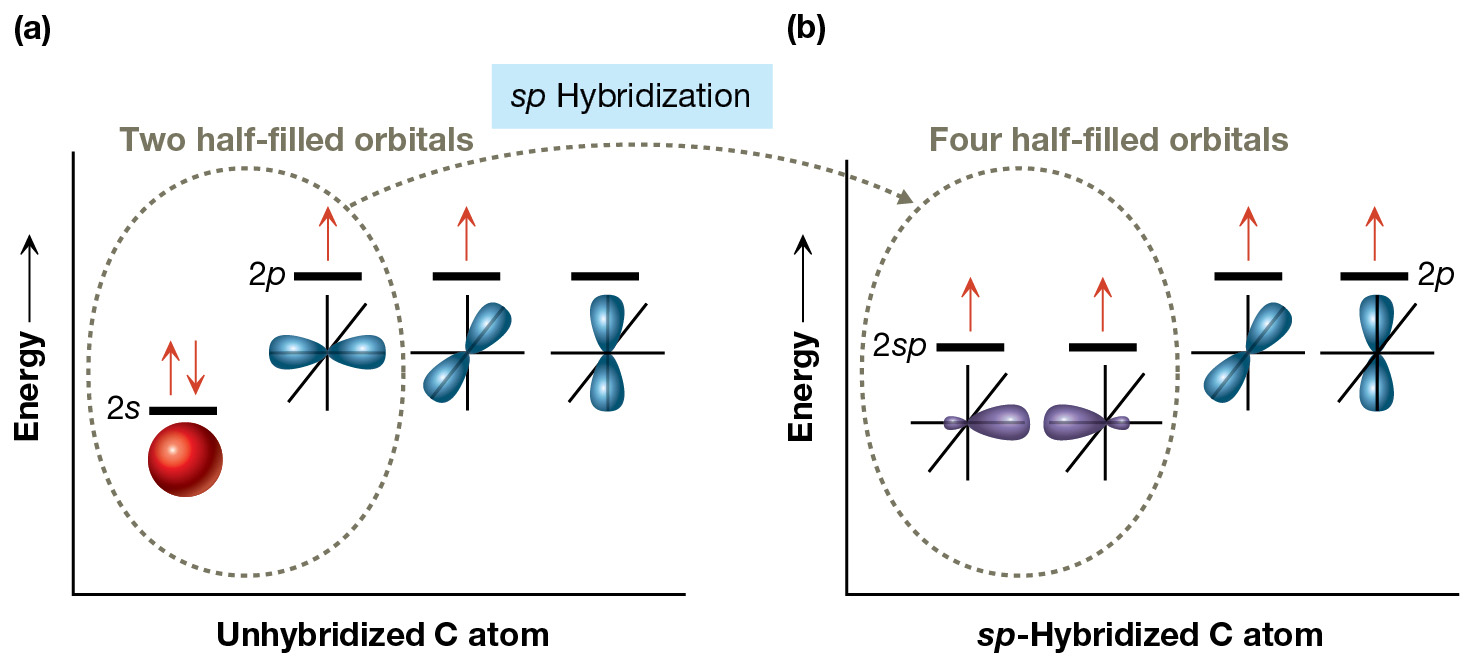
An atom with a linear geometry needs two hybrid orbitals to accommodate its two electron groups; to arrive at those hybrid orbitals, we consider sp hybridization. In sp hybridization, the valence s orbital mixes with just one of the three valence p orbitals, producing two new orbitals called sp hybrid orbitals (Figure 3-18).
More information
Two charts show the energy levels of electrons in an unhybridized carbon atom and an s p hybridized carbon atom. Both have four valence electrons. The first chart is of an unhybridized C atom. Two electrons occupy the 2 s orbital. The s orbital is shown as a sphere. The s orbital has a low energy level. There are three p orbitals all shown as dumbbells along one of the 3 axes. Two are half filled with only one electron each and the other is empty. These orbital all have high energy levels. An arrow points from the first chart to the second chart and is labeled s p hybridization. The second chart has two 2 s p 2 orbitals all at intermediate energy levels and two 2 p orbitals at a high energy level. Each s p orbital has one large lobe and one small lobe and are pointed in different directions along an axis. The 2 p orbitals are shown as a dumbbell with lobes of equal sizes. Each of the 4 orbital has one valence electron in it.
FIGURE 3-18sp Hybridization in HC≡CH (a) The s orbital and one of the p orbitals from the valence shell of the unhybridized atom mix in sp hybridization. (b) Those two orbitals become sp hybrid orbitals in an sp-hybridized carbon atom, and they point 180° apart. The two remaining p orbitals are perpendicular to the line containing the hybrid orbitals and are perpendicular to each other.
Any atom that has a linear electron geometry is sp-hybridized.
An sp-hybridized atom contributes two sp hybrid orbitals and two unhybridized p orbitals from the valence shell.
The sp hybrid orbitals point 180° apart along the same line.
The two unhybridized p orbitals are perpendicular to the sp hybrid orbitals and are perpendicular to each other.
Because sp hybrid orbitals are generated by mixing one s orbital and one p orbital, each sp hybrid orbital has 50% s-character (one part out of two) and 50% p-character (one part out of two).
CONNECTIONS 3.5
Acetylene and its uses Acetylene (Fig. 3-17) is one of the hottest burning fuels, reaching temperatures over 3300 °C (6000 °F), which made it popular in the welding industry until a few decades ago. Arc welding, which uses electrical arcs, is now the technique of choice in most applications.
More information
A photo of someone cutting a metal beam. Sparks are flying out from where the metal is being cut.
Because an uncharged C atom contributes four valence electrons, the two sp orbitals and the two p orbitals in Figure 3-18 are each half-filled.
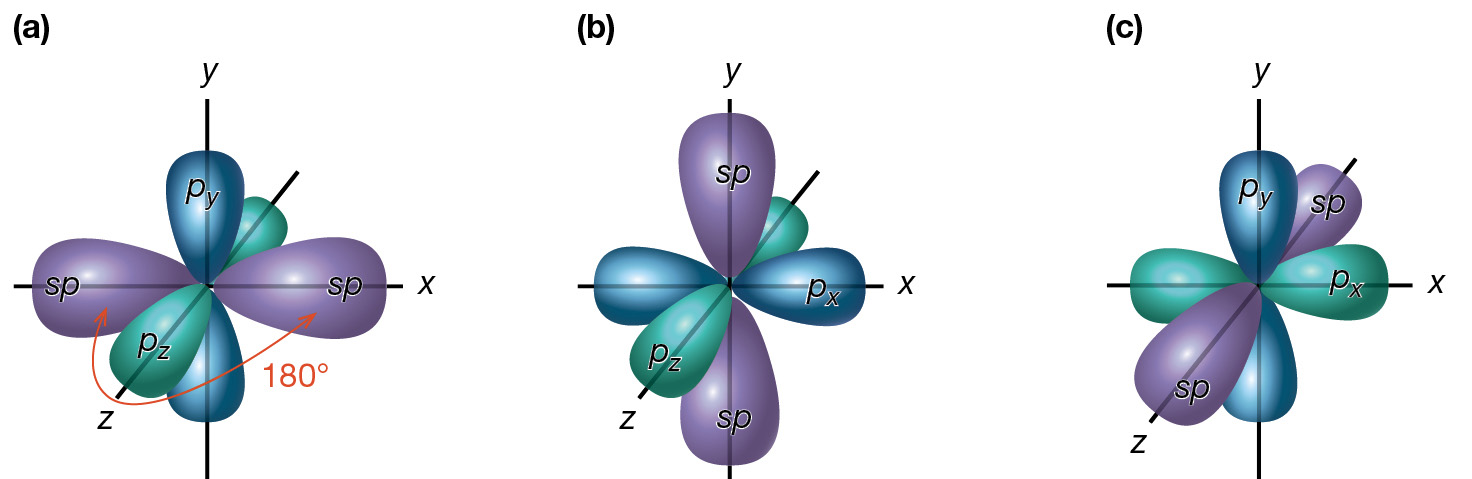
In Figure 3-18, the line containing the hybrid orbitals is the x-axis, and the unhybridized p orbitals are the py and pz. All four of these orbitals are shown together on the same sp-hybridized atom in Figure 3-19a. Two other orientations of an sp-hybridized atom are shown in Figure 3-19b and 3-19c. Notice in the three orientations that the unhybridized p orbitals are aligned along different axes, so they receive different labels.
More information
Three illustrations show the different ways of depicting an s p-hybridized atom. Each illustration shows x, y, and z axes in a plane. In the first illustration, the dumbbell shaped sp orbital is aligned along the x axis, the dumbbell shaped p y orbital is aligned along the y axis, and the dumbbell shaped p z orbital is aligned along the z axis. A curved arrow from one lobe of the s p orbital to the other is labeled “180 degrees.” In the second illustration, the dumbbell shaped sp orbital is aligned along the y axis, the dumbbell shaped p x orbital is aligned along the x axis, and the dumbbell shaped p z orbital is aligned along the z axis. In the third illustration, the dumbbell shaped sp orbital is aligned along the z axis, the dumbbell shaped p y orbital is aligned along the y axis, and the dumbbell shaped p x orbital is aligned along the x axis. The caption reads, “Three different but equivalent depictions of an s p-hybridized atom: a. An sp-hybridized atom has two sp hybrid A Os directed 180 degrees apart and two unhybridized p orbitals. In this depiction, the sp hybrid orbitals are aligned along the x axis, indicating that the p x orbital was used for hybridization. b. In this depiction, the p y orbital was used for hybridization. c. In this depiction, the p z orbital was used for hybridization. In all cases, the small lobes of the hybrid A Os are omitted for clarity.”
FIGURE 3-19Different orientations of ansp-hybridized atom In all three orientations, the sp hybrid orbitals (shown in purple; small lobes are omitted) lie along the same line and point 180° apart, and the two unhybridized p orbitals are perpendicular to that line. The sp hybrid orbitals lie along (a) the x-axis, (b) the y-axis, and (c) the z-axis.
CONNECTIONS 3.6
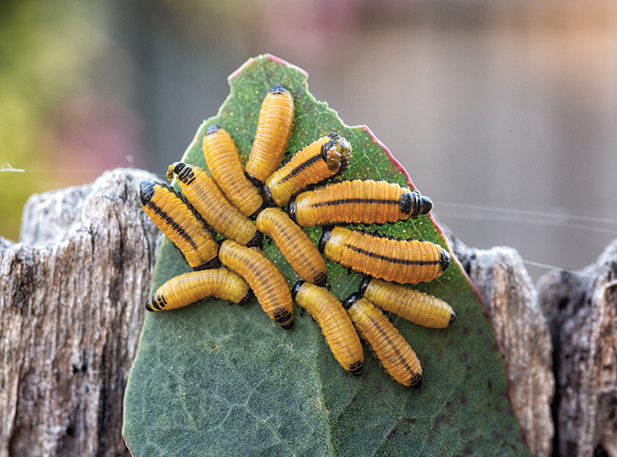
A useful poison HCN (Solved Problem 3.5, p. 126) is hydrogen cyanide, also called hydrocyanic acid. It is used industrially to make precursors of some polymers such as poly(methyl methacrylate) and nylon-6,6. HCN is poisonous, and the larvae of the eucalyptus leaf beetle release the compound as a defense mechanism.
More information
A photo shows seven larvae of eucalyptus leaf beetles clustered together on a leaf. The larvae are yellow with black spots on either end.
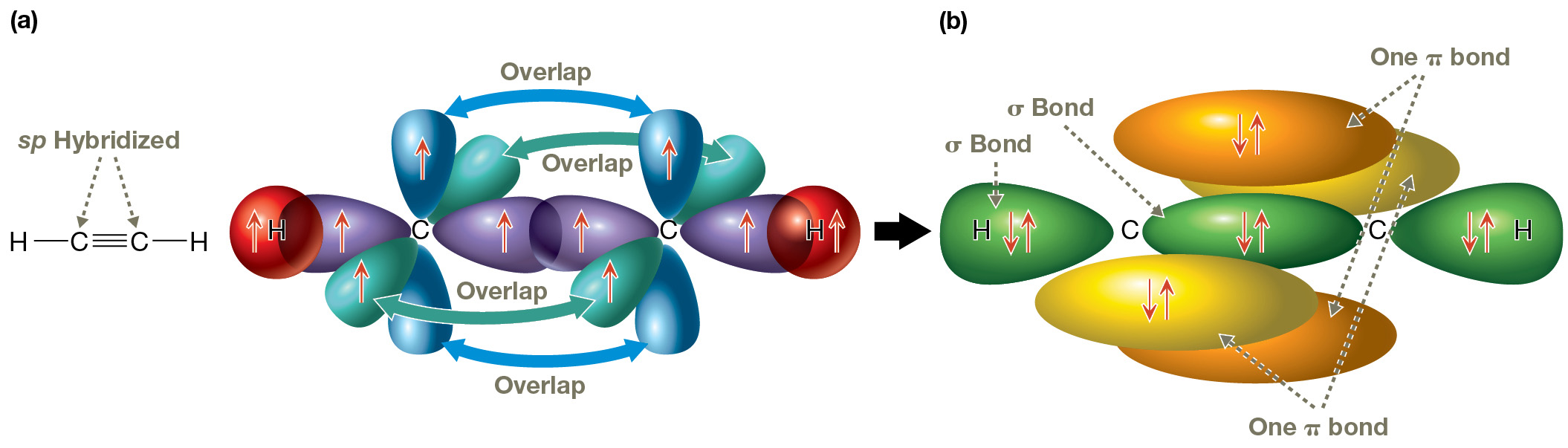
The VB picture of HC≡CH is presented in Figure 3-20 (next page). Figure 3-20a shows the contributed valence orbitals and valence electrons. Each H atom (red) contributes a half-filled 1s orbital. Each sp-hybridized C atom contributes two sp hybrid orbitals and two unhybridized p orbitals. σ Overlap occurs along each of the two H—C bonding axes and along the C—C bonding axis. π Overlap involving the two py orbitals (blue) occurs above and below the C—C bonding axis. In addition, π overlap occurs with the two pz orbitals (teal) in front of and behind the bonding axis. Figure 3-20b shows the resulting bonds. Three σ bonds (green) appear in the molecule: two H—Cσ bonds and one C—Cσ bond. There are also two C—Cπ bonds (one orange and one yellow).
More information
Two illustrations show the overlapping of atomic orbitals in a molecule of ethyne. The first illustration shows a molecule of ethyne, where a carbon atom is bonded to another carbon atom by a triple bond. Each carbon atom is bonded to a hydrogen atom by a single bond. Arrows pointing to the two carbon atoms read, “sp hybridized.” Another illustration shows a molecule of ethyne where each carbon atom has two purple lobes around it, aligned along the directions of its bonds. Each lobe has one electron. Each carbon atom also has two dumbbell shaped orbitals, one in green and the other in blue. In each of the two dumbbell shaped orbitals, one of the lobes has one electron. Around each hydrogen atom is a red spherical orbital. One purple orbital from each carbon overlaps the other in the carbon-carbon bond, and one purple orbital from each carbon overlaps the red orbital from hydrogen in each carbon-hydrogen bond. Four curved two-way arrows connecting the corresponding lobes of the green and blue dumbbell shaped orbitals read, “overlap.” An arrow leads from this illustration to the next. An ethyne molecule is shown with this resulting orbitals. A green oval orbital with two electrons is between the two carbon nuclei. A green lobe orbital extends outward in the same plane from each carbon nuclei. They also have two electrons and surround the hydrogen nuclei. The green orbitals are labeled as sigma bonds. Above and below the green oval orbital are two orange ovals labeled one pi bond. The one above has two electrons. In front of and behind the green oval orbital are two yellow ovals labeled one pi bond. The one in front has two electrons.
FIGURE 3-20The valence bond picture of ethyne (a) Contributing valence orbitals and valence electrons in HC≡CH. σ Overlap takes place along each of the two H─C bonding axes and along the C─C bonding axis. The adjacent py orbitals (blue) undergo π overlap, as do the adjacent pz orbitals (teal). (b) Bonds formed by the build-up of the orbitals: Three σ bonds (green) and two π bonds (orange and yellow). The C≡C triple bond consists of one σ bond and two π bonds.
The VB picture of ethyne in Figure 3-20b illustrates that the triple bond consists of one σ bond and two π bonds, an outcome that is true for other triple bonds, too:
Any triple bond consists of one σ bond and two π bonds.
Another example of a triple bond is illustrated in Solved Problem 3.5.
SOLVED PROBLEM 3.5
How to draw the valence bond picture of a molecule that has a triple bond
Break It Down Draw the VB picture of HCN. How many σ bonds does the molecule have? How many π bonds?
Think
Solve
What electron geometry and hybridization do the C and N atoms have?
➤
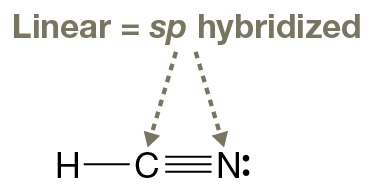
Both C and N atoms have linear electron geometry and are sp-hybridized.
More information
The structural formula of H C N is shown. A carbon atom is single bonded to a hydrogen atom and triple bonded to a nitrogen atom. The nitrogen atom also has a lone pair of electrons. The carbon atom and nitrogen atom are labeled “linear equals sp hybridized.”
What valence orbitals does each atom contribute? How many valence electrons does each atom contribute?
➤
The H atom contributes a 1s orbital and one valence electron. Both the C and N atoms contribute two hybrid orbitals, 180° apart, as well as two p orbitals perpendicular to the hybrid orbitals. The C atom contributes four valence electrons, whereas the N atom contributes five.
How many regions of orbital overlap occur along the bonding axes? How many occur on opposite sides of the bonding axis? How many valence electrons occupy each orbital?
➤
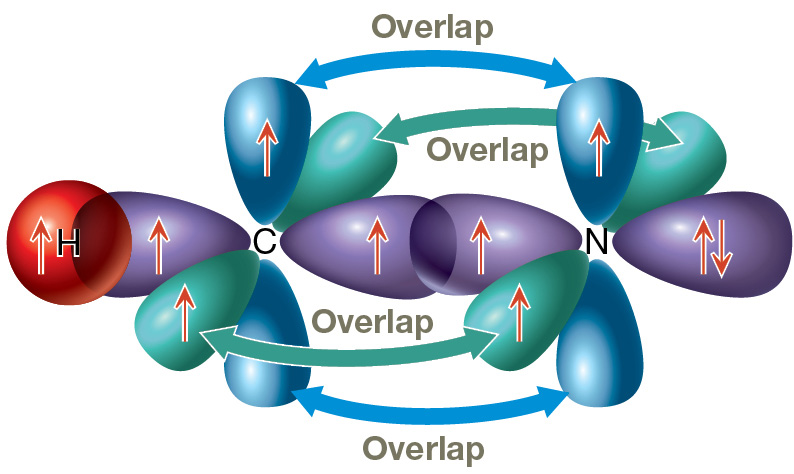
Two pairs of orbitals overlap along bonding axes: one along the H—C bonding axis and one along the C—N bonding axis. Two pairs of p orbitals overlap on opposite sides of the C—N bonding axis. All four orbitals contributed by C are half-filled (Fig. 3-18). Of the orbitals contributed by N, one hybrid orbital and both p orbitals are half-filled; the other hybrid orbital is completely filled.
More information
An illustration shows the overlapping of orbitals of H C N. The H C N molecule is shown where the carbon atom and the nitrogen atom each have two purple lobes around it, aligned along the directions of its bonds. The lobes around carbon each have one electron. One of the lobes around nitrogen has one electron and the other has two electrons. The carbon atom and the nitrogen atom also each have two dumbbell shaped orbitals, one in green and the other in blue. In each of the two dumbbell shaped orbitals, one lobe has one electron and the other lobe has none. Around the hydrogen atom is a red spherical orbital. One purple orbital from the carbon and one from the nitrogen overlap each other in the carbon-nitrogen bond. One purple orbital from the carbon overlaps the red orbital from hydrogen. Four curved two-way arrows connecting the corresponding lobes of the green and blue dumbbell shaped orbitals read, “overlap.”
What type of bond does each pair of overlapping half-filled orbitals produce?
➤
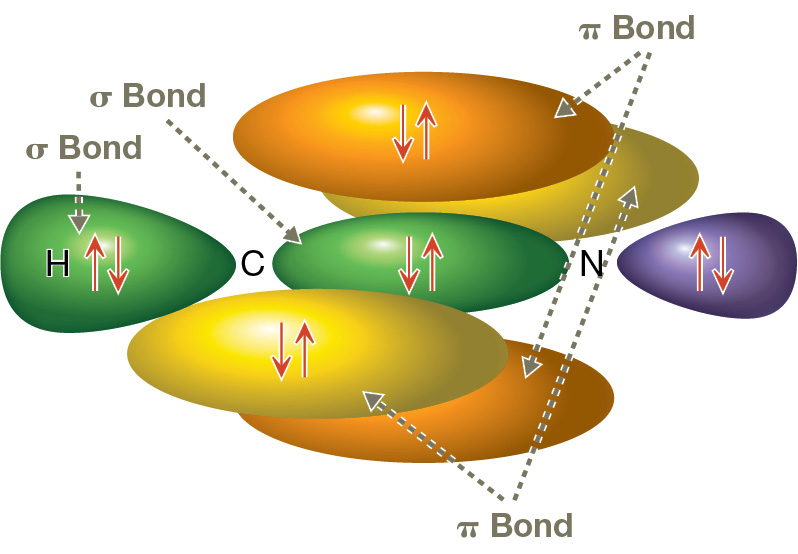
Each pair of half-filled orbitals overlapping along a bonding axis produces a σ bond (green). Each pair of half-filled orbitals overlapping on opposite sides of a bonding axis produces a π bond (orange and yellow). There is one nonoverlapping orbital that contains a lone pair of electrons (purple). Thus, there are two σ bonds and two π bonds in the molecule.
More information
An illustration shows the resulting orbitals of H C N. A green oval orbital with two electrons is between the carbon and nitrogen nuclei. A green lobe orbital extends outward in the same plane from the carbon nucleus. It has two electrons and surrounds the hydrogen nucleus. A purple orbital with two electrons extends outward from the nitrogen nucleus. The green orbitals are labeled as sigma bonds. Above and below the green oval orbital are two orange ovals labeled pi bond. The one above has two electrons. In front of and behind the green oval orbital are two yellow ovals labeled pi bond. The one in front has two electrons.
Try ItDraw the valence bond picture of HC≡C—CH2—C≡N. How many σ bonds does the molecule have? How many π bonds?
YOUR TURN 3.9
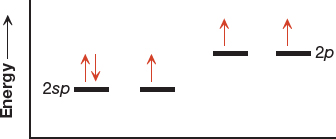
Redraw the energy diagram from Figure 3-18b, assuming an uncharged N atom. Which orbitals are half-filled? Completely filled? Empty? Do your answers agree with the statement in Solved Problem 3.5?
SHOW ANSWERHIDE ANSWER
One hybrid orbital is completely filled and one is half-filled, both unhybridized p orbitals are half-filled, and no orbitals are empty, in agreement with Solved Problem 3.5.
More information
Hybrid orbital diagram. Energy increases from bottom to top. Two orbitals labeled as 2 s p with the first orbital filled with an up and down arrow, the second orbital half filled with an up arrow. Another higher two orbitals labeled 2 p each half filled with an up arrow.
describes an atom in which the valence s orbital mixes with one valence p orbital to produce two sp hybrid orbitals. Atoms that have a linear electron geometry are sp-hybridized. (Ch. 3)