Section 3.3 Objectives
You will be able to:
- Draw the VB picture of a molecular species containing an atom that has a tetrahedral electron geometry and a lone pair of electrons.
- Identify the type of orbital that holds such a lone pair of electrons.
In Section 3.2, we used VB theory to describe alkanes, which have no lone pairs of electrons. Let’s see how to apply VB theory to methanol, CH3OH, in which the O atom has two lone pairs of electrons (Figure 3-8).
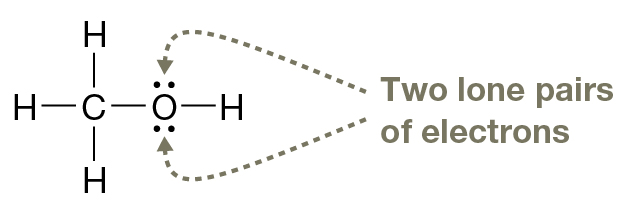
The structural formula of methanol is shown. A single carbon atom is linked by single bonds to three hydrogen atoms. The carbon is also linked by a single bond to and O H. The oxygen atom has two lone pairs of electrons.
As in applying VB theory to alkanes, we first determine the valence orbitals contributed by each atom in CH3OH and identify the valence electrons occupying those orbitals (Figure 3-9a). The C atom has a tetrahedral electron geometry, so as we learned in Section 3.2, it is sp3-hybridized and contributes four half-filled sp3 hybrid orbitals. The O atom, with its four electron groups (two single bonds and two lone pairs), also has a tetrahedral electron geometry: it, too, is sp3-hybridized and contributes four sp3 hybrid orbitals. Unlike C, the O atom contributes six valence electrons, so two of the four hybrid orbitals are completely filled and the other two remain half-filled (see Your Turn 3.3). Finally, each of the four H atoms contributes a half-filled 1s orbital.
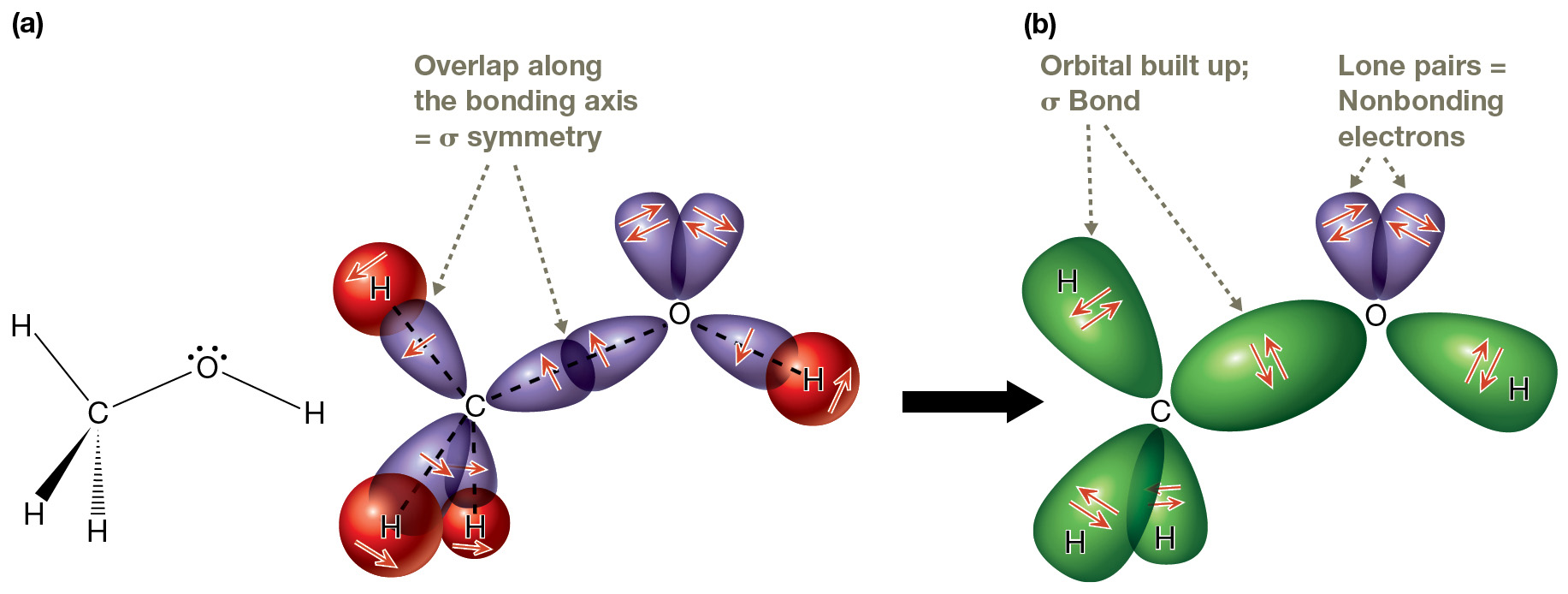
An illustration shows the structure and orbitals of methanol. In the structural diagram, a single carbon atom is linked by single bonds to three hydrogen atoms. One H is linked by a line, one H is linked by a solid wedge, and one H is linked by a dashed wedge. The carbon is also linked by a single bond to an O H. The oxygen atom has two lone pairs of electrons. An illustration to the right shows the same molecule but with atomic orbitals. All hydrogen atoms have a spherical orbital around their nucleus with one electron. The carbon atom has four lobes around its nucleus. Each lobe has one electron. The oxygen atom has four lobes around its nucleus. Two of these lobes have two electrons and do not overlap with any other orbitals. The other two lobes have one electron each. One lobe overlaps with a hydrogen orbital and one overlaps with a carbon orbital. The three remaining carbon lobes each overlap with a hydrogen orbital. Overlapping along the bonding axes characterizes sigma symmetry. An arrow points from this illustration to a third illustration. This shows the same molecule but with the resulting orbitals. Between the carbon nucleus and the oxygen nucleus is a large oval orbital with two electrons. The carbon atom has three other large teardrop shaped orbitals that extend in different directions. Each of these orbitals has two electrons and surrounds a hydrogen nucleus. The oxygen atom also has three other orbitals extending in different directions. One is a large orbital that contains two electrons and surrounds a hydrogen nucleus. The other two are smaller lobes that have two electrons. The are labeled as lone pairs with nonbinding electrons. All other orbitals are labeled as sigma bonds.
YOUR TURN 3.3
Redraw the energy diagram from Figure 3-6b (p. 116) so that it describes an oxygen atom that has tetrahedral electron geometry. How many hybrid orbitals are completely filled? How many are half-filled? How many are empty? Do your answers agree with Figure 3-9a?
Two hybrid orbitals are completely filled, two are half-filled, and no orbitals are empty, in agreement with Figure 3-9a.
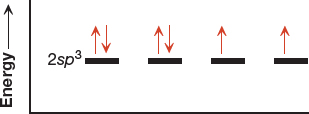
Hybrid orbital diagram. Energy increases from top to bottom. The diagram is for a 2 s p 3 with four orbitals. The first two orbitals are filled with an up and down arrow, the second two orbitals are half filled with only up arrows.
Figure 3-9b shows the orbitals after taking into account the buildup in each region where half-filled orbitals overlap is considered. The five regions of overlap along the bonding axes result in five σ bonds (green). The two remaining orbitals (purple) represent the hybrid orbitals from O that were shown to be completely filled in Figure 3-9a. Those hybrid orbitals do not overlap with orbitals from another atom, so no buildup occurs. Those hybrid orbitals therefore end up holding the two lone pairs of electrons on O.
SOLVED PROBLEM 3.3
How to draw a valence bond picture when a tetrahedral atom has a lone pair
Break It Down As we learned in Section 1.12, a carbon atom has a formal charge of –1 if it has three bonds and a lone pair of electrons. With that in mind, draw the VB picture of CH3CH–CH3. How many σ bonds does the ion have?
|
Think |
Solve |
|
|
What is the complete Lewis structure of the species? How do you include dash–wedge notation? (You might construct a model to better visualize it.) |
➤ |
In the Lewis structure, the two terminal carbons have formal charge of 0, so they each have four bonds and no lone pairs. The central carbon has a –1 formal charge, giving it three bonds and one lone pair. Each of the three carbons has a tetrahedral electron geometry, which is shown in the dash–wedge notation. 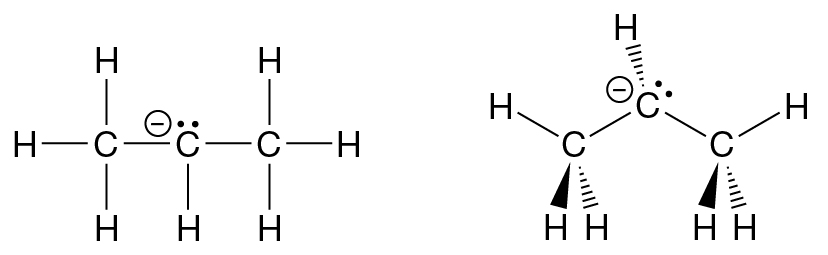
More informationA two part diagram showing the structural formula of C H 3 C H minus C H 3. The first part shows a three carbon chain. Carbon 1 and 3 are each linked by single bonds to three hydrogen atoms and to middle carbon atom. Carbon 2, the middle carbon, is linked by single bonds to the other two carbons and to a hydrogen atom. Carbon two also has a lone pair of electrons and is marked with a negative charge. The second part of this diagram shows the same molecule but the bonds are shown at different angles. H C C C H are linked together by straight lines to form the shape of a W. The other two hydrogen atoms linked to carbon 1 are connected by wedges. One wedge is solid and one is dashed. The same is true for the hydrogen atoms linked to carbon 3. The hydrogen atom linked to carbon 2 is connected by a dashed wedge. |
|
What valence orbitals does each atom contribute? How many valence electrons does each atom contribute? |
➤ |
Each H atom contributes a half-filled 1s orbital. Because each of the three C atoms has a tetrahedral electron geometry, each is sp3-hybridized and contributes four hybrid orbitals. Each uncharged C contributes four valence electrons, making each hybrid orbital half-filled. The negatively charged C contributes one additional valence electron, for a total of five. These occupy the four hybrid orbitals to give three half-filled hybrid orbitals and one that is completely filled (see Your Turn 3.4). |
|
How many regions of orbital overlap are there along bonding axes? What type of symmetry does that kind of overlap characterize? |
➤ |
There are nine regions of orbital overlap along the bonding axes: seven along the H—C bonding axes and two along the C—C bonding axes. Each overlap along a bonding axis characterizes σ symmetry. 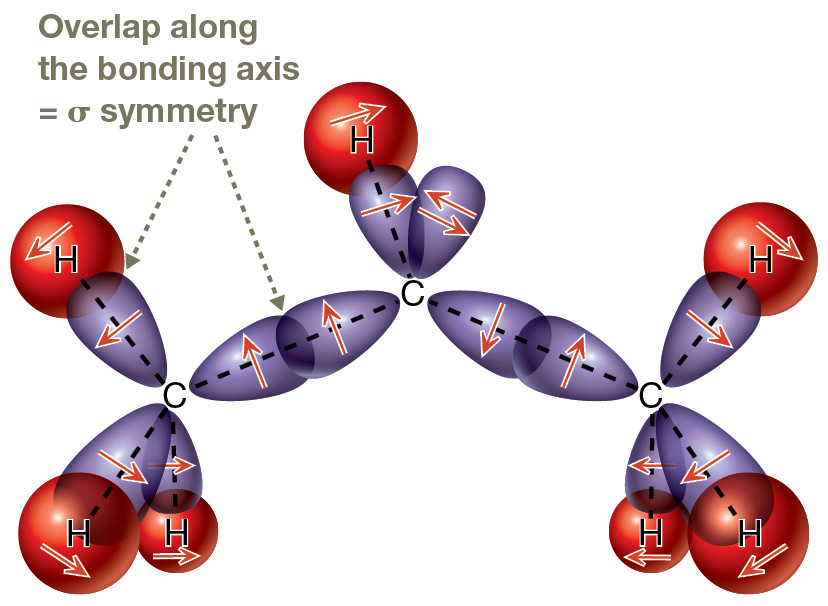
More informationAn illustration that shows the orbitals of C H 3 C H minus C H 3. Each of the seven hydrogen atoms are shown as a spherical orbitals with one electron that surrounds a nucleus. Each of the three carbon atoms has four lobes that surround the nucleus. The lobes of carbon 1 and carbon 3 each contain one electron. Three of the lobes around carbon 2 contain 1 electron and the fourth lobe contains two electrons. One of the lobes of carbon 1 overlaps with a lobe of carbon 2. A different lobe of carbon 2 overlaps with a lobe of carbon 3. Each of the other lobes that contain one electron overlaps with a hydrogen orbital. The hydrogen nuclei are linked to the carbon nuclei by dashed lines. The only orbital that is not overlapping with another is the lobe off of carbon 2 that contains two electrons. A label pointing to the dashed line reads overlap along the bonding axes equals sigma symmetry. |
|
How is each resulting orbital derived from the overlapping orbitals? |
➤ |
Each pair of overlapping orbitals results in a new orbital (green) that has been built up where the overlap occurs. A pair of electrons filling such an orbital characterizes a σ bond, and there are nine such σ bonds. The remaining orbital, shaded purple, does not overlap with another orbital; it contains the lone pair of electrons. 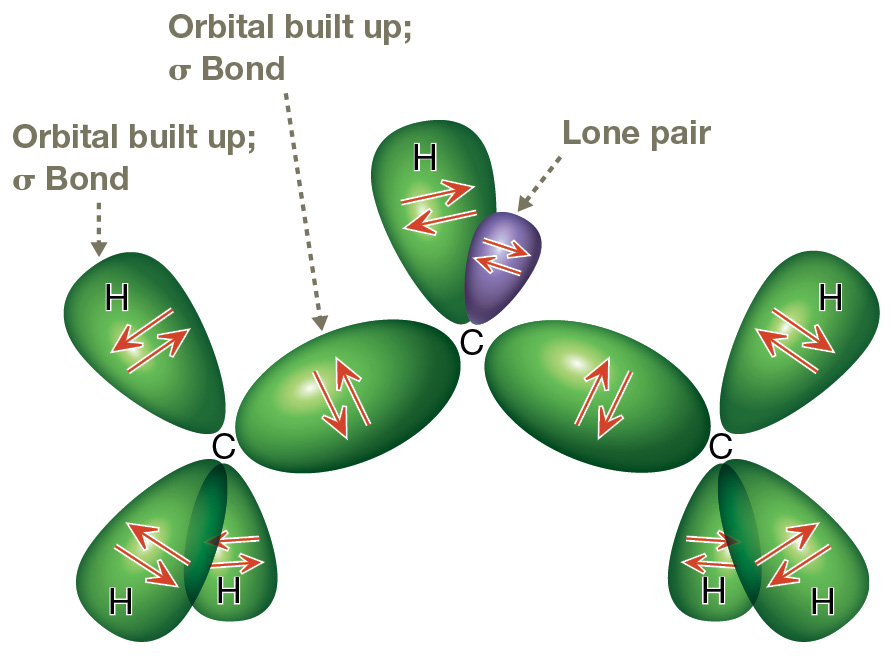
More informationAn illustration that shows the resulting orbitals of C H 3 C H minus C H 3. The orbital between the carbon 1 nucleus and the carbon 2 nucleus is a large oval with two electrons. It is labeled orbital built up sigma bond. The orbital between the carbon 2 nucleus and the carbon 3 nucleus is a large oval with two electrons. There are three teardrop shaped orbitals extending from the carbon 1 nucleus in different directions. Each orbital contains two electrons and surrounds a hydrogen nucleus. There are two teardrop shaped orbitals extending from the carbon 2 nucleus in different directions. One orbital is large, contains two electrons, and surrounds a hydrogen nucleus. The other orbital is small, contains two electrons, and is labeled lone pair. There are three teardrop shaped orbitals extending from the carbon 3 nucleus in different directions. Each orbital contains two electrons and surrounds a hydrogen nucleus. |
|
Try ItDraw the VB picture of CH3NH–. How many σ bonds does the molecule have? |
||
YOUR TURN 3.4
Redraw the energy diagram from Figure 3-6b (p. 116) so that it describes a carbon atom having a −1 charge. How many hybrid orbitals are completely filled? How many are half-filled? How many are empty? How do your answers compare with the numbers given in Solved Problem 3.3?
One hybrid orbital is completely filled, three are half-filled, and no orbitals are empty, in agreement with Solved Problem 3.3.
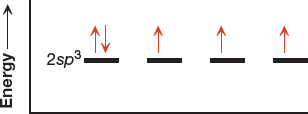
Hybrid orbital diagram. Energy increases from top to bottom. The diagram is for a 2 s p 3 with four orbitals. The first orbital is filled with an up and down arrow, the last three orbitals are half filled with only up arrows.