3.9 Hybridization, Bond Characteristics, and Effective Electronegativity
Section 3.9 Objectives
You will be able to:
Determine which of two atoms, differing only in their hybridization, has the greater effective electronegativity.
Identify the relative lengths and strengths of bonds that differ by the hybridization of the atoms involved in the bond.
Thus far, we have not treated the various types of hybrid orbitals as being significantly different, but their differences do have some important consequences in chemistry. One is the effect on bond length and bond strength:
As the hybridization of an atom goes from sp3 to sp2 to sp, its bonds become shorter and stronger.
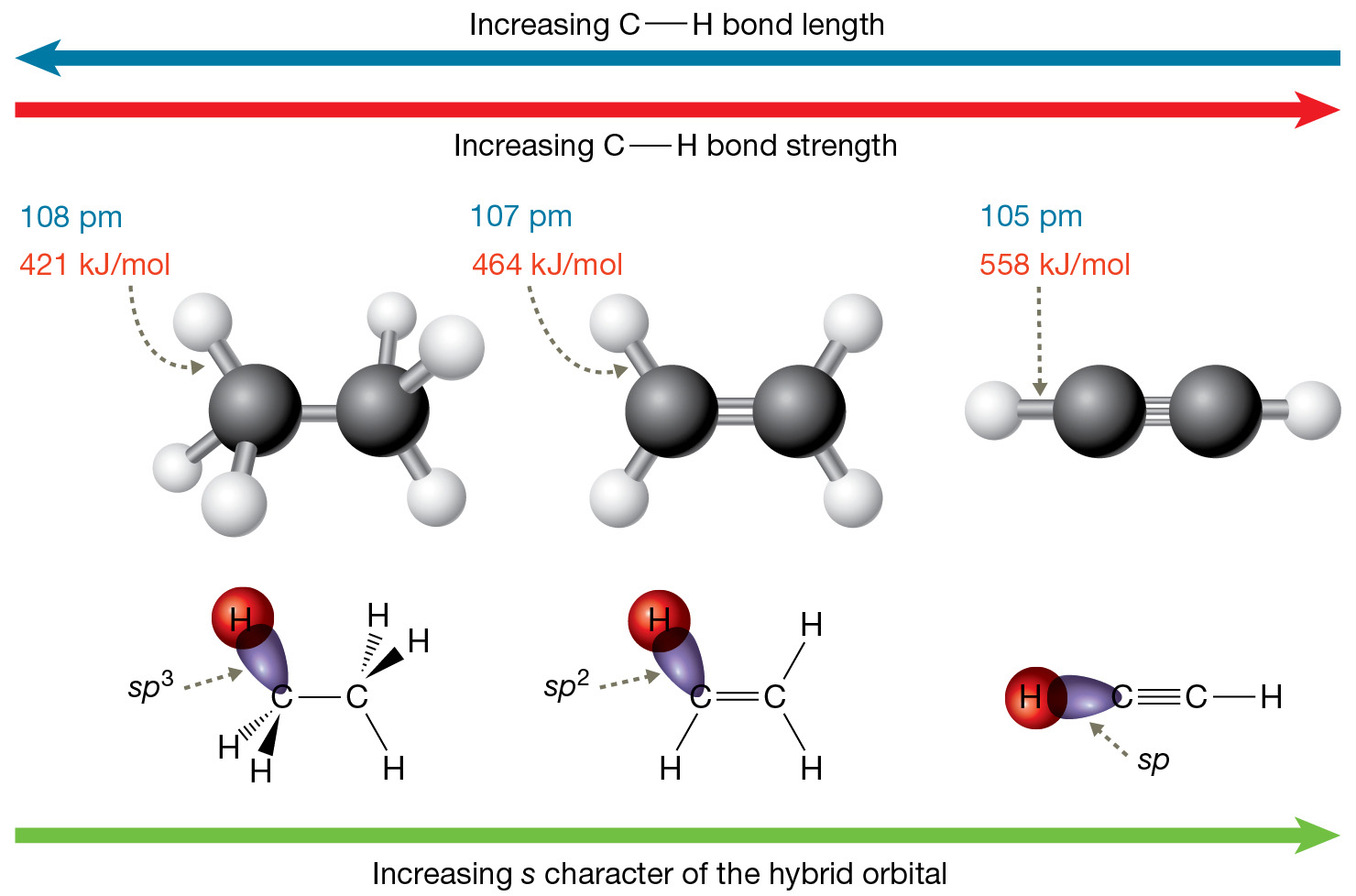
This can be seen in Figure 3-28 (top) with the C—H single bonds in ethane (H3C—CH3), ethene (H2C═CH2), and ethyne (HC≡CH).
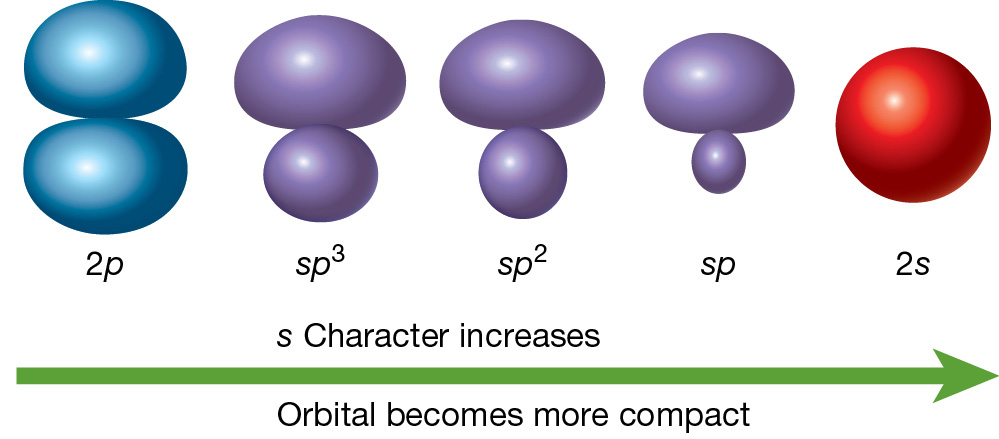
The main difference in these molecules is the hybridization of the orbital from C (Fig. 3-28, bottom). More specifically, the s-character of that orbital increases going from sp3 to sp2 to sp. A 2s orbital is more compact than a 2p orbital, so the hybrid orbital becomes more compact as the s-character increases, as illustrated in Figure 3-29 (next page). With a shorter hybrid orbital, bonds made from it must also be shorter in order to maintain sufficient orbital overlap. And, as we learned in Section 1.4, shorter bonds connecting the same atoms are typically stronger.
More information
An illustration compares the carbon-hydrogen bond length and strength and the s character of the hybrid A O in ethane, ethene, and ethyne. At the upper end of the illustration, a red arrow from the left to right is labeled “increasing C-H bond strength,” and a blue arrow from the right to left is labeled “increasing C-H bond length.” At the lower end of the illustration is a green arrow labeled “increasing s character of the hybrid A O.” The illustration shows the ball-and stick models and the corresponding condensed structural formulas of ethane, ethene, and ethyne, from left to right. The structure of ethane shows a carbon atom bonded to another carbon atom by a single bond. Each carbon atom is bonded to one hydrogen atom by a solid line, to another hydrogen atom by a solid wedge, and to a third hydrogen atom by a dashed wedge. In the ball-and-stick model of ethane, an arrow pointing to the carbon-hydrogen bond reads, “108 picometers, 421 kilojoules per mole.” In the structural formula of ethane, one of the carbon-hydrogen bonds is depicted by a purple lobe representing the s p 3 orbital in carbon overlapping with a spherical red lobe representing the s orbital in hydrogen. The structure of ethene shows a carbon atom bonded to another carbon atom by a double bond. Each carbon atom is bonded to two hydrogen atoms. In the ball-and-stick model of ethene, an arrow pointing to the carbon-hydrogen bond reads, “107 picometers, 464 kilojoules per mole.” In the structural formula of ethene, one of the carbon-hydrogen bonds is depicted by a purple lobe representing the s p 2 orbital in carbon overlapping with a spherical red lobe representing the s orbital in hydrogen. The structure of ethyne shows a carbon atom bonded to another carbon atom by a triple bond. Each carbon atom is bonded to one hydrogen atom. In the ball-and-stick model of ethyne, an arrow pointing to the carbon-hydrogen bond reads, “105 picometers, 558 kilojoules per mole.” In the structural formula of ethyne, one of the carbon-hydrogen bonds is depicted by a purple lobe representing the s p orbital in carbon overlapping with a spherical red lobe representing the s orbital in hydrogen. The caption reads, “Relationship between hybridization, bond length, and bond strength, as shown on the top: The bond distances decrease and bond energies increase for the carbon-hydrogen bonds on going from ethane to ethene to ethyne. As shown in the bottom, in all cases, the carbon-hydrogen bond involves the overlap of the 1 s orbital of a hydrogen atom with a hybrid orbital from carbon. The s character of the carbon atom’s hybrid orbital increases in the order s p 3, s p 2, s p.”
FIGURE 3-28Relationship between hybridization, bond length, and bond strength (Top) The C─H bonds become shorter and stronger on going from ethane to ethene to ethyne. (Bottom) In all cases, the C─H bond involves the overlap of the 1s orbital of a H atom with a hybrid orbital from C. The s-character of the C atom’s hybrid orbital increases in the order sp3 < sp2 < sp.More information
An illustration shows five orbitals 2 p, s p 3, s p 2, s p, and 2 s from left to right. An arrow pointing from the left to right shows a note that reads, “s Character increases. Orbital becomes more compact.” The 2 p orbital is dumbbell shaped. Both the lobes are equal in size. The s p 3 orbital shows a lower lobe that is smaller than its upper lobe. The s p 2 orbital shows a lower lobe that is smaller than the lower lobe of the s p 3 orbital. The sp orbital shows a lower lobe that is much smaller than the lower lobe of the s p 2 orbital and an upper lobe that is slightly smaller than the upper lobe of the s p 2 orbital. The 2 s orbital is spherical and is shaded uniformly in red. The caption reads, “Comparison of pure and hybrid orbitals: As s character increases, an orbital becomes more compact and therefore holds electrons closer to the nucleus, on average.”
FIGURE 3-29Comparison of pure and hybrid orbitals As s-character increases, an orbital becomes more compact and therefore holds electrons closer to the nucleus, on average.
YOUR TURN 3.14
Review the percent s-character in each of the hybrid orbitals in Figure 3-29, and write that percentage above the appropriate orbital.
SHOW ANSWERHIDE ANSWER
sp3 orbitals are 25% s, sp2 orbitals are 33.3% s, and sp orbitals are 50% s.
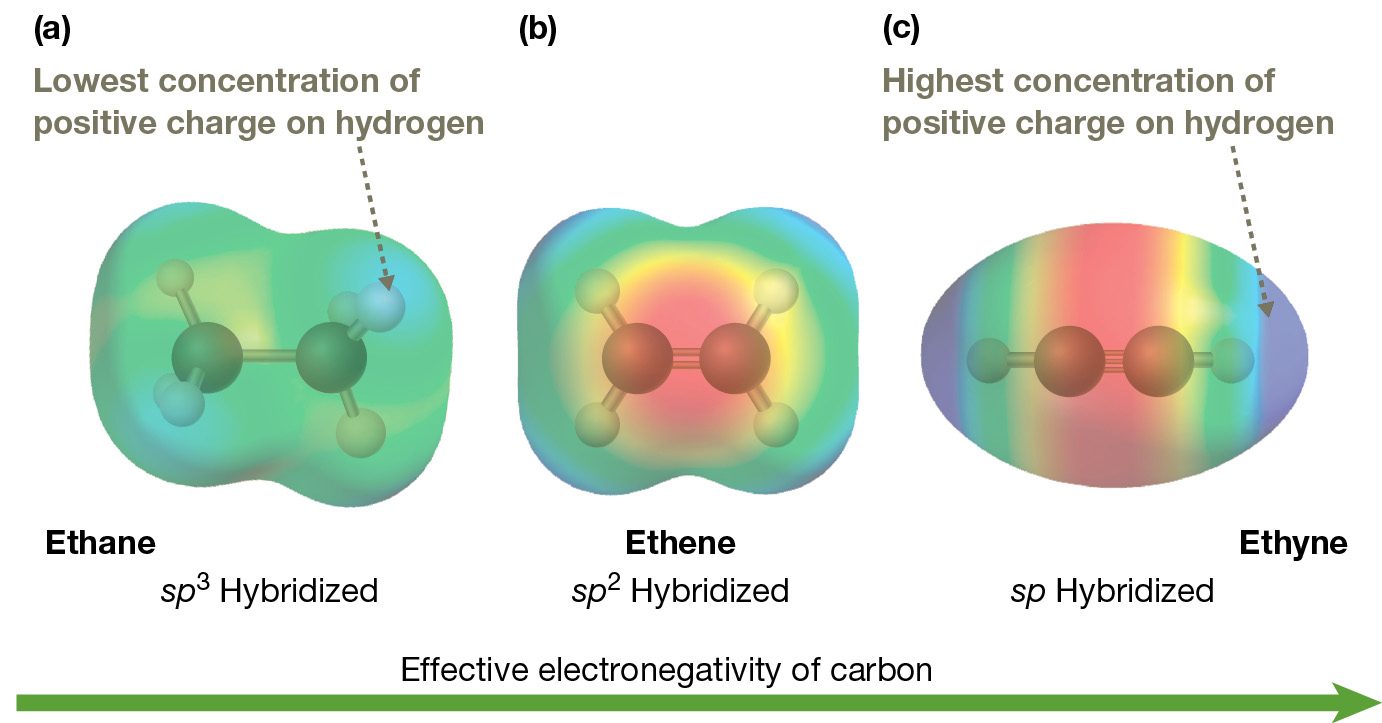
In addition to bond lengths and bond strengths, hybridization can also affect bond polarity. This can be seen in the electrostatic potential maps in Figure 3-30, where the concentration of positive charge (blue) on H increases on going from ethane (sp3) to ethene (sp2) to ethyne (sp).
More information
Three illustrations show the electrostatic potential maps and hybridization of ethane, ethene, and ethyne. Each structure is represented by a ball-and-stick model enclosed in an electrostatic potential map. The structure of ethane shows a two-carbon chain where each carbon is bonded to three hydrogen atoms. The skewed dumbbell shaped electrostatic map of ethane is shaded in turquoise around the hydrogen atoms and in green everywhere else. An arrow pointing to the turquoise region reads, “Lowest concentration of positive charge on hydrogen.” Text below the illustration reads, “Ethane: s p 3 Hybridized.” The structure of ethene shows two carbon atoms bonded by a double bond. Each carbon atom is bonded to two hydrogen atoms. The dumbbell shaped electrostatic potential map of ethene is shaded in blue around the regions representing the hydrogen atoms, and in red around the carbon-carbon double bond. Moving from the center to the edges, the map is shaded in yellow, green, and turquoise. Text below the illustration reads, “Ethene: s p 2 Hybridized.” The structure of ethyne shows two carbon atoms bonded by a triple bond. Each carbon atom is bonded to one hydrogen atom. The oval shaped electrostatic potential map of ethyne is shaded in blue around the regions representing the hydrogen atoms, and in red around the carbon-carbon triple bond. Moving from the center to the edges, the map is shaded in yellow, green, and turquoise. An arrow pointing to the blue region reads, “Highest concentration of positive charge on hydrogen.” Text below the illustration reads, “Ethyne: s p Hybridized.” The caption reads, Hybridization and effective electronegativity: Electrostatic potential maps of a. ethane, H 3 C-C H 3, b. ethene, H 2 C double bond C H 2, and c. ethyne, H C triple bond C H. Ethyne has the highest concentration of positive charge on hydrogen. Therefore, as the hybridization of carbon goes from s p 3 to s p 2 to s p, the effective electronegativity of carbon increases.
FIGURE 3-30Hybridization and effective electronegativity Electrostatic potential maps of (a) ethane, H3C─CH3, (b) ethene, H2C═CH2, and (c) ethyne, HC≡CH. Ethyne has the highest concentration of positive charge on hydrogen. Therefore, as the hybridization of carbon goes from sp3 to sp2 to sp, the effective electronegativity of carbon increases.
As the hybrid orbital on carbon becomes more compact from increased s-character, electrons occupying that orbital are held closer to the nucleus. The C atom therefore behaves as if its electronegativity is increasing. However, because the nucleus is not changing (it is carbon in all cases), the actual electronegativity is not changing either. Instead, we say that the carbon atom’s effective electronegativity increases. In general:
As the hybridization of an atom goes from sp3 to sp2 to sp (i.e., as the s-character increases), its effective electronegativity increases.
SOLVED PROBLEM 3.8
How to determine relative bond lengths and strengths from atom hybridization
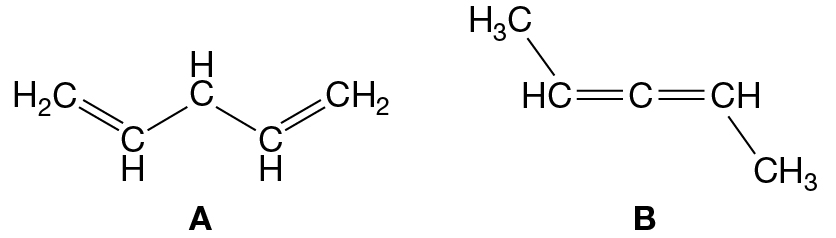
Break It Down In which molecule, A or B, do you think the C═C distances are longer? In which molecule are the C═C bonds stronger?
More information
Two illustrations show the condensed structural formulas of two molecules labeled A and B. The first illustration shows a five-carbon chain with double bonds between carbon atoms 1 and 2, and carbon atoms 4 and 5. Carbon atoms 1 and 5 are each bonded to two hydrogen atoms. Carbon atoms 2, 3, and 4 are each bonded to one hydrogen atom. The second illustration shows a five-carbon chain with double bonds between carbon atoms 2 and 3, and carbon atoms 3 and 4. Carbon atoms 1 and 5 are each bonded to three hydrogen atoms. Carbon atoms 2 and 4 are each bonded to one hydrogen atom.
Think
Solve
What is the hybridization of each atom involved in the C═C bonds?
➤
In A, each C═C bond involves two sp2-hybridized C atoms. In B, each C═C bond involves one sp2-hybridized C atom and one sp-hybridized C atom.
What is the s-character in each of those C atoms? How does the s-character of an atom affect bond length and bond strength?
➤
An sp hybrid orbital has greater s-character (50%) than an sp2 hybrid orbital (33.33%). With greater s-character, hybrid orbitals are more compact, so the C═C bonds in B are shorter and stronger than the ones in A.
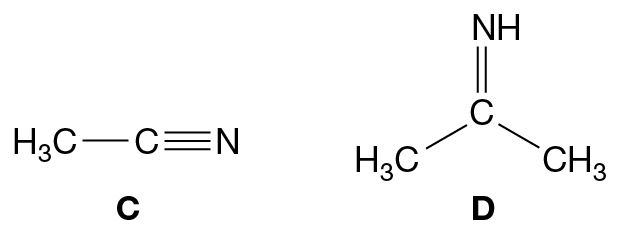
Try It(a) In which molecule, C or D, is the C—C bond shorter? In which molecule is it stronger? Explain. (b) Answer the same questions about the carbon–nitrogen bonds.
More information
An illustration shows the condensed structural formulas of two molecules. Molecule C shows a carbon atom bonded to three hydrogen atoms and a nitrile group. Molecule D shows a three carbon-chain where carbon 2 is bonded to an amine group by a double bond. Carbon 1 and 3 are each bonded to three hydrogen atoms.
Carbyne: The World’s Strongest Material
In Section 3.9, we saw that an atom’s bonds tend to get stronger as the atom’s hybridization goes from sp3 to sp2 to sp. Scientists are looking to take advantage of this property by developing materials composed entirely of sp-hybridized carbon atoms. Because each carbon atom would have a linear geometry, the material, called carbyne, would necessarily consist of one-dimensional chains, a portion of whose structure might be represented as in Figure 3-31.
More information
An illustration shows the condensed structural formula of a segment of the chain in carbyne. The structure shows a ten-carbon chain with triple bonds between carbon atoms 1 and 2, carbon atoms 3 and 4, carbon atoms 5 and 6, carbon atoms 7 and 8, and carbon atoms 9 and 10. Carbons 1 and 10 are each connected to a wavy line representing the rest of the chain.
FIGURE 3-31
In 2013, Professor Boris Yakobson at Rice University carried out a theoretical study on carbyne. He concluded that carbyne is 3 times stiffer than diamond and its tensile strength (i.e., its ability to withstand stretching) is twice that of graphene, the two-dimensional sheet of carbon atoms that wraps into cylinders to form carbon nanotubes (see Chemistry with Chicken Wire in Section 1.3). And that’s saying something, because carbon nanotubes have found applications in toughening materials in everyday use, including those used in tennis racquets and bicycle frames.
More information
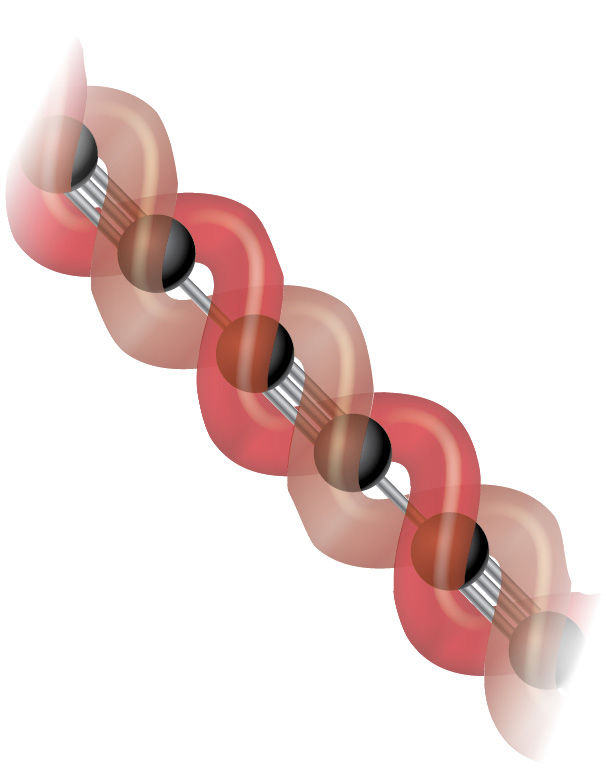
A ball-and-stick model of a segment of a carbyne chain, with two strands intertwined around it. One strand is lighter than the other.
FIGURE 3-32
In addition to its mechanical properties, carbyne is theorized to have other properties that are potentially very useful. For example, it has a band gap (a property that determines its electrical conductivity) that varies from 3.2 to 4.4 eV simply by stretching the chain 10%. And molecules can be attached to the ends of the chain that, when twisted 90°, give the chain the helical highest occupied molecular orbital (see Section 3.11) shown in Figure 3-32 and turn carbyne into a magnetic semiconductor.
Unfortunately, the potential for carbyne is far from being fully realized, in large part because it is difficult to synthesize. To date, researchers have been able to synthesize only very small chains, up to 44 carbon atoms long. If this hurdle can be overcome, however, carbyne has a bright future.