3.8 Strategies for Success: Molecular Modeling Kits, Bond Rotations, and Extended Geometries
Section 3.8 Objectives
You will be able to:
Use a molecular modeling kit to demonstrate rotational characteristics about single and double bonds.
Obtain the extended three-dimensional geometry of a molecule with double bonds by using a molecular modeling kit.
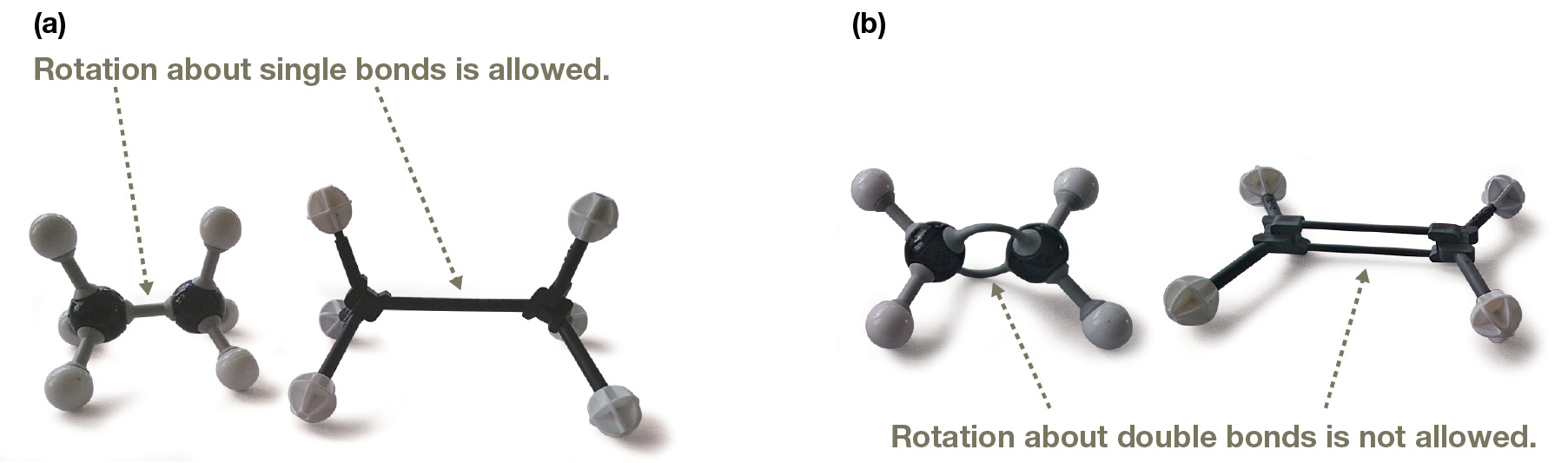
In Section 2.3, we saw that a molecular modeling kit can help us visualize three-dimensional molecules. Molecular models are particularly helpful for studying the rotational characteristics of the single and double bonds discussed in Section 3.7. Figure 3-26 shows molecular models of ethane (H3C—CH3) and ethene (H2C═CH2), constructed using different modeling kits. Take the time to build these two molecules with your own kit and try to rotate one group relative to the other. You will find that your model allows groups to rotate about single bonds but not double bonds, mimicking what takes place in real molecules.
More information
Two photos show ethane and ethene molecules made from different model kits. The first photo shows two ethane molecules, each of which shows a two-carbon chain, with each carbon atom bonded to three hydrogen atoms. The carbon-carbon bond in the first molecule is shorter than the carbon-carbon bond in the second. Arrows pointing to the carbon-carbon bonds show a note that reads, “Rotation about single bonds is allowed.” The second photo shows two ethene molecules, each of which shows two carbon atoms bonded by a double bond. Each carbon atom is bonded to two hydrogen atoms. The carbon-carbon double bond in the first molecule shows two curved lines, and the carbon-carbon double bond in the second molecule shows two parallel lines. Arrows pointing to the carbon-carbon bonds show a note that reads, “Rotation about double bonds is not allowed.” The caption reads, Model kits and rotational characteristics of molecules: a. Molecular models of ethane, H3C-CH3, made with different model kits allow one CH3 group to rotate freely with respect to the second. b. Molecular models of ethene, H2C double bond CH2, show that rotation of one CH2 group relative to the other is restricted.
FIGURE 3-26Modeling kits and rotational characteristics of molecules (a) Molecular models of ethane (H3C─CH3) made with different modeling kits allow one CH3 group to rotate freely with respect to the second. (b) Molecular models of ethene (H2C═CH2) show that rotation of one CH2 group relative to the other is restricted.
Strategies for Success: Molecular Modeling Kits and Single versus Double Bonds: Bond Rotations and Extended Geometry
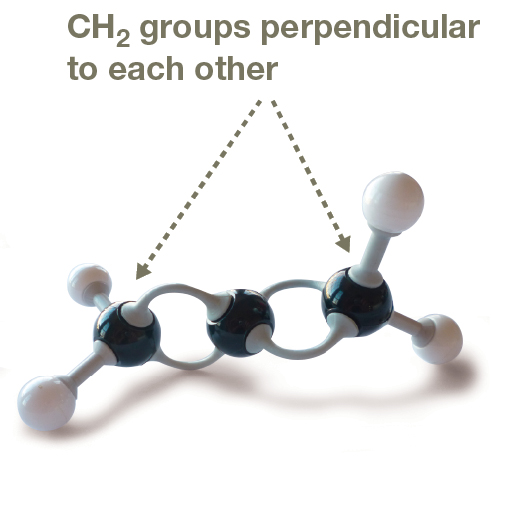
Modeling kits also do a good job of showing accurate extended geometries about double bonds—that is, the three-dimensional location of the atoms directly attached to each double bond. Because of the planar nature of double bonds, for example, it might be tempting to think that the entire propa-1,2-diene (allene, H2C═C═CH2) molecule is planar. Experiments show, however, that one CH2 group is perpendicular to the other. As we can see in Figure 3-27, these are the same results we obtain from molecular modeling kits! (See also Problem 3.5 at the end of the chapter.)
More information
A photo shows a molecule of propa-1,2-diene constructed with a model kit. This structure shows a three-carbon chain where carbon atoms 1 and 3 are each bonded to two hydrogen atoms. Double bonds exist between carbon atoms 1 and 2, and carbon atoms 2 and 3. The double bonds are shows by curved lines. Two arrows pointing to the two C H 2 groups at either end show a note that reads, “C H 2 groups perpendicular to each other.” The caption reads, Molecular modeling kits and extended geometry: A molecular model of propa-1,2-diene, an allene written as H 2 C double bond C double bond C H 2, constructed with a modeling kit shows that the two C H 2 groups are perpendicular to each other, which agrees with experimental results.
FIGURE 3-27Molecular modeling kits and extended geometry A molecular model of propa-1,2-diene (allene, H2C═C═CH2) constructed with a modeling kit shows that the two CH2 groups are perpendicular to each other, which agrees with experimental results.
YOUR TURN 3.13
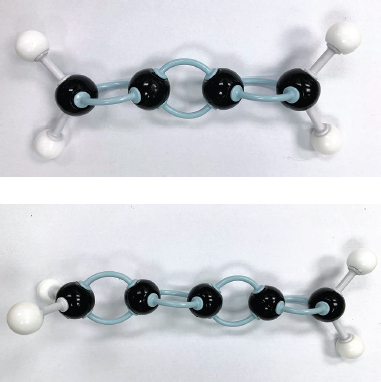
(a) Using a molecular modeling kit, construct a molecule of H2C═C═C═CH2. Is the entire molecule planar? (b) Next, construct a molecule of H2C═C═C═C═CH2. Is that molecule entirely planar?
SHOW ANSWERHIDE ANSWER
(a)H2C═C═C═CH2 is planar (top image).
(b)H2C═C═C═C═CH2 is not planar; one CH2 group is perpendicular to the other (bottom image).
More information
Image shows modeling kit of a and b. Structure a shows a four carbon chain each double bonded to each other, the end carbons are bonded to two hydrogens.The outer double bonds are into the page and the middle double bond is parallel to the page. Structure b shows a five carbon chain. The end carbons each have two hydrogens, the first carbon has hydrogens in and out of the page, and the second end carbon has hydrogens parallel to the page. The first and third double bond are parallel to the page, and the second and fourth bonds are into the page.