ARISTOTLE AND EMPIRICISM
Aristotle was born in Stagira, a small city in the northern Greek kingdom of Macedon. His father was a physician whose skills were so highly regarded that he became the family doctor to the Macedonian King Amyntas II. Therefore, Aristotle grew up in close proximity to royalty and very likely had been a childhood friend of Amyntas’s son, the future King Philip II.
As a bright youngster Aristotle witnessed and absorbed some of his father’s successful medical practices. In later life he wrote glowingly about the greatness of Hippocrates as a physician, so probably these practices involved naturalistic explanations in terms of the four humors. At the very least they emphasized close observation followed by diagnosis, an empirical and practical approach that Aristotle would favor throughout his life. Sadly, his father died when Aristotle was still a youth, and his much older brother-in-law became his guardian. Little is known about those formative years, except that Aristotle clearly showed intellectual gifts; at age 17 he was sent to Athens and admitted to Plato’s Academy, where he rapidly rose through the ranks.*
Although Aristotle’s family had been in close, friendly contact with royalty and members of the aristocracy, they still represented a working class well beneath the aristocratic status of Plato. Furthermore, during Aristotle’s years at the Academy, Macedon had sometimes sided with the enemies of Athens and under the rule of his boyhood acquaintance, now King Philip II, had dramatically expanded its territory to the north. Despite Aristotle’s brilliance and intellectual success, his northern background was therefore suspicious, and his fit at the Academy probably became increasingly uneasy. As noted, this may have been one factor in his decision to leave at the age of 37.
In any case, it was fortunate for posterity that Aristotle left Athens and got involved with various aspects of the empirical, phenomenal world that Plato had de-emphasized. He first crossed the Aegean Sea to Asia Minor, where he had friendly family connections with, and came under the patronage of, a local king named Hermias. In due course, Aristotle married the king’s niece Pythias, and was joined by a gifted young native from the region named Theophrastus (ca. 371–287 B.C.). Theophrastus had previously studied at the Academy in Athens, where he met Aristotle and became first his student, then his friend and lifelong confidant. The two shared a keen interest in the diversity of life forms in the natural world, and began what would become the first recorded and systematic observations in natural history. Aristotle concentrated on hundreds of animal specimens, including a large number of sea creatures, many of which he carefully dissected. Theophrastus gave the same attention to local plant life.
After a few years in Ionia, Aristotle was perhaps surprised to be invited by King Philip to return to the Macedonian capital and become the tutor to his teenaged son Alexander. One would give a great deal to know exactly what transpired between these two historically monumental characters, in a relationship that lasted three years. Chances are, the relationship was usually less formal than the one depicted in Figure 1.6, painted by a much later artist. The evidence suggests that Alexander developed a healthy respect for learning and education, and throughout his later life sent specimens and artifacts from his conquered territories to his old tutor for study. And because Alexander showed powerful military and political aptitudes even as an adolescent, Aristotle may have learned something about these fields from his pupil.
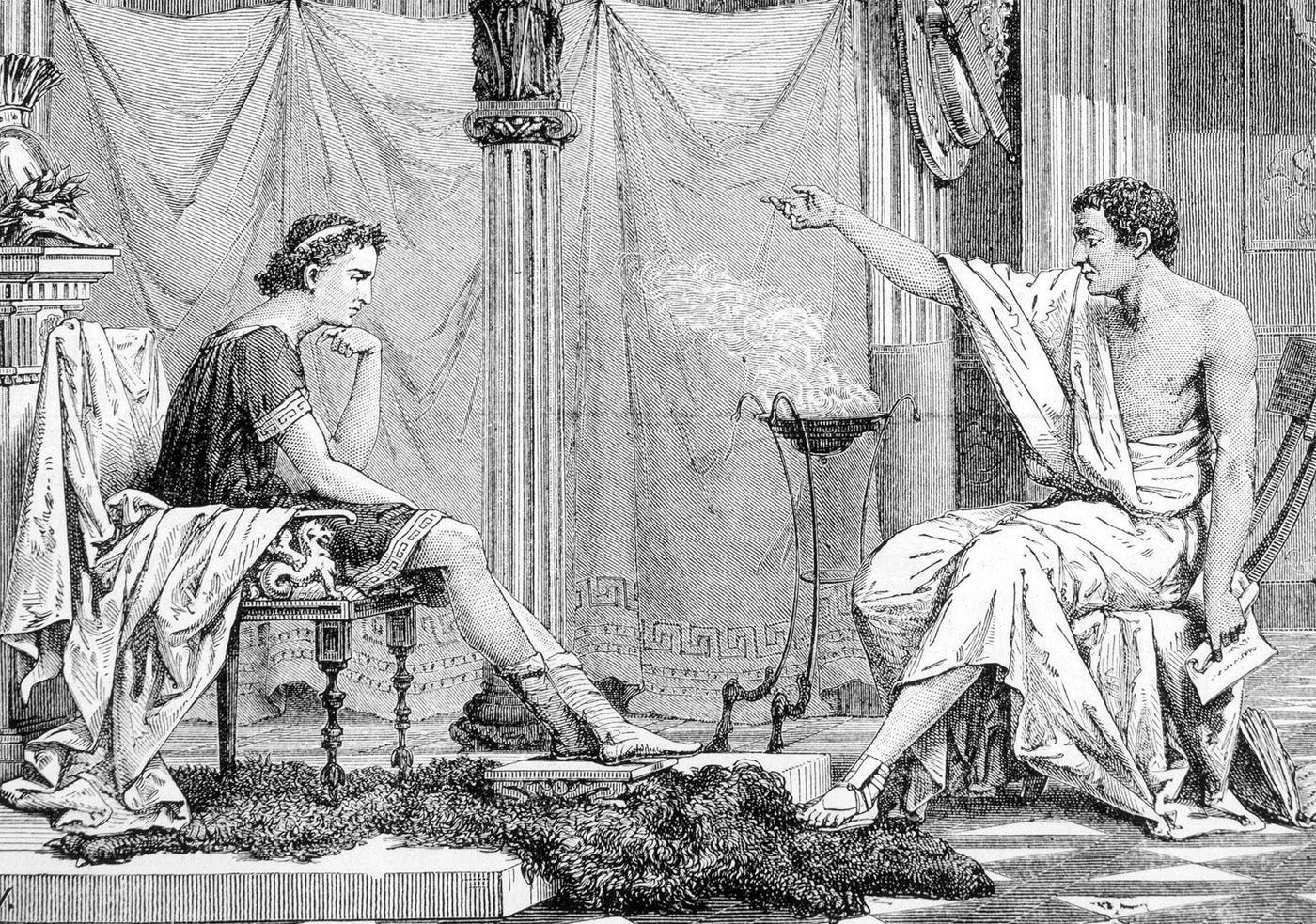
Figure 1.6 An artist’s conception of Aristotle, on the right, tutoring the future Alexander the Great.
At the young age of 20 Alexander inherited his father’s crown, and over the next twelve years earned his reputation as Alexander the Great, leading his armies on a massively successful campaign of conquest that extended from Egypt to India. We shall later see that this had major intellectual consequences centuries afterwards, as Greek-trained scholars migrated to many of the conquered territories where classical writings were preserved and honored throughout the so-called Dark Ages of Western European civilization.
After Alexander became king, Aristotle returned to Athens and became the director of his own school, called the Lyceum.* Broader in its scope than the Academy, the Lyceum attracted hundreds of scholars who worked and studied collaboratively in subjects ranging from what we today call the humanities and arts through the social and natural sciences. Many of the discussions were conducted outdoors as the participants walked about, leading to the name Peripatetic School (from the Greek for “walking”) for Aristotle’s institution.
Although these studies were collaborative, Aristotle himself was the primary recorder and summarizer of the results, producing a body of treatises that is breathtaking in its scope. One ancient biographer compiled a list of 150 books written by him, on such diverse subjects as justice, poetics, political theory, rhetoric, animals and dissections, astronomy, physics, geography, botany, and even the psyche or soul. Unfortunately much of his written work has been lost, but enough remains to give a good sense of the range and power of his interests and intellect. Aristotle came as close as any single person in recorded history to amassing and describing all of the formal knowledge of the time, leading one modern historian of philosophy to call him “Mr. Know It All.”6 We will focus here on those surviving works and ideas that became most important for the development of Western psychological thought.
Aristotle’s strong interest in natural history continued throughout his life. Alexander assisted him by sending him and Theophrastus (who accompanied Aristotle to Athens) new animal specimens from the far reaches of his ever-expanding empire. The two men produced a series of works that are landmarks in the history of biology, demonstrating in a straightforward way Aristotle’s general approach to knowledge.
Knowledge acquisition, for Aristotle and Theophrastus, had two essential steps: careful and extensive observations, followed by their systematic classification into meaningful groups or categories. Their early classifications of zoological and botanical specimens marked the beginning of the biological field of taxonomy, the arrangement of organisms into hierarchically ordered groups and subgroups. Every biology student today learns that living organisms, both animals and plants, are subdivided, in descending order, according to kingdom, phylum, class, order, family, genus, and species. Although the classifications Aristotle and Theophrastus proposed were less detailed and contained numerous errors that have been detected and corrected, they provided the starting point for an enduring biological practice.*
Although Aristotle believed that careful observation of the empirical world was the necessary and essential starting point for knowledge, the mere accumulation of facts was not enough. The mind or intellect also had to do something with those facts, converting them from a disorganized jumble of sensations into a meaningful system of organized ideas and abstract concepts. For Aristotle the mind was not passive, but it functioned primarily as the organizer rather than the origin (as Socrates and Plato maintained) of ideas and knowledge.
Aristotle developed this idea in the treatise Peri Psyche, a Greek title later translated into Latin as De Anima and usually into English as On the Soul. We’ll refer to it here as On the Psyche. Sometimes described as the first systematic work on psychology, it was more than that since, as noted, the Greek word psyche had a broad meaning as the general animating principle of all living things. In his treatment of this extensive subject, Aristotle argued that living organisms possess psyches with varying degrees of complexity depending upon their relative positions on the scale of nature, a hierarchical ordering bounded by simple plants at the bottom and human beings at the top.
The lowest organisms, plants, possess two abilities that differentiate them from dead objects: to nourish themselves and to reproduce. Therefore, according to Aristotle, nourishment and reproduction were the two most fundamental functions of all psyches. The two are sometimes lumped together and referred to in English as the vegetative soul. The simplest animals possess the additional abilities to move themselves, the function of locomotion; and to react to changing stimuli in their environment, or the function of sensation. Higher animals show a further capacity to remember and learn from their sensory experiences—the function of memory. Still higher animals can anticipate the future by imagination. These four functions collectively make up, in English, the sensitive soul. The final and “highest” function of the Aristotelian psyche, possessed only by human beings among living things, was the ability to reason: to think logically about their remembered or imagined experiences. Reason was the defining function of the rational soul.
Aristotle made several specific comments about the functions of sensation and reason that held considerable importance for the future development of psychology. In describing sensation, he likened the tissues of the sensory organs to the surface of a wax tablet, capable of receiving impressions or “imprints” from the stimuli that strike them from the outside world. Similarly to the way a signet ring leaves its imprint when pressed against soft sealing wax, a stimulus leaves an imprint that replicates its essential features. These imprints, or replicas of them, are somehow preserved and become the basis of memories, and then are erased so the tablet once again becomes blank and ready for the reception of new imprints. We shall see in Chapter 2 how the notion of the receptive mind as a blank slate, or tabula rasa, became one of the important metaphors in the development of modern psychology.
Some of Aristotle’s most important writings expounded on the special capacities of the uniquely human rational soul. Many of these were pertinent to the second component of his biological studies: the classification and organization of empirical observations. Aristotle argued that the human psyche has an innate set of categories into which the memories and ideas of empirical experiences are classified and organized. These categories include substance (what something is, such as a person, a rock, or any other object); quantity (how many, how much); quality (what color, what shape, etc.); location; time; relation (bigger, smaller, before, after, etc.); and activity—what it is doing (telling, hitting, etc.) or undergoing (being told or hit). Experiences organized according to these categories enable one to make meaningful statements, which describe a subject, about which something is predicated or asserted. In an extended series of writings collectively called The Organon by Aristotle’s successors, he showed how various kinds of subject-predicate statements or propositions relate to and interact with each other according to inferred laws of logic. Aristotelian logic has, in fact, been a fundamental aspect of Western philosophy ever since.
* * *
To summarize: Plato and Socrates had regarded the human psyche as a reservoir of innate ideas and forms, which may be brought out or partially revealed by empirical experiences. Aristotle, by contrast, emphasized empirical experiences as the necessary “raw materials” the psyche subsequently processes by means of its inborn categories, thereby creating the abstract concepts and “ideal” general laws the Platonists thought were innate.
Taken together, these three philosophers laid essential conceptual foundations for a future science of psychology. First, they made the very subject of the psyche, including what we today refer to as the mind, the specific object of analysis and discourse. Second, they debated thoughtfully about the specific relationships between that mind and the empirical stimuli that influence it from the outside world. Their emphases clearly differed, and we shall see repeatedly throughout this book how their debate about the relative weight given nativistic versus empirical explanation has continued to reverberate. In Chapter 4, we shall see how the reintroduction of the notion of innate mental categories by Immanuel Kant played a particularly important role in the origins of the psychology of sensation and perception.
Aristotle went further than Plato by attempting to describe the psyche’s biological and (in modern terminology) psychological functions in considerable detail. Many of his observations were astute and precedent-setting. From a modern viewpoint, however, we cannot regard his views as truly scientific because he regarded the functions as elemental explanatory factors in their own right, rather than as phenomena to be explained in terms of still more basic underlying factors. Only rarely, as in likening sensation to the imprinting of a stimulus on a wax tablet, does he hint about the possible physical or mechanistic processes that might underlie various functions. For the most part, he assumed that living organisms reproduce, move, or think because they have a psyche with the appropriate functions—and the causal analysis largely stopped there.
As Chapter 2 will show, our modern, scientific approach to psychological theorizing did not fully arise until 2,000 years after Aristotle, when European mental philosophers began to look seriously for underlying physical explanations. Their research followed the rediscovery of a theory that had actually been formulated in ancient Greece by a contemporary of Socrates, but which was strongly criticized and dismissed by leading philosophers, including Plato and Aristotle, and then suppressed for centuries largely for religious reasons. The story of the atomic theory and its origins provides an important concluding footnote to our discussion of Greek philosophy.