THREE ISLAMIC PIONEERS
The burgeoning Islamic empire arose rapidly in the century after the Prophet Muhammad’s death in 632 A.D., extending eventually from western India on the east to Spain and Morocco on the west. It produced a series of great, multifaceted scholars who not only preserved and translated a large portion of the classical Greek works, but also elaborated upon them while developing new and revolutionary ideas of their own. Aristotle’s works were a particular focus, and several scholars emulated him by becoming polymaths—experts in a host of different disciplines, ranging from the physical sciences and mathematics to music and the arts, as well as theology and philosophy. We single out three of these great scholars to give some idea of their breadth and ultimate importance.
Al-Kindi and the Introduction of Indo-Arabic Numerals
Abu Yusuf Ya‘qub ibn Ishaq Al-Kindi, better known to Western scholars as simply Al-Kindi (ca. 800–871), was born in the city of Basra in present-day Iraq, but moved to Baghdad as a young man. There he quickly became a leader in the so-called House of Wisdom, the equivalent of a modern research institute whose members had led the campaign to preserve the classical Greek texts, and translate them into Arabic. Al-Kindi became known as “the philosopher of the Arabs” for his learned commentaries on Aristotle, whose ideas he skillfully discussed and synthesized with the main tenets of his own Muslim faith. Like Aristotle, Al-Kindi mastered a wide range of disciplines, from physics and medicine to astronomy and music theory. Arguably, however, his work with the greatest worldwide and lasting impact was his treatise, On the Use of the Indian Numerals, written when he was about 30.
In this work Al-Kindi described and promoted a mathematical numbering system that had been developed in relative obscurity in India during the previous two centuries. He referred to the system as Indian numerals, but it has since become better known as Indo-Arabic numerals. This deceptively simple system led to some of the most important and revolutionary developments in the history of civilization. Although the Greeks and their Roman successors had developed considerable skill in geometry, dealing with shapes and the relative sizes of objects, they lacked a coherent system for performing precise calculations with numbers—problems in basic addition, subtraction, multiplication, and division that are solved easily by schoolchildren today. The reason for this deficiency lay in the haphazard system of symbols they used to represent numbers. The “Roman numerals” predominant in Western Europe from antiquity until medieval times represented numbers by complicated arrangements of I, V, X, L, C, D, and M. Even a simple calculation, such as the subtraction of 349 from 427, was mind-bogglingly difficult within a system that represented those numbers as CCCXLIX and CDXXVII, respectively.
The introduction of Indo-Arabic numerals resolved this problem, representing the numbers 1 through 9 with distinctive symbols and adding an all-important zero. With its 0 symbol and ingenious method of representing increasing powers of 10 in successive columns to the left (i.e., units, tens, hundreds, thousands, etc.), the new number symbols made possible a clearly describable and internally consistent system for performing arithmetical calculations. The flexibility and utility of this new system were immediately recognized by Al-Kindi and his slightly older Baghdad colleague Muhammad ibn Musa al-Khwārizmī. Recognizing they could not only easily do calculations, they could also represent unknown or variable numbers by letters or other symbols, and place them in solvable equations. The Arabic name Al-Kindi gave to these procedures was al-jabr, meaning “the reunion or restoration of broken parts.” Here was the root and origin of the modern word algebra.
On an abstract level, the new system comprised an infinite array of numbers that could be studied in their own right (independently of association with particular objects) and classified into logical subgroups (such as odd, even, and prime numbers; squares; cubes). A new mathematical field of number theory arose, dedicated to the study of these “pure” numbers and the often surprising interrelationships among their subgroups. If Plato and the Pythagoreans were still living, they would have rejoiced at the discovery of this fascinating realm of ideal mathematical forms existing independently of the concrete appearances of everyday life.
The new system, however, also held enormous implications for the world of everyday life, most immediately in practical fields like accounting and finance, but also more gradually in scientific projects that calculated the relationships between quantitatively measured variables. Some eight centuries after Al-Kindi, the great Italian scientist Galileo summarized the field of physics in saying, “This grand book—I mean the universe—which stands continually open to our gaze . . . is written in the language of mathematics.”7 A century after Galileo, the great French physicist Pierre Laplace noted that all of this progress depended on the Indo-Arabic numbering system, which he described as:
[A] profound and important idea which appears so simple to us now that we ignore its true merit. . . . Its very simplicity, the great ease which it has lent to all computations, puts our arithmetic in the first rank of useful inventions; and we shall appreciate the grandeur of this achievement when we remember that it escaped the genius of . . . the greatest minds produced by antiquity.8
Quite apart from these important applications, the new system had profound implications for theories about the mind. We shall see in Chapter 14 how the act of calculating with Indo-Arabic numerals came to be seen as a model for the systematic manipulation of symbols in general—a process assumed to underlie all logical reasoning. This idea directly stimulated the development first of mechanical calculators and then of electronic computers, whose “artificial intelligence” has played a role in the rise of modern cognitive psychology.
Alhazen and Modern Visual Science
About a century after Al-Kindi’s death another great scholar was born in the city of Basra, named Ibn al-Haytham, known to later European scholars by the Latinized translation Alhazen (ca. 965–1040). Like Al-Kindi, Alhazen was a child prodigy who mastered many fields before moving to a larger, more important city—in his case the Egyptian capital of Cairo. Full of youthful ambition and confidence, he impressed the caliph (the supreme religious and political leader) with a proposal to regulate the annual flooding of the River Nile by building a dam far to the south at Aswan. Soon enough he realized that such a project was far beyond the technological capacities of the time (it would be nearly a thousand years before the Aswan dam could be successfully built). This presented a dilemma because the caliph did not take kindly to failure. According to legend, Alhazen so feared the caliph’s anger that he pretended to go insane, and went into seclusion for ten years until the ruler died.
Whatever the details, Alhazen did retreat from the public eye for several years to write major treatises on astronomy, mathematical number theory, geometry, and most importantly for modern psychology, optics and the theory of visual perception. His seven-volume Book of Optics, based on rigorous experimental methods and observations that continue to hold up today, remains foundational for visual scientists.
In this work Alhazen resolved a debate that had gone on since classical times about whether vision worked because of “probes” emitted from the eyes out to the sensed objects, or because of signals or rays originating in the objects and impressing themselves on the eyes. Alhazen decided in favor of the second alternative, partly through experiments with a camera obscura, or pinhole camera, a predecessor of modern cameras consisting of a darkened box with a small hole on one side through which light from the external scene or object enters. When the thin light beam enters the box, it projects a miniature and inverted image of the outside scene onto the back wall. Alhazen recognized that something similar happens in the human eye, when light from the outside world is refracted by the lens in front to result in inverted images on the retina in the back. We shall see in Chapter 2 how this phenomenon intrigued and puzzled the philosopher Descartes.
In substantial detail, Alhazen described the geometrical properties of light rays and their reflection, the features of the eye as an optical device, the influence of binocular (two-eyed) vision in enabling depth perception, and a number of what are now considered psychological phenomena, including the “moon illusion”—why the moon appears larger when rising from the horizon than when positioned high in the sky. We shall see in Chapter 5 how the scientific investigation of visual perception, including optical illusions, played an essential role in the origination of experimental psychology in the nineteenth century. A leading modern expert on the psychology of vision has stated that Alhazen’s book “inspired all other books on optics from the thirteenth to the seventeenth century; . . . he used mathematics and experimental observation to examine the human visual system more systematically than anyone before him or anyone after him until the nineteenth century.”9 Alhazen is also remembered as a national hero in his native country of Iraq, and has been pictured on several of its banknotes (Figure 1.8).
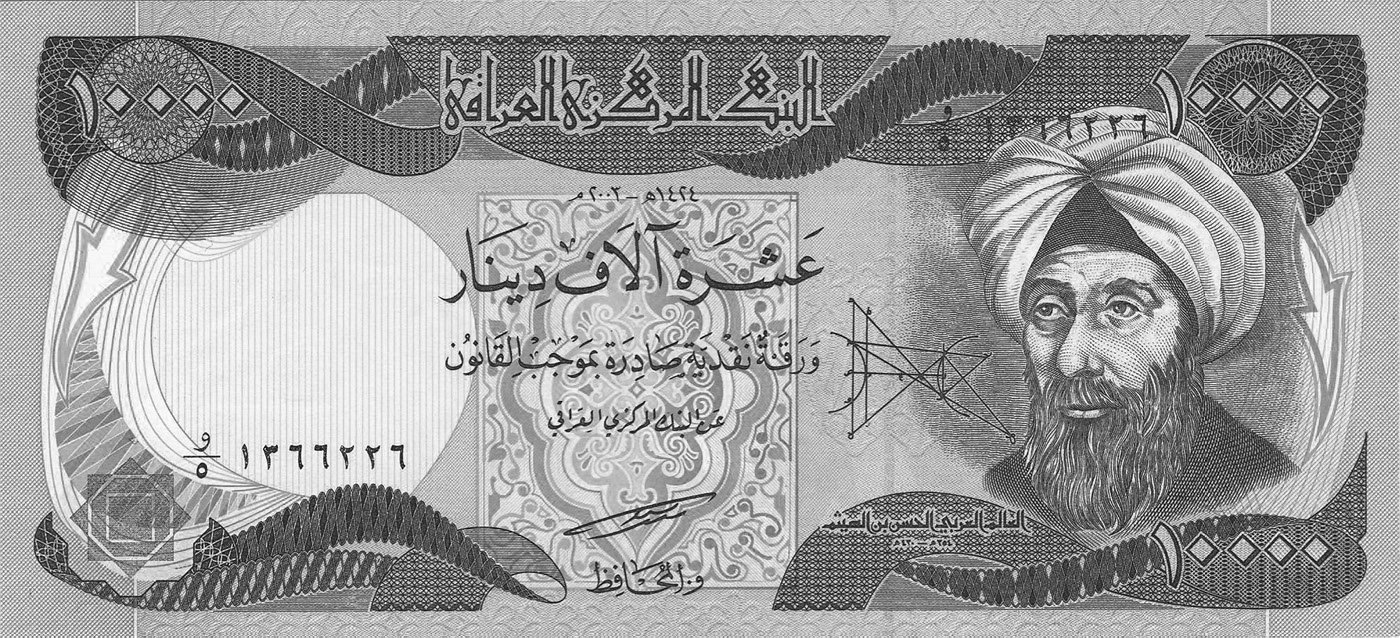
Figure 1.8 Alhazen on an Iraqi banknote.
Avicenna on Medicine and the Aristotelian Soul
Our third early Islamic polymath, whose birthname was Abu ‘Ali al-Husayn ibn Sina but became known in the West as Avicenna (ca. 980–1037), was born in the Persian city of Bukhara (now part of Uzbekistan) and spent most of his adult life in what is today Iran. Fifteen years younger than Alhazen, the amazingly versatile Avicenna came the closest of our three pioneers to assuming the full mantle of an Islamic Aristotle.
Avicenna left behind a personal document notable for its lack of modesty (perhaps partly due to embellishments added by the student who recorded it). It describes young Avicenna as a prodigy who had memorized the Koran by age 10, who learned arithmetic and algebra from a local greengrocer, and was tutored in logic by a professional teacher at age 12. Rapidly surpassing his teachers, he continued his studies independently, focusing on translations of the early Greek philosophers. Sometime in his mid-teens he undertook the study of medicine, carefully observing doctor-patient interactions whenever possible and quickly developing skills as an independent physician.
Declaring that medicine was much easier to master than mathematics or philosophy, he became famous at age 18 for curing the local sultan of a mysterious illness, and in reward was granted access to his patient’s magnificent library. He immersed himself in and literally memorized Aristotle’s major metaphysical writings, and, in a rare note of humility, confessed to finding them difficult until discovering a century-old commentary on them by an earlier Persian scholar.
This opened the gates, and at age 21 Avecenna embarked on a prolific career of analyzing and writing about basic Aristotelian themes—amounting to virtually the entire realm of recorded knowledge. Some 250 of Avecenna’s works still survive, representing just over half the titles he is known to have produced. Two massive works, in particular, cemented his historical reputation.
The Canon of Medicine was a five-volume compendium of everything Avicenna had learned and practiced in what was, for him, the “easy” discipline of healing. The first part discussed the humoral theory of the Hippocratics, and some modifications of it that had been proposed by the famous Greco-Roman physician Claudius Galen in the second century AD. Most of the work, however, provided detailed empirical observations of many disease states, ranging from those specific to particular organs to those that are systemic (e.g., fevers), and described the most effective techniques that had been developed to treat them. The treatments included more than 700 drugs and other chemical or herbal remedies that had up to then been tried and tested. Significantly, Avecenna did not consider this list to be fixed and unchangeable, and prescribed proper methods for systematically testing new remedies. Ironically, this suggestion that medicine was not a fixed discipline but was ever-evolving and should be “evidence-based” (as modern terminology puts it) was widely overlooked for many centuries, and the main body of Avicenna’s Canon became regarded as the definitive medical textbook for many centuries, in European as well as Arabic countries. Figure 1.9 shows Avicenna and the title page from a Latin translation of his Canon of Medicine, published more than 500 years after his death. As we’ll see in Chapter 2, only in the latter 1600s did John Locke and other European physicians begin to practice a medicine that was based on evidence and experiment rather than medieval theories.
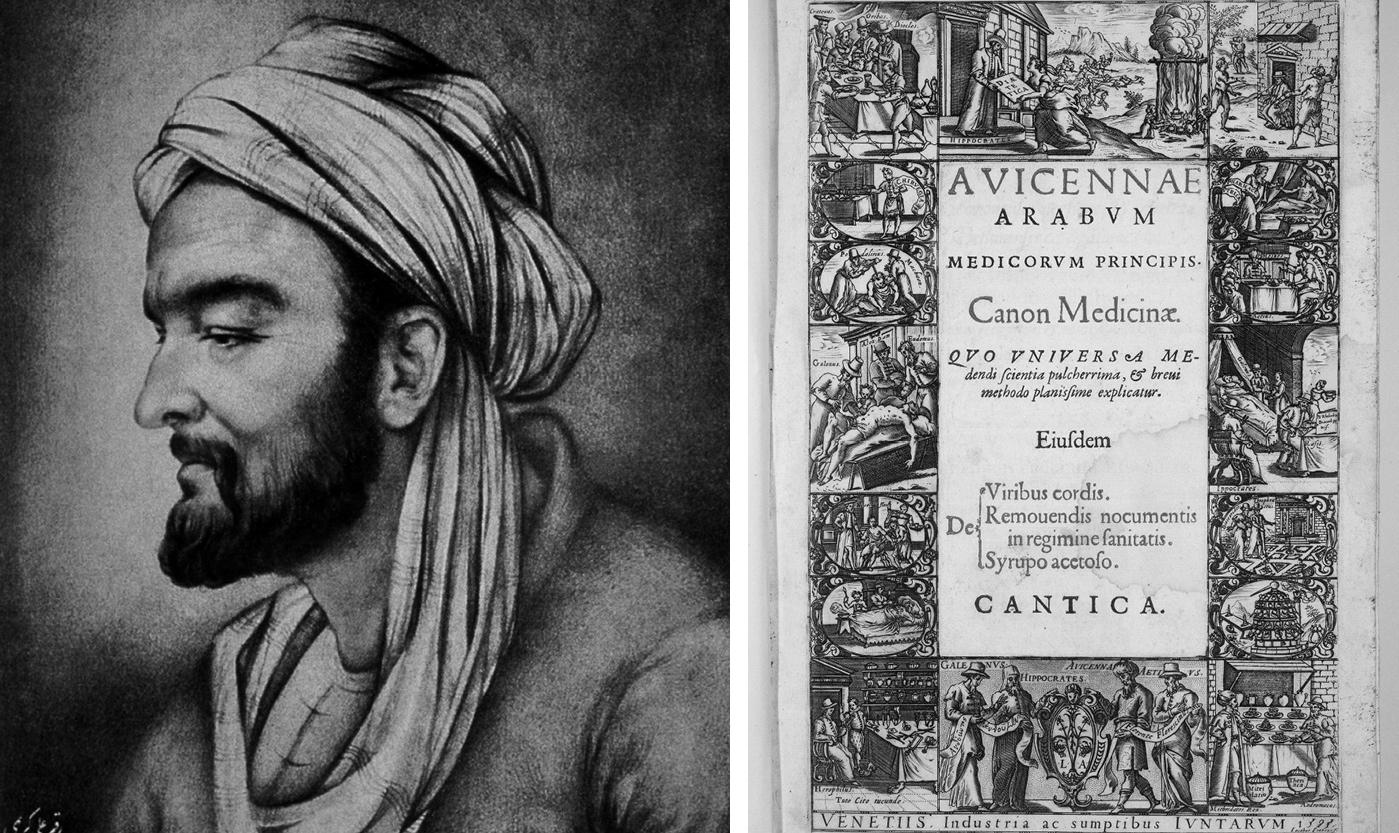
Figure 1.9 Avicenna (ca. 980-1037), and the title page from a Latin translation of his Canon of Medicine.
The title of Avicenna’s second monumental work is variously translated as The Book of the Cure or The Book of Healing. Although it sounds like another medical text, it was actually an encyclopedia covering the full range of topics Aristotle had discussed, intended as a cure for ignorance rather than physical diseases. Its coverage included philosophy (logic and metaphysics); mathematics (encompassing astronomy and music as well as geometry, advanced arithmetic, and algebra); natural sciences (physics, chemistry, geology); and an exposition of the Aristotelian soul. Considered as a whole, this work more than any other summarized and crystallized classical Greek thought and preserved it for future study, while at the same time discussing it in light of the scientific and mathematical discoveries by Avicenna and his contemporaries.
Avicenna’s discussion of the soul included two noteworthy features. First, it elaborated, in some significant ways, on Aristotle’s hierarchy of functions, particularly those constituting the sensitive soul. Avicenna differentiated between what he called the “exterior” and “interior” senses. The exterior senses constituted the basic capacities for receiving impressions via the organs of vision, hearing, touch, taste, and smell; the interior senses all involved doing something with those exterior sensations. The “common sense,” for example, allows impressions from several different exterior senses to be combined into perceptions of actual objects (such as the sight, smell, touch, and taste of an apple). “Imagination” creates mental copies of those objects, “estimation” provides intuitions about the possible benefits or dangers of the objects, and “memory” and “recollection” enable the mental recreation of them when they are no longer physically present. Most significantly, Avicenna added to these essentially receptive functions of the traditional sensitive soul an internally originating motivating function that he referred to as “appetition.” Whereas the “estimations” enable the soul to distinguish desirable or undesirable objects, the “appetites” provide the impulses and energy to approach the former and avoid the latter. This idea was not only an echoing of Plato’s postulation of the appetites as one of the three components of the psyche, but also a foreshadowing of much later developments in which the role of internally originating motives and emotions would be stressed in what we call dynamic psychologies.
Avicenna’s second noteworthy elaboration of Aristotle concerned the rational soul. In a famous floating man thought experiment, he asked his reader to imagine a newly created but fully formed man suspended in space with his sense organs blocked and limbs constrained to prevent moving or touching. Avicenna’s question: With no prior recollected experience and with all sensory organs blocked, would this man have any consciousness of his own soul or self? Avicenna’s answer was a resounding yes. For him, self-awareness was an innate capacity of the human rational soul, and evidence for the soul’s or the mind’s distinct existence independent of the body and its physical sensations. In Chapter 2, we’ll see how Descartes came to a very similar conclusion, which had significant consequences for the subsequent discipline of psychology.
During his lifetime Avicenna was celebrated for his brilliance as a doctor and scholar, but his outspoken and often arrogant personal style also made enemies. Some accused him of having an inordinate fondness for wine and women, and this reputation may have played a role in his demise. In the late spring of 1037, while serving as physician to a powerful Persian prince on a military campaign, he was overcome with severe intestinal symptoms. Resisting advice from friends to stop and rest, he reportedly said it was better to lead a short life with width than a narrow one with length, and carried on while prescribing for himself some powerful medications. Possibly because an enemy tampered with these and secretly added a poison, they failed in their purpose, and Avicenna died at the age of 57. His grave in the Iranian city of Hamadan has remained until the present day as a much-visited memorial to one of history’s greatest scholars.