
Trade creates value
We have seen that improving technology and adding resources make an economy more productive. A third way to create gains for society is through specialization and trade. Specialization is the limiting of one’s work to a particular area. Determining what to specialize in is an important part of the process. Every worker, business, or country is relatively good at producing certain products or services. Suppose you decide to learn about information technology. You earn a certificate or degree and find an employer who hires you for your specialized skills. Your information technology skills determine your salary. You can then use your salary to purchase other goods that you are not so skilled at making yourself and services that you desire.
In the next section, we explore why specializing and exchanging your skilled expertise with others makes gains from trade possible.
Trade creates value
Let’s return to our two-good economy. Now we’ll make the further assumption that this economy has only two people. One person is better at making pizzas, and the other is better at making wings. In this case, the potential gains from trade are clear. Each person will specialize in what he or she is better at producing and then will trade to acquire some of the good produced by the other person.
Figure 2.5 shows the production potential of the two people in our economy, Gwen and Blake. From the table at the top of the figure, we see that if Gwen devotes all of her work time to making pizzas, she can produce 60 pizzas. If she does not spend any time on pizzas, she can make 120 wings. In contrast, Blake can spend all his time on pizzas and produce 24 pizzas or all his time on wings and produce 72 wings.
The graphs illustrate the amount of pizza and wings each person produces daily. Wing production is plotted on the x axis, pizza production on the y axis. Each production possibilities frontier is drawn from the data in the table at the top of the figure.
Trade-offs
Because the production possibilities frontiers here are straight, not bowed, Gwen and Blake each face a constant trade-off between producing pizza and producing wings. Gwen produces 60 pizzas for every 120 wings; this means her trade-off between producing pizza and producing wings is fixed at 60:120, or 1:2. Blake produces 24 pizzas for every 72 wings. His trade-off between producing pizza and producing wings is fixed at 24:72, or 1:3. Because Gwen and Blake can choose to produce at any point along their production possibilities frontiers, let’s assume they each want to produce an equal number of pizzas and wings. In this case, Gwen produces 40 pizzas and 40 wings, while Blake produces 18 pizzas and 18 wings. Since Gwen is more productive in general, she produces more of each food. Gwen has an absolute advantage, meaning she can produce more than Blake can produce with the same quantity of resources.
FIGURE 2.5
The Production Possibilities Frontier with No Trade
(a) If Gwen cannot trade with Blake, she chooses to produce 40 pizzas and 40 wings, because she likes both foods equally. (b) If Blake cannot trade with Gwen, he chooses to produce 18 pizzas and 18 wings, because he likes both foods equally.
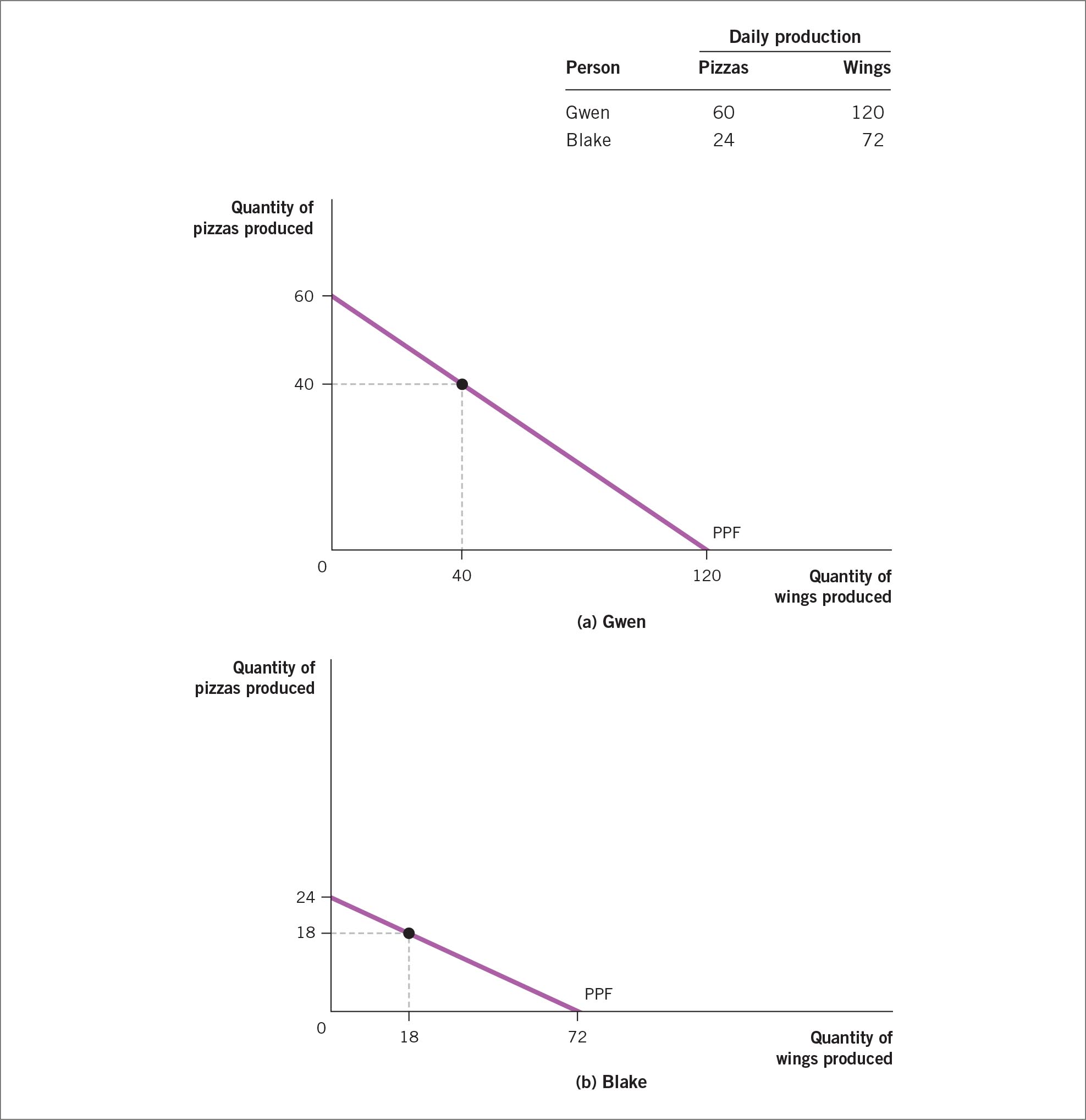
Gwens and Blakes individual production possibilities frontiers with no trade, and a table showing the daily production of pizzas and wings for Gwen and Blake. The x axis represents the quantity of wings produced. The y axis represents the quantity of pizzas produced. Graph (a) represents Gwen, whose possibilities frontier is a straight line from the point with 0 wings and 60 pizzas to the point with 120 wings and 0 pizzas. This line passes through the point with 40 wings and 40 pizzas. Graph (b) represents Blake, whose production possibilities frontier is a straight line from the point with 0 wings and 24 pizzas to the point with 72 wings and 0 pizzas. This line passes through the point with 18 wings and 18 pizzas.
TABLE 2.1
The Gains from Trade
|
Without trade |
With specialization and trade |
||||||
|
Person |
Good |
Production |
Consumption |
Production |
Consumption |
Gains from trade |
|
|
Gwen |
Pizza |
40 |
40 |
60 |
41 (keeps) |
+1 |
|
|
Wings |
40 |
40 |
0 |
47 (from Blake) |
+7 |
||
|
Blake |
Pizza |
18 |
18 |
0 |
19 (from Gwen) |
+1 |
|
|
Wings |
18 |
18 |
72 |
25 (keeps) |
+7 |
||
At first glance, it would appear that Gwen should continue to work alone. But consider what happens if Gwen and Blake each specialize and then trade. Table 2.1 compares production with and without specialization and trade. Without trade, Gwen and Blake have a combined production of 58 units of pizza and 58 units of wings (Gwen’s 40 + Blake’s 18). But when Gwen specializes and produces only pizza, her production is 60 units. In this case, her individual pizza output is greater than the combined output of 58 pizzas (Gwen’s 40 + Blake’s 18). Similarly, if Blake specializes in wings, he is able to make 72 units. His individual wing output is greater than their combined output of 58 wings (Gwen’s 40 + Blake’s 18). Specialization has resulted in the production of 2 additional pizzas and 14 additional wings.
Trade creates value
Specialization leads to greater output. But Gwen and Blake would like to eat both pizza and wings. So if they specialize and then trade with each other, they will benefit. If Gwen gives Blake 19 pizzas in exchange for 47 wings, they are each better off by 1 pizza and 7 wings. This result is evident in the final column of Table 2.1 and in Figure 2.6.
In Figure 2.6a, we see that at point A, Gwen produces 60 pizzas and 0 wings. If she does not specialize, she produces 40 pizzas and 40 wings, represented at point B. If she specializes and then trades with Blake, she can have 41 pizzas and 47 wings, shown at point C. Her value gained from trade is 1 pizza and 7 wings. In Figure 2.6b, we see a similar benefit for Blake. If he produces only wings, he will have 72 wings, shown at point A. If he does not specialize, he produces 18 pizzas and 18 wings (point B). If he specializes and trades with Gwen, he can have 19 pizzas and 25 wings, shown at point C. His value gained from trade is 1 pizza and 7 wings. In spite of Gwen’s absolute advantage in making both pizza and wings, she is still better off trading with Blake. This amazing result occurs because of specialization. When Gwen and Blake spend their time on what they do best, they are able to produce more collectively and then divide the gain.
FIGURE 2.6
The Production Possibilities Frontier with Trade
(a) If Gwen produces only pizza, she will have 60 pizzas, shown at point A. If she does not specialize, she will produce 40 pizzas and 40 wings (point B). If she specializes and trades with Blake, she will have 41 pizzas and 47 wings (point C). (b) If Blake produces only wings, he will have 72 wings (point A). If he does not specialize, he will produce 18 pizzas and 18 wings (point B). If he specializes and trades with Gwen, he can have 19 pizzas and 25 wings (point C).
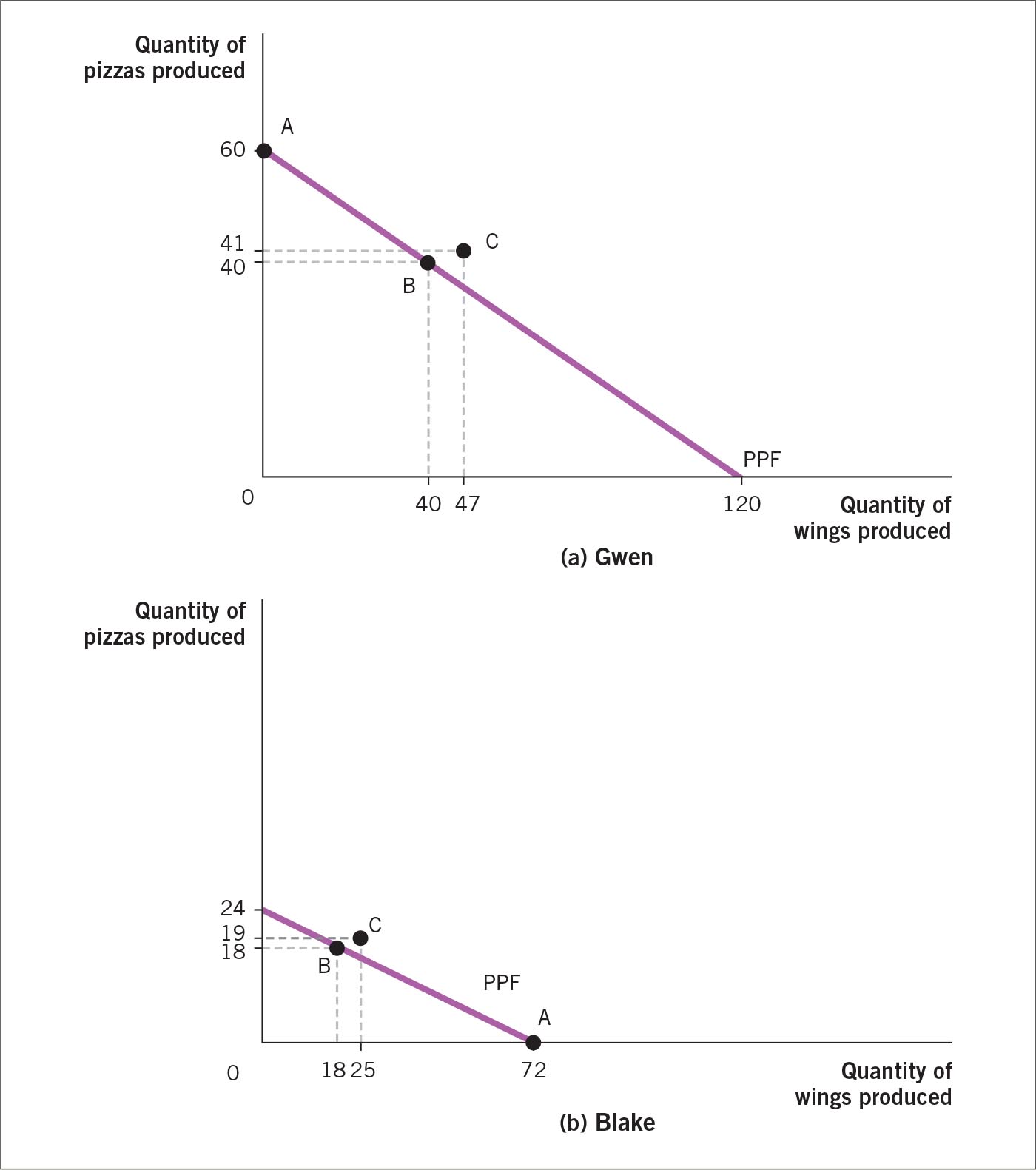
Gwens and Blakes individual production possibilities, with trade. The x axis represents the quantity of wings produced. The y axis represents the quantity of pizzas produced. The first graph represents Gwen, whose production possibilities frontier is a straight line from point A with 0 wings and 60 pizzas to the point with 120 wings and 0 pizzas. This line passes through point B with 40 wings and 40 pizzas. Point C outside the frontier is 47 wings and 41 pizzas, which represents a shift resulting from trade. The second graph represents Blake, whose production possibilities frontier is a straight line from the point with 0 wings and 24 pizzas to point A with 72 wings and 0 pizzas. This line passes through point B with 18 wings and 18 pizzas. Point C outside the frontier is 25 wings and 19 pizzas, which represents a shift resulting from trade.
Opportunity cost
We have seen that specialization enables workers to enjoy gains from trade. The concept of opportunity cost provides us with a second way of validating the principle that trade creates value. Recall that opportunity cost is the highest-valued alternative that is sacrificed to pursue something else. Looking at Table 2.2, you can see that in order to produce 1 more pizza, Gwen must give up producing 2 wings. We can say that the opportunity cost of 1 pizza is 2 wings. We can also reverse the observation and say that the opportunity cost of one wing is ½ pizza. In Blake’s case, each pizza he produces means giving up the production of 3 wings. In other words, the opportunity cost for him to produce 1 pizza is 3 wings. In reverse, we can say that when he produces 1 wing, he gives up ⅓ pizza.
TABLE 2.2
The Opportunity Cost of Pizza and Wings
|
Opportunity cost |
||
|
Person |
1 Pizza |
1 Wing |
|
Gwen |
2 wings |
½ pizza |
|
Blake |
3 wings |
⅓ pizza |
Recall from Chapter 1 that comparative advantage is the ability to make a good at a lower opportunity cost than another producer. Looking at Table 2.2, you can see that Gwen has a lower opportunity cost of producing pizza than Blake does—she gives up 2 wings for each pizza she produces, while he gives up 3 wings for each pizza he produces. In other words, Gwen has a comparative advantage in producing pizzas. However, Gwen does not have a comparative advantage in producing wings. For Gwen to produce 1 wing, she would have to give up production of ½ pizza. Blake, in contrast, gives up ⅓ pizza each time he produces 1 wing. So Gwen’s opportunity cost of producing wings is higher than Blake’s. Because Blake is the low-opportunity-cost producer of wings, he has a comparative advantage in producing them. Recall that Gwen has an absolute advantage in the production of both pizzas and wings; she is better at making both. However, from this example we see that she cannot have a comparative advantage in making both goods.
Applying the concept of opportunity cost helps us see why specialization enables people to produce more. Gwen’s opportunity cost of producing pizzas (she gives up 2 wings for every pizza) is less than Blake’s opportunity cost of producing pizzas (he gives up 3 wings for every pizza). Therefore, Gwen should specialize in producing pizzas. If you want to double-check this result, consider who should produce wings. Gwen’s opportunity cost of producing wings (she gives up ½ pizza for every wing she makes) is more than Blake’s opportunity cost of producing wings (he gives up ⅓ pizza for every wing he makes). Therefore, Blake should specialize in producing wings. When Gwen produces only pizzas and Blake produces only wings, their combined output is 60 pizzas and 72 wings.
Opportunity cost
We have seen that Gwen and Blake will do better if they specialize and then trade. But how many wings should it cost to buy a pizza? How many pizzas for a wing? In other words, what trading price will benefit both parties? To answer this question, we need to return to opportunity cost. For context, think of the process you likely went through when trading lunch food with friends in grade school. Perhaps you wanted a friend’s apple and he wanted a few of your Oreos. If you agreed to trade three Oreos for the apple, the exchange benefited both parties, because you valued your three cookies less than your friend’s apple, and your friend valued your three cookies more than his apple.
In our example, Gwen and Blake will benefit from exchanging a good at a price that is lower than the opportunity cost of producing it. Recall that Gwen’s opportunity cost is 1 pizza per 2 wings, or half a pizza per wing. This means that any exchange where she can get a wing for less than half a pizza will be beneficial to her, because she ends up with more pizza and wings than she had without trade. Blake’s opportunity cost is 1 pizza per 3 wings, so any trade where he can get a pizza for less than three wings will be beneficial to him. For trade to be mutually beneficial, the exchange ratio must fall between Gwen’s opportunity cost ratio of 1:2 (0.50) and Blake’s opportunity cost ratio of 1:3 (0.33). Outside of that range, either Gwen or Blake will be better off without trade, because the trade will not be attractive to both parties. In the example shown in Table 2.3, Gwen trades 19 pizzas for 47 wings. The ratio of 19:47 (0.40) falls between Gwen’s and Blake’s opportunity cost ratios and is therefore advantageous to both of them.
Specialization
HOW TO MAKE A $1,500 SANDWICH IN ONLY SIX MONTHS
This video on the YouTube channel How to Make Everything features a YouTuber who takes building a sandwich from scratch to new lengths. We’re not talking about going to the store and getting the needed ingredients. We’re talking 100% do-it-yourself: growing the vegetables, evaporating seawater for salt, milking a cow and using the milk to make cheese, slaughtering a chicken for the protein, and grinding wheat to make bread flour. It is all quite fascinating to watch. At the end he taste tests the sandwich. “Not bad” he says, “not bad for six months of my time”—and then he puts his head down on the table.
When you decide to forgo specialization and comparative advantage, you’re effectively turning back the clock on economic progress and living like our ancestors did. Without any help, we end up doing everything ourselves. When that happens, we are not getting the benefits of comparative advantage. So the next time you think to yourself, I can do this on my own, think again.
Video still. Step 1 in making a sandwich from scratch is Grow a Garden. A man with a shovel is starting this step.
Trade creates value
Sandwiches only take a few minutes to make, precisely because in a modern economy we rely on others to make the component parts we want. You can even get your sandwich brought to your door by someone who specializes in food delivery. That’s amazing, when you think about it.
As long as the terms of trade fall between the trading partners’ opportunity costs, the trade benefits both sides. But if Blake insists on a trading ratio of 1 wing for 1 pizza, which would be a good deal for him, Gwen will refuse to trade because she will be better off producing both goods on her own. Likewise, if Gwen insists on receiving 4 wings for every pizza she gives to Blake, he will refuse to trade with her because he will be better off producing both goods on his own.
TABLE 2.3
Gaining from Trade
|
Person |
Opportunity cost |
Ratio |
|
Gwen |
1 pizza equals 2 wings |
1:2 = 0.50 pizza per wing |
|
Terms of trade |
19 pizzas for 47 wings |
19:47 = 0.40 pizza per wing |
|
Blake |
1 pizza equals 3 wings |
1:3 = 0.33 pizza per wing |
Opportunity Cost
QUESTION: Imagine that you are planning to visit your family in Chicago. You can take a train or a plane. The plane ticket costs $300, and traveling by air takes 2 hours each way. The train ticket costs $200, and traveling by rail takes 12 hours each way. Which form of transportation should you choose?
 ANSWER
 ANSWER: The key to answering the question is learning to value time. The simplest way to do this is to calculate the cost savings of taking the train and compare that with the value of the time you would save if you took the plane.
|
Cost savings with train |
Round-trip time saved with plane |
|
$300 − $200 = $100 |
24 hours − 4 hours = 20 hours |
|
(plane) − (train) |
(train) − (plane) |

An airplane flies directly above a high-speed train.
A person who takes the train can save $100, but it will cost 20 hours to do so. At an hourly rate, the savings would be $100/20 hours = $5 per hour. If you value your time at exactly $5 an hour, you will be indifferent between plane and train travel (that is, you will be equally satisfied with both options). If your time is worth more than $5 an hour, you should take the plane. If your time is worth less than $5 an hour, you should take the train.
Opportunity cost
It is important to note that this approach to calculating opportunity cost gives us a more realistic answer than simply observing ticket prices. The train has a lower ticket price, but very few people ride the train instead of flying, because the opportunity cost of their time is worth more to them than the difference in the ticket prices. Opportunity cost explains why most business travelers fly—it saves valuable time. Good economists learn to examine the full opportunity cost of their decisions, which must include both the financials and the cost of time.
We have examined this question by holding everything else constant (that is, applying the principle of ceteris paribus). In other words, at no point did we discuss possible side issues such as the fear of flying, sleeping arrangements on the train, comparisons of comfort and personal space, or anything else that might be relevant to someone making the decision.
WHY JASON MOMOA USES BODYGUARDS

Jason Momoa flanked by two bodyguards. He towers over them.
Jason Momoa is a giant of a man—6´4˝, 235 pounds, and ripped. He is best known as the actor who played the fearsome warlord Khal Drogo on Game of Thrones and who starred in the movie Aquaman. Given his size and strength, you might think that Momoa is the last person who would need two bodyguards. But despite the fact that he could likely defend himself better than two ordinary bodyguards, they were hired to protect him, even though next to him, they look like they need the protecting! Let’s examine the situation to see if this was a wise decision.
Opportunity cost
Momoa has an absolute advantage in both acting and being a great bodyguard. But as we have seen, an absolute advantage doesn’t mean that Momoa should do both tasks himself. When you are paid millions of dollars to act, the time spent interacting with paparazzi is time lost earning money—a substantial opportunity cost. The bodyguards, with a much lower opportunity cost of their time, have a comparative advantage in dealing with pesky photographers and overzealous fans—so Momoa made a smart decision to hire them!