LEARNING GOAL
Explain how studying twins helps us understand the roles of genes and the environment in producing phenotypes.
LEARNING GOAL
Explain how studying twins helps us understand the roles of genes and the environment in producing phenotypes.
When you were a child, did you ever think, “I am so different from the rest of this family! I must be adopted!” At one time or another, most of us have marveled at how different biological siblings can be. Even siblings raised around the same time and in the same household have their individual appearances, unique personalities, and so on. These differences are to be expected, however.
Biological siblings always share some genes, and they often share much of their environment. But most siblings do not have identical genes or identical life experiences. Within the household and outside it, environments differ subtly and not so subtly. Siblings have different birth orders. Their mother may have consumed different foods and other substances during the different pregnancies. The siblings may have different friends and teachers. Their parents may treat them differently. Behavioral genetics is the study of how genes and environment interact to influence mental activity and behavior. Scientists in this field use two methods to assess the degree to which traits are inherited: twin studies and adoption studies.
Behavioral Genetics Twin studies compare similarities between different types of twins to determine the genetic basis of specific traits. Monozygotic twins are identical. They result from one zygote (fertilized egg) dividing in two (Figure 2.31a on p. 84). Because they come from the same fertilized egg, both twins have the same genetic makeup. Dizygotic twins, sometimes called fraternal twins, result when two separately fertilized eggs develop in the mother’s womb simultaneously (Figure 2.31b on p. 84). Because they come from two separately fertilized eggs, these twins are no more similar genetically than any other pair of siblings.

The picture shows two girls who look identical. The diagram explains that one sperm fertilizes one egg and the zygote splits into two.
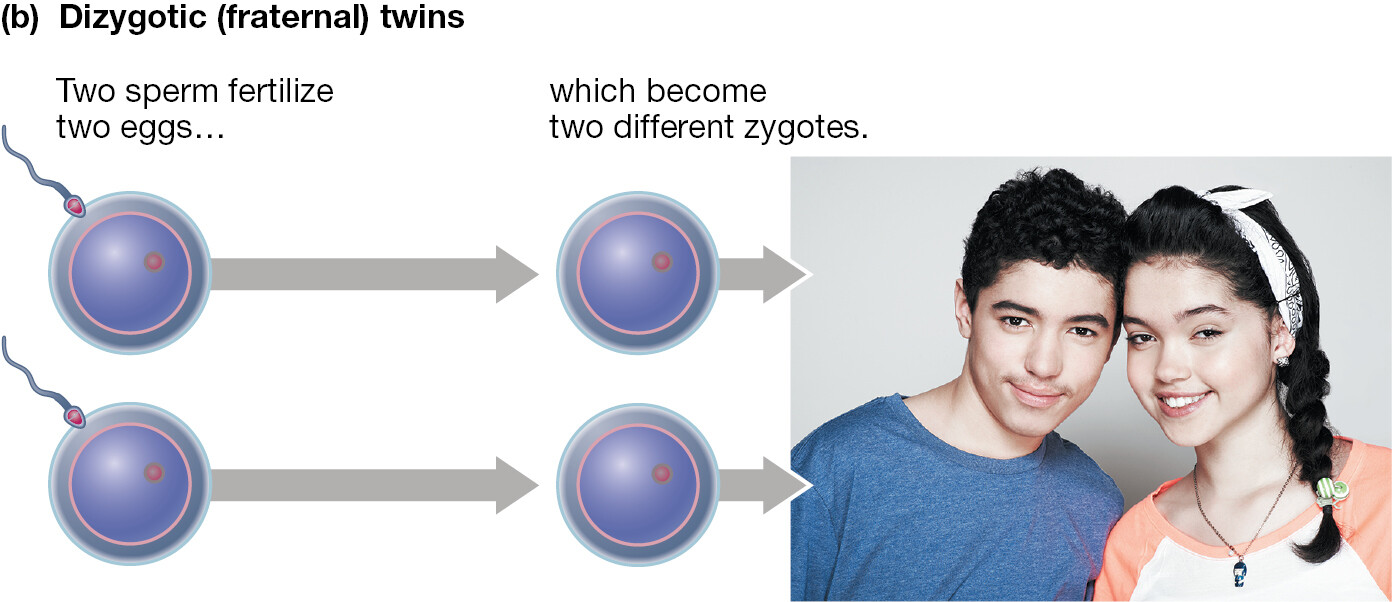
The picture shows a boy and girl who look like siblings of around the same age sitting next to eat other. The diagram explains that in dizygotic (fraternal) twins, 2 sperm fertilize 2 eggs which become two different zygotes.
FIGURE 2.31Genes Produce Two Types of Twins
(a) Monozygotic, or identical, twins result when one fertilized egg splits in two. Because of this splitting, the twins are always the same biological sex. (b) Dizygotic, or fraternal, twins result when two separate eggs are fertilized at the same time. Thus, the twins may be the same biological sex or different sexes. Which type of twin comes from two zygotes?
How do researchers use this information to judge genetic influence? They focus on a specific trait. They compare how similar monozygotic twins are in phenotypes (observable traits and characteristics) with how similar dizygotic twins are. The increased similarity in that trait for monozygotic twins is considered most likely due to genotypes (genetic influences), although the environment still has important effects (Harden, 2021).
By contrast, adoption studies compare the similarities between biological relatives and adoptive relatives—for instance, by examining adopted children’s similarity to the parents who raised them compared to their similarity to the biological parents they may never have met. Being more similar to their biological parents than to their adoptive parents suggests a genetic influence. Likewise, adopted nonbiological siblings may share similar home environments, but they have different genes. Therefore, researchers assume that similarities among adopted siblings who are not biologically related have more to do with environment than with genes.

FIGURE 2.32 Identical Twins Raised Apart Are Also Similar
Identical twins Gerald Levey and Mark Newman, participants in Dr. Bouchard’s study, were separated at birth. Reunited at age 31, they discovered they were both firefighters and had similar personality traits.
One way to understand the importance of environment is to compare twins who have been raised together with twins who were raised apart in adoptive families. In a classic study, Thomas Bouchard and his colleagues at the University of Minnesota identified more than 100 pairs of identical and fraternal twins, some who were raised together and some who were raised apart (Bouchard, Lykken, et al., 1990). The researchers examined a variety of these twins’ characteristics, including intelligence, personality, well-being, achievement, alienation, and aggression. The general finding from the Minnesota Twin Project was that identical twins, whether raised together or not, were likely to be similar (Figure 2.32).
The “Jim twins” were among the most famous case studies to emerge from this project. These twin brothers were separated at birth and raised by different families. But in adulthood, they were strikingly similar. Not only were they the same height and weight, but also they chain-smoked the same brand of cigarettes, drank the same brand of beer, and were part-time law enforcement officers. The many similarities in the Jim twins’ lives point to the possibility that strong genetic influences could have shaped their personalities and behavior.
Some critics have argued that most of the adopted twins in the Minnesota study were raised in relatively similar environments. Other critics feel that nothing more than coincidence is at work in these case studies. They argue that any two people of the same age will exhibit many surprising similarities just by coincidence, even though their lives differ in most other ways. Studies also fail to examine the many ways these twins differ on key traits. But twins and other relatives share similarities beyond coincidental attributes and behavior quirks. For instance, intelligence and personality traits such as shyness tend to run in families, indicating a strong genetic component.
Epigenetics An exciting new field of genetic study is epigenetics (M. C. Jones et al., 2018). This term literally means “on top of genetics.” Here, environment is seen as layered over genes. Epigenetics researchers are looking closely at how environment affects gene expression. They have found that various environmental exposures do not alter the genes themselves but do alter how or when those genes are expressed. For example, living under stress or suffering maltreatment as a child makes some genes more active and some genes less active. Indeed, the study of epigenetics is providing important information about how people develop psychological disorders (O’Donnell & Meaney, 2020).
What is really fascinating is that these changes in how genes are expressed can be passed along to future generations (Daxinger & Whitelaw, 2012). For example, males who experienced famine during childhood are more likely to father children who later become obese (Veenendaal et al., 2013). A simple way to think about epigenetic processes is that a parent’s experiences create tags on genes that tell them when to express, and these tags are passed along with the genes to future generations.
LEARNING GOAL CHECK: REVIEW & APPLY