What is feminist psychology, and why is it important?
Psychology of women is a subfield of psychology that focuses on the lives and experiences of girls and women. It emerged and grew alongside many of the political and social movements connected to feminism (Rutherford & Granek, 2010). Although feminism has been defined in many ways, we like author and social activist bell hooks’ version: “Simply put, feminism is a movement to end sexism, sexist exploitation, and oppression” (hooks, 2000, p. 26). As we’ll soon discuss, there are multiple feminist perspectives, but all feminisms share the goal of ending sex bias and the unequal treatment of girls and women (Enns & Forrest, 2005).
Some psychologists use the term feminist psychology to signal when psychological research and theory are explicitly informed by feminism and to distinguish them from more general work about girls and women (Parlee, 1975; Rutherford & Granek, 2010). Feminist psychology argues that psychological research is never value-neutral or objective (Crawford & Kimmel, 1999; Teo, 2015). As a result, feminist psychologists make their theoretical positions explicit so as to create transparency and genuine equity, fairness, and respect among people (Stewart & Dottolo, 2006). Feminist psychologists are also particularly attentive to issues of oppression—the ways in which certain people experience degradation because of political, economic, or social realities (e.g., poverty, homelessness, lack of access to health care). Feminist psychologists believe that by addressing oppression, both through research and in the practice of psychology, everyone’s well-being will improve.
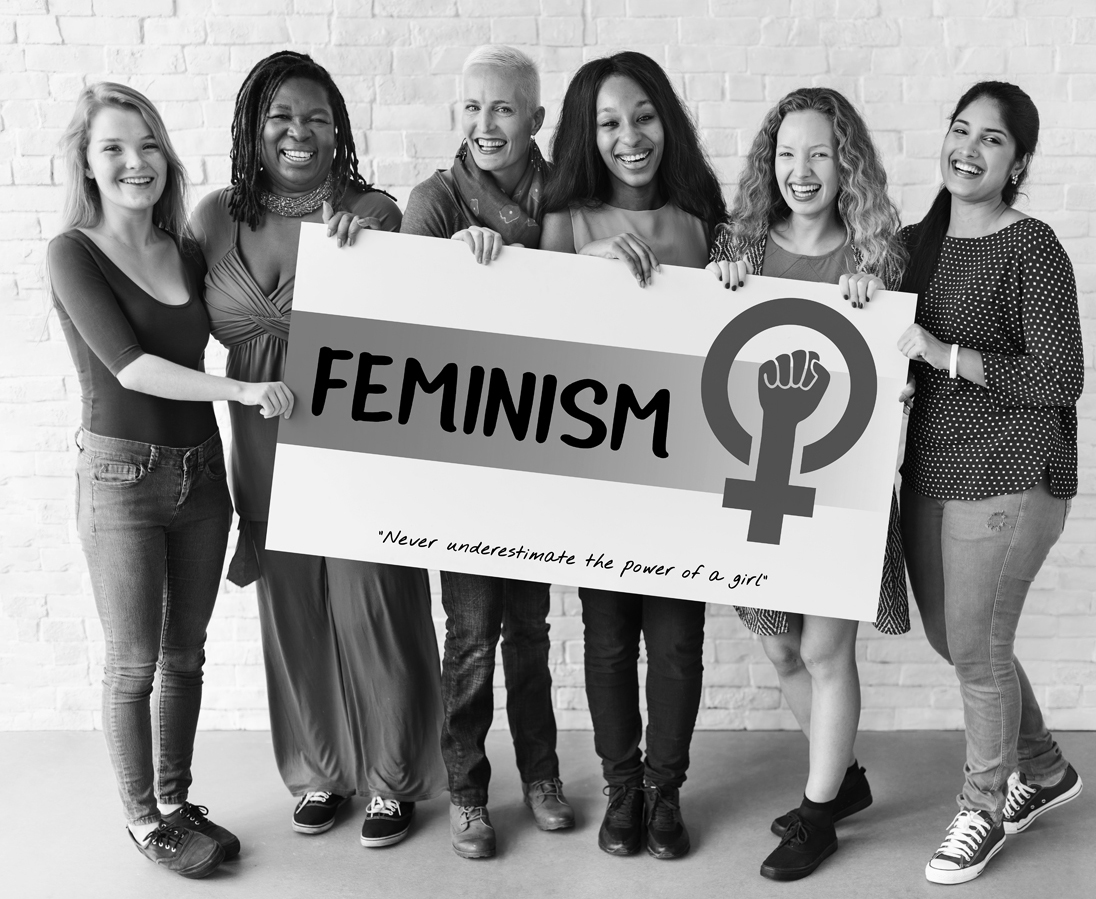
Image Description
The board also shows a raised fist within Venus symbol and the tagline that reads “Never underestimate the power of a girl.”
What comes to mind when you think of feminism—just one single, clear definition? In actuality, there are multiple feminist perspectives, though they all share the goal of ending sex bias and the unequal treatment of girls and women.
As you begin to read this book, you’ll notice that girls’ and women’s roles in society are complicated. Within the last few decades, girls and women have made substantial strides in creating more opportunities for themselves. Consider, for example, that in 1970 only 14% of U.S. women graduated from college and only 38% of U.S. women worked outside the home (Chronicle of Higher Education, 2015; Cohn, Livingston, & Wang, 2014). Compare the statistics from 2010, when 36% of U.S. women graduated from college and 59% worked outside the home (Chronicle of Higher Education, 2015; Cohn et al., 2014). There is even progress in men’s involvement. In 2014, during an address to the United Nations, British actress and UN Women’s Goodwill Ambassador Emma Watson kick-started the popular #heforshe campaign in which she asked men to join the fight for gender equity and to recognize that gender stereotypes are harmful for men as well as for women. The campaign’s popularity clearly indicated that some boys and men are also ready to re-define masculinity in order to create societal change.
We might look at this progress, wipe our brows, and think, “Phew . . . thank goodness discrimination against women is over. The world is finally changing, and girls and women have all they need in order to live productive and happy lives.” Well . . . not so fast. While some things have changed for the better, there’s still a long way to go. If we aren’t careful, this “half-changed world” might cause us to unquestioningly accept some gains without examining whom these gains benefit and if they actually provide equity (Orenstein, 2000, p. 11). It could also keep us from recognizing some of the harmful, at times even life-threatening, situations that certain girls and women still face. Consider these statistics:
In the United States, women are the fastest-growing group who are incarcerated (Swavola, Riley, & Subramanian, 2016). They are disproportionately women of color and/or poor, and they are typically survivors of violence. Nearly 80% of women who are incarcerated are mothers, and most are single mothers (Swavola et al., 2016).
The prevalence of eating disorders has been increasing since 1950 (Hudson, Hiripi, Pope, & Kessler, 2007). In a survey of Esquire magazine readers, over half of female respondents age 18 to 25 said they would prefer to be “run over by a truck” than to be fat, and two thirds of these women said they would rather be described as mean or stupid than fat (Carroll, 1994, p. 58; Maine, 2000).
Transgender women of color are the victims of 61% of all lesbian, gay, bisexual, transgender, and queer (LGBTQ) murders in the United States (Waters, 2017). They are highly vulnerable to hate crimes and more likely than other victims to experience police violence, discrimination, threats, and intimidation.
In the United States, women are paid 80% of what men are paid (National Women’s Law Center, 2017). This pay gap occurs in almost every occupation, increases with age, and is worse for women of color. Single mothers, women of color, and elderly women living alone are especially vulnerable to poverty.
Every day, 39,000 girls worldwide are forced into child marriage, resulting in early pregnancy, social isolation, disruption of school, and increased risk of domestic violence (UNICEF, 2013).
The United States is the only industrialized nation in the world that does not require employers to offer paid maternity leave, resulting in 51% of U.S. mothers without any paid leave (Chatterji & Markowitz, 2004). These women are more likely than other new mothers to develop depression, fatigue, and anxiety.
In 2017, only 19% of representatives in the U.S. Congress were women, and of them, only 32% were women of color (Center for American Women and Politics, n.d.). There was only one representative who was an out lesbian, and only one openly bisexual representative who was a woman.
In the past half-century, only 38% of the world’s nations have had a female head of government for at least one year (Geiger & Kent, 2017). In 2017, eight female leaders were the first in their country: Chile, Estonia, Germany, Liberia, Lithuania, Marshall Islands, Mauritius, and Nepal.
These statistics remind us that the psychological well-being of girls and women is still at risk. In the past, societal bias against women was much more direct. For example, employers were free to ask female job applicants about their marital status and childbearing plans, and women weren’t allowed, among other things, to apply for credit or file a sexual harassment lawsuit (Chrisler et al., 2013). Examples like these are usually easy to spot. It’s much more difficult to notice subtle incidents. For example, Facebook chief operating officer Sheryl Sandberg has observed that, in the workplace, women are often expected to do low-value tasks such as setting up meetings, serving as note-taker, or planning office parties (Grant & Sandberg, 2015). The cumulative effect can be costly since women spend more time doing mundane tasks that don’t typically result in high-profile recognition or financial bonuses within a company. Because such subtle experiences are more common than the obvious ones, a course like Psychology of Women and Gender is even more necessary now than in the past.
This book and course will help you develop critical thinking skills that will allow you to see how gender biases shape women’s psychology. Exactly how equity can be achieved is a difficult question—one that we’ll wrestle with throughout the course. For example, let’s consider the word empowerment, which refers to the capacity to attain power. It’s a buzzword these days, but it isn’t always well defined and applied (Archibald & Wilson, 2011). In the feminist view, far too often the idea of empowerment has been manipulated to sell products. Companies selling everything from Barely There push-up bras to Lean Cuisine microwavable meals have featured themes of female empowerment to market their products. However, this consumer-based approach generally doesn’t lead to substantial changes in the lives of girls and women. When women hear that they can make strides by wearing fashionable clothing, doing their nails, and eating diet foods, the message may help a company’s bottom line, but it doesn’t translate into meaningful change for all girls and women. Although some may benefit because they already have adequate purchasing power, many who can’t afford the so-called empowering products will be left behind.
The word empowerment is also often used to discuss the achievements of individual women, usually those who succeed in predominantly male domains. When the capacity to gain power is only used in this way, it limits the potential for larger-scale change. For example, a woman may feel powerful when she receives a promotion in a predominantly male law firm, or a girl may think she’s empowered when she strikes out a male batter during a baseball game. Although these are excellent accomplishments, they’re often isolated from the experiences of other women. In other words, some women will succeed in predominantly male domains, but most women will not.
With such a focus on the individual, there is little expectation that the system will change, and this realization places a huge burden on individual girls and women. The saying “the personal is political” was a rallying cry during the women’s movement in the 1960s and 1970s (Collins, 2009). It means that the personal lives of girls and women are interconnected with larger social systems. A girl who thinks she’s fat and ugly may feel alone with her worries, but her thoughts are driven by countless messages—from peers, parents, the media, and more—that girls should conform to specific ideals of beauty. A mother who struggles to manage her work hours, get dinner on the table, and find appropriate child care may think that these are her problems alone, but they should be understood within a social context in which (a) the availability of child care is inadequate, (b) inflexible work hours are the norm, (c) women are primarily responsible for household management, and (d) women are paid less than men. As these examples show, individual women’s struggles are part of a larger social struggle for all women. Therefore, even today what seems personal is actually political.
For this reason, feminist psychologists believe that research focusing on both the individual and the culture in which that individual lives is important (Fine & Roberts, 1999). Power doesn’t only exist within an individual; it also exists in relationship with other people and larger social structures. If we don’t focus on the entire picture, we risk having a shallow, and ultimately problematic, approach to advancing psychological well-being for all people. Therefore, feminist psychologists are attentive to many different disciplinary perspectives (e.g., history, sociology, political science, religion, economics, etc.) in order to conduct sophisticated research and well-rounded practice.
your turn
Reflect on a time when you felt empowered. Was the feeling based on an individual accomplishment or a collective accomplishment? What does power mean to you? Now ask five other people who differ from you on some dimension (e.g., gender, age, race, ethnic background, sexual orientation). What similarities and differences among people’s perspectives do you notice?
A perspective within the field of psychology in which work is explicitly informed by feminism, in contrast to more general research and theory about girls and women; feminist psychology is an explicitly political perspective because it aims to advance social justice.
The ways in which certain people experience degradation because of political, economic, or social realities (e.g., poverty, homelessness, lack of access to health care).