What are different ways that language is used to maintain gender hierarchies?
Language is another area in which sexism can be overlooked. There are many patriarchal assumptions in language. When internalized, these messages can further reinforce sexist attitudes and behaviors (Swim, Mallett, & Stangor, 2004). Yet, in the same way that most people may not notice benevolent sexism or microaggressions, it’s often the case that people don’t notice the problematic messages in everyday conversations. Psychologists have identified biased language as a source of microaggressions (Nadal, 2013; Sue, 2010; Woodford, Howell, Kulick, & Silverschanz, 2013). Let’s explore some of the subtle ways language reflects sexism.
People = Male Bias
Words like humankind and freshman have one thing in common—they use man to represent everyone. As we mentioned earlier, one component of privilege is that the privileged group is considered the norm. Accordingly, man is often used interchangeably with human, and this usage reinforces the idea that male characteristics and actions are representative of all humans. In fact, classic studies have shown that when participants receive no other information, they tend to associate the generic word person with a White, heterosexual, able-bodied, young man (Fiske, 1998; Stroessner, 1996). This tendency reflects the people = male bias. For example, when researchers asked a sample of primarily White college students to read passages in which an occupation was introduced with either a male-biased noun (e.g., policeman, salesman) or a gender-neutral noun (e.g., police officer, sales person), participants later recalled the gender-neutral noun in reference to a man (Hamilton, 1991). In another study, college students most frequently assumed that a generic person named “Chris” was a man, and White college students were more likely than students of color to label “Chris” as a White man (Merrit & Harrison, 2006).
Both women and men are likely to name men as examples of famous people they know and are likely to refer to God as male (Foster & Keating, 1992; Moyer, 1997). Moreover, when study participants were asked to describe the most typical person they know, men were mentioned more often than women (Hamilton, 1991). The same study showed that participants were three times as likely to spontaneously describe a man, instead of a woman, after reading a gender-neutral description. In another study, when discussing attitudes toward sexual minority individuals, participants overwhelmingly referred to men (Haddock, Zanna, & Esses, 1993).
There is even an animal = male bias in which both children and adults are likely to refer to animals using a male pronoun (Lambdin, Greer, Jibotian, Wood, & Hamilton, 2003). This effect was even found when researchers shared a story with children about an animal that used a female pronoun. All the children later used a male pronoun to refer to the animal.
In addition to emphasizing the masculine, language has a strong cisgender bias, most notably in the use of pronouns. In English, there is no gender-neutral third person singular pronoun. Only the third person plural pronoun (they) is gender neutral. Since English pronouns are based on a binary (he/she), he often serves as the human generic (McHugh & Hambaugh, 2010). But such usage wasn’t always standard. The singular use of they was much more common until 1850, when the British Parliament required that all official documents only use masculine pronouns (McCurdy, 2013). The change was made because, according to Parliament, men were simply superior to women. Although some grammar enthusiasts might argue otherwise, use of the generic he in English was the result of a sexist political decision. In this way, pronoun use can be seen to reflect social beliefs (McCurdy, 2013; Zimman, 2015).
Additionally, when language patterns change, social perceptions also change. For example, when feminists introduced the term Ms. as an alternative to terms that reflect women’s marital status (Miss or Mrs.), it initially met significant resistance. Today, however, Ms. is commonly used to refer to women regardless of their marital status. This practice subsequently changed the way women are viewed—there is less focus today on marital status as their most important attribute.
The use of gender-neutral pronouns is gaining in popularity. In 2014, Facebook and the dating website OkCupid publicly announced they would provide non-binary pronoun options. In the same year, the University of Vermont became the first institution of higher education in the United States to offer students the option of registering with gender-neutral pronouns (see Table 2.5; Poon, 2015). Since then, several other institutions have also permitted gender-neutral pronouns, although K–12 schools have been more reluctant to do so. These decisions did come with challenges, though. The capacity to add gender-neutral options to the University of Vermont’s information system took years of lobbying, a special task force, and $80,000 in software updates. And not everyone supports using resources in this way. In order for attitudes to change regarding the use of gender-neutral pronouns, scholars say that people will need to start introducing them more often in everyday language (Zimman, 2015). As with the Ms. movement, gender-neutral pronouns would probably become more commonplace if large groups of people began to use them on a regular basis.
TABLE 2.5 Possible Pronouns in Different Grammatical Forms
Pronoun (all singular)
Nominative (subject)
Objective (object)
Possessive determiner
Possessive pronoun
Reflexive
He
He smiled.
I called him.
His eyes gleam.
That is his.
He likes himself.
She
She smiled.
I called her.
Her eyes gleam.
That is hers.
She likes herself.
They*
They smiled.
I called them.
Their eyes gleam.
That is theirs.
They like themselves.
Ze
Ze smiled.
I called zir.
Zir eyes gleam.
That is zirs.
Ze likes zirself.
Xe
Xe smiled.
I called xem.
Xyr eyes gleam.
That is xyrs.
Xe likes xemself.
Note. Content drawn from Wikipedia. *They is being used as a third-person singular noun.
Men Come First
In language, men come first. Shakespeare didn’t title his play Juliet and Romeo. We don’t refer to royalty as queen and king, and teachers generally don’t address their classes as girls and boys. The tendency to name men before women is characteristic of a binomial pair, a two-word expression in which the word order is fixed and unchangeable (Hegarty, Watson, Fletcher, & McQueen, 2011). In fact, researchers have found that participants habitually named men first in heterosexual pairings, and among non-heterosexual couples, they attributed first-named partners with more stereotypically masculine qualities. Also, men’s names tend to appear before women’s names on the Internet (Wright & Hay, 2002). The common phrase “ladies and gentlemen” does break from this rule, but it’s worth mentioning that the term lady isn’t always perceived favorably. One study showed that people are more likely to associate the term gentlemen with greater competence and warmth than the term lady, which is associated with being cold and distant (Moely & Kreicker, 1984). Further, historically the concept of ladyhood was associated with White, upper-class, married women (Myers, 2010). As a result, it’s possible to say that the term lady not only has elements of benevolent sexism, but it also prioritizes a particular social order that privileges some women over others.
If you review the words in Table 2.6, you’ll notice a pattern of prioritizing men and viewing the male as the norm. Unmarked words tend to be used as the generic. For example, the unmarked word lion can describe a male or female lion. The word lioness, however, only refers to a female lion. The female version is a marked word and can’t be used to describe a male. In this way, the female version is a deviation from the norm. Women may choose to call themselves waiters, hosts, or actors. But men would never call themselves waitresses, hostesses, or actresses. However, when unmarked terms are used, people generally assume that the person being referred to is male (McHugh & Hambaugh, 2010). Further, marked words can be seen as conveying a lower status, which can influence how girls and women think about themselves as well as how others behave toward them (McHugh & Hambaugh, 2010).
For example, even in writing this textbook, we discovered our own biases. One reviewer of our early work pointed out that we were consistently marking the race of people of color, but not doing the same for White people. As we mentioned in Chapter 1, we also found that our default was to say “men and women” rather than “women and men.” It is important that we address these linguistic biases. They may seem subtle, but the cumulative effect shows a tendency to prioritize some types of people over others. These patterns revealed how easy it is to perpetuate the status quo.
Gender-fair language, which refers to all people with symmetrical linguistic forms, has been found to promote gender equality (Koeser & Sczesny, 2014). Instead of using male generics, gender-fair language aims to use more inclusive terms, like they (as singular use) instead of he or first-year student instead of freshman. Further, gender-fair language seeks to reduce stereotypes. Instead of saying, “Dear Mothers, please bake cookies for the bake sale,” a gender-fair alternative would be: “Dear Parents, please bake cookies for the bake sale.” Gender-fair language is less common in everyday language than gendered language is, but research shows that women are more likely to use gender-fair language than men (Koeser, Kuhn, & Sczesny, 2015). In another study, when men were made aware of sexist language, their use of gender-fair forms did increase, but they tended to return to sexist language when tired or distracted (Koeser & Sczesny, 2014; Koeser et al., 2015).
TABLE 2.6 Examples of Marked and Unmarked Language
Male/Unmarked
Female/Marked
author
authoress
waiter
waitress
host
hostess
headmaster
headmistress
landlord
landlady
actor
actress
hero
heroine
lion
lioness
One example of a move toward gender-fair language is use of the word Latinx, meant to be a gender-neutral alternative to Latina and Latino. People who use Latinx are part of a linguistic movement seeking to reject gender binaries, be inclusive, and modify the language and traditions of Europeans that relate to people of Latin American descent (Love Ramirez & Blay, 2016). Critics, however, feel that the new word is disrespectful to the Spanish language, which is linguistically gendered. In Spanish, nouns are gendered—such as guitar being feminine and referred to with la instead of el—but there is evidence that this practice reinforces sexist beliefs. In one study, when bilingual high school students were randomly assigned to complete a survey addressing sexist attitudes in either English or a language with a grammatical gender (French or Spanish), students in the English condition expressed less sexist attitudes than those in the French or Spanish conditions (Wasserman & Weseley, 2009). Further, because language is used every day, the repetition can normalize these subtle forms of sexism.
Most people are not aware of the larger social effect of language, but research shows that using more gender-biased language and holding sexist beliefs are related (Prewitt-Freilino, Caswell, & Laakso, 2012; Wasserman & Weseley, 2009). In the years to come, as gender-fair language becomes more integrated into our daily lives, as has already happened with the use of Ms., it will be interesting to see if research continues to show the same patterns related to marked and unmarked words, a people = male bias, and so on.
What’s in a Name?
Names also reveal hidden biases. For example, some girls’ names reflect aesthetics or femininity (e.g., Bella, Lily, Jasmine, Grace), and gendered patterns are even found among nicknames. When researchers analyzed 380 popular nicknames, they found that male nicknames—especially among peers—often implied strength, largeness, hardness, and maturity (e.g., Champ, Digger, Stud, Maddog; Phillips, 1990). In contrast, female nicknames were more associated with beauty, pleasantness, kindness, and goodness (e.g., Angel, Babe, Munchkin, Honey).
Women’s subordinate status shows up again with the use of formal titles. In formal settings, the probability of being addressed by a professional title is greater for men than for women. It’s likely that most faculty at your school are referred to as either Professor or Doctor. Have you ever heard instructors being addressed as Mr. or Ms. or Mrs.? It’s likely that if you have, it was a female professor being addressed this way. One study showed that students were more likely to refer to male professors by a formal title than female professors (Takiff, Sanchez, & Stewart, 2001). However, when female professors were addressed by title, students perceived them as less accessible—a pattern that didn’t hold for male professors. This is especially true for women of color, who are often referred to as Ms., while their colleagues are referred to as Doctor or Professor (Berry, 2014). Being addressed as Mrs. is a major pet peeve of ours. Addressing a professor this way not only denies the status and recognition of being called Dr. or Professor that she earned—it also reflects an assumption that (a) she is married and (b) she changed her name when getting married.
Each year, about 90% of women in the United States who marry men will change their last name to their husband’s last name (Goldin & Shim, 2004; Johnson & Scheuble, 1995). This practice originates from the traditional family structure in which, upon marriage, a woman became her husband’s property (Suarez, 1996). The practice basically erases maternal lines over generations and can also erase many of the social networks that women develop prior to marriage. This happens because people can be difficult to find, even through social network searches, when they change their name unless you know their new last name.
Until the 1970s, in some states women were not permitted to vote unless they registered using their husband’s last name (Goldin & Shim, 2004). The practice of taking a husband’s name varies considerably by country. In Spain, Latin American nations, and China, women typically keep their birth name after marriage. In France, most women retain their birth name for legal documents and use their husband’s name in social settings (Chapman & Ciment, 2015).
In the United States, changing one’s name is time-consuming and expensive. Several Internet businesses, like HitchSwitch.com and MissNowMrs.com, have emerged to help manage the time and cost of ordering a new driver’s license and passport, updating bank accounts, and changing other official documents (Urken, 2012). Despite the hassle, the practice appears to be popular, particularly among White women. In an analysis of wedding announcements published in the New York Times from 1982 to 2002, 71% of all women changed their names, while 29% chose to keep their birth name or hyphenate it (Hoffnung, 2006). However, only 39% of women of color changed their names. This finding is consistent with other research showing that women of color are less likely than White women to change their name following marriage (Twenge, 1997). Women’s level of education can also be a factor (Gooding & Kreider, 2010; Hoffnung, 2006; Twenge, 1997). According to results from one study, women with a master’s degree are nearly three times more likely to use their birth name than those without a bachelor’s degree, and those with a doctorate are nearly 10 times more likely to do so (Gooding & Kreider, 2010).
EMPOWERING OR OPPRESSING?
Reclaiming Words
C
an misogynistic words ever be used in ways that are empowering? Reappropriation occurs when a person or group of people from a subordinate group intentionally reclaims a slur that was previously used by a dominant group to oppress or stigmatize them (Galinsky et al., 2013). The ability to reclaim negative words has been hotly debated within feminist circles, and much like other feminist discussions, there is tremendous diversity in how people think about it.
For some feminists, words like bitch and slut are hateful terms that perpetuate denigration and rape culture. From their perspective, these words—and others that are generally considered even more offensive—are sexist, plain and simple. According to those who hold this perspective, it’s important to advocate for the complete elimination of their use because such words cause harm, particularly when normalized as acceptable parts of everyday language (Hodge, 2012). Some scholars have even suggested that such words qualify as hate speech and should be taken as a literal threat, particularly when used by someone in a dominant position (Hom, 2008; Hornsby, 2001).
Despite this view, slurs are used by many women to build solidarity and to mobilize for political purposes. As an example of reappropriation, we can think of the enthusiasm around the pussy hats during the 2017 Women’s March. Before that, in 2011, activists used the provocative title Slut Walk to describe their protest against the ways in which law enforcement routinely suggests that women invite rape by wearing revealing clothing. In The Vagina Monologues, one very popular monologue encourages the audience to repeat a word for women’s genitalia that many find particularly offensive as a way to gain momentum and power.
SlutWalks began in 2011 in Toronto in response to a police officer telling a group of college women that, in order to prevent sexual assault, they shouldn’t dress “like sluts.” The comment sparked a worldwide campaign. Although many people supported the goal of ending rape culture, not everyone was comfortable with the name “SlutWalks.”
There is also evidence that reappropriation can be successful under the right conditions (e.g., Croom, 2013; Galinsky et al., 2013). For example, in one experiment, participants were exposed to the term slut in different contexts (Gaucher, Hunt, & Sinclair, 2015). Women were less likely to endorse common rape myths after being exposed to the word in the context of a protest march (e.g., Slut Walk) than they were if they heard it on the street. Further, within the context of Slut Walk marches, the use of the word did not significantly lower women’s feelings of empowerment, and women were more likely to refer to themselves and friends as sluts after participating in the event (Gaucher et al., 2015).
What are your thoughts about this debate? Is the use of slurs empowering or oppressing? Why or why not? Are there certain situations in which it may be politically beneficial to do so? Does it matter who uses the slurs? Are there ways in which other variables (e.g., racism or classism) might determine whether the use of a slur is empowering or oppressing?
The decision to take a spouse’s name is far less common among non-heterosexual couples. In one study, lesbian and gay couples reported that they kept their own surnames in order to maintain their personal and professional identities, reject heterosexual customs, and avoid the cost and inconvenience of having to change their name (Clarke, Burns, & Burgoyne, 2008). Interestingly, within the United States, a husband who wishes to take his wife’s last name (or a hyphenated version of it) must obtain a court order (Slade, 2015). Only nine states do not require this: California, Georgia, Hawaii, Iowa, Louisiana, Massachusetts, New York, North Dakota, and Oregon. The fact that husbands, and not wives, are required to obtain court permission shows how the government continues to regulate gender relations in marriage.
Some individuals (usually women) have adopted the strategy of using their surname in some situations (e.g., professional settings) and their spouse’s name in other settings (e.g., familial situations). This practice is known as name shifting. Among 600 married women who taught at a college or university or were married to university faculty, 12% were found to use name shifting (Scheuble & Johnson, 2005). Engaging in name shifting was related to working full-time, having a higher level of education, and being older. Researchers suggest that name shifting might reflect women’s ambivalence in managing social pressures that create a conflict between personal identity and the role of wife and mother (Scheuble & Johnson, 2005). For example, when 222 college students were asked to rate women who took their husband’s name, those who did were perceived as less agentic and more communal than women who kept their surnames or hyphenated their surname with their partner’s name (Etaugh, Bridges, Cummings-Hill, & Cohen, 1999).
try it for yourself
If you’re married, did you change your name? Why did you make the choice you did? If you’re not married, have you considered your options in regard to surnames if you were to get married? What do you think you will do? Ask a diverse group of people these questions. What patterns do you see? Are men less likely to change or consider changing their surname? What do you think explains the patterns you observe?
Last names have implications for children too. Even when women keep their last names, they are unlikely to pass that name along to their children. One study found that 90% of heterosexual women who kept their own name when they got married still gave their children their husband’s surname (Johnson & Scheuble, 2002). It is worth considering this statistic in light of the fact that women, not men, carry and birth children. Another study showed that, as an alternative, women who kept their surname were more likely to include their birth surname in their child’s name—for example, as a first or middle name (Liss & Erchull, 2013).
Degrading Language
There are many slang words that degrade women (e.g., bitch and slut). The equivalent slang words for men aren’t nearly as negative (e.g., tool and stud). Most notably, slang words that are used to describe women are disproportionally sexualized. One linguist found that North American English has no fewer than 220 words for a sexually promiscuous woman but only 20 for a sexually promiscuous man (Lei, 2006). People also seem to be more likely to spontaneously use sexual slang terms to describe women than men. When researchers asked college students to list slang words used to describe women and men, 50% of the terms used to describe women were sexual as compared to 23% for men (Grossman & Tucker, 1997). Studies also show that men are more likely to use slang and women are more likely to be targeted with slang words (Braun & Kitzinger, 2001; Grossman & Tucker, 1997). This is especially true when women deviate from traditional feminine behaviors. In one study, when women deviated from gender-typical behaviors, speakers were more likely to use animal references (e.g., chick, bitch) to express their disapproval (Nilsen, 1996). Also, girls and women are commonly referred to as food (e.g., honey), animals (e.g., chick), or children (e.g., baby; Hines, 1999).
When men deviate from gender-typical behaviors, they are often described in terms of female genitalia (Fair, 2011). Referring to someone by terms associated with male genitalia, while not nice, still conveys status and power, which is why men don’t consider it as offensive as a homophobic slur (Saucier, Till, Miller, O’Dea, & Andres, 2015). Also, when someone does something courageously, it’s common to say, “That took balls”—slang for a part of men’s genitalia. Ironically, the gonads are actually very sensitive, and the uterus is the strongest muscle in the human body (Norton, 2010). So maybe people should start saying, “That took uterus!”
Talking Styles
How do talking styles, speech use, and interrupting reflect power differentials?
Another way in which we can see how language reflects men’s higher status and power is by examining the different ways gender operates in conversation. It’s a popular stereotype that women talk more than men, but numerous studies have debunked this myth (Cashdan, 1998; Mehl, Vazire, Ramirez-Esparza, Slatcher, & Pennebaker, 2007; Tannen, 1995). One study showed that men take up to 75% of talking time in a mixed-group setting (Karpowitz & Mendelberg, 2014). This is an example of how sexism can be overlooked since it’s generally not noticeable when men take up conversational space, but it’s very noticeable when women do it. The tendency for men to control most of a conversation is consistent with the theory of communicator status, which holds that individuals with higher status are perceived as having more credibility and expertise than those with lower status. This translates into more talking time for men and women’s decreased ability to control conversations.
This theory has very real implications because talking time influences everything from whose thoughts get heard, to who gets to influence major decisions in meetings, to who gets opportunities for active learning in a classroom. For example, studies have shown that male students speak more frequently than female students in college classrooms and are more likely to be listened to by a professor (Basow, 2004; Litosseliti, 2013; Swann, 1992). In elementary school, boys raise their hands in more disruptive ways, which results in more teacher attention (Sadker & Sadker, 1994). Men appear to dominate media conversations too. In 2012, the OpEd Project determined that men wrote 80% of traditional opinion pieces, 67% of online opinion pieces, and 62% of college newspaper opinion pieces (Yaeger, n.d.). In social media, although girls and women make up 62% of Twitter users, men have been found to be re-tweeted almost twice as often as women (Bennett, 2012).
Another way men may exhibit control of conversations is through mansplaining. This term was coined to describe a man explaining something, typically to a woman, in a condescending way (Solnit, 2015). Some feminists have critiqued the term because it implies that the problem is only about men explaining things to women (Kelly, 2015). In reality, it’s likely that people in positions of power often attempt to explain things to those in lower-status positions; this may have to do with many different characteristics that make up a person’s social identity—including, but not limited to, gender (Bridges, 2017).
Tentative Speech In her now-classic book Language and Women’s Place, the feminist linguist Robin Lakoff (1975) was one of the first to offer an explanation for why men, rather than women, dominate talk time. Women, she said, are taught to be polite and to speak in ways that are unconfident and powerless. In particular, Lakoff proposed that women are more likely than men to use tentative speech forms, including hedges (e.g., mostly), hesitations (e.g., um), tag questions (e.g., right?), and intensifiers (e.g., very). For example, a woman may say “I . . . um . . . don’t really like it” rather than “I don’t like it,” or “I just wanted to check the time, okay?” rather than “I’m checking the time.”
Several studies have been done to examine women’s and men’s conversations in order to test the dominance model, and the results have been mixed. Overall, results do show a small difference, with women being somewhat more likely than men to use tentative speech (Reid, Keerie, & Palomares, 2003). However, linguists are concerned that these small findings have led to overgeneralizations about women. For example, most women in most contexts will not use tentative speech; however, when they do use tentative speech, people notice it, contributing to confirmation bias (Reid et al., 2003). In other words, people selectively attend to stereotypical behaviors and then conclude that certain behaviors are characteristic of the whole group. One sociolinguist has referred to this as the “naming and shaming” phenomenon (Liberman, 2007, para. 2).
Further, Lakoff’s original claim that tentative speech reflects powerlessness may not be true. In fact, tentative speech may improve connection and increase power in certain social contexts. For example, in one study, women were more likely to use tentative styles of speaking in longer versus shorter conversations, in research labs versus other settings, and in groups versus dyads (Leaper & Robnett, 2011). Some researchers believe these findings reflect interpersonal sensitivity rather than a lack of assertiveness. Tentative speech has also been found to relate to some aspects of success, particularly among women. For example, successful female contestants on Jeopardy are more likely than contestants who aren’t successful to use uptalk (also known as upspeak), a style of speech in which declarative sentences end with a rising intonation that is typically indicative of questions (Linneman, 2013). In high school settings, the “cool girls” are more likely to use tentative talk than the “nerd girls” (Bucholtz, 2001).
In fact, it appears that when women do use more direct styles of communication, they risk social punishment. There is no shortage of studies showing all the ways in which girls and women face a “damned if you do, damned if you don’t” situation, known as a double bind. In other words, if girls and women speak in tentative ways, they’re perceived as weak and inferior. However, if they speak up and act assertively, they’re perceived as stepping out of line and, more often than not, experience backlash. The communication double bind happens in many settings and situations. For example, in one study, researchers asked businesswomen and businessmen to evaluate the competence of chief executives who voiced their opinions (Brescoll, 2011). Male executives who spoke up were often rewarded with higher ratings of competence; however, the same behavior was punished in female executives. When female executives spoke with more frequency, both women and men punished them with lower ratings. We’ll talk more about how the double bind affects women in work contexts in Chapter 10.
your turn
In 2015, Fortune magazine published a satirical essay in which famous quotes were rewritten as if women had said them (Addady, 2015). For example, U.S. president Ronald Reagan’s Cold War challenge—“Mr. Gorbachev, tear down this wall!”—directed to Soviet leader Mikhail Gorbachev was rewritten this way: “I’m sorry, Mikhail, if I could? Didn’t mean to cut you off there. Can we agree that this wall maybe isn’t quite doing what it should be doing? Just looking at everything everyone’s been saying, it seems like we could consider removing it. Possibly. I don’t know, what does the room feel?” (Addady, 2015, para. 6).
The goal of the article was to showcase the double bind that women face with language. If a woman had actually said the original quote, she probably would have been perceived as aggressive, but the alternative wouldn’t have been nearly as effective. Do you think this essay helps to point out power dynamics in language, or does it hurt and shame women? Explain your response.
Policing women’s language is a profitable social phenomenon. For example, in 2015 the app Just Not Sorry was marketed to women to help them develop “stronger voices” by warning them about their use of so-called undermining words, such as sorry and just (Cauterucci, 2015). As another example, women, but not men, have been critiqued for their use of vocal fry (an unnaturally low, creaky voice). The irony here is that many famous men—including Leonardo DeCaprio, Johnny Depp, and Bruce Willis—use vocal fry (Saxena, 2015). In fact, radio-show host Howard Stern criticized women about their use of vocal fry while he himself was using it. In her blog, language: a feminist guide, sociolinguist Debbie Cameron sarcastically described all the articles written in the Economist and the Business Insider aimed at coaching men on their use of language in business settings: “OK, people haven’t been talking about that article—mainly because I made it up. No one writes articles telling men how they’re damaging their career prospects by using the wrong words” (Cameron, 2015, para. 2). From her perspective, the critique of female voices is just another way to tell women to stop talking (Marcotte, 2015).
Interrupting Another manifestation of power in language is that women are interrupted more than men. These interruptions can come from both men and women. In one study, when researchers transcribed the conversations of 20 women and men in pairs, they found that, in a three-minute conversation, women interrupted men just once, on average, but they interrupted other women 2.8 times (Hancock & Rubin, 2015). Men interrupted their male conversational partner twice, on average, and interrupted female partners 2.6 times. Also, a comprehensive review of 43 studies found that men were likely to interrupt women with the intent to assert dominance in the conversation, meaning that men were interrupting to take over the conversation (Anderson & Leaper, 1998). When women interrupted, it was because of increased enthusiasm or interest in the speaker’s topic. Women were especially likely to do this in mixed groups as opposed to one-on-one conversations.
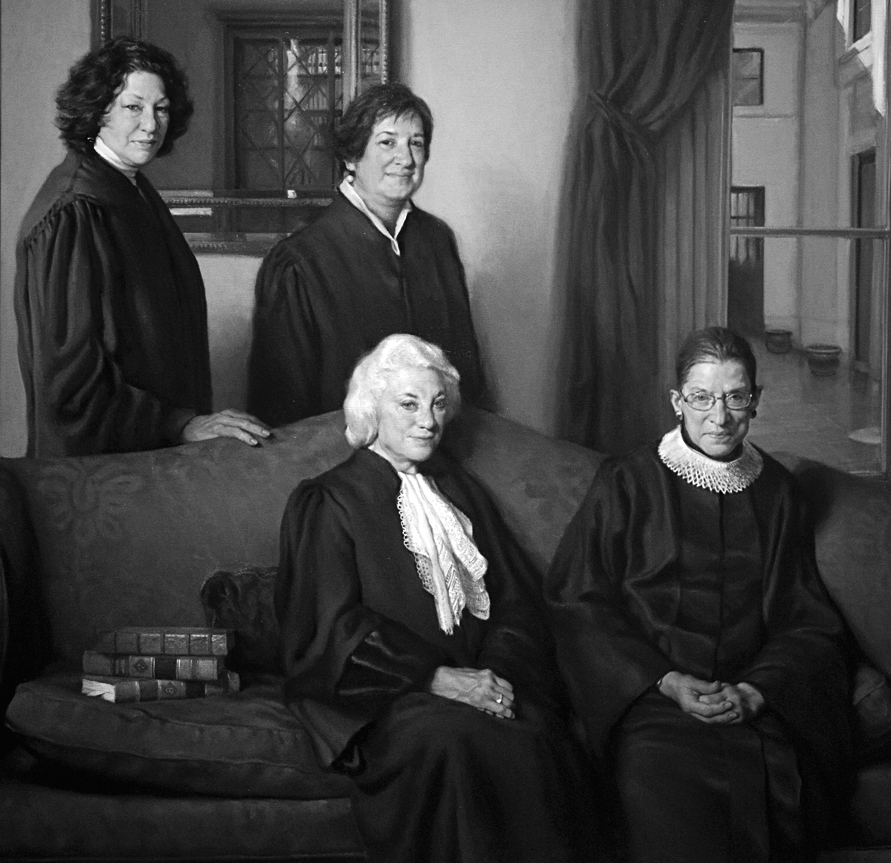
There have been four female U.S. Supreme Court justices. Pictured from left to right, they are Sonia Sotomayor, Elena Kagan, Sandra Day O’Connor, and Ruth Bader Ginsburg. It has been documented that women justices are interrupted far more often than their male colleagues.
The phenomenon of men interrupting women is getting increasing attention in the media. In 2017, the New York Times asked women to report on Facebook their experiences of being interrupted (Chira, 2017). There were hundreds of responses. One woman said, “I can’t even count the number of times I’ve witnessed a woman being interrupted and talked over by a man, only to hear him later repeat the same ideas she was trying to put forward” (para. 8). Another reported, “My female boss told me she needed to allow each man to interrupt her four times before protesting in a meeting. If she protested more often, there were problems” (para. 9). Even women in very high-powered positions are interrupted more than men in the same positions. For example, between 2004 and 2015, the female U.S. Supreme Court justices were three times more likely to be interrupted than male justices (Jacobi & Schweers, 2017). Ruth Bader Ginsburg, Sonia Sotomayor, and Elena Kagan were each interrupted more than 100 times. However, only 4% of interruptions were by female justices. Clearly, women in positions of authority are likely to be interrupted—especially if they’re in the minority, as the female justices are.
Body Language
How do people use body language to demonstrate their social status?
Language is not only spoken, and power is regularly performed in non-verbal ways (Hall, Coats, & LeBeau, 2005). Non-verbal communication is communication without words. It includes gestures, expressions, body posturing, eye contact, and physical appearance (Mast & Sczesny, 2010). Much like spoken communication, non-verbal cues reflect a social hierarchy (Hall et al., 2005). Many high-status people have been found to say whatever they want without concern for social approval, appear more relaxed, take up more space, and be likely to make eye contact when speaking as opposed to listening (Renninger, Wade, & Grammer, 2004; Tiedens & Fragale, 2003). They have also been found to be more likely than lower-status people to display non-verbal cues of disengagement (e.g., doodling, self-grooming) and less likely to show non-verbal cues of engagement (e.g., laughing, nodding, raised eyebrows; Kraus & Keltner, 2009).
Because of women’s lower social status, psychologist Nancy Henley (1977) initially proposed that women are more likely to engage in low-status non-verbal behaviors whereas men are more likely to engage in high-status non-verbal behaviors. However, this theory hasn’t received consistent research support since there is evidence that women in high-powered positions don’t always engage in low-status non-verbal behaviors (Mast & Sczesny, 2010). In other words, much like other forms of communication, non-verbal communication and its relationship to gender and status are complicated.
In some ways, women have been found to be more likely than men to exhibit behaviors that reliably predict low status (Mast & Sczesny, 2010). In one study, girls and women were found to smile more, gaze more, exhibit more expressive gestures, self-touch more, speak with a softer voice, and maintain smaller interpersonal distance (Hall, Carter, & Horgan, 2000). The same study showed that men appeared to engage in behaviors that display dominance. This finding was indirectly supported in 2014 when the New York Metropolitan Transportation Authority released a series of public service ads targeted at men’s tendency to engage in manspreading, a sitting style characterized by spreading the legs wide into a V-shaped slouch, effectively occupying two seats (Fitzsimmons, 2014). Moreover, the tendency to take up space isn’t limited to public transportation. If you look around the next time you’re sitting in class, you’ll probably notice some degree of manspreading on the part of male students, while female students are likely to be sitting with legs crossed and body turned inward, a low-status position. In fact, some of our female students say they feel uncomfortable if they aren’t sitting with their legs crossed. This practice might come from years of being told to cross their legs as a way to shield their genitals.
Smiling, in particular, seems to be something women do more than men (Hall, 2006). This tendency appears to come from a feeling of obligation rather than a display of authentic positive emotion (LaFrance, 2001). After all, women are taught to be “nice” and “sweet” rather than “strong.” If you Google men telling women to smile, you’ll find several hundred links suggesting that this phenomenon is a popular topic. Particularly when the request comes from a stranger, women report accommodating because of fear of retaliation (Glaser, 2014). Smile requests can be considered a form of street harassment that disproportionately affects women of color (Nielsen, 2000). In fact, artist Tatyana Fazlalizadeh unveiled a series of public art displays in 2013 entitled Stop Telling Women to Smile in order to draw attention to this problematic practice.
Have you noticed instances of manspreading as illustrated here? How do you think people would react had it been a woman sprawled across two seats?
The practice of asking women to smile also can occur in high-profile situations. After winning her 21st Grand Slam tennis title, an exhausted Serena Williams was asked by a male reporter why she wasn’t smiling (Capogna, 2015). Later Roger Federer, also a non-smiling, winning tennis player, wasn’t asked to comment on his stoic appearance. Not surprisingly, the frequent request for girls and women to smile results in one of the largest gender differences in non-verbal behavior between women and men (Mast & Sczesny, 2010). A comprehensive review of several studies that explored smiling showed that girls and women smile 66% more than boys and men (Hall, 2006). Smiling is an excellent example of doing gender since it conforms to gender-role stereotypes that girls and women should be nurturing and communal (Bosak, Sczesny, & Eagly, 2008).
The process of a person or group of people from a subordinate group intentionally reclaiming a slur that was previously used by a dominant group to oppress or stigmatize them.
A strategy by which some individuals (usually women) use their surname in some situations (e.g., professional settings) and their spouse’s name in other settings (e.g., familial situations).