What are some advantages and disadvantages of the similarities and the differences perspectives?
Because claims about sex/gender differences have been long linked to sexism, many feminist psychologists, especially liberal feminists, take a similarities perspective. This is the idea that women and men are more similar than different (Hyde, 2005). This view stems from the hope that if women and men are seen as more similar than different, then barriers that keep women from achieving in traditionally male-dominated domains would disappear (Eagly, 1995). For example, in 1903 psychologist Helen Thompson-Woolley tested motor skills among 25 female and 25 male White undergraduate students (Thompson, 1903). She then graphed the distributions of data from the female and male students demonstrating tremendous overlap and argued that the small difference found resulted from socialization practices rather than from heredity. Therefore, she argued that if women were given the same educational opportunities as men, those differences would likely disappear. Thompson-Woolley’s work is an example of how focusing on a similarities perspective provided evidence to refute sexist ideas that girls and women shouldn’t advance in academic and professional settings. More recently, feminist psychologist Janet Hyde (2005, 2014) has analyzed similarities and differences between women and men and strongly supports the similarities perspective. She notes that there are important costs to over-emphasizing difference. For example, a couples therapist who believes that women and men fundamentally cannot communicate may not be optimally effective (Hyde, 2014).
However, other feminist psychologists take a differences perspective. They view women and men as more different than similar and think people should appreciate and value women’s unique experiences and attributes (Hare-Mustin & Marecek, 1988). Although those who take a differences perspective may appear to advocate for gender essentialism, this can be a strategic choice to help support social causes that uniquely affect large numbers of women. This practice is known as strategic essentialism (Spivak, 1990). The 2017 Women’s March, discussed in Chapter 2, is an example of strategic essentialism because it was framed around how women are systemically disadvantaged compared to men.
try it for yourself
Take a piece of paper, and list all the ways in which you think women and men are different. Next ask five of your friends, of different genders, to come up with as many examples of differences between women and men as they can. Then list all the ways in which you think women and men are similar, and ask your friends to list similarities too. Which list was easier to generate? Do you advocate more of a similarities or a differences perspective? As for your friends, do their responses seem to relate to their gender identity?
Those who hold a differences perspective generally view women as a unified social group, despite the fact that women vary on numerous other social identity dimensions. Seeing women as unified and sharing a special quality of womanhood can be a way to mobilize for social activism (although, as discussed in Chapter 2, this approach can be controversial). Furthermore, the idea that women have unique qualities that should be valued is consistent with cultural feminism. In Chapter 1, you considered whether cultural feminism is empowering or oppressing, and the same issues are relevant in deciding whether a similarities or differences approach is helpful or harmful for girls and women.
According to the differences perspective, ignoring differences between women and men can be harmful, especially if knowledge gained from studying only men is applied to women. In clinical research, for example, if the symptoms of a heart attack typically differ in women and men, but if only men have been studied, then doctors may not recognize symptoms of a heart attack in women (Eagly & Wood, 2011). The differences perspective has also had some influence in modern science. In 2014, the U.S. National Institutes of Health (NIH) changed its policy for cell and animal research to require that all funded studies have a balanced number of female and male subjects (Clayton & Collins, 2014). Previously, most animal research had been done on males so that the female reproductive cycle wouldn’t complicate the data.
Both perspectives can be useful, and both can be problematic. It could also be argued that questioning whether women and men are similar or different in the first place is overly simplistic and reinforces gender essentialism because it keeps the attention on difference (Shields, 2013). Therefore, it would be more useful to ask what factors increase or decrease similarities and differences.
Four Questions about Differences
What four questions should be asked when studying sex/gender differences?
It may seem easy to determine whether women and men are similar or different: Simply measure their scores on a given variable. In reality, it’s much more complicated. For example, this line of research rarely takes into account the experiences or traits of transgender women and men. Contemporary scholars have suggested specific questions to guide researchers when investigating sex/gender differences (Joel & McCarthy, 2017). Without rigorous scrutiny, researchers may unknowingly propose simplistic models that risk over-emphasizing gender essentialism.
Does Everyone Show This Difference? As discussed in Chapter 2, much of the research in psychology does not incorporate an intersectional analysis, so research has often ignored other important factors that shape sex/gender. Therefore, a first question to ask is this: Is the difference consistent, or does it change based on other aspects of one’s social identity?
Recent research shows that many sex/gender differences change when other intersecting variables—such as age, race, or socioeconomic status—are taken into account. For example, some sex/gender differences may only appear during certain developmental stages (Joel & McCarthy, 2017). For example, in one meta-analysis, researchers exploring aggression found that some differences were only true at certain ages (Archer, 2004). Specifically, while women reported engaging in more indirect aggression (e.g., socially isolating others) than men, these effects greatly varied by age. Women were more likely than men to participate in indirect aggression as children or adolescents, not as adults.
Other studies show that sex/gender differences disappear when race and/or ethnic background is taken into account. For example, a meta-analysis of almost 700 studies found that sex/gender differences in experiencing guilt were only true for White participants and not for Asian American, Black, or Latinx participants (Else-Quest, Higgins, Allison, & Morton, 2012). In a study based on hundreds of thousands of state assessments mandated by the No Child Left Behind Act, researchers found that the over-representation of boys at the highest levels of math achievement was only true for White students (Hyde, Lindberg, Linn, Ellis, & Williams, 2008). For Asian American students, the reverse was true. For example, at the 99th percentile of math achievement, White boys outnumbered White girls by a ratio of around 2:1. However, for Asian American students at this level of achievement, there were slightly more girls than boys, with 0.9 Asian American boys scoring at this level for every 1 Asian American girl (Hyde et al., 2008).
Social class also appears to influence research findings on sex/gender differences. In a study of spatial skills, researchers found that among middle- and upper-middle-class participants, boys did better than girls (Levine, Vasilyeva, Lourenco, Newcombe, & Huttenlocher, 2005). Among participants of lower socioeconomic status, however, no sex/gender differences were found. All of these findings illustrate how solely exploring differences between girls and boys without considering other identity variables can result, at best, in incomplete understanding.
As the influence of intersectionality becomes more mainstream, it’s likely that research on sex/gender differences will become more nuanced. Because so much previous research has involved primarily White participants, an intersectional approach will also address ethnocentric tendencies in this line of research.
Does the Difference Change in Different Contexts? Much research on sex/gender differences hasn’t accounted for the ways in which context may influence findings. So a second question to ask is: Does the difference depend on context, or does it occur in any situation?
Research suggests that a great number of gender differences can change, and even reverse, depending on the situation. In one study, researchers examined the density of neurons in the hippocampus of rats, a part of the brain involved with memory (Shors, Chua, & Falduto, 2001). When the rats had led peaceful, non-stressful lives, female rats had denser neurons than male rats. But when the rats had been exposed to even a short stressful experience, the sex/gender difference reversed: Males had denser neurons. In other words, the context seemed to matter quite a bit.
The same is true of helping behaviors. In studies where helping behavior was openly observed by others, men tended to help more than women did (Eagly & Crowly, 1986). However, when helping took place without anyone watching, there were no sex/gender differences. Men were also more likely to help women than to help men. These findings suggest that men may act in a brave or heroic manner because that’s how they think they’re supposed to act, especially in front of others.
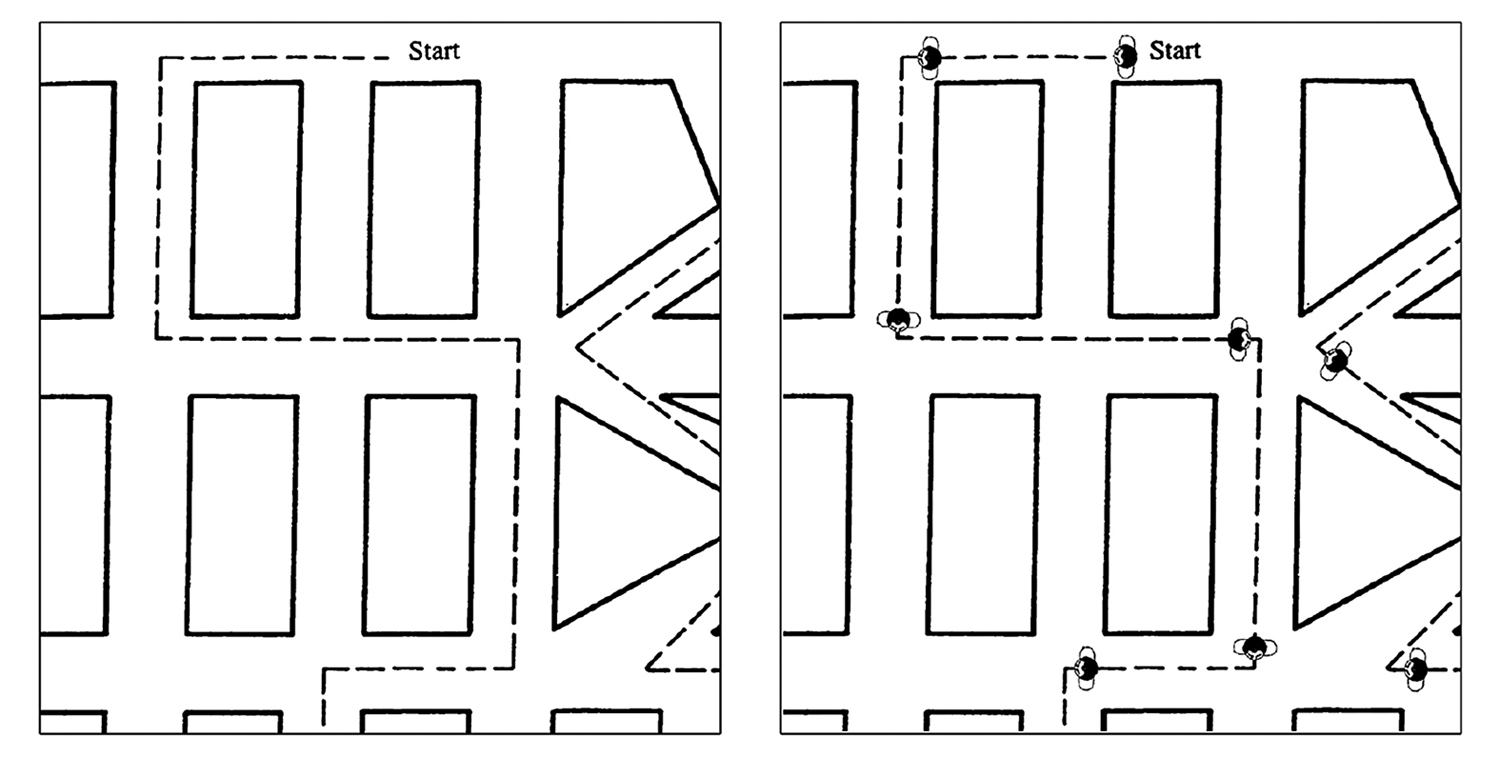
Research has also suggested that differences in spatial skills may have a great deal to do with how researchers ask questions. In one study, researchers gave women and men a spatial perspective-taking task that involved viewing a diagram of a city from above and navigating from one location to another by writing “right” or “left” at every turn (Tarampi, Heydari, & Hegarty, 2016). In one condition, participants were given the start and stop points and were told the task was a measure of spatial ability. Men did better than women. However, in another condition, the researchers showed the exact same map but drew a human figure that needed to be directed through the city (see Figure 3.1). Participants were told that it was a task of empathy rather than of spatial ability. Voilà—the sex/gender differences disappeared! The context in which participants encountered the task mattered. This suggests that differences in some spatial skills may have more to do with expectations about what women and men are supposed to be good at than actual cognitive differences.
Image Description
A map shows two panels with three rectangular blocks in three rows and a navigation path between the rectangular blocks. A dashed line depicts the navigation path, which makes several right and left turns around the blocks. The right panel has a human figure at each turn and shows the same navigation path as in the first panel.
Figure 3.1 In the Tarampi et al. (2016) study, the map on the left was used for participants who were told that the study was exploring spatial ability. The map on the right, identical except for the inclusion of a human figure at each turn, was used for participants who were told that the study was exploring empathy. A sex/gender difference was found when participants thought it was a task of spatial ability but not when they thought the task was about empathy.
Is the Difference Categorical or Dimensional? If a sex/gender difference is categorical (i.e., occurring in two distinct forms), then women and men can be treated as truly different groups or separate categories. So an important third question is this: Is the difference categorical (women are one way, men are another way) or dimensional (any differences between women and men are a matter of degree)?
Taxonomic analysis is a statistical technique for determining whether observed groups can be classified as categorical or dimensional (Carothers & Reis, 2013). If women and men are categorically different, then they’re so different that they can be considered completely different groups (or classes or taxons). Accordingly, simply knowing that someone is a woman or a man would enable others to predict what that person is like on a given trait.
For example, dogs and cats are categorically different (they represent different taxons), and knowing that Puddles is a dog and Whiskers is a cat allows you to predict with near certainty that Puddles will bark and Whiskers will meow. This kind of assumption about women and men is found in the popular press books described previously (men = waffles and Mars; women = spaghetti and Venus), and it also underlies gender essentialism. In contrast, if the differences between women and men are dimensional, then any differences found are differences of degree with considerable overlap—and knowing that someone is a woman or a man wouldn’t give much information about how that person would score on a given trait. Two species of dogs may have barks that, on average, differ in loudness, but knowing whether you have a Labrador or a Golden Retriever won’t tell you with certainty how loud a given bark will be.
In one study, researchers used taxonomic analysis to determine whether the differences between women and men could better be described as categorical or dimensional (Carothers & Reis, 2013). The authors picked the most gender-stereotyped behaviors they could identify, such as enjoying taking a bath and using cosmetics (associated with women) and enjoying boxing and playing video games (associated with men). Not surprisingly, they found that interest in these activities was categorical (see Table 3.1). Therefore, if the researchers knew whether a participant liked using cosmetics more than playing video games, they could relatively accurately guess whether that person was a woman or a man. Of course, just because there were categorical differences doesn’t mean that all women like to take baths and all men like to box. It simply means that, on average, this information does a good job predicting whether a person is a woman or a man.
However, on all other psychological variables studied, the differences between women and men were better described as dimensional than categorical (Carothers & Reis, 2013). Knowing that a participant was a woman or a man didn’t even enable researchers to accurately predict whether that person was feminine or masculine. Empathy, interest in science, and comfort with casual sex were also found to be dimensional. This study suggests that women and men may, on average, be different, on these variables, but there is too much overlap between women’s and men’s scores to describe them as being in distinct categories.
What Is the Source of the Difference? Even if an observed sex/gender difference persists over time and across situations and is found to represent a categorical difference between women and men, it isn’t clear what causes the difference. It could be based in biological factors, and biological differences may be rooted in different evolutionary pressures. However, differences may also be due to differential gender socialization, internalized stereotypes, or a complex combination of factors. To make things more complicated, differences may be related to an array of variables across various social identities. Often, many variables contribute to sex/gender differences. Therefore, a fourth question must be: What is the source of the difference?
TABLE 3.1 Categorical Sex/Gender Differences Identified in Carothers & Reis (2013)
Categorical Differences Found
Categorical Differences Not Found*
Men
sexual attitudes
enjoy playing golf
sexual behaviors
enjoy boxing
mate selectivity
enjoy construction
empathy
enjoy video games
perspective taking
enjoy watching pornography
importance of relationships
better at long jump, high jump, and javelin throw
masculinity
have wider shoulders
femininity
importance of care
Women
interest in science
enjoy taking a bath
fear of success
enjoy talking on the phone
personality traits
enjoy scrapbooking
social support
enjoy watching talk shows
intimacy with friends
enjoy cosmetics (including hair and nail care)
intimacy with partners
Note. *For these variables, dimensional differences were found.
Four Explanations for Differences
What are four explanations for sex/gender differences? How are they distinct, and how may they overlap?
As we discussed previously, historically there has been tension between those who emphasize biological explanations and those who emphasize social and cultural explanations for sex/gender differences. Biological and evolutionary explanations have often served to justify sexism, so feminist psychologists have instead gravitated to social and cultural explanations. However, it’s overly simplistic to assume that anything is either completely biological or completely sociocultural, as these factors often can’t be clearly separated. Given this complexity, it’s important to understand evolutionary, biological, and more social explanations for sex/gender differences. For any given trait or behavior, any or all of these explanations may apply.
Evolution The evolutionary perspective holds that differences between women and men stem from pressures for survival and reproduction throughout human evolutionary history (Buss & Schmitt, 2011). Of course, women and men faced many similar challenges to survival as humans evolved, so it’s possible to expect that they should be quite similar. However, one evolutionary theory emphasizes the different pressures women and men faced in terms of mating and survival, leading them to develop different mating strategies to ensure their success (Buss, 1995; Buss & Schmitt, 1993). This sexual strategies theory argues that, as humans evolved, men impregnated as many women as possible in order to maximize the chance that some of their children would survive. As a result, according to this theory, even today men should be more invested in short-term mating strategies (e.g., hookups, flings) and have lower standards for short-term relationships. Women, in contrast, had greater maternal investment in each child in order to aid their survival (e.g., pregnancy, breastfeeding) and therefore preferred long-term, stable mates who would contribute resources to promote their children’s survival. Evolutionary psychologists point to data that suggest, for example, that tall men have greater reproductive success (Nettle, 2002). They argue that this mate preference is due to an evolved tendency for women to select mates who could protect them. Of course, a preference for taller male partners may have nothing to do with protection. Being taller could have signaled better health, which could make someone a more desirable mate as one’s children may then be more likely to be healthy.
The fact that women, due to gestation and lactation, are more invested in their offspring than men underlies the differential parental investment theory—an evolutionary explanation for why women are more invested in child care than men (Bjorklund & Shackelford, 1999). Another reason men may be less invested relates to the fact that early human men could never be 100% sure that a child was theirs, an idea known as paternity uncertainty (Goetz & Shakleford, 2009). Evolutionary psychologists also argue that paternity uncertainty helps explain why men developed aggression toward and control over women (Goetz, Shackelford, Romero, Kaighobadi, & Miner, 2008). Such tendencies ensured that the children the men were supporting hadn’t been fathered by other men.
Although evolutionary theorists claim that women and men adapted to ensure survival, it’s unclear what the best reproductive strategy actually was during humans’ evolutionary past. For example, one might assume (as sexual strategies theory does) that men would maximize the likelihood of producing children by impregnating lots of women. However, if humans traveled in small bands in which many individuals were related, a man would probably do better by mating with and remaining monogamous to one of the women in his social group. In contrast to sexual strategies theory, attachment fertility theory focuses on how evolutionary forces may have selected for similarity in reproductive strategies (Miller & Fishkin, 1997). This theory suggests that survival was enhanced when women and men worked together to ensure the survival of their offspring. Because human infants are dependent and vulnerable, this theory implies that it wouldn’t be adaptive for men to impregnate women and then leave their offspring to potentially die. Instead, it was more adaptive for men to stay with their mating partner and help nurture infants to ensure offspring survival.
Evolutionary theorists are often criticized because, although attitudes and behaviors can be measured in the present, one can only make hypotheses about the evolutionary past (Ketelaar & Ellis, 2000). Also, while there are feminist approaches to evolutionary theory (e.g., attachment fertility theory) and evolutionary theorists who identify as feminists, evolutionary theories about gender have a long history of tension with feminism (Smith & Konik, 2011). For example, some evolutionary theorists have argued that rape was an adaptive strategy to help men impregnate fertile women (Thornhill & Palmer, 2000). Others have argued that domestic violence was a way for men to control women to make sure they weren’t having affairs or having children with other men (Peters, Shakleford, & Buss, 2002). Critics have accused evolutionary theorists of insensitivity, victim blaming, and assuming that men can’t control sexual urges (Rose, 2000). Of course, not all evolutionary psychologists view rape and domestic violence as adaptive traits. Furthermore, viewing sexual and domestic violence as having evolved to control women does not mean excusing or justifying these behaviors (Peters et al., 2002).
Biology Most research on biological explanations for sex/gender differences has focused on the brain and on hormones. In general, research on brain differences between women and men has yielded a complicated picture. Although some studies find small differences between the brains of women and men, the differences often disappear when other variables are taken into account.
A review of research found no compelling evidence for many beliefs—held by both the general public and scientists themselves—about differences between women’s and men’s brains (Wallentin, 2009). One belief is that women have a bigger corpus callosum, the band of fibers that connect the brain’s hemispheres, and some have used this supposed difference to justify sex/gender stereotypes. For example, in the 1990s, a Time magazine article claimed that the fact that women’s brain hemispheres talk to each other more than men’s accounts for women’s greater intuition (Gorman, 1992, as cited in Bishop & Wahlsten, 1997). However, a review of the literature reported no consistent difference across studies and called this belief a myth (Wallentin, 2009). The fact that studies finding non-significant sex/gender differences are less likely to be published than those that do find significant differences is a particular problem for brain research (Fine et al., 2013).
Even if a sex/gender difference in the brain is found, the difference doesn’t necessarily lead to women and men acting differently. In 2009, a review of the literature concluded that “hundreds of sex differences have been found in the central nervous system, but only a handful can be clearly linked to sex differences in behavior . . . we do not know the functional consequences of most of the others” (de Vries & Södersten, 2009, p. 598). For example, in a study of women and men with similar scores on intelligence tests, there were some brain differences in what areas correlated with intelligence (Haier, Jung, Yeo, Head, & Alkire, 2005). But because the participants’ intelligence levels were the same, this was an example of brain differences having no actual behavioral effect. In fact, researchers hypothesized that instead of causing sex/gender differences, observed brain variations might serve to compensate for other biological differences (e.g., hormonal levels), so that behavior is actually more similar than might be expected (deVries, 2004).
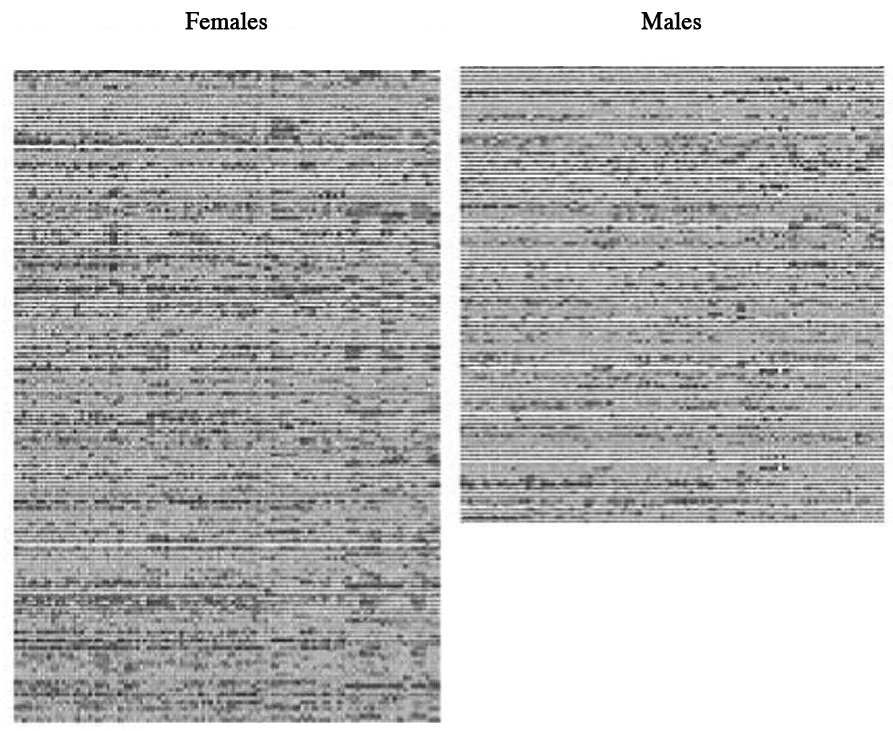
Another complication to biological theories is that while there may be small sex/gender differences in the brain, on average, that doesn’t mean individual women and men have clearly gender-typed brains. In one study, researchers examined MRI scans of over 1,400 adults and identified the brain areas where the largest average differences between women and men occurred (Joel et al., 2015). Researchers then looked at each brain, one at a time, to see if women and men consistently had gender-typed brains. But instead of “female” or “male” brains, the researchers found a mosaic with a mix of female-typed and male-typed brain characteristics. Most participants had parts of the brain that were “female-typed,” other parts “male-typed,” and still other parts somewhere in between (see Figure 3.2).
Finally, even if there are brain differences between women and men, one can’t assume that different brains cause different abilities or behaviors. In fact, research suggests that the reverse may be true. Brains demonstrate plasticity—that is, they have the ability to change to a certain degree in response to aspects of the environment and learning experiences. For example, taxi drivers develop larger-than-usual brain structures devoted to visual memory due to their experience with driving (Maguire et al., 2000), and musicians develop a larger-than-usual auditory cortex due to their greater need to process sound (Jäncke, Gaab, Wüstenberg, Scheich, & Heinze, 2001). So even if women and men do show brain differences, it may be the result of different experiences. In other words, biological explanations don’t rule out social explanations. They can go hand in hand.
Biological explanations also focus on hormones’ potential for shaping sex/gender differences. This research raises similar questions about whether biology is a cause of difference or a consequence of environmental factors. Although it’s often assumed that stereotypically masculine behavior is caused by testosterone (van Anders, 2013), the data are complicated. Instead of masculinity per se, high testosterone appears to be linked to behaviors such as competitiveness, and low testosterone appears to be linked to nurturance. Moreover, these connections occur in both women and men. Testosterone levels also appear to be reactive to environmental situations. For example, a longitudinal study found that testosterone levels decreased in fathers and that men who did more child care had the largest decreases (Gettler, McDade, Feranil, & Kuzawa, 2011). In another study comparing fathers from two communities in Tanzania, those who were involved in daily child care had lower levels of testosterone than those who weren’t (Muller, Marlowe, Bugumba, & Ellison, 2009).
FIGURE 3.2 This illustration shows the human brain mosaic. Each horizontal line represents the brain of one participant (women on the left and men on the right); each column represents one brain region, and darker gray colors represent greater gray-matter volume. Each brain is a unique mosaic of features. While there are some sex/gender differences on average, each brain is unique and extremely variable. (From Joel et al., 2015)
Variations in testosterone levels appear to be linked to the ability to nurture. When young men were in a room with a fake baby that cried but couldn’t be comforted, their testosterone levels went up (van Anders, Tolman, & Volling, 2012). But when they were able to comfort the baby, their testosterone levels went down. Testosterone levels are also linked to displays of power and aggression. In another study, when women were asked to act out firing someone (an act that demonstrates power), their testosterone levels went up (van Anders, Steiger, & Goldey, 2015). In general, men have higher testosterone levels than women (Mayo Clinic, n.d.). However, researchers hypothesize that the fact that women are socialized not to display aggression may be one reason for their lower testosterone (van Anders et al., 2015).
Social Role Theory Another theory, known as social role theory or social structural theory, emphasizes how gender roles are responses to, rather than causes of, different roles in society (Eagly & Wood, 1999, 2011). This theory holds that differences between women and men arise from the roles they’ve traditionally held rather than from biologically based differences. These roles, such as women being caretakers and men being breadwinners, may have their origins in biology. However, according to social role theory, cognitive and personality differences, such as women having nurturing qualities and men having better spatial skills, reflect adaptation to social roles. In other words, this theory argues that being a caregiver causes someone to be nurturing, not that being nurturing causes someone to be a caregiver.
It’s important to note that this theory is not inconsistent with some of the biological research we’ve discussed. After all, hormone levels can change in response to social roles (e.g., they decrease during caregiving). Furthermore, due to plasticity, the very structure of the brain can change in response to the activities one engages in. Therefore, social role theory and biological theories can be seen as complementary rather than oppositional. Gendered behaviors shape the brain and endocrine system, which, in turn, influence gendered behaviors (Kaiser, Haller, Schmitz, & Nitsch, 2009).
Expectancy Role Value Theory Yet another theory, expectancy role value theory, also focuses on how environmental factors and gender socialization promote sex/gender differences. This theory centers on the notion that women and men have internalized stereotypes about how they’re supposed to act (Eccles, 1994). As a result, men may have a difficult time assuming caretaking roles because doing so goes against their internalized beliefs that a man is supposed to be assertive and a powerful breadwinner (Croft, Schmader, & Block, 2015). According to this theory, people make decisions about what activities to pursue based on two factors: the expectation that doing the activity will lead to success, and the value that person puts on the activity (Eccles, 1994).
For example, if a woman is thinking about taking a challenging math class, she’ll first consider whether she believes she can succeed in the class. She’ll then consider whether the class is interesting and valuable to her. Even if she has the skills to successfully complete the class, she may think she doesn’t. Also, she may not value math because she doesn’t see it as something that “girls” do. Expectancy role value theory adds to the idea of social roles by noting that people make active choices about the kinds of activities they wish to pursue.
The four explanations are not mutually exclusive. Evolutionary forces can help shape social roles. Biological differences can be influenced by evolution but can also be a result of gendered environments. While arguments often present evolution and biology on one side and social roles and expectancy role value on the other side, this needn’t be the case. The explanations can be complementary.
your turn
Think about the four explanations presented previously. Which one (or combination of them) do you think best explains some of the research on differences between women and men? Which one have you most heard other people use to explain differences? Why do you think some explanations are more appealing than others? These four don’t reflect all possible explanations. What other explanations can you think of for why some differences are found between women and men?
A theory suggesting that women and men developed different mating strategies to ensure survival: Men maximized potential offspring through sexual activity with many women, while women were selective with sexual partners in order to find stable mates who would contribute resources to promote their children’s survival.
A theory suggesting that women are more invested in their offspring than men because of women’s greater contributions to parenting through gestation and breastfeeding.
The idea that differences between women and men arise from the different roles they have traditionally held (e.g., caretaker, provider) rather than from biologically based differences passed down through evolutionary forces. Also known as social structural theory.
A theory suggesting that people make decisions about the activities they want to pursue based on both the expectation that doing the activity will lead to success and the value they put on the activity.