What are the negative consequences of self-objectification, and through what process do these happen?
We have established that beauty norms are learned from parents, peers, and the media and that they’re generally internalized so that women feel they must live up to those standards, even if they’re unrealistic. But does this actually harm women? To better understand this, it might be useful to imagine yourself participating in the following study—the first experimental exploration of self-objectification. You arrive at the assigned time and think you’re taking part in a study about consumer preferences. After evaluating a unisex cologne (to throw you off track about the real purpose of the study), you’re asked to enter a dressing room with a full-length mirror in order to try on an article of clothing—either a swimsuit (a one-piece for women and swim trunks for men) or a V-neck sweater in your size. You’re asked to wear it for 15 minutes before making your evaluation, and while you wait, you’re asked to complete a math test. How do you think you would do on the test? Would the clothing you’ve put on impact your performance?
It turns out that for the predominantly White, female participants who took part in the study described above, the clothing did make a difference (Fredrickson, Roberts, Noll, Quinn, & Twenge, 1998). The women wearing swimsuits performed significantly worse than those in sweaters, but there was no such difference for men. The women also reported more negative feelings about their bodies while wearing the swimsuit as compared to the sweater. Wearing a swimsuit placed the female, but not the male, participants into a state of self-objectification, and their focus on their bodies distracted them, inhibiting their performance on the math test.
But men aren’t immune from self-objectification. In a subsequent study in which male participants had to wear a Speedo rather than trunks, men and women of all ethnic groups were found to self-objectify when wearing a swimsuit (Hebl, King, & Lin, 2004). Those in swimsuits also performed worse on a math test than those who wore a sweater.
It doesn’t take wearing a swimsuit to create a state of self-objectification, however. Countless events can have the same effect. We can offer two familiar examples. If someone makes a comment about your appearance right before you enter the classroom, you might start thinking about how your body looks instead of focusing on the classwork. And if you’re wearing a form-fitting shirt, you might worry about visible fat rolls while you sit. In situations like these, some people self-objectify more than others.
In one study with a primarily White sample, participants were asked to unscramble sentences that either did or did not contain words related to objectification (e.g., appearance, slender, and shapely vs. honesty, happy, and silly; Roberts & Gettman, 2004). Just being exposed to these words was enough to change participants’ self-reported levels of self-objectification. Overhearing fat talk has also been shown to induce self-objectification (Gapinski, Brownell, & LaFrance, 2003). In another study, predominantly White female participants who anticipated interacting with a man reported higher levels of self-objectification than those who anticipated interacting with a woman (Calogero, 2004).
Even though the human mind is able to multi-task, there’s a limit to what it can focus on at any given moment (Pashler, 1994). When we think about our appearance, we’re less able to focus on a math test, athletic performance, or an oral presentation, for example. Once we enter a state of self-objectification, the effects also tend to linger. For example, one study showed that after being in a bathing suit, women were still distracted by thoughts about their body even after they had put their regular clothing back on (Quinn, Kallen, & Cathey, 2006).
The studies mentioned above use experimental designs, randomly assigning participants into situations that produced a state of self-objectification or into a control group, but most of the research on self-objectification relies on correlational designs. This type of research typically uses surveys to assess the extent to which women report experiencing self-objectification on a daily basis. For example, researchers might ask them to report how much they value their bodies’ appearance as compared to their bodies’ function (e.g., what the body can do; Fredrickson et al., 1998). Women who report that they value being thin more than they value being physically coordinated, for example, would be considered higher in self-objectification.
Other studies assess the extent to which women report viewing their bodies from an observer’s perspective and evaluating their physical appearance—a process that has been named body surveillance (McKinley & Hyde, 1996). Body surveillance is a behavioral manifestation of self-objectification. Women who report checking in on their appearance more frequently are considered to be higher on self-objectification. Research has shown that self-objectification is related to a host of negative outcomes (Moradi & Huang, 2008; Tiggemann, 2011).
One commonly studied negative outcome of self-objectification is body shame. This is an ongoing experience of negative emotions as a result of judging one’s body as undesirable. It can occur when people continually evaluate their appearance against the societal beauty norms that they’ve internalized (Fredrickson & Roberts, 1997; McKinley & Hyde, 1996; Moradi & Huang, 2008). Because few, if any, women can conform to these norms, when women engage in body surveillance and find their appearance lacking, they’re likely to experience body shame. Highly valuing the thin ideal, for example, has been related to a greater likelihood of reporting body shame (Calogero & Thompson, 2009; Noll & Fredrickson, 1998). The feeling of shame can, in turn, relate to other negative outcomes, as we’ll discuss below.
try it for yourself
To what extent do you think you regularly engage in body surveillance? Try going for an entire day without looking in a mirror. (Yes, reflective surfaces count too—so do your best to avoid them.) How did it make you feel not to be able to use a mirror? Were you comfortable leaving the house and doing all your usual activities? Did you change what you were wearing or how you styled your hair because you couldn’t easily evaluate your appearance? Were you tempted to “cheat” and look in a mirror? Did you actually make it through an entire day? Explain your responses.
The Process of Self-Objectification
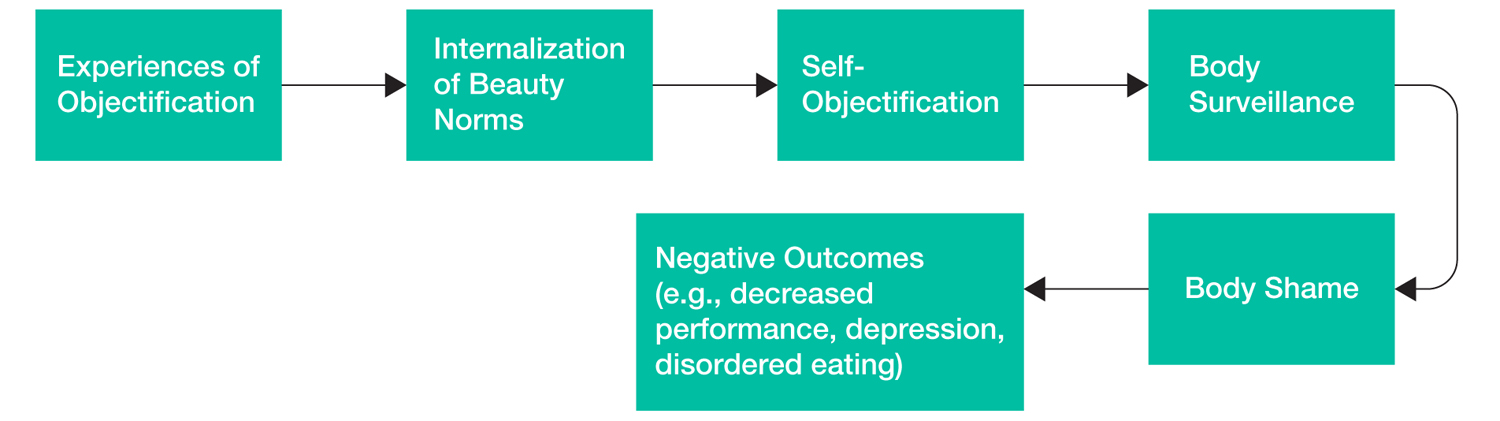
As shown in Figure 6.1, researchers believe that the process of self-objectification works in the following way. Exposure to objectification, through both personal experiences (e.g., people commenting on your body) and exposure to objectified women in the media, leads to the internalization of beauty norms and the belief that it’s important to meet cultural standards of beauty. When this happens, it leads to self-objectification, or the placing of greater emphasis on the body’s appearance as compared to its function. Self-objectification, in turn, leads to an increase in body surveillance. Once people think that being beautiful is more important than what one’s body does, they view the body from the outside in, continually checking their appearance to make sure it lives up to society’s standards of beauty. Greater surveillance almost inevitably leads to increased body shame because it’s typically impossible to meet current beauty standards. Body shame is then believed to relate to a host of negative outcomes, ranging from decreased task performance (e.g., doing poorly on a math test: Fredrickson et al., 1998; Hebl et al., 2004) and self-esteem (Choma et al., 2010; Mercurio & Landry, 2008) to increased levels of depression (Szymanski & Henning, 2007; Tiggemann & Kuring, 2004) and disordered eating (Calogero, Davis, & Thompson, 2005; Tylka & Hill, 2004).
Image Description
Objectification process
Experiences of objectification
Internalization of beauty norms
Self-objectification
Body surveillance
Body shame
Negative outcomes such as decreased performance, depression, and disordered eating
Figure 6.1Objectification process. This flow chart illustrates how the cultural objectification of women can lead to negative outcomes through the experience of self-objectification.
Intersectionality and Self-Objectification
How can social identity influence women’s experience of self-objectification, and what are research limits in this area?
Women’s experiences with self-objectification may be related to dealing with discrimination in terms of aspects of their social identities. For example, one study showed that among deaf women, struggles with deaf cultural identity predicted greater internalization of beauty norms, which was related to body surveillance, body shame, and disordered eating (Moradi & Rottenstein, 2007). A similar pattern has been found with lesbian and bisexual women. When these women internalize problematic messages about being a sexual minority, they’re more likely to experience self-objectification (Brewster et al., 2014; Haines et al., 2008). Further, among transgender and gender non-conforming individuals, experiencing high levels of transphobia can be related to increases in body surveillance and compulsive exercise (Cox, 2015).
Among ethnic/racial minority women, there are mixed findings. In one study, researchers found that the relationship between body surveillance and body dissatisfaction was stronger among Asian and Latinx women than it was for White women (Frederick, Forbes, Grigorian, & Jarcho, 2007). However, in another study of Black and White adolescent girls, researchers found no differences in self-objectification (Harrison & Fredrickson, 2003). Engaging in surveillance related to skin tone may also be an important predictor of body shame, in addition to engagement in general body surveillance (Buchanan et al., 2008). That said, although there is some research on how race and ethnicity influence self-objectification, most studies have involved predominantly White samples (Moradi & Huang, 2008). When women of color are included, their experiences are typically compared to White women’s. Furthermore, as with research on body satisfaction, research on self-objectification prioritizes concerns that are more typical of White women. For example, body shame is generally operationalized as shame about one’s weight rather than including other aspects of appearance that may be more relevant for women of color (e.g., hair texture, eye shape). These patterns reflect research bias. The very nature of the questions being asked reflects the fact that most of the research is being done by and about White women. Research on self-objectification would benefit from a less Eurocentric approach. Using the intersectionality questions presented at the end of Chapter 1 to inform methodology would be a good first step.
EMPOWERING OR OPPRESSING?
Wearing a Hijab
T
he hijab is a head covering worn by some Muslim women. Although many variations of the hijab exist, varying in terms of the amount of the body concealed from view, the most common forms cover the hair or the hair and neck.
Some people have argued that the hijab, or other modesty requirements, is oppressing for women. Some opponents of the hijab see it as a means of controlling and limiting women’s sexuality while also serving as a reminder that women are sexual objects, which is why they need to be hidden (Bakr, 2014; Hatem, 1988; Mernissi, 1987). Others, however, have indicated that wearing a hijab can be a means of protecting oneself from the male gaze and allowing women to assert themselves as individuals rather than as sexual objects by drawing their own and others’ focus away from appearance (Ali, 2005; Droogsma, 2007; Noor, 2009; Ruby, 2006). Salma Yaqoob, a British Muslim activist, spoke in support of women’s right to choose to wear a hijab by stating that “the aim of hijab is to de-emphasise sexuality in public interactions, whilst encouraging sexuality in private ones” (Yaqoob, 2004, para. 7). People who support the hijab argue that Western women are oppressed by social expectations that they display their bodies. These supporters would argue that the requirement to wear a bathing suit on a beach is more oppressive for women than the requirement to wear a hijab.
There’s not much data on this topic to inform us on how it relates to women’s relationships with their bodies. However, we can consider a few studies. In one, more than 500 Muslim women who lived in London completed a survey (Swami, Miah, Noorani, & Taylor, 2014). Those who wore the hijab reported less body dissatisfaction, had lower levels of internalization of beauty norms, and viewed appearance as less important than did women who didn’t wear the hijab. Researchers also found that among Muslim women in the United States (Tolaymat & Moradi, 2011) and Australia (Mussap, 2009), hijab wearing was related to lower levels of self-objectification. Young Muslim women in the United States who wore the hijab were also less likely to have internalized the thin ideal (Dunkel, Davison, & Qurashi, 2010).
Image Description
Overview
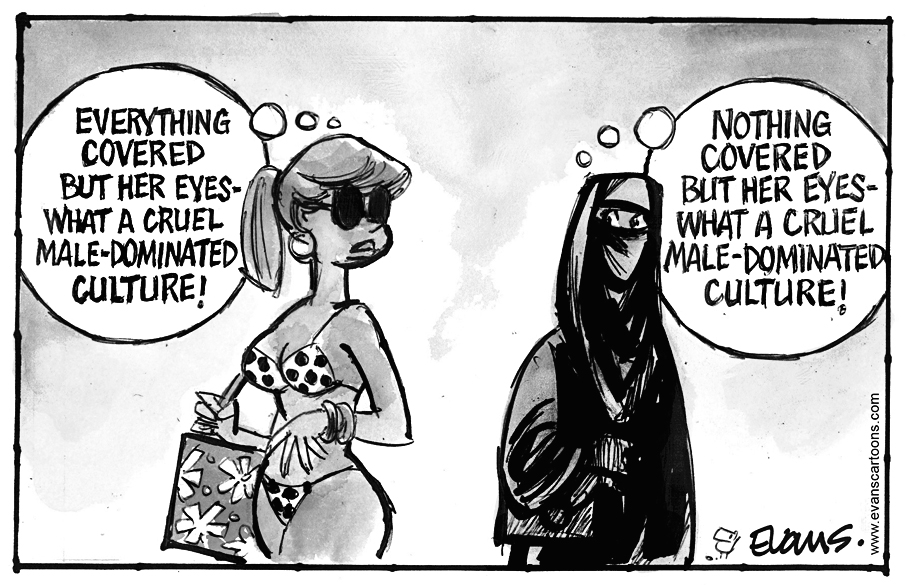
Two women, one wearing a bikini and the other a burqa, are looking at each other with thought bubbles over their heads.
Speech bubbles
The woman wearing a bikini and sunglasses thinks, “Everything covered but her eyes. What a cruel male-dominated culture!”
The woman wearing a burqa thinks, “Nothing covered but her eyes. What a cruel male-dominated culture!”
What we see as oppressive is influenced by our culture.
What do you think? Is wearing a hijab empowering or oppressing? Does it “allow women to claim the gaze and to become the ones who observe the world” (Afshar, 2000, p. 531), or does it serve as a constant visual reminder of women’s status as sexual objects? Would your answer be the same or different if we were talking about the burqa, which covers the entire body and face (see cartoon at left), rather than the hijab, which covers much less of the body?
Other research has shown that self-objectification can change as people age (Augustus-Horvath & Tylka, 2009). It may start as early as 10 years of age and may be linked to peer sexual harassment that becomes particularly problematic around puberty (Lindberg, Grabe, & Hyde, 2007). Self-objectification also appears to rise throughout adolescence and peak around college age (McKinley, 1999). As women age, they appear to self-objectify less frequently, with the lowest levels of self-objectification occurring for the oldest women (in one study, up to 84 years old; Tiggemann & Lynch, 2001). It’s not clear why self-objectification decreases as women age. It may be that when they’re no longer the age of the majority of models they see in the media, they feel less pressure to conform to beauty standards. Alternatively, it may be that when women age, they become more concerned with what their bodies can do (e.g., be physically active) than with how their bodies look. This pattern may also reflect generational differences among women’s body concerns. Nevertheless, research shows that no matter what age women are, self-objectification is still related to body shame, disordered eating, and depression (Grabe, Hyde, & Lindberg, 2007; Slater & Tiggemann, 2002; Tiggemann & Lynch, 2001).