3 Research Methods: The Case of Gender Similarities and Differences

More information
An overhead photo of four people sitting at a table working on a project together.
- 3.1 Gender Essentialism: From Research to the Popular Press
- 3.2 Understanding Research Methods
- 3.3 Identifying Sex/Gender Bias in Research
- 3.4 Reducing Sex/Gender Bias in Research
- 3.5 Skills in Action: Evaluating Research on Sex/Gender Differences/Similarities
- 3.6 Consequences of a Belief in Gender Essentialism
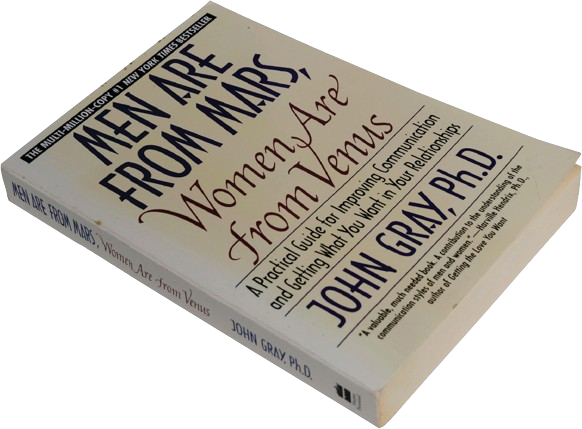
IF YOU VISIT ALMOST ANY BOOKSTORE, you’ll probably find books about sex/gender differences. Many of these are for couples seeking relationship advice, and they typically describe women and men as totally different from each other. A famous book of this type was John Gray’s Men Are from Mars, Women Are from Venus, an international best seller published in 1992 (Figure 3.1). As the title suggests, Gray (1992) imagines that men and women fell in love and moved to Earth from Mars and Venus, after which they forgot they were supposed to be different. When a woman and a man in a relationship think they’re supposed to be similar, Gray says, the result is unmet expectations and conflict. The fundamental difference, he believes, is that men experience fulfillment through success and accomplishment, whereas women experience it through sharing, relating, and feeling.
More information
A photo shows the book titled Men are from Mars, Women are from Venus by John Gray.
Figure 3.1 Gender Essentialism
The prolific Mars and Venus series provides many examples of books that approach gender differences from an essentialist perspective.
Another book, Men Are Like Waffles, Women Are Like Spaghetti (Farrel & Farrel, 2007), explains that men separate life into compartments like those in waffles and focus on one thing at a time (career, family, leisure). Women, in contrast, see all aspects of life as interrelated, like pieces of spaghetti. They want to connect issues and talk things through. The book His Needs, Her Needs (Harley, 2011) similarly presents the contrasting needs of women and men. For example, she needs affection; he needs sexual fulfillment. She needs financial support; he needs peace, quiet, and domestic support. She needs intimate conversation; he needs recreational companionship. The book aims to teach people in heterosexual relationships how to meet the needs of their partners—needs that are allegedly completely different from their own.
In Act Like a Lady, Think Like a Man (2011), comedian Steve Harvey instructs women about what to expect from men and how to attract them. He notes that women and men have different goals and needs: Men need to protect and provide for their women, and in exchange they want support, loyalty, and sex. Harvey warns women who are self-sufficient that “if you’ve got your own money, your own car, your own house, a Brinks alarm system, a pistol, and a guard dog, and you’re practically shouting from the rooftops that you don’t need a man to provide for you or protect you, then we will see no need to keep coming around” (Harvey, 2011, p. 182). So he advises women, even those with plenty of money, to let men pick up the check—and if they need their sink fixed, to “act like you haven’t a clue what to do” and then tell him, “Baby, thank you so much for doing this for me—I don’t know what I’d do without you” (p. 188).
All these books make assumptions about sex/gender. But do these views reflect reality? In this chapter, we’ll explore why some assumptions about sex/gender are so popular and how they historically served to reinforce a sex/gender binary and justify sexism. Then we’ll take a step back so that you can understand how psychological research is done and how gender bias can creep into each step of the research process. We’ll then practice interrogating research by more closely examining research that focuses on gender essentialism. In doing so, you’ll see that gender essentialism and the sex/gender binary are not supported by research, despite how frequently they’re mentioned in the popular press.